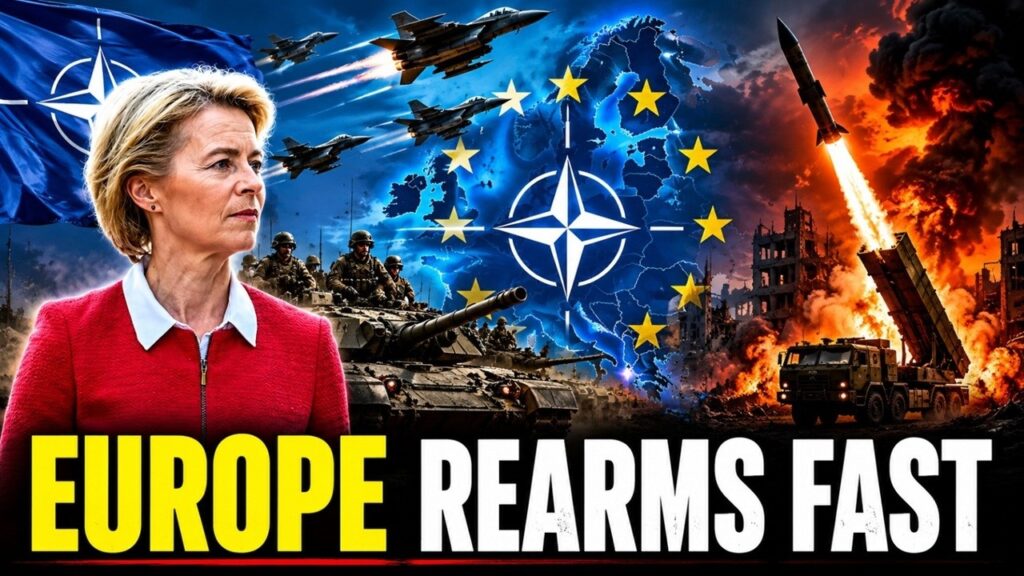
Europe Expands Its Military
For most of the last three decades, European defense was an afterthought. Governments cut military budgets, scaled back armed forces, and assumed that large-scale war on the continent belonged to history. That assumption ended on February 24, 2022, when Russia launched its full-scale invasion of Ukraine.
Since then, Europe has been rearming — and the pace is accelerating. Defense budgets across the continent have surged from around 218 billion euros in 2021 to an expected 381 billion euros in 2025. NATO is now pushing member countries toward spending targets that would have seemed politically impossible just a few years ago. And the European Union has launched a 150 billion euro military financing fund to rebuild the industrial capacity that decades of underspending left depleted.
But Europe is not moving in a single direction. The rearmament drive is real, urgent, and politically charged — and the continent is genuinely divided over how fast to go, how much to spend, and whether the economies can sustain it.
How Much European Defense Spending Has Already Grown
The numbers tell a clear story. Between 2021 and 2025, European Union defense budgets increased by roughly 75 percent in aggregate. That is an extraordinary rate of growth by any measure, and it happened largely in response to a single event: the Ukraine war.
European governments have been buying missiles, tanks, air defense systems, fighter aircraft, and ammunition at rates not seen since the end of the Cold War. Countries that had allowed their militaries to atrophy — Germany is the most prominent example — have made formal commitments to rebuild. Germany announced a 100 billion euro special defense fund in 2022, a figure that would have been politically unthinkable before the invasion of Ukraine.
The Ukraine war also exposed a more uncomfortable reality: European defense industries had been running on minimal capacity for so long that they could not produce ammunition fast enough to meet wartime demand. Ukraine’s consumption of artillery shells and missiles exceeded Europe’s ability to resupply at scale. That gap is now one of the central problems driving the broader rearmament push.
The NATO 5 Percent Target: What It Is and Why It Matters
For years, NATO’s official defense spending benchmark was 2 percent of GDP. Most member countries failed to meet even that modest target. The new figure under discussion — 5 percent of GDP — represents a completely different scale of commitment.
To understand what 5 percent means in practice: the United States currently spends around 3.5 percent of its GDP on defense and fields the most powerful military on earth. A 5 percent target for European NATO members would imply defense budgets larger, as a share of national income, than anything seen since the height of the Cold War.
Countries closest to Russia are the strongest advocates for aggressive spending targets. Poland has already pushed its defense budget above 4 percent of GDP and has been acquiring large quantities of weapons from the United States and South Korea. The Baltic states — Estonia, Latvia, and Lithuania — have consistently pressed for higher NATO commitments, given that they share direct borders with Russia or its close ally Belarus.
The argument from these countries is straightforward: Russia did not stop at Ukraine’s border in its ambitions, and Europe should not assume it will. Building credible deterrence now is cheaper, in every sense, than responding to a broader conflict later.
Why Some European Countries Are Pushing Back
Not every European government shares the same sense of urgency — or the same fiscal capacity. Spain publicly rejected an interim NATO spending target of 3.5 percent of GDP, a position that drew criticism from allies but reflected a genuine domestic political calculation.
The countries most resistant to rapid military expansion tend to share a common set of economic conditions: high public debt levels, ongoing budget deficits, inflation pressures, and sluggish growth. For these governments, committing to dramatically higher defense spending means either cutting other public services, raising taxes, or taking on more debt — all of which carry serious political consequences at home.

There is also a philosophical dimension to the debate. Some European political traditions, particularly on the left, have long resisted large-scale militarization on principle. These voices argue that pouring money into weapons does not automatically make Europe safer, and that diplomatic engagement with Russia — however difficult — cannot simply be abandoned.
The result is a continent that is moving in the same general direction but at very different speeds, driven by very different calculations about threat, risk, and economic capacity.
The EU’s 150 Billion Euro SAFE Fund: What It Does
Alongside national budget increases, the European Union has launched its own collective response to the defense gap. The SAFE program — which stands for Safe, Agile, Flexible, Effective — is a 150 billion euro rearmament loan facility designed to help member states jointly finance military procurement and defense industrial expansion.
The logic behind a collective EU fund is partly financial and partly strategic. Individual European countries acting alone face higher costs and fragmented production. A coordinated approach allows the EU to pool demand, achieve scale in procurement, and develop shared defense capabilities — things like joint ammunition production, shared air defense platforms, and coordinated logistics — that individual member states cannot efficiently build on their own.
The Ukraine war made the case for this approach impossible to ignore. European countries discovered that their combined stockpiles of critical munitions were far smaller than assumed, and that their defense industries could not rapidly scale production. The SAFE fund is partly an attempt to fix that structural problem before the next crisis arrives.
China Deploys Carrier Fleet as Japan Joins Balikatan 2026 — The Indo-Pacific’s New Flashpoint
The Ukraine War Changed the Entire Strategic Calculation
It is worth being direct about what changed and why. Before February 2022, the dominant view in many European capitals was that Russia was a declining power with legitimate security concerns that could be managed through a combination of economic engagement and limited deterrence. That view is now largely gone.
The scale of Russia’s invasion — the deliberate targeting of civilian infrastructure, the destruction of entire cities, the sustained campaign to eliminate Ukraine as an independent state — fundamentally altered how European governments assess Russian intentions. The question is no longer whether Russia might use military force against a neighboring state. It already has, at massive scale, in the middle of Europe.
That shift in threat perception is what makes the current rearmament drive different from previous post-Cold War defense upticks. This is not a short-term reaction to a single incident. European governments are now planning for the possibility of sustained military competition with Russia over a period of years or even decades.
NATO has responded by substantially reinforcing its eastern flank — the stretch of territory from Estonia in the north to Romania in the south — with additional troops, equipment, and enhanced readiness postures. Alliance exercises have become larger and more focused on actual warfighting scenarios rather than symbolic presence.
The Economic Problem Europe Cannot Ignore
The rearmament drive is real and it is happening. But it exists alongside a set of economic constraints that are not going away.
Europe’s major economies are carrying high debt loads built up through the 2008 financial crisis, the COVID-19 pandemic response, and the energy shock that followed Russia’s invasion of Ukraine. Interest rates remained elevated through much of 2024 and 2025, increasing the cost of public borrowing. Economic growth in the eurozone has been modest at best.
Into this environment, governments are now trying to substantially increase defense spending. The political math is genuinely difficult. Every euro that goes to a new tank or missile system is a euro that does not go to a hospital, a school, or a pension. In countries where populations are aging and social spending demands are rising, that trade-off is a real political vulnerability.
This is why the NATO spending debate has become one of the most contentious political arguments in Europe in 2026. It is not just a technical disagreement about defense budgets. It is a fundamental argument about national priorities, economic capacity, and how much risk governments should ask their citizens to carry.
Where Europe Stands Now
Europe is rearming. That is not in dispute. Defense spending is up sharply, new military programs are underway, NATO is stronger than it was three years ago, and the political consensus for doing more has never been broader.
But the continent is also divided — between countries that feel the Russian threat viscerally and those that feel it more abstractly, between economies that can absorb higher defense costs and those that cannot, and between political traditions that prioritize collective security and those that prioritize economic stability at home.
The resolution of that division will shape European security for the next generation. If the high-spending advocates prevail and Europe builds genuinely capable, well-funded militaries, the deterrence calculation against Russia changes significantly. If the economic and political pressures slow the process down, the window of vulnerability stays open longer.
Either way, Europe has crossed a threshold. The era of minimal defense investment is over. What comes next is still being decided.
Follow Indo-Pacific Report for More Global Security Analysis
For in-depth coverage of NATO, European defense, Indo-Pacific security, and global military developments, follow Indo-Pacific Report across all platforms:
Website
Facebook
YouTube