China Deploys Carrier Fleet as Japan Joins Balikatan 2026 — The Indo-Pacific’s New Flashpoint
By IndoPacific Report | April 24, 2026 | 9 min read
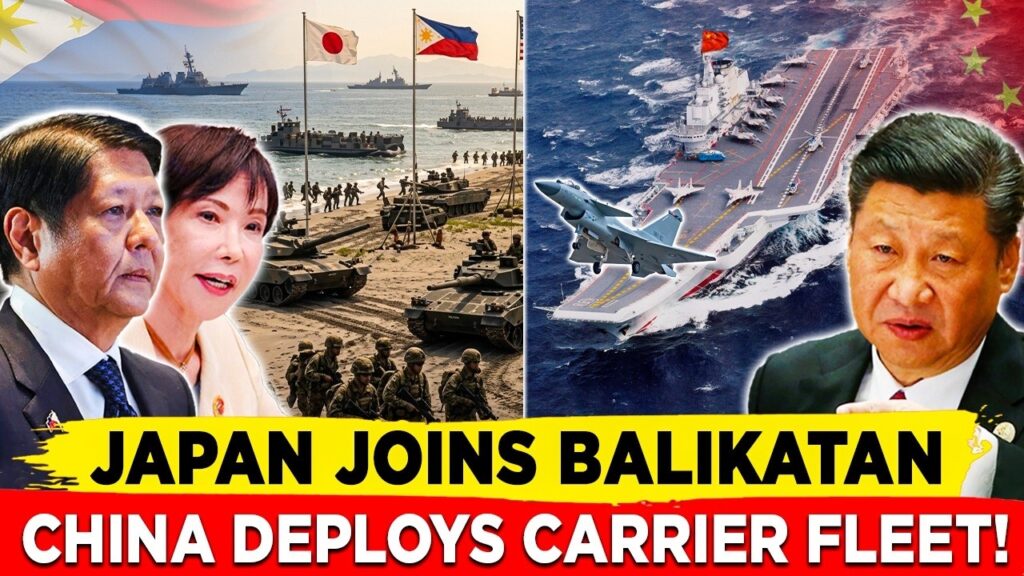
Three things happened in the same 24 hours. Japan’s Ground Self-Defense Force stepped onto Philippine soil as a combat participant for the first time since World War II. China’s aircraft carrier Liaoning transited the Taiwan Strait — eight J-15 fighters loaded on deck, heading south. And China’s newest warship — the Sichuan, the world’s first drone carrier — departed Shanghai and set course for the same waters where 17,000 allied troops were drilling.
April 20, 2026. One date. Three events. And every single one of them a direct response to the others.
What makes this moment different from every Balikatan before it is not just the scale — though the scale is historic. It is the simultaneity. Japan fires weapons on Philippine soil for the first time since 1945. China deploys a drone carrier into the South China Sea for the first time in history. A Japanese destroyer spends fourteen hours in the Taiwan Strait on the anniversary of China’s most humiliating military defeat. A Chinese PLA officer publicly states that firing the first shot is “a viable option.” All in the same week. All of it connected.
Dr. Alessio Patalano of King’s College London — one of Europe’s foremost experts on East Asian naval strategy — argues that China’s grey-zone tactics have now crossed into full blue-water power projection. Beijing is no longer reacting at the margins. It is rehearsing, in real time and in plain sight, the exact conflict scenarios that Balikatan is being built to prevent. Two exercises. One crisis. Three weeks until Trump sits down with Xi in Beijing.
The Trigger: Japan’s Destroyer and the Treaty of Shimonoseki
Japan did not just send a warship through the Taiwan Strait. It sent one on the most painful date in Chinese history.
At 4:02 in the morning on April 17, 2026, the Japanese destroyer JS Ikazuchi entered the Taiwan Strait. It did not rush through. It spent 14 hours navigating the waterway — a passage that, at normal speed, should have taken far less.
The date was not random. April 17 is the 131st anniversary of the Treaty of Shimonoseki — the 1895 agreement that ended the First Sino-Japanese War and forced a humiliated Qing Dynasty to cede Taiwan to Japanese colonial rule for fifty years. In China, that date is not a footnote. It is a national wound. And Tokyo sailed a warship through the most sensitive waterway on earth — slowly, visibly, for fourteen hours — on the exact anniversary of the day China lost Taiwan to Japan.
The Ikazuchi was heading to the Philippines to join Balikatan 2026, where it would fire Japanese anti-ship missiles on Philippine soil for the first time since World War II. Beijing did not miss the sequence.
China’s response was immediate and precise. The PLA Eastern Theater Command deployed J-20 stealth fighters and CH-4 attack drones to track the Ikazuchi in real time — then released the footage publicly through state broadcaster CCTV. This went far beyond a standard diplomatic complaint. It was Beijing saying: we see you, we have you in range, and we want the world to watch us say so.
Within two days, China dispatched a naval task force led by guided-missile destroyer Baotou through the Yokoate Waterway near Japan’s southwestern islands. Then came the carriers. Then came the Sichuan. As Dr. Patalano has argued, China increasingly uses “compellence through historical grievance” — wrapping military moves in wounded national memory to justify escalation domestically while signalling red lines internationally. The Ikazuchi’s transit gave Beijing exactly the historical trigger it needed.
China’s Naval Response: The Sichuan, the Liaoning, and Tactical Envelopment
While 17,000 allied troops were drilling on Philippine soil, China was moving ships.
On April 20 — the exact day Balikatan opened — Taiwan’s military tracked the Liaoning transiting the Taiwan Strait with eight J-15 fighters and three helicopters on deck, heading south toward the South China Sea.
The very next day came something more significant. The PLA Navy announced that the Type 076 Sichuan — the world’s first amphibious assault ship fitted with an electromagnetic catapult, capable of launching drones, helicopters, and fixed-wing aircraft — had departed Shanghai for the same waters where Balikatan was underway. Beijing called it “routine training not directed at any specific target.”
The timing — one day after Japan’s ground troops set foot on Philippine soil for the first time since World War II — was impossible to dismiss as coincidence. In a Taiwan contingency, the Sichuan is the ship that carries the invasion. In the South China Sea right now, it is the ship that watches and rehearses.
The deeper military logic is what analysts are calling tactical envelopment. With the PLA’s 133rd naval task group operating in the Philippine Sea to the east of Luzon, and the Liaoning moving into the South China Sea to the west, the allied exercise was being bracketed from two directions simultaneously.
What makes this even more alarming is the speed of China’s shipbuilding. The Sichuan went from keel to sea trials in just 25 months — compared to 53 months for its closest American equivalent. Professor Toshi Yoshihara of the Center for Strategic and Budgetary Assessments has argued the PLAN is no longer building ships to defend its coastline. It is building ships to contest the entire western Pacific — to make every allied exercise, every missile battery on the first island chain, operate under constant Chinese naval presence.
The Japan Factor: New Militarism or New Realism?
Japan has spent seventy years apologising for World War II. Now it is deploying missiles 110 kilometres from Taiwan.
This is not a sudden lurch. It is the end point of a slow, deliberate transformation. In November 2025, Prime Minister Sanae Takaichi said out loud what Tokyo had been carefully avoiding for decades — that a Chinese attack on Taiwan would constitute a “survival-threatening situation” for Japan, implying Tokyo could activate its self-defence forces in response.
Beijing exploded. China immediately restricted exports to forty Japanese firms accused of contributing to Japan’s “remilitarisation.” Chinese drones approached Yonaguni Island — Japan’s westernmost point — forcing Japan to scramble fighter jets. Tokyo did not apologise, did not retract, and did not slow down.
https://indopacificreport.com/brahmos-missile-at-balikatan-2026-how-the-philippines-just-changed-the-south-china-sea/
Japan deployed medium-range surface-to-air missile units to Yonaguni — placing parts of mainland China within operational range — and accelerated its entire southwestern island defence buildup, fortifying positions from Kyushu all the way down the Ryukyu chain toward Taiwan. Then came Balikatan 2026, where Japan sent 1,400 combat troops to the Philippines, fired Type 88 anti-ship missiles on Philippine soil for the first time in history, and sailed its destroyer through the Taiwan Strait on the anniversary of China’s greatest modern humiliation.
Two Views on What Japan Is Doing
Beijing’s view: Xinhua has declared Japan’s moves “a clear and present danger,” citing the Yonaguni missiles, the counterstrike capabilities in Kumamoto, and PM Takaichi’s Taiwan remarks as a deliberate push toward remilitarisation dressed up in the language of defence.
Western analysts’ view: Geopolitical analyst Arnaud Bertrand describes this as a continuation of a process underway since Abe’s 2014 reinterpretation of collective self-defence. Tokyo’s calculation, as Bertrand states it, is blunt: “the window for military build-up without major consequences is perceived to be closing — China’s capabilities are growing rapidly, and if Japan doesn’t establish these forward positions now, it may not be able to later.”
Trump, Xi, and the Diplomatic Backdrop
Everything happening in the South China Sea right now has a date attached to it — and that date is May 14. That is when President Trump arrives in Beijing for his summit with President Xi Jinping, confirmed by the White House, originally delayed by the US war in Iran, and now described by Trump himself as a “monumental” and “historic” event.
China is not just responding to a Japanese destroyer or an allied military exercise. It is shaping the military balance ahead of high-level diplomacy with Washington. The calculation is simple: no major power enters a summit from a position of perceived weakness if it can help it. The Liaoning through the Taiwan Strait. The Sichuan into the South China Sea. The J-20s tracking the Ikazuchi. All of it happened in the three weeks between Balikatan opening and Trump landing in Beijing.
Xi had already signalled in a February phone call with Trump that he hoped 2026 would be a year of “mutual respect, peaceful coexistence, and win-win cooperation.” But in Beijing’s strategic culture, sitting down to talk does not mean stopping the signalling. It means making sure your adversary knows exactly what you are capable of before you sit across the table from him.
The summit also carries a risk running in the opposite direction. Multiple analysts worry it could “default to narrow trade discussions” — leaving Taiwan, the South China Sea, Japan’s expanding military role, and the entire Balikatan missile architecture off the table in favour of a deal on tariffs and rare earths. China has already withheld help on the Strait of Hormuz, understanding that the longer the Iran war drags on, the more constrained America’s bandwidth in Asia becomes — and the stronger Beijing’s hand grows at the negotiating table.
Professor Graham Allison of Harvard’s Belfer Center — the man who coined the term “Thucydides Trap” — has argued that the most dangerous moment in great-power competition is not open conflict but the gap between military signalling and diplomatic clarity. Right now, that gap is wide.
What the First Island Chain Now Looks Like
Draw a line on a map. Start at Japan’s northern islands. Run it south through the Ryukyu chain, past Taiwan, down through the Philippines, and on toward Borneo. That line is the first island chain — the geographic wall separating China from the open Pacific. For decades it was a concept more than a reality. In 2026, it is becoming a kill zone.
The hardware being put in place right now:
▸ Typhon MRC (USA): Deployed to Yamaguchi Prefecture, Japan, and Zambales, Philippines — over 1,000 nautical mile range, covering southeastern China’s coastline
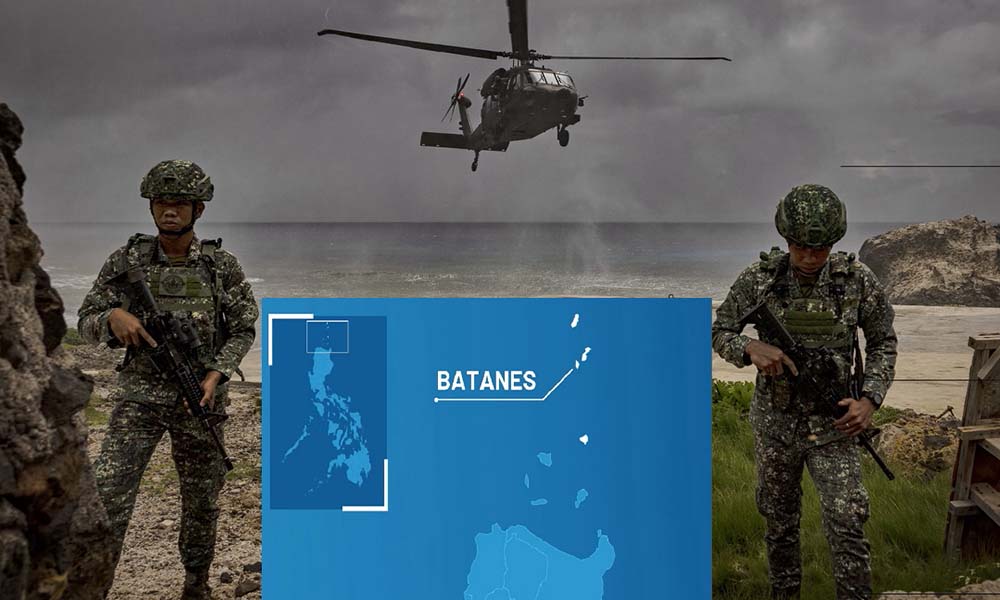
▸ NMESIS (USA): Anti-ship systems on Okinawa, Miyako, Ishigaki (Japan) and Batan Island (Philippines) — mobile, concealable, jungle-deployable
▸ Type-12 Missiles (Japan): Counterstrike missiles in Kyushu; air-defence systems on Yonaguni — 110 km from Taiwan
▸ BrahMos (Philippines): Mach 2.8 coastal batteries in western Luzon and Palawan — already operational
▸ Forward Base (USA-PHL): USNI reports surveyors assessing a new forward operating base 120 miles south of Taiwan
BrahMos Missile at Balikatan 2026: How the Philippines Just Changed the South China Sea
As one strategic analysis put it: the first island chain is no longer a defensive line — it is becoming a distributed launch platform, a mirror of China’s own anti-access strategy, turned back against Beijing from every island and archipelago along its maritime frontier.
From Beijing’s side of the map, this looks like encirclement. Chinese strategists have long called the first island chain a “cordon sanitaire” — a noose limiting China’s strategic depth and cutting the PLA Navy from the open Pacific. More critically, China’s ballistic missile submarines based in Hainan must pass through this chain to reach deeper Pacific waters where they can operate undetected. Every BrahMos battery added to the Philippine coast, every Typhon launcher that stays in Luzon, tightens that noose one turn further.
Professor Andrew Krepinevich of the Hudson Institute — the strategist who first developed the concept of “archipelagic defence”, the intellectual backbone of America’s entire first island chain strategy — argues that the goal is not to win a fight after it starts, but to make the cost of starting one so prohibitive that China’s military planners conclude the maths simply does not work.
The weapons are real. The coalition is real. The rehearsals are real. The only question that remains is whether China’s leadership reaches the same conclusion — or decides to test it.
The first island chain is no longer a line on a map. It is a loaded weapon.
Key Facts at a Glance
Item Detail
JS Ikazuchi Taiwan Strait Transit April 17, 2026 — 14 hours, on anniversary of Treaty of Shimonoseki (1895)
Liaoning Carrier Group Transited Taiwan Strait April 20 — 8 × J-15 fighters, 3 helicopters, heading south
Type 076 Sichuan World’s first drone carrier — departed Shanghai April 21, first-ever South China Sea deployment
Sichuan Build Speed Keel to sea trials: 25 months (US equivalent: 53 months)
Japan Troops at Balikatan 1,400 combat troops — largest Japanese military presence on Philippine soil since WWII
Japanese Weapon Fired Type 88 surface-to-ship missiles — first time fired outside Japan in history
China’s Export Retaliation Restricted exports to 40 Japanese firms following PM Takaichi’s Taiwan remarks (Nov 2025)
Trump–Xi Summit May 14, 2026 — Beijing
Typhon MRC Deployment Yamaguchi Prefecture (Japan) + Zambales (Philippines) — 1,000+ nm range
Yonaguni Missiles Japanese air-defence systems — 110 km from Taiwan
New Forward Base Survey USNI reports: 120 miles south of Taiwan under review for US–PH joint operations
Allied Troop Count (Balikatan) 17,000+ from 8 nations; 17 observer nations
Expert Sources & Citations
• Dr. Alessio Patalano — King’s College London (China blue-water power projection; compellence through historical grievance)
• Professor Toshi Yoshihara — Center for Strategic and Budgetary Assessments (PLAN western Pacific strategy)
• Professor Graham Allison — Harvard Belfer Center (Thucydides Trap; military signalling vs. diplomatic clarity)
• Professor Andrew Krepinevich — Hudson Institute (archipelagic defence; first island chain kill zone strategy)
• Arnaud Bertrand — Geopolitical analyst (Japan military transformation; strategic window analysis)
• Professor Ken Jimbo — Keio University (Japan defense perimeter shift)
• AFP Chief Gen. Romeo Brawner — Opening ceremony address, Balikatan 2026, April 20
• USNI News — Forward operating base survey, 120 miles south of Taiwan
• The Diplomat — Tactical envelopment analysis, PLA 133rd naval task group
• PM Sanae Takaichi — Japanese Parliament statement, November 2025 (Taiwan survival-threatening situation)
• Guo Jiakun — China Foreign Ministry spokesperson, April 20, 2026 (‘playing with fire’ warning)
• Xi Jinping — February 2026 phone call with President Trump (mutual respect, peaceful coexistence)