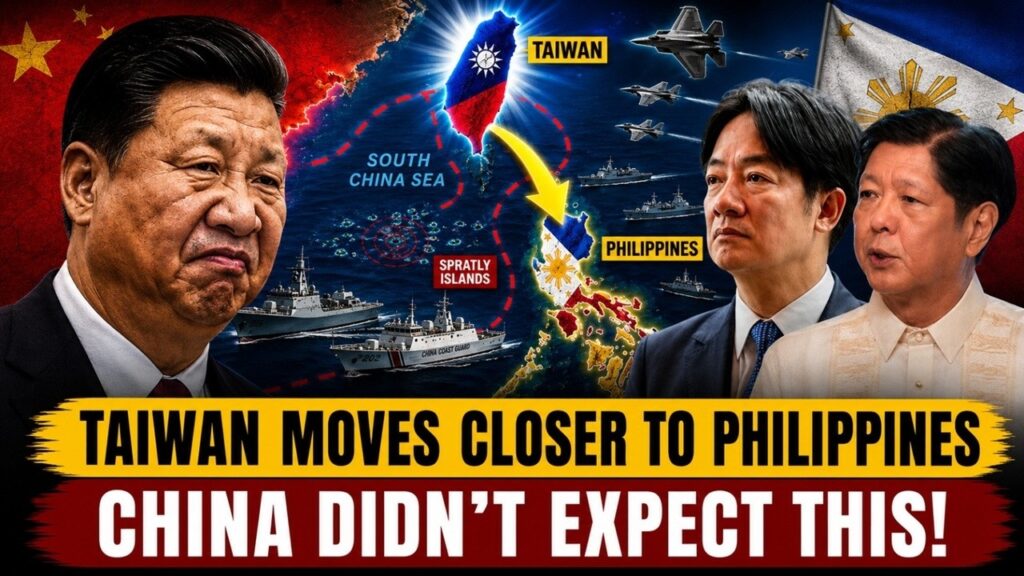
China Furious as Taiwan Backs Philippines in the South China Sea Dispute
Taiwan’s latest South China Sea statement has sparked renewed debate across the Indo-Pacific. While many headlines suggested Taipei was backing the Philippines, the reality is more nuanced. Taiwan has maintained its historical claims while increasingly emphasizing international law, peaceful dispute resolution, and a free and open Indo-Pacific. This article explains the history, strategic context, and implications in a clear, audience-focused way
Taiwan’s Unexpected Move
At first glance, it looked like a routine diplomatic statement.
On July 12, 2026, Taiwan’s Ministry of Foreign Affairs reaffirmed its long-standing position on the South China Sea. Its sovereignty claims, it said, remained unchanged.
Nothing unusual But then came the wording that caught Beijing’s attention.
Taipei called for disputes to be resolved peacefully under international law. It opposed unilateral expansion, gray-zone coercion, and militarization, and pledged to work with like-minded countries to safeguard freedom of navigation and maintain a free, open, and stable Indo-Pacific.
Those words immediately stood out because they closely echoed concerns that the Philippines, Japan, the United States, and other regional partners have repeatedly raised about China’s growing maritime activities.
Just days later, Taiwan also reported a sharp increase in Chinese coast guard activity around the island, reinforcing concerns that Beijing’s pressure was expanding across multiple fronts.
So, was Taiwan changing its South China Sea policy?
Not exactly. And that’s where this story becomes far more interesting.
For decades, Taiwan and China have disagreed on almost everything. Different governments. Different political systems. Different visions for the future. Yet there was one issue where they appeared to share remarkably similar positions. The South China Sea. Both inherited historical claims dating back to the Republic of China. Both continue to claim sovereignty over islands in the region, including Taiping Island, the largest naturally formed feature in the Spratly Islands.
So why are analysts increasingly saying Taiwan is moving closer to the Philippines—even though it has never abandoned those historical claims?
The answer lies in a little-known chapter of history that changes how this entire story is understood.

Taiwan’s Forgotten South China Sea Claim
To understand Taiwan’s position today, we have to go back to 1947.
Here’s the part that surprises most people.
The Nine-Dash Line didn’t originally come from the People’s Republic of China.
It came from the Republic of China, or ROC—the government that ruled China before the Communists came to power. In 1947, the ROC published an official map of the South China Sea marked by the Eleven-Dash Line, laying out its territorial claims years before the People’s Republic of China even existed. Then history took a dramatic turn.
After losing the Chinese Civil War in 1949, the ROC government retreated to Taiwan, while Mao Zedong established the People’s Republic of China on the mainland. From that moment, two rival governments emerged.
Both claimed to represent China. Both inherited the same historical map.
But over time, their paths began to diverge.
France’s Military JUST Entered the Philippines | China Is Watching!
Beijing later revised the original Eleven-Dash Line into today’s Nine-Dash Line. Taiwan never adopted that version. Instead, it continued to uphold the Republic of China’s original historical claims.
The clearest example is Taiping Island, also known as Itu Aba.
Nearly 1,600 kilometers south of Taiwan, this tiny island is the largest naturally formed feature in the Spratly Islands. Taiwan has administered it for decades, maintaining a coast guard presence, an airstrip, and civilian facilities.
Here’s the irony. Taiwan has never abandoned its South China Sea claims.
Yet it also supports resolving disputes peacefully under international law, protecting freedom of navigation, and avoiding military escalation.
At first glance, that sounds contradictory. But it reveals something much more important. Taiwan and China may still claim many of the same islands. What they no longer share is the same strategic vision. And that raises an even bigger question. If Taiwan’s claims haven’t changed… what has?
The Real Turning Point
If Taiwan’s claims in the South China Sea haven’t fundamentally changed…
what has?
The answer isn’t Taiwan. It’s China. Over the past decade, Beijing has steadily transformed the security environment around the island.
Almost daily, Chinese fighter jets cross into Taiwan’s Air Defense Identification Zone. Warships circle nearby waters. Large-scale military exercises now routinely simulate blockades and encirclement operations, rehearsing scenarios that once seemed unthinkable.
But the most significant change isn’t always made by fighter jets or destroyers.
It’s made by ships painted white.
China’s coast guard has become one of Beijing’s most effective tools for what analysts call gray-zone tactics—operations designed to increase pressure without triggering open war.
And the scale of that campaign is growing.
According to Taiwan’s Coast Guard, 55 Chinese government vessels, including coast guard cutters and research ships, were detected operating around Taiwan in June 2026. That was an 83 percent increase in just one month—and more than double the number recorded a year earlier.
Taiwanese officials say these aren’t ordinary patrols.
Some of China’s largest coast guard ships are former naval destroyers, refitted for law-enforcement missions. Others have reportedly questioned commercial vessels at sea, while Taiwan has instructed those ships to ignore Chinese radio broadcasts and continue their voyages.
Individually, these incidents may seem routine.
Together, they reveal a different strategy.
Rather than relying solely on military force, Beijing is using coast guard patrols, maritime law enforcement, research vessels, and constant military activity to gradually reshape the status quo—one encounter at a time, without crossing the threshold into open conflict.
For Taiwan, that has changed everything.
The immediate challenge is no longer simply defending historical claims in the South China Sea.
It is responding to a security environment where military pressure, law enforcement, and psychological signaling increasingly work together.
And that helps explain why Taiwan is finding more common ground with countries like the Philippines.
Its territorial claims may be rooted in history.
But its security concerns are firmly focused on the future.
Why Taiwan Is Quietly Moving Closer to Manila
If Taiwan and the Philippines aren’t allies…
why does Beijing seem so concerned whenever they grow closer?
The answer lies in how modern geopolitics works.
Countries don’t need formal diplomatic relations to become strategically important to one another.
And Taiwan and the Philippines have far more in common than many people realize.
Both sit along the First Island Chain—a string of islands stretching from Japan through Taiwan and the Philippines that occupies one of the most strategically significant regions in the Indo-Pacific.
Both rely on the same sea lanes for trade.
Both depend on freedom of navigation.
And both have watched China’s military and coast guard become increasingly active in the waters around them.
That doesn’t mean Taipei and Manila have formed a military alliance.
They haven’t. Nor do they agree on every territorial issue in the South China Sea. They don’t. But shared security concerns have quietly expanded cooperation in other ways. Trade and investment have continued to grow as companies diversify supply chains across Asia. Taiwan’s semiconductor industry and the Philippines’ manufacturing sector have become increasingly complementary, creating stronger economic links between the two economies. People have strengthened those ties as well.
Hundreds of thousands of Filipinos live and work in Taiwan, supporting industries ranging from healthcare to advanced manufacturing. Education, tourism, and business exchanges have also continued to deepen despite the absence of formal diplomatic relations.
Taken individually, none of these developments appears extraordinary.
Taken together, they tell a different story.
Two governments without formal diplomatic ties are gradually becoming more connected through economics, people, and shared security interests.
And that’s precisely what Beijing notices.
From China’s perspective, influence isn’t measured only by military alliances.
It’s measured by networks.
Every new partnership, every stronger economic relationship, and every shared strategic concern along the First Island Chain makes the regional environment more complex.
That’s why even a carefully worded statement from Taipei can draw such close attention in Beijing.
Because the real story isn’t about a single diplomatic statement.
It’s about a relationship that has been quietly evolving for years.
The Statement That Angered Beijing
On July 12, 2026, Taiwan’s Ministry of Foreign Affairs released a statement on the South China Sea.
At first glance, it looked like business as usual.
Taiwan reaffirmed that its sovereignty claims over the South China Sea remained unchanged. It also repeated a position it has maintained for years—that disputes should be resolved peacefully under international law, including the United Nations Convention on the Law of the Sea, or UNCLOS.
Nothing surprising. Then the tone began to change. Taipei openly opposed unilateral expansionism, gray-zone coercion, and militarization, warning that such actions threaten regional peace and stability. It also called on all parties to respect international law and safeguard freedom of navigation and overflight through one of the world’s busiest maritime corridors. Then came the line that drew the most attention.
Taiwan declared that it would continue working with like-minded countries and regional partners to preserve a free, open, peaceful, and stable Indo-Pacific. That sentence may have sounded diplomatic. But in geopolitics, wording matters.
Although Taiwan never mentioned the Philippines by name, its language closely echoed positions that the Philippines, Japan, the United States, Australia, and other Indo-Pacific partners have repeatedly taken in response to China’s growing maritime activities.
This is where headlines and diplomacy begin to part ways.
Many media reports portrayed the statement as Taiwan backing the Philippines.
Officially, that isn’t what happened. Taiwan did not endorse Philippine sovereignty claims, nor did it abandon its own historical claims in the South China Sea. Instead, it reaffirmed its sovereignty claims while emphasizing peaceful dispute resolution, adherence to international law, opposition to coercion, and cooperation with countries seeking regional stability.
For Beijing, however, that legal distinction was almost beside the point.
China has long opposed any development that brings Taiwan into closer alignment with other regional governments. From Beijing’s perspective, the significance of the statement wasn’t a change in Taiwan’s territorial claims—it was the diplomatic language it chose to use and the broader strategic community it appeared to identify with.
The issue was no longer just about the South China Sea.
It was about where Taiwan increasingly appeared to position itself within the Indo-Pacific security landscape.
Why Beijing Still Isn’t Satisfied
At this point, the story seems almost paradoxical.
Taiwan still controls Taiping Island.
It has never abandoned its historical claims in the South China Sea.
So why did Beijing react so strongly to Taiwan’s statement?
Because today’s competition is no longer just about who claims the islands.
It’s about how those claims are pursued.
Taiwan’s July 2026 statement reaffirmed its sovereignty claims.
But it also emphasized something Beijing increasingly rejects—resolving disputes peacefully under international law, protecting freedom of navigation, opposing gray-zone coercion, and working with like-minded partners to preserve regional stability.
That marks a clear difference in approach.
Beijing argues that many of these disputes should be settled primarily through direct negotiations and continues to reject the 2016 South China Sea Arbitration, which concluded that China’s Nine-Dash Line has no legal basis under UNCLOS.
Then comes another unexpected twist.
Taiwan also rejected part of that same ruling.
But not for the same reason as China.
The tribunal ruled that Taiping Island, despite being the largest naturally formed feature in the Spratly Islands, should legally be classified as a rock, not a fully entitled island. That meant it would not generate a 200-nautical-mile Exclusive Economic Zone under Article 121 of UNCLOS.
Taiwan rejected that conclusion because it directly affects territory that Taipei continues to administer.
Both Taiwan and China rejected part of the same ruling.
But that’s where their similarities largely end.
Taiwan increasingly speaks about a rules-based international order, peaceful dispute resolution, and cooperation with democratic partners.
China, meanwhile, continues expanding its military presence, coast guard operations, and gray-zone activities across both the South China Sea and the Taiwan Strait.
down to the Philippines… and across to Australia… a network of countries is strengthening security cooperation, expanding military access, sharing intelligence, and coordinating more closely than before. The Philippines is expanding access to bases under EDCA.
Japan is reinforcing its southwestern defenses. The United States continues to deepen its Indo-Pacific presence.
And while Taiwan has no formal military alliance with any of them, its diplomatic language is increasingly aligned with many of the same principles. Military planners often describe this broader strategy as integrated deterrence—not one alliance, but a network of partners whose combined political, economic, and security cooperation raises the cost of aggression.
From Beijing’s perspective, that’s the real challenge.
It’s not that Taiwan still claims islands in the South China Sea.
It’s that Taiwan is becoming increasingly connected to a wider regional network that shares many of the same security concerns.
And that’s why this story was never really about an old map.
It’s about who will shape the future security order of the Indo-Pacific.
What Does the Philippines Gain?
If the Philippines cannot officially recognize Taiwan… why deepen ties at all? The answer is simple. Manila isn’t looking for another military alliance. It’s looking for more options. The Philippines continues to recognize the People’s Republic of China as the sole legal government of China under its One China Policy, and it maintains no formal diplomatic relations with Taiwan.
That hasn’t changed. What has changed is the region around it.
As competition across the Indo-Pacific intensifies, the Philippines has increasingly sought to strengthen relationships wherever its interests align.
Taiwan is one of those partners.
Politically, Taiwan’s support for international law, peaceful dispute resolution, and opposition to coercion reinforces many of the same principles that Manila has championed since the 2016 South China Sea Arbitration. While Taipei does not endorse Philippine sovereignty claims, another regional voice supporting a rules-based maritime order strengthens the broader diplomatic narrative.
The benefits extend beyond diplomacy.
Taiwan is one of the world’s leading technology economies and home to the global semiconductor industry. As companies diversify supply chains, the Philippines hopes to attract greater Taiwanese investment in electronics, advanced manufacturing, and other high-value industries—bringing jobs, technology, and new opportunities.
The relationship is also built on people.
Hundreds of thousands of Filipinos live and work in Taiwan, contributing to healthcare, manufacturing, shipping, and other critical industries. Those long-standing personal and economic ties have created a relationship that extends well beyond official diplomacy.
Then there’s the strategic reality. Neither Taiwan nor the Philippines has a formal defense agreement with the other.
But both rely on secure sea lanes. Both face growing maritime pressure. And both would benefit from greater cooperation in areas such as disaster response, maritime awareness, fisheries management, and the resilience of critical infrastructure. For Manila, this isn’t about choosing between Beijing and Taipei. It’s about reducing strategic dependence on any single partner. In today’s Indo-Pacific, resilience comes from having more economic connections, more diplomatic channels, and more trusted partners. And that’s why Beijing watches this relationship so closely. Not because Taiwan and the Philippines have become allies. But because even limited cooperation can gradually reshape the strategic landscape.
What Happens Next?
So where does this go from here?
No one knows for certain.
The future of Taiwan–Philippines relations won’t be decided only in Taipei or Manila. It will also depend on decisions made in Beijing, Washington, Tokyo, and capitals across the Indo-Pacific.
But based on current trends, three futures appear more likely than the others.
The first is continuity.
This is also the most likely outcome.
Taiwan and the Philippines continue expanding practical cooperation while carefully avoiding steps that could dramatically alter the regional balance. Taipei keeps advocating international law, freedom of navigation, and peaceful dispute resolution.
Without crossing Beijing’s political red lines.
The second future is deeper unofficial cooperation.
Not an alliance. But something more substantial than today’s relationship.
Trade could expand in advanced manufacturing and semiconductor industries. Maritime agencies could cooperate more closely on fisheries, disaster response, search and rescue, and maritime domain awareness. Universities, businesses, and technology sectors could build even stronger connections. None of that would require formal diplomatic recognition.
Yet together, those seemingly small steps could create a much more resilient partnership.
The third possibility is greater pressure from Beijing.
This is also the most unpredictable.
If China expands military exercises around Taiwan, increases coast guard activity in the South China Sea, or applies greater diplomatic and economic pressure on governments engaging with Taipei, both Taiwan and the Philippines may face increasingly difficult choices.
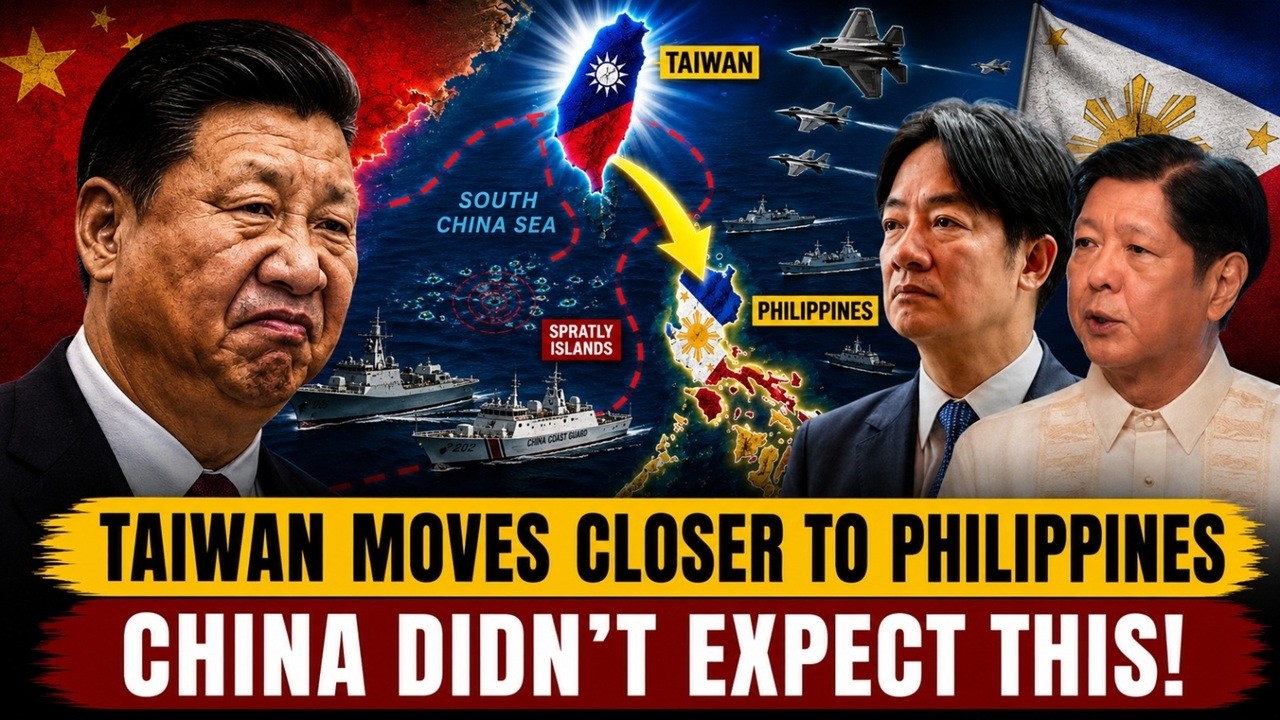
Regional partners could respond by strengthening their own coordination, accelerating exactly the kind of strategic networking Beijing hopes to discourage. That doesn’t mean conflict is inevitable. Far from it. But it does suggest that competition across the Indo-Pacific is unlikely to ease anytime soon. And that brings us to the biggest takeaway from this entire story. Perhaps this was never really about Taiwan and the Philippines alone. Perhaps it is about something much larger. The gradual emergence of a new security architecture across the Indo-Pacific.
Conclusion
At first glance, this seemed like a story about Taiwan backing the Philippines in the South China Sea.
But that was never the whole story.
Taiwan has not abandoned its historical claims, nor has it formally endorsed Philippine sovereignty.
What has changed is the strategic environment around both.
As China’s military, coast guard, and gray-zone activities continue to expand across the Indo-Pacific, Taiwan and the Philippines have found increasing common ground—not in territorial claims, but in their support for international law, regional stability, and a rules-based maritime order.And that is likely why Beijing paid such close attention to a carefully worded diplomatic statement. Because the real issue was never just the statement itself. It was what that statement represented. For decades, the Taiwan Strait and the South China Sea were often viewed as separate geopolitical flashpoints. Today, they are becoming increasingly interconnected.
The decisions made in one theater are beginning to shape the strategic calculations in the other.
And that may prove to be one of the defining geopolitical shifts of the Indo-Pacific in the years ahead.
About Indo-Pacific Report
For more geopolitical analysis, strategy coverage, and Indo-Pacific security reporting, visit Indo-Pacific Report:
Website
Facebook
YouTube