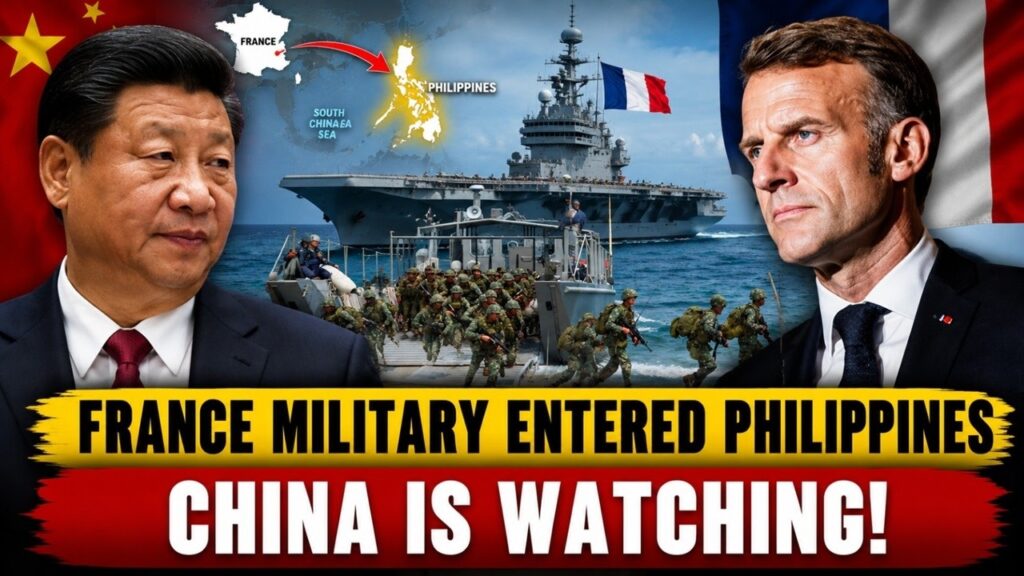
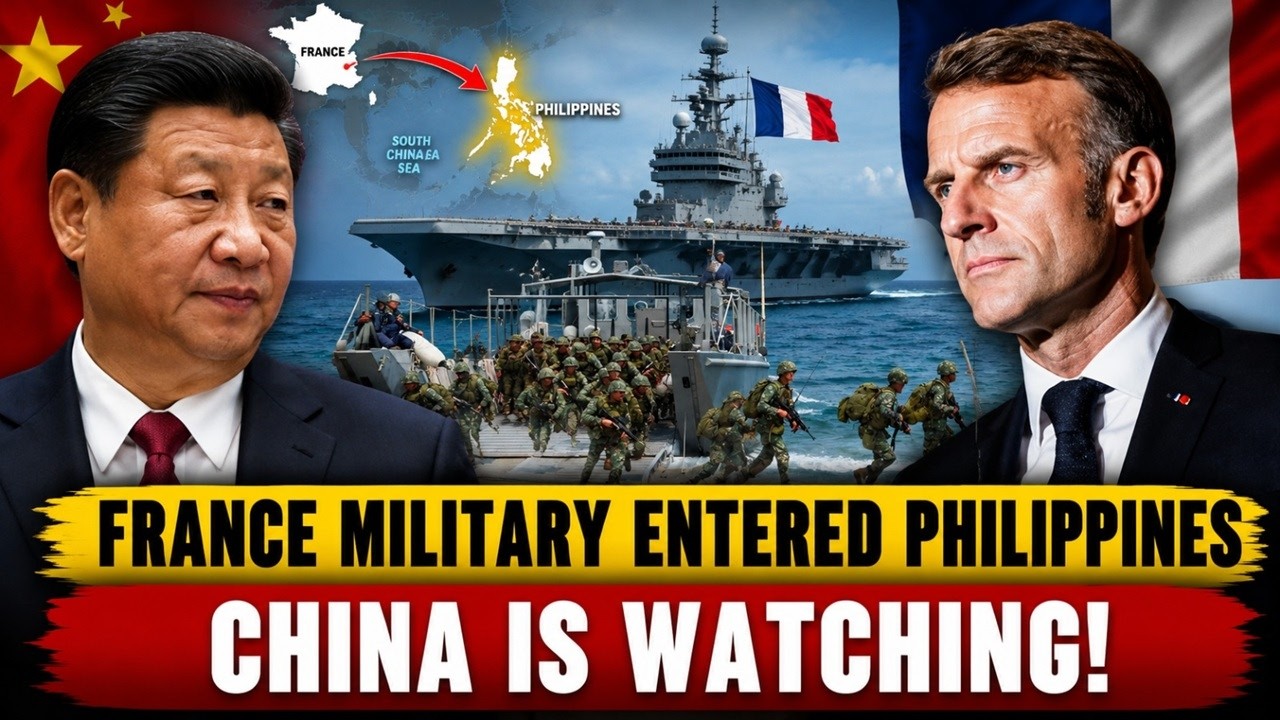
France’s Military JUST Entered the Philippines | China Is Watching!
Explore how the France–Philippines Visiting Forces Agreement reshapes Indo-Pacific security, strengthens maritime cooperation, and reflects Europe’s growing strategic role in Asia.The Indo-Pacific is rapidly becoming the world’s most strategically important region. France’s landmark Status of Visiting Forces Agreement (SOVFA) with the Philippines marks a historic step in regional security cooperation. More than a legal framework for military cooperation, the agreement reflects the emergence of a broader, interconnected security architecture spanning Asia, Europe, and North America.
France has just become the first European country to sign a Status of Visiting Forces Agreement with the Philippines—a historic breakthrough that could reshape the Indo-Pacific’s evolving security architecture. Signed in Paris by Philippine Defense Secretary Gilberto Teodoro Jr. and French Minister for the Armed Forces Catherine Vautrin, the agreement establishes the legal framework for French and Philippine forces to train together, conduct joint exercises, and deepen defense cooperation. But this is about far more than military drills. It marks the first time a European military power has formally joined the Philippines’ growing network of security partners, signaling that the strategic competition unfolding in the Indo-Pacific is no longer being shaped solely by the United States and regional allies. So why is France expanding its military partnership with a country more than 10,000 kilometers away—and what does that reveal
What Exactly Is A Visiting Forces Agreement?
But before we go any further, here’s an important question. If France and the Philippines already had friendly relations, why did they need another agreement?
The answer is simple. A Status of Visiting Forces Agreement, or SOVFA, is not a military alliance. It doesn’t create permanent foreign bases or require either country to fight for the other. Instead, it provides the legal framework that allows their armed forces to work together smoothly.
Once it takes effect, the agreement covers joint military exercises, troop visits, logistics, humanitarian assistance, disaster response, maritime security, and the legal status of visiting military personnel. Without a framework like this, even routine military activities can become legally and administratively complicated. With it, both countries can train, coordinate, and respond to regional challenges far more efficiently.
That’s why Philippine Defense Secretary Gilberto Teodoro Jr. described the agreement as a foundation for expanding defense cooperation. Beyond military training, it is designed to improve maritime domain awareness, emergency response, and interoperability between the two armed forces.
In short, this agreement doesn’t create a new alliance—it makes an existing partnership more practical and effective.
But that raises an even bigger question. If the agreement is simply a legal framework, why was France so eager to become the first European country to sign one with the Philippines?
The answer begins with a surprising fact: France isn’t entering the Indo-Pacific—it already lives there.
France Isn’t Entering the Indo-Pacific… It Already Lives There
Here’s where the story takes an unexpected turn.
At first glance, France seems like an unlikely security partner for the Philippines. Paris is more than 10,000 kilometers from Manila. So why would a European country invest so heavily in security on the other side of the world?
Because France isn’t entering the Indo-Pacific.
It already lives there.
Unlike most European nations, France is a resident Indo-Pacific power. Through overseas territories such as New Caledonia, French Polynesia, Wallis and Futuna, Réunion, and Mayotte, nearly 1.6 million French citizens live across the region. These territories also give France one of the world’s largest Exclusive Economic Zones, with most of its maritime territory located in the Indian and Pacific Oceans.
That means what happens in the Indo-Pacific isn’t someone else’s problem for France—it’s a matter of national security.
And France isn’t just flying its flag on a map.
Philippines Opens New Luzon Strait Base to Bolster Deterrence Against China
It permanently stations around 7,000 military personnel across the region, supported by naval forces, maritime patrol aircraft, surveillance assets, and regular deployments of frontline warships. Earlier this year, the Charles de Gaulle carrier strike group trained with the Philippine Navy and Air Force in the South China Sea before making a port call at Subic Bay. French warships also regularly participate in multinational exercises and freedom of navigation operations throughout the region.
This explains why France has its own Indo-Pacific Strategy. Protecting its territories, defending freedom of navigation, and strengthening partnerships with countries like the Philippines aren’t optional—they’re part of France’s long-term national strategy.
So when France signed its first Visiting Forces Agreement with the Philippines, it wasn’t announcing its arrival in the Indo-Pacific.
It was reinforcing a region where it already has people, territory, and strategic interests.
But that raises another question.
If France has been an Indo-Pacific power for decades, why did this agreement happen now?
The answer lies in a much bigger shift—one driven not just by France, but by the Philippines’ own strategy to build a broader network of security partners.
Why The Philippines Wants France
But France’s strategy is only half the story.
The other half begins in Manila.
Over the past few years, the Philippines has quietly transformed the way it thinks about national defense. For decades, its security depended largely on one treaty ally—the United States. Today, that strategy is changing.
Instead of relying on a single partner, Manila is building a broader network of security relationships designed to strengthen deterrence, improve interoperability, and make its defenses more resilient. As tensions in the West Philippine Sea continued to rise, the Philippines steadily expanded its circle of defense partners. The United States remained its cornerstone ally, followed by Australia’s Visiting Forces Agreement in 2007. Then came Japan in 2024, New Zealand and Canada in 2025, and now France in 2026—the first European country to sign a Visiting Forces Agreement with Manila. Negotiations with the United Kingdom are also underway.
Taken together, these aren’t isolated agreements.
They’re part of a much bigger strategy.
Defense planners often describe it as security diversification—building multiple partnerships instead of relying too heavily on any single country. Every new agreement creates more opportunities for joint exercises, military training, intelligence sharing, humanitarian assistance, disaster response, and maritime cooperation. The result is a more capable and more interoperable Armed Forces of the Philippines.
France fits naturally into that strategy.
It doesn’t replace the Philippines’ alliance with the United States, nor does it create a new military bloc. Instead, it adds another trusted partner to an expanding network that now stretches across North America, Europe, and the Indo-Pacific.
And that sends a clear message.
The Philippines isn’t replacing old allies. It’s making sure it never has to rely on just one.
But as Manila expands its network of security partners, another question becomes impossible to ignore.
How will China respond to another military partner—especially one from Europe—entering the picture?
France’s Expanding Military Footprint
By now, one thing should be clear.
The France–Philippines agreement didn’t create this partnership—it formalized it.
Long before the document was signed in Paris, France had already been steadily expanding its military presence across the Indo-Pacific and working more closely with the Philippines.
One of the clearest examples came earlier this year, when the Charles de Gaulle Carrier Strike Group—France’s most powerful naval formation—deployed to the region. The nuclear-powered aircraft carrier conducted joint exercises with the Philippine Navy and Air Force in the South China Sea before making a port call at Subic Bay. It was a powerful reminder that France was no longer an occasional visitor—it was becoming an active security partner.
And the carrier deployment wasn’t an isolated event.
Over the past several years, French warships have participated in major multinational exercises, conducted maritime patrols, expanded humanitarian and disaster response cooperation, and increased professional exchanges with the Armed Forces of the Philippines. France has also joined larger regional exercises such as Balikatan, training alongside the United States, Australia, Japan, New Zealand, Canada, and the Philippines.
Each deployment, exercise, and port visit followed the same direction.
More cooperation. More interoperability. More presence.
The Status of Visiting Forces Agreement simply provides the legal framework to make those activities more regular and more ambitious in the years ahead.
But that also raises an important question.
If France’s military presence in the Indo-Pacific is becoming increasingly visible, how will China interpret the arrival of another capable security partner in one of its most strategically sensitive regions?
Why China Will Watch Carefully
As the Philippines expands its network of defense partnerships, one question naturally follows.
How is China likely to view all of this?
While Beijing has not issued a formal response to the France–Philippines Status of Visiting Forces Agreement, its broader position has remained consistent. Chinese officials have repeatedly criticized the growing involvement of external military powers in the South China Sea, arguing that it increases strategic competition and complicates regional stability.
From Beijing’s perspective, the issue isn’t France alone.
It’s the bigger picture.
A Visiting Forces Agreement doesn’t create a military alliance or establish permanent bases. But it does make military cooperation easier, allowing partners to train together more often, improve interoperability, strengthen maritime awareness, and respond more effectively to crises.
On its own, one agreement changes very little.
But together, they tell a different story.
The Philippines has steadily expanded defense cooperation with the United States, Australia, Japan, New Zealand, Canada, and now France. Rather than relying on a single ally, Manila is building a broader network of security partners—one designed to improve resilience and deter coercion.
This comes as tensions in the South China Sea remain high. Coast guard confrontations, dangerous maritime maneuvers, electronic interference, and increasingly sophisticated surveillance activities have become recurring features of the region. While analysts consider the risk of a full-scale conflict to be low, they also warn that a more crowded operating environment increases the chances of miscalculation.
Viewed in that context, the France–Philippines agreement is more than a bilateral deal.
It’s another sign that the Indo-Pacific’s security landscape is becoming increasingly interconnected and increasingly multipolar.
And that raises the biggest question of all.
If this trend continues, what will the Indo-Pacific’s balance of power look like a decade from now?
Europe’s Return To Asian Security
As competition in the Indo-Pacific grows, more European nations are increasing their security engagement—not because they want to project power halfway around the world, but because stability in these waters is closely tied to their own economic and strategic interests.
France has led that effort, supported by its territories, citizens, and military presence across the Indo-Pacific. But it isn’t acting alone. The United Kingdom, Germany, Italy, and the Netherlands have all expanded naval deployments, joined regional exercises, and strengthened defense cooperation with Indo-Pacific partners.
Together, they reflect a broader European commitment to freedom of navigation, international law, and a stable maritime order.
That commitment is also reflected in official strategies adopted by both France and the European Union, which identify the Indo-Pacific as a region of growing strategic importance.
The France–Philippines Status of Visiting Forces Agreement fits naturally into that larger picture. It shows that developments in the South China Sea are no longer viewed as concerns for Asia alone. These waters carry a significant share of global trade, linking European economies with markets across the Indo-Pacific every day.
And that may be the biggest lesson of this story.
The Indo-Pacific is no longer just a regional theater. It’s becoming one of the defining arenas of global security.
The New Security Architecture
Step back from each individual agreement, and a much bigger picture begins to emerge.
The France–Philippines Status of Visiting Forces Agreement isn’t just another defense pact. It’s another building block in a new Indo-Pacific security architecture—one based on networks rather than isolated alliances.
For decades, the region’s security largely revolved around the United States and its bilateral alliances with countries like Japan, South Korea, Australia, and the Philippines. Those partnerships remain strong, but today’s security landscape is becoming far more interconnected. Countries are increasingly training together, sharing expertise, coordinating maritime operations, and strengthening cooperation beyond their individual ties with Washington.
The Philippines is one of the clearest examples of this shift. While its alliance with the United States remains the foundation of its defense, Manila has steadily expanded cooperation with Japan, Australia, France, Canada, New Zealand, South Korea, and ASEAN partners. Each new agreement adds another link to a growing regional network.
France’s agreement fits naturally into that evolution. As the Philippines’ first Visiting Forces Agreement with a European country, it extends that network beyond the traditional Indo-Pacific framework and highlights the growing role of middle powers in regional security.
The result is a more flexible and resilient system—one where countries can train together, improve interoperability, share maritime information, and respond more effectively to regional crises.
And perhaps that’s the biggest takeaway from this story.
The Indo-Pacific’s future security won’t be shaped by one alliance alone, but by an expanding network of partnerships stretching across Asia, Europe, and North America.
What Happens Next?
So where does the France–Philippines partnership go from here?
The honest answer is that no one knows for sure. Defense agreements create opportunities—not guarantees. But based on the agreement and the direction both countries have taken, three realistic paths stand out.
The first is a steady but cautious partnership. France and the Philippines could expand officer exchanges, humanitarian assistance, disaster response, and occasional joint exercises. Even at this level, the agreement would mark a historic milestone as France becomes the Philippines’ first European Visiting Forces Agreement partner.
The second is deeper operational cooperation. The new legal framework could support more regular naval deployments, expanded participation in exercises like Balikatan, greater maritime surveillance, logistics coordination, and more frequent joint training. Over time, the two militaries would become increasingly interoperable during both security missions and humanitarian operations.
The third depends on the broader security environment. If tensions in the Indo-Pacific continue to rise, France could take on a larger role in multinational maritime security, freedom of navigation activities, and regional defense cooperation—consistent with its Indo-Pacific Strategy. That wouldn’t require a new alliance or permanent bases, but it would deepen France’s role as a regional security partner.
Which path ultimately emerges will depend on decisions made in Manila, Paris, and the wider Indo-Pacific.
But one conclusion is already clear.
The France–Philippines Visiting Forces Agreement isn’t a promise of what will happen next. It’s a framework that gives both countries the flexibility to respond together—whatever the future may bring.
Final Thought
France becoming the first European country to sign a Visiting Forces Agreement with the Philippines marks more than a diplomatic milestone—it symbolizes a changing Indo-Pacific. As regional and European partners deepen their cooperation, the security landscape is becoming more interconnected than ever before. Whether this new architecture strengthens peace or intensifies competition remains to be seen. But one thing is certain: the future of the Indo-Pacific will not be decided by Asia alone—it will help shape the future of global security.
Conclusion
The France–Philippines SOVFA represents a significant evolution in Indo-Pacific security. Rather than creating a new alliance, it enhances cooperation, interoperability, and regional resilience. As strategic competition continues to evolve, partnerships like this are likely to play an increasingly important role in preserving stability and freedom of navigation.
Stay Connected
Website: https://indopacificreport.com/
Facebook: https://www.facebook.com/IndoPacificReportIPR
YouTube: https://www.youtube.com/@IndoPacific_Report
SEO Keywords
France Philippines Visiting Forces Agreement, France Philippines SOVFA, Indo-Pacific security, South China Sea, Philippines defense, France Indo-Pacific strategy, maritime security, West Philippine Sea, European security in Asia
About Indo-Pacific Report
For more geopolitical analysis, strategy coverage, and Indo-Pacific security reporting, visit Indo-Pacific Report:
Website
Facebook
YouTube
France’s Military JUST Entered the Philippines | China Is Watching!