Marcos: A “Future-Ready” PH–US Alliance Evolving Beyond Defense
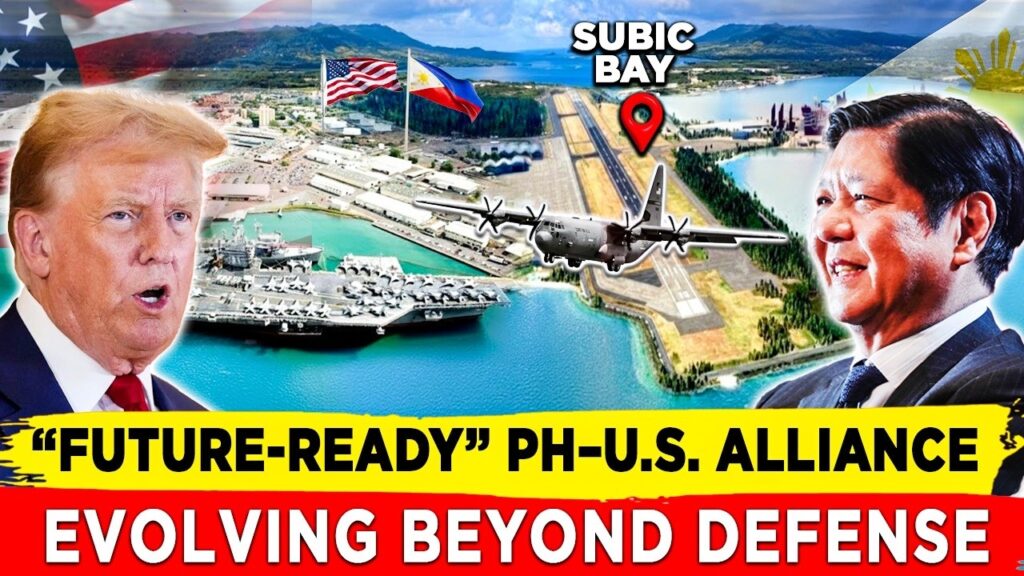
Eighty years in, this alliance is no longer running on muscle memory. And President Ferdinand Marcos Jr. knows it. Standing at the milestone anniversaries, 80 years of Philippine–US diplomatic relations and 75 years of the Mutual Defense Treaty, Marcos didn’t sound nostalgic. He sounded forward-looking, almost impatient with the idea that the alliance should be frozen in Cold War amber. His message was clear: this is no longer just a defense pact built for yesterday’s wars. It’s becoming a future-ready, whole-of-state partnership designed for a messier, more connected, more contested Indo-Pacific.
That shift isn’t rhetorical. You can see it on the ground. The expanded U.S. rotational military presence under EDCA isn’t just about troops moving in and out, it’s about routines, access, and predictability. Add to that institutionalized coordination mechanisms that now run year-round instead of flaring up during crises, and the alliance starts to feel less reactive, more permanent in function if not in form. This is what grown-up alliances look like: boring when things are calm, invaluable when they aren’t.
What really marks the evolution, though, is where the partnership is heading next. Cybersecurity and outer space are no longer side conversations or future agenda items, they’re sliding into the core of alliance planning. Marcos is effectively saying that sovereignty today isn’t defended only at sea or in the air, but in networks, satellites, and data flows. That’s a big conceptual leap for a treaty born in 1951. And it’s overdue.
Zoom out, and the strategic weight becomes obvious. This modernized PH–US alliance now sits squarely inside First Island Chain deterrence, shaping how power is balanced from Japan down through Taiwan and into Southeast Asia. At the same time, Marcos is careful not to frame it as exclusionary. The alliance, as he presents it, supports ASEAN-centered regional stability, not by dominating the region, but by anchoring it.
In short, this isn’t about remembering the past. It’s about refusing to be trapped by it. Marcos is betting that an alliance which adapts across domains, military, political, technological, doesn’t just survive its anniversaries. It earns relevance long after the celebrations end.

Historical Anchors and Strategic Continuity
There’s a reason President Marcos keeps reaching back before he points forward. In this part of the world, history isn’t decoration, it’s credibility. The timeline itself reads like a spine holding the alliance upright. 1946, diplomatic relations begin, right as the Philippines steps into independence. 1951, the Mutual Defense Treaty is signed, locking in a security guarantee that has outlived wars, administrations, and entire global orders. And now 2026, a rare dual milestone: 80 years of diplomatic ties and 75 years of the MDT. Marcos didn’t let that moment pass quietly. When he said, “For 80 of those 250 years, the Philippines has been proud to call the United States a trusted friend, a steadfast partner, and an unwavering ally,” he wasn’t just praising the past. He was anchoring the future to it.https://www.youtube.com/watch?v=HGmYM1-883I
That anchoring matters because alliances don’t operate in a vacuum. The MDT remains the legal backbone of everything that follows, EDCA access, rotational presence, interoperability, even emerging cooperation in cyber and space. Without that treaty, all the modern upgrades would be politically fragile and strategically reversible. With it, they inherit legitimacy. That’s the quiet power of continuity.
The anniversary year is being used very deliberately. Not to reopen old debates. Not to renegotiate fundamentals. But to signal something steadier: this alliance isn’t wobbling, even as the region does. In an environment filled with hedging, realignment, and strategic ambiguity, Marcos is choosing reassurance over rupture. The message to allies is consistency. The message to rivals is endurance.
There’s also a personal, almost generational undertone here. Marcos is leading an alliance shaped long before him, but instead of distancing himself from its origins, he’s owning them. That choice says a lot. History, in this framing, isn’t a constraint. It’s leverage, proof that some partnerships don’t need reinvention to remain relevant. They just need to keep showing up.
Alliance Scope: Beyond Military Cooperation
Here’s where Marcos really leans into the “bigger than defense” narrative. The Philippines–U.S. alliance isn’t just about ships, jets, or patrols anymore, though none of those traditional security pillars are going anywhere. Defense, deterrence, maritime security, law enforcement, disaster response, and humanitarian assistance remain front and center, but they’re now explicitly framed as part of a wider, integrated partnership. They’re the baseline, not the ceiling.
Philippines Nears Strategic Defense Partnership with France to Enhance Naval Capabilities
What makes this moment unusual is the breadth Marcos is claiming on the civil and societal front. Officially, the partnership now stretches across at least 12 sectors: trade, investment, agriculture, food security, energy, transport, labor, health, education, tourism, culture, and people-to-people exchanges. When Marcos says, “Today that cooperation is broad and it is comprehensive… addressing domestic, regional and international challenges,” he’s signaling something subtle but powerful: the alliance is indispensable to nation-building, not just national defense.
Analytically, this is a clever move. By embedding the alliance into domestic development priorities, Marcos strengthens political legitimacy at home. Critics who worry about foreign influence are reminded that this partnership isn’t just about external threats, it’s about infrastructure, schools, jobs, and trade. Strategically, it also reframes regional security: the U.S. is no longer just a military actor, it’s a development partner whose contributions ripple across society, reinforcing the Philippines’ role in ASEAN stability and broader Indo-Pacific networks.
In short, Marcos is pushing the idea that modern alliances are multi-domain by necessity: the security you want depends on the economic, societal, and technological foundations you build and that’s exactly the story he’s telling about the PH–U.S. partnership.
New Strategic Domains: Cyber and Outer Space
This is the part where the PH–U.S. alliance stops looking like a traditional “boots and ships” partnership and starts looking… futuristic. Marcos is putting cybersecurity and outer space squarely on the table as explicit domains of cooperation. And that’s no small footnote.
In practical terms, this means the Philippines is aligning with U.S. Indo-Pacific priorities on multiple levels: building cyber resilience against attacks that could disrupt critical systems, hardening digital infrastructure that underpins commerce and government, and leveraging space-based communications and situational awareness for both civilian and military purposes. In other words, the alliance isn’t just about stopping someone at the waterline; it’s about controlling, protecting, and observing the invisible architecture that modern states rely on.
Why it matters strategically is simple: very few Southeast Asian allies are stepping into these non-kinetic domains with Washington. This signals that Manila is thinking long-term, not just episodically. It’s a way of saying, “We’re in this for the next generation of threats and technologies, not just the next patrol rotation.” For regional observers, it’s a clear alignment marker, the Philippines is now in the club of partners who can operate across land, sea, air, cyber, and space, rather than just the traditional triad.
In short, Marcos isn’t just upgrading the alliance; he’s future-proofing it. And in a region where the strategic environment changes faster than bureaucracies can react, that kind of foresight counts.https://indopacificreport.com/china-is-watching-the-9th-u-s-philippines/
Leadership Signaling and High-Level Diplomacy
Here’s where the politics get personal, not just institutional. Marcos isn’t just talking about treaties or military rotations, he’s showing that the alliance lives at the highest levels of leadership. When he references his White House engagement with U.S. President Trump during Trump’s second term, “Our positive initial engagement provided renewed momentum for sustained high-level exchanges” he’s signaling two things at once: that Manila can play in the big leagues, and that personal rapport still matters in diplomacy.
The moves on the ground reinforce that signal. By inviting Trump to Manila for the 2026 ASEAN Summit, Marcos isn’t just hosting a former U.S. president, he’s sending a message to the region: the Philippines can convene powerful partners without compromising ASEAN centrality. That emphasis on alliance compatibility with ASEAN-led frameworks is deliberate. It tells neighbors, allies, and potential adversaries that Manila isn’t pivoting away from regional institutions while strengthening bilateral ties.
In short, this is leadership signaling at its most sophisticated: projecting confidence, maintaining legitimacy at home and abroad, and embedding the alliance into the regional diplomatic fabric, all while keeping the optics constructive rather than confrontational. It’s less about ceremony and more about shaping perceptions, showing that the PH–U.S. partnership is active, personal, and influential at the top tables where decisions actually get made.
How Ukraine Is Supporting Philippines Defense—And What It Means for China?
Case Study 1 — U.S. Army Rotational Force–Philippines (ARF-P)
Here’s a concrete example of how the alliance is evolving from theory into day-to-day reality: the U.S. Army Rotational Force–Philippines (ARF-P).
Key facts first: ARF-P was formally established in July 2025, but public awareness only came in January 2026. It’s small, roughly 50 U.S. Army personnel but the size belies its significance. Commanded by U.S. Army Pacific (USARPAC), the force is explicitly rotational and non-permanent, meaning it doesn’t constitute a base or long-term footprint, yet it represents a shift toward sustained engagement. As Col. Isaac Taylor put it: “This represents a shift from previous years’ iterative engagement to a more sustained rotational presence.”
Strategically, that shift is huge. The ARF-P moves the alliance from sporadic exercises to persistent presence, which has real operational and planning consequences. First, it allows for continuous infrastructure coordination, ongoing maintenance, logistics alignment, and readiness improvements. Second, it deepens army-to-army interoperability, meaning U.S. and Philippine forces can actually operate together rather than just train alongside each other in bursts. Third, it builds institutional familiarity with Philippine terrain and forces, so that when a contingency arises — whether disaster relief or regional security, the U.S. Army is already embedded in local operational logic.https://www.youtube.com/watch?v=qEjKVtS0z-E
In short, ARF-P isn’t big in numbers, but it’s a force multiplier in knowledge, readiness, and coordination. It exemplifies how the PH–U.S. alliance is moving from episodic engagement toward a future-ready posture, quietly shaping both capability and trust.
Here’s where all the pieces start to fit together, showing that the PH–U.S. alliance is more than the sum of its parts.
Case Study 2 — Task Force–Philippines (TF-PH) illustrates a clever behind-the-scenes move. Announced on October 31, 2025, it’s a compact ~60-personnel hub led by a one-star general, explicitly for coordination, not combat. The U.S. Pacific Fleet was careful to clarify: “It does not involve new combat forces or permanent military basing.” That matters because it allows Manila and Washington to deepen integration, linking EDCA sites, rotational forces, and joint exercises, without stirring sovereignty concerns. Strategically, it’s low-profile but high-utility, a quiet glue that turns scattered operations into a functioning network.
Case Study 3 — Exercise Balikatan 25 shows what all this coordination enables in practice. Conducted in Aparri, Cagayan Valley, near the Luzon Strait, it involved the U.S. Army 25th Infantry Division and the Armed Forces of the Philippines in counter-landing and maritime defense scenarios. The strategic lessons are clear: northern Luzon is a critical node for Taiwan contingency planning and South China Sea access control. More importantly, it demonstrates that the alliance can operate at high-end combined operations, not just humanitarian assistance and disaster relief.
All of this feeds directly into the First Island Chain context. The Philippines sits at the geostrategic hinge between the South China Sea and the Taiwan Strait, meaning even small rotational forces, like ARF-P or TF-PH, have outsized effects. Infrastructure, coordination, and readiness create a distributed force posture, strengthen deterrence by denial, and embed resilience into critical chokepoints.
From a diplomatic lens, the ASEAN dimension is just as deliberate. As ASEAN Chair in 2026, Manila stresses that the alliance is aligned with ASEAN centrality and promotes community-building, signaling that being a U.S. partner doesn’t mean abandoning regional consensus. Marcos puts it plainly: “We look forward to continued support for ASEAN community building… through our comprehensive strategic partnership.”
Strategic assessment brings it home. What has clearly changed? Sustained U.S. Army presence, formalized coordination via TF-PH, and expansion into cyber and space domains. What remains non-negotiable politically? No permanent U.S. bases, all deployments framed defensively, and respect for Philippine sovereignty.
Conclusion:
the PH–U.S. alliance is no longer just a Cold War-era treaty or a series of rotating bases. It’s a future-ready, multi-domain partnership that is militarily credible, politically calibrated, and regionally embedded. Marcos closes the narrative with a line that captures both history and ambition: “I am confident that this alliance will move forward with even greater conviction… for the next 80 years and beyond.”
The picture is now unmistakable: a measured, sophisticated, and forward-looking alliance, small footprints, big effects, and a diplomatic balance that keeps Manila central to both U.S. strategy and ASEAN cohesion.https://youtu.be/SBN3QPtTQHw?si=OuXox-zYMmehmQpk