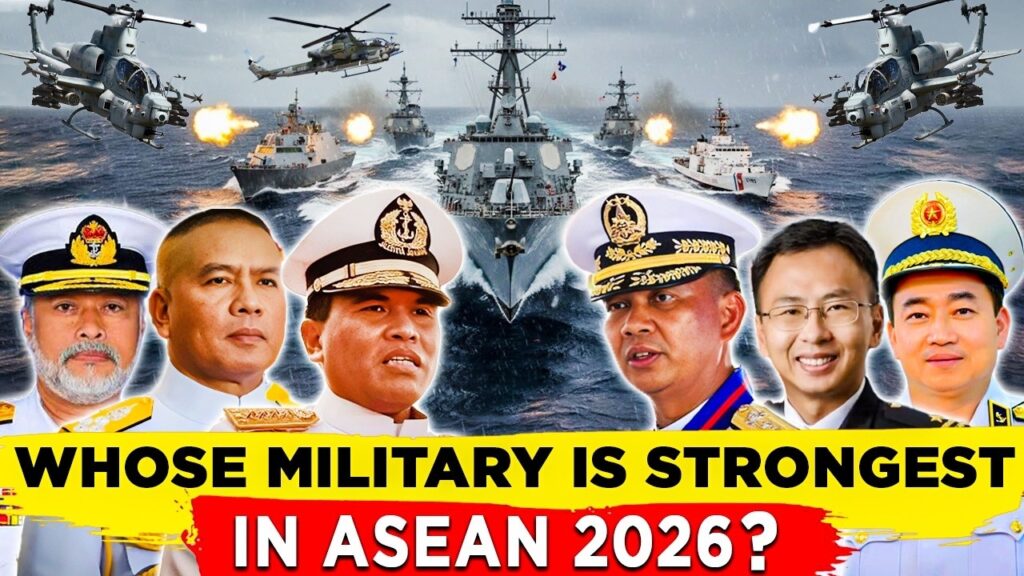
Whose Military is Strongest among ASEAN Nations (2026)?
Is it the one with the flashiest jets? The biggest budget? Or the country that quietly controls the map itself? That question is suddenly everywhere after recent regional drills, naval standoffs, and defense budget bumps across Southeast Asia. ASEAN militaries are no longer just about parades and peacekeeping. They’re being stress-tested in real time, from the South China Sea to the Malacca Strait. And when you zoom out and look at raw scale, geography, and staying power, one country keeps popping up at the top of the conversation: Indonesia.
I’ll be honest, Indonesia doesn’t always look like the loudest military power. It doesn’t posture the way some countries do. No constant chest-thumping. But numbers, geography, and long-term intent? That’s where it starts to feel serious. Take this for context: as of 2026, Indonesia ranks 13th globally in the Global Firepower Index, still the highest position held by any ASEAN nation. That alone turns heads. But rankings only matter if the foundations are real. Indonesia’s are.https://youtu.be/WcUPmsULvZc?si=Xm83BkpL9fw4uPhb
With around 400,000 active personnel across the army, navy (including marines), and air force plus a reserve pool of nearly 450,000, Indonesia fields the largest standing military in Southeast Asia. That manpower matters when you’re an archipelagic state with more than 17,000 islands to secure. You’re not just guarding borders, you’re guarding sea lanes, chokepoints, airspace, and internal stability all at once. It’s exhausting. And expensive.
Speaking of money, Jakarta’s 2026 defense budget sits at roughly $11.8 billion USD, reflecting a major jump from prior years. That makes it the second-largest defense spender in ASEAN, just behind Singapore. It’s not unlimited cash, but it’s enough to fund steady modernization: new Rafale fighter jets, combat helicopters, armored vehicles, and upgraded naval platforms. Nothing flashy for show, but broad, balanced, and quietly effective. Very Indonesian.

Much of this push traces back to President Joko Widodo’s Nawacita vision, the idea that Indonesia isn’t just a land power with islands attached, but a maritime nation at its core. That mindset has reshaped defense planning: maritime domain awareness, naval reach, and air coverage over key waters. Indonesia doesn’t aim for dominance, it wants control of its own vast space.
Still, it’s not all smooth sailing. The military has long been shaped by internal security roles, and shifting fully toward external defense isn’t simple. Modernization moves slower when budgets must compete with social programs and political consensus. Add counterterrorism, disaster response, border security, and growing regional competition to the mix, and you see why strategic patience is key.
Indonesia’s doctrine remains cautious but firm: territorial defense, internal stability, and maritime control. But don’t confuse caution with weakness. Sometimes the strongest military isn’t the one shouting the loudest. It’s the one quietly positioned everywhere it needs to be. And in ASEAN, when you factor in scale, geography, manpower, advanced procurement, and long-term intent, Indonesia isn’t just part of the strongest-military conversation in 2026. It anchors it.

Vietnam
When you think of ASEAN military powers, Vietnam immediately comes to mind, not because it flaunts the flashiest jets, but because it’s quietly built a force that’s disciplined, patient, and strategically stubborn. As of 2026, Vietnam ranks around 22nd globally in the Global Firepower Index, comfortably ahead of most of its neighbors in Southeast Asia except Indonesia and a few others. But the numbers alone don’t tell the full story. Vietnam’s military is massive and layered: about 450,000 active personnel, backed by a potential reserve force of up to 5 million. That’s huge for a country roughly the size of California in land area, and it shows why Vietnam can mobilize fast when it needs to.

Money matters too, and Hanoi has been steadily increasing its spending. The defense budget sits at roughly $7.8 billion USD in 2026, with growth projected above 5% annually. That’s not enough to fund every wish list item, but it’s enough to prioritize modern weapon systems and critical upgrades. Historically, Vietnam has leaned heavily on Russian gear, fighter jets, submarines, coastal defense missiles but many of these are legacy Soviet-era platforms, meaning modernization gaps still exist.
Yet where Vietnam shines is coastal defense and regional coordination. Long, vulnerable coastlines along the South China Sea have forced Hanoi to think smart: layered missile batteries, rapid-response naval units, and emerging ISR (intelligence, surveillance, reconnaissance) capabilities. Add in increasing joint drills with the United States, Singapore, Russia, and India, and you start to see a military learning from everyone, not just copying anyone.https://indopacificreport.com/whose-military-is-strongest-among-asean-nations/
Challenges remain. Modernization is expensive, old systems need replacing, and every investment must be carefully prioritized. But Vietnam’s strategic mindset is clear: balance air, naval, and coastal defense while preparing to deny access to potential aggressors. It’s patient. It’s deliberate. And it’s exactly why regional observers respect Hanoi’s military, even if it doesn’t make headlines every day.
At the end of the day, Vietnam may not anchor the ASEAN military conversation the way Indonesia does, but in 2026, it commands attention quietly, strategically, and effectively, the kind of presence you notice most when things get tense in the South China Sea.
Thailand
When you hear “Thailand,” most people think of beaches, temples, and bustling Bangkok streets, not fighter jets and submarines. But 2026 tells a slightly different story. Thailand’s military quietly punches above its weight, and if you pay attention to the numbers and posture, it’s clear why analysts keep tabs on Bangkok.https://youtu.be/WcUPmsULvZc?si=Xm83BkpL9fw4uPhb
Thailand ranks around 25th globally in the Global Firepower Index, placing it just behind Vietnam in Southeast Asia’s pecking order. With roughly 306,000 active personnel and another 245,000 reservists, it has a solid manpower base, not the biggest in the region, but enough to manage conventional defense and protect its extensive territorial waters.
Money-wise, Thailand’s defense budget has more than tripled over the past two decades, though it still hovers around 1.4% of GDP. That’s moderate by global standards, but it’s enough to fund selective upgrades that make a difference. For instance, the Royal Thai Air Force fields multi-role fighters like F-16s and Gripens, capable of both air defense and ground attack. The navy, meanwhile, is starting to flex with submarine acquisitions and upgrades, signaling Bangkok’s intent to protect its Exclusive Economic Zone and assert some maritime presence in the Gulf of Thailand and Andaman Sea.
Thailand’s strengths are clear: a well-trained, conventional military, increasingly modernized air and naval platforms, and flexibility to respond to regional contingencies. But the downsides are persistent. Political instability, coups, changing governments, and shifting priorities, continues to undermine long-term planning. Corruption and budget constraints also mean modernization programs can stall or stretch across decades.
Strategically, Thailand plays it safe but deliberate: flexible conventional defense at home, plus maritime patrols to protect EEZs and chokepoints. The Thai military doesn’t seek to dominate the region, but it ensures it isn’t ignored. In 2026, Thailand might not anchor the ASEAN military conversation like Indonesia, nor dominate attention like Vietnam along the South China Sea. But it’s quietly keeping itself ready, capable, and unpredictable, which in a region as volatile as Southeast Asia, is a kind of strength all on its own.
Singapore
When you talk about ASEAN militaries, Singapore immediately stands out but for reasons very different from Indonesia or Vietnam. It’s tiny in land and population, but when it comes to technology, precision, and sheer deterrence, the city-state punches way above its weight.
As of 2026, Singapore ranks around 30th globally in the Global Firepower Index. That may seem modest, but numbers don’t tell the whole story. What it lacks in manpower, Singapore makes up for with cutting-edge capabilities, strategic planning, and digital warfare know-how. The Singapore Armed Forces (SAF) may be small in size, but it’s highly modern, integrating army, navy, air force, and dedicated digital/ISR units to create a multi-layered, tech-driven force.

The budget is where Singapore really flexes. Its defense spending sits at roughly 4.9% of GDP, one of the highest in the region. That’s not casual investment, that’s a commitment to being ready for anything, anywhere. The money goes into advanced jets, long-range missile systems, stealth programs, ISR networks, and high-tech naval vessels, often giving Singapore the edge in scenarios where speed, intelligence, and precision matter more than sheer manpower.
Singapore also leans heavily on international partnerships. Joint training exercises, access to overseas ranges, and participation in programs like the F-35 fighter initiative ensure its personnel aren’t just technically proficient, they’re globally aware, adaptable, and integrated into the highest levels of modern warfare.
Challenges exist, of course. Singapore’s manpower pool is small, so its force depends on high-tech systems and a robust reserve structure to multiply its impact. Heavy reliance on imported platforms can also create vulnerabilities if supply chains are disrupted. But for a country of just 5.9 million people, it’s a carefully engineered strength, not a weakness. Strategically, Singapore focuses on tech-centric deterrence, rapid-response readiness, and high-value force multipliers. It doesn’t need to flood a battlefield with soldiers; it needs to make every soldier, ship, and jet count and in Southeast Asia, that strategy is paying off.https://youtu.be/NM7gPnuoVgE?si=7xu3-u6nO6AsL2GY
In 2026, Singapore may not have the manpower to anchor the ASEAN military discussion like Indonesia, but in terms of high-end capability, strategic reach, and digital warfare dominance, it’s in a league of its own.
Philippines
When it comes to ASEAN militaries, the Philippines often flies under the radar but anyone who follows the South China Sea closely knows how high-stakes its position really is. Manila may not have the biggest army or the most advanced jets yet, but it’s quietly trying to build a force that matters where it counts: on its waters, over its skies, and in contested maritime spaces.

As of 2026, the Philippines ranks around 34th globally in the Global Firepower Index. That’s respectable for a country juggling both internal security and territorial challenges. The Armed Forces of the Philippines (AFP) has roughly 130,000 active personnel, plus about 100,000 reservists, not huge by regional standards, but a disciplined force working with increasingly modern equipment.
Budget is a limiting factor. The defense budget sits at roughly $4.9 billion USD, around 1.04% of GDP. That may not sound like much, especially compared to Indonesia or Singapore, but Manila has a strategic 10-year modernization plan worth around $35 billion. The focus is clear: intelligence, surveillance, reconnaissance (ISR), maritime domain awareness, and naval assets, the things that matter most when your disputes are largely maritime and asymmetric.
Modernization is making tangible changes. The AFP has added offshore patrol vessels, missile corvettes, and cruise missile systems, gradually boosting deterrence. These aren’t flashy superweapons; they’re practical, smart investments meant to give the Philippines a real say in its territorial waters.https://indopacificreport.com/whose-military-is-strongest-among-asean-nations/
But challenges persist. Budget constraints and slower acquisition cycles mean that the plan unfolds incrementally. Territorial disputes in the South China Sea create ongoing asymmetric threats, and infrastructure limitations, ports, bases, and logistics networks, continue to constrain operational flexibility.
Strategically, the Philippines is playing a patient, maritime-centered game. The goal isn’t to dominate the region but to watch, sense, and respond. Littoral surveillance, domain awareness, and careful incremental capability build-up define its approach. And when paired with alliances, particularly with the United States, the AFP can punch above its weight, showing that even mid-sized forces can matter if deployed smartly.
In 2026, the Philippines may not anchor ASEAN military rankings, but it holds a critical role in maritime security, shaping how power is projected in one of the world’s most contested waters. Quietly, strategically, it’s becoming impossible to ignore.
Myanmar
When you think of ASEAN militaries, Myanmar often comes up quietly, not because it’s weak, but because its military focus has always been very different from its neighbors. The Tatmadaw, Myanmar’s armed forces, dominates the national landscape, and it has been battle-tested in decades of internal conflicts. But 2026 finds it in a tricky position: strong on paper, strained in reality.
Globally, Myanmar sits around 35th in the 2026 Global Firepower Index. Its strength is mainly in its army, which remains large, disciplined, and historically resilient against insurgencies. Troop toughness is a hallmark of the Tatmadaw, years of internal operations have honed its ground forces into a highly experienced, if not entirely modern, fighting machine.
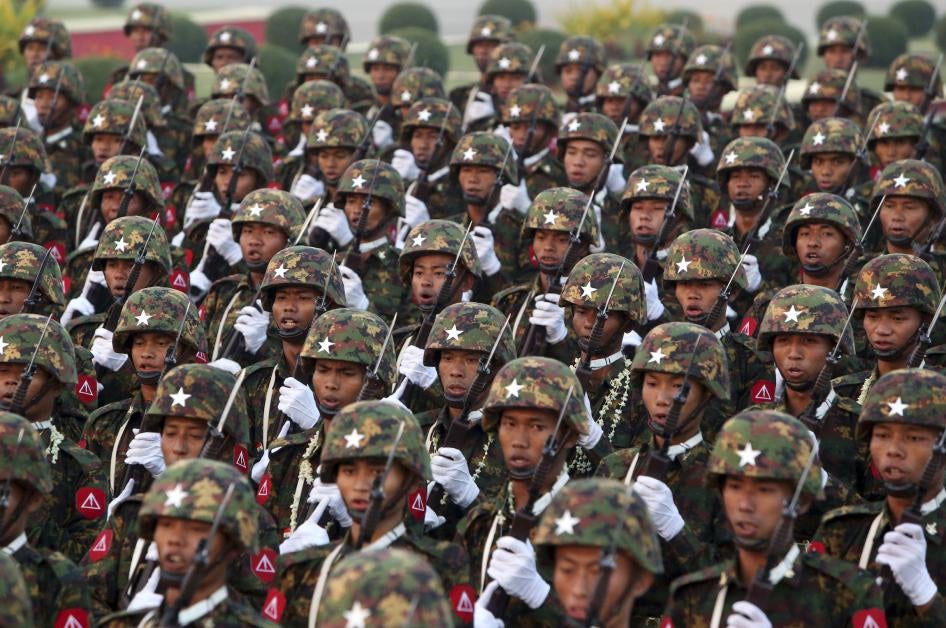
Yet almost everything else is a challenge. Political turmoil, widespread resistance, and internal conflicts sap its capacity to project power externally. Human rights concerns and heavy international scrutiny have led to sanctions and isolation, making weapons procurement, modernization, and training increasingly difficult. Infrastructure and logistics, already limited, are stretched further by the ongoing domestic crises.
Strategically, Myanmar isn’t looking outward. Its doctrine is almost entirely about internal control, counterinsurgency, and maintaining the regime’s grip, rather than defending borders or projecting force regionally. It’s a military built for persistence at home, not influence abroad.
In 2026, Myanmar may have a formidable reputation for toughness, and its army can still handle domestic threats with brutal efficiency. But when you compare it with ASEAN neighbors, Indonesia’s maritime dominance, Singapore’s tech edge, Vietnam’s coastal resilience, Myanmar is anchored inward, a force shaped by internal struggle rather than regional ambition.
Malaysia
When you think of ASEAN militaries, Malaysia doesn’t always grab headlines, but that doesn’t mean it’s irrelevant. In 2026, Kuala Lumpur is quietly maintaining a balanced, stability-focused military designed to protect its borders, support internal security, and manage challenges in the South China Sea.
Globally, Malaysia ranks around 42nd in the 2026 Global Firepower Index. Its 113,000 active personnel, backed by 51,000 reservists, make for a modest but capable force. Malaysia doesn’t have the manpower of Indonesia or Vietnam, nor the high-tech sophistication of Singapore, but it punches above its weight when it comes to regional stability.
The defense budget is moderate, with proposed increases under recent administrations signaling a slow but steady push toward modernization. However, manpower and funding limitations mean that upgrades happen selectively, with priority often given to coastal patrol, EEZ monitoring, and low-intensity contingency planning rather than high-end power projection.
Malaysia’s strategic orientation is clear: focus on stability, protect key maritime routes, and maintain readiness without overextending resources. Its geographical position gives it an important role in managing South China Sea tensions, but political and budgetary realities mean modernization and readiness progress cautiously.
In short, Malaysia’s military in 2026 is reliable, balanced, and pragmatic. It may not anchor the ASEAN military conversation, but in a region full of flash and headline-grabbing maneuvers, it quietly ensures security and stability where it counts..
Comparative Insights — What Makes a “Strong” Military?
Indonesia – The Regional Anchor
Indonesia combines scale, geography, and steady modernization. It’s the largest military in Southeast Asia, with around 400,000 active personnel and hundreds of thousands of reserves. Its balanced approach to army, navy, and air force, along with ongoing modernization, gives Jakarta credible deterrence and maritime reach, even if budget and political trade-offs slow some upgrades.
Vietnam – Coastal Defender
Vietnam’s strength is in manpower and coastal defense. With 450,000 active personnel and reserves that could reach 5 million, Hanoi can mobilize massively when needed. Its Soviet-era platforms are gradually modernized, and joint drills with external powers enhance operational experience. Vietnam is quietly building an anti-access and ISR-focused military that can punch well above its raw size.
Thailand – Conventional but Volatile
Thailand maintains a well-trained, conventional force, including multi-role fighters and new submarine programs. But political instability, shifting priorities, and budget constraints limit long-term modernization. It’s flexible and capable for conventional defense and EEZ protection, yet unpredictable in sustained, strategic growth.
Philippines – Modernizing Slowly
The Philippines is focused on maritime awareness and capability build-up. Its modernization plan (~$35B over 10 years) is ambitious, but budget limits and acquisition delays slow progress. Still, new offshore patrol vessels, missile corvettes, and ISR investments are gradually giving Manila a more credible maritime posture in the South China Sea.
Malaysia – Balanced but Constrained
Malaysia’s military is reliable, pragmatic, and geared toward stability, but budget and manpower shortages limit modernization. Its forces are positioned well geographically to monitor the South China Sea and handle low-intensity conflicts, but it lacks the high-end tech or large-scale force projection that neighboring powers have.
Myanmar – Tough but Isolated:
Myanmar’s Tatmadaw is battle-hardened and large, but decades of internal conflict, political turmoil, and international isolation weaken its capacity. Its orientation is almost entirely domestic, focused on counterinsurgency rather than regional power projection. Toughness matters, but in ASEAN 2026, it’s a force constrained by politics and geography.
Singapore – Tech Kingpin
Singapore is tiny in manpower but enormous in capability. With cutting-edge technology, a high GDP defense allocation (~4.9%), and advanced ISR/digital networks, the SAF turns a small population into a formidable force. Force projection isn’t massive, but Singapore’s high-tech systems act as force multipliers, making it arguably the most modernized military in ASEAN
2026 ASEAN Military Strength Ranking (Tentative)
When it comes to ASEAN militaries in 2026, the question isn’t just about who has the biggest army or the flashiest jets. It’s about strategy, tech, geography, and how each country balances manpower, modernization, and political realities. Some countries dominate through sheer numbers, some through cutting-edge capabilities, and some quietly punch above their weight in ways that matter most when tensions flare.
Here’s the rundown:
1️⃣ Singapore – The Tech Titan
Tiny population, massive capability. Singapore tops the list because it turns cutting-edge technology into a real edge, backed by high GDP allocation (~4.9%) and world-class ISR, digital, and naval systems. Force projection is limited by size, but Singapore’s precision, tech integration, and rapid-response ability make it the most advanced military in ASEAN.
2️⃣ Indonesia – The Regional Anchor
Indonesia is all about scale, geography, and modernization momentum. With 400,000 active personnel and hundreds of thousands in reserves, it’s the largest military in Southeast Asia. Balanced across army, navy, and air force, Jakarta continues steady modernization with Rafale jets, armored vehicles, and new naval platforms. Indonesia quietly ensures control over its vast archipelagic territory without shouting for attention.
3️⃣ Vietnam – The Coastal Defender
Vietnam’s strength lies in manpower and coastal defense. About 450,000 active personnel plus millions in reserves give Hanoi a rapid-mobilization advantage. Its forces are modernizing, integrating ISR capabilities, and building anti-access strategies while strengthening joint exercises with the U.S., Singapore, Russia, and India. Vietnam may not dominate headlines, but it’s strategically resilient in the South China Sea.
4️⃣ Thailand – Conventional but Volatile
Thailand keeps a well-trained, conventional force, equipped with multi-role fighters and new submarines. But political instability, shifting governments, and budget constraints hinder long-term modernization. Flexible and capable for conventional defense and EEZ protection, Thailand remains a cautious but capable regional player.
5️⃣ Philippines – Modernizing Slowly
The Philippines is focused on maritime domain awareness and capability build-up. Its $35B 10-year modernization plan is ambitious, including offshore patrol vessels, missile corvettes, and ISR investments. Budget constraints and slower acquisition cycles slow the pace, but alliances, strategy, and geography give Manila punch beyond its size.
6️⃣ Myanmar – Tough but Isolated
The Tatmadaw is large and battle-hardened, but decades of internal conflict, political turmoil, and international isolation limit its external power projection. Its orientation is almost entirely domestic, focused on counterinsurgency and regime control, making it strong internally but constrained regionally.
7️⃣ Malaysia – Balanced but Constrained
Malaysia’s military is pragmatic and stability-focused, with roughly 113,000 active personnel and 51,000 reserves. Budget and manpower shortages limit modernization, but the armed forces are strategically positioned to protect key maritime routes and maintain domestic security. Resource constraints keep Malaysia from competing with regional heavyweights, but it remains a quietly capable force.
Key Takeaways
When it comes to technical sophistication, Singapore clearly leads the pack. Its focus on cutting-edge systems, digital networks, and advanced ISR capabilities makes it the most technologically advanced military in ASEAN, proving that size isn’t everything when it comes to regional influence.
In terms of manpower and defense footprint, Indonesia and Vietnam stand out. Indonesia’s vast archipelago requires a large, well-distributed force, while Vietnam combines a sizable active military with a massive reserve pool, giving both countries the ability to mobilize quickly and maintain a strong presence across critical maritime and territorial zones.
When it comes to modernization ambition, the Philippines and Indonesia are leading the charge. Both countries are investing heavily in long-term plans to upgrade equipment, strengthen maritime capabilities, and integrate new technologies, signaling that they are serious about building forces that can meet future regional challenges.
Political volatility plays a key role in shaping military effectiveness, and in ASEAN, Thailand and Myanmar illustrate this reality. Frequent government changes, internal unrest, and ongoing domestic conflicts can slow modernization, disrupt strategic planning, and limit the ability to respond effectively to regional tensions.
Finally, budget constraints remain a defining factor for several nations, particularly Malaysia and the Philippines. Limited resources force careful prioritization, slow acquisition cycles, and selective modernization, meaning that even capable militaries may struggle to maintain readiness or expand operational reach in a rapidly changing regional environment.
The 2026 ASEAN military landscape is a mix of technology, scale, strategy, and politics. Some nations lead with brains, some with brawn, and some are quietly preparing for the challenges ahead.
Want to see how these militaries might influence the next South China Sea standoff or regional balance? Keep following for deep-dive updates, country comparisons, and real-time defense insights across Southeast Asia.https://youtu.be/YH5WM7-qERo?si=e-0Gm9xhZHuuQZZq