US and Philippines Boost Presence in the Bashi Channel Amid Rising Tensions
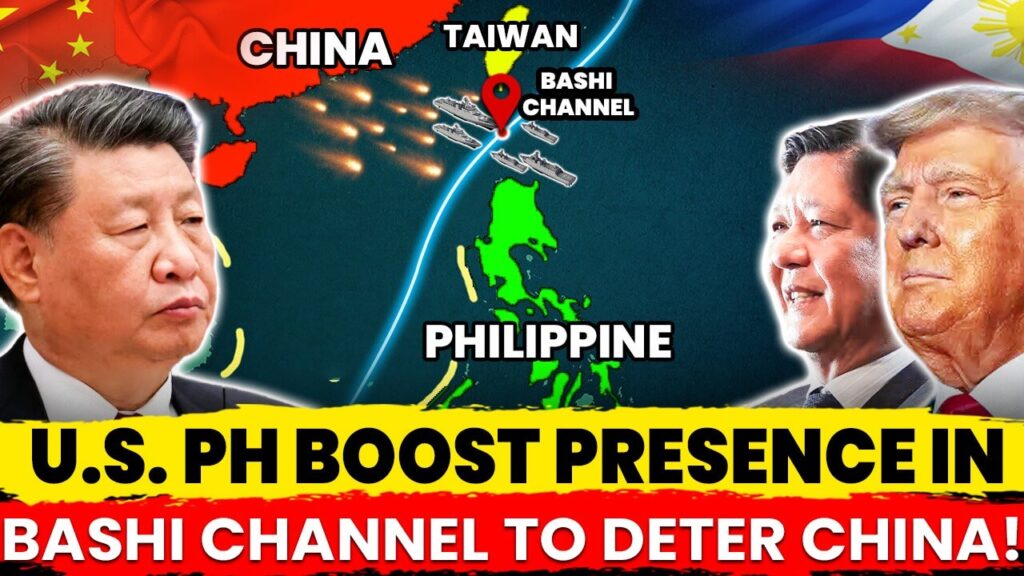
The Indo-Pacific has become the defining arena of 21st-century power competition, and few places capture that reality more starkly than the Bashi Channel. Stretching between northern Philippines and southern Taiwan, this narrow waterway has rapidly shifted from a geographic footnote into a frontline of deterrence as tensions between the United States and China intensify. Recent months have seen a clear uptick in joint U.S.–Philippine military activity around northern Luzon and Batanes, coinciding with expanded Chinese naval and air operations near Taiwan. What is emerging is not a symbolic presence, but a deliberate effort to shape the operational environment around one of Asia’s most strategically sensitive chokepoints.
Unlike the heavily militarized South China Sea, where overlapping territorial claims dilute collective response, the Bashi Channel occupies a cleaner strategic space: it is a gateway rather than a disputed reef. It connects the Pacific Ocean to the South China Sea and sits astride the routes Chinese submarines and surface combatants must use to break through the First Island Chain. In this sense, its role increasingly resembles the Cold War–era GIUK Gap in the North Atlantic, where NATO monitored Soviet naval movements, or Japan’s fortification of the Ryukyu Islands to control access between the East China Sea and the Pacific.
The difference today is speed and proximity: any crisis involving Taiwan would place the Bashi Channel at the center of real-time military decision-making within hours, not days.
For Manila, deeper involvement in the Bashi Channel marks a strategic evolution rather than a rupture. The Philippines is no longer positioned solely as a South China Sea claimant but as an active participant in wider regional stability, aligned through alliance commitments and geography alike. For Washington, cooperation with the Philippines provides what unilateral power cannot: persistent access, local legitimacy, and forward positioning close to Taiwan without crossing its political red lines.
Compared with other flashpoints, such as the Taiwan Strait itself or the Spratly Islands, the Bashi Channel offers a quieter but potentially more decisive form of leverage: control of movement rather than control of territory. In an era where deterrence increasingly depends on denying options rather than winning battles, this narrow stretch of water is rapidly becoming one of the Indo-Pacific’s most consequential spaces.
The Bashi Channel: Geography and Strategic Importance
The Bashi Channel occupies a deceptively small but strategically decisive stretch of water linking the South China Sea with the western Pacific Ocean. Geographically, it lies between northern Philippines, specifically Luzon, and the Batanes island chain and southern Taiwan, placing it squarely along one of the most heavily trafficked maritime corridors in East Asia. Commercial shipping, energy flows, and naval transits all funnel through this passage, making it not just a regional waterway but a structural artery of Indo-Pacific connectivity.

What elevates the Bashi Channel beyond simple transit is its physical character. The channel’s narrow contours, deep waters, and complex seabed make it ideal for submarine movement while simultaneously complicating detection. Its proximity to Taiwan, Luzon, and critical undersea communication cables means activity here has implications that extend well beyond naval maneuvering, touching intelligence collection, command-and-control resilience, and even global data traffic.
In practical terms, whoever monitors the Bashi Channel closely gains a window into both military movements and the broader strategic pulse of the region.
From a military planning perspective, the channel is viewed as a critical axis rather than a standalone chokepoint. In any contingency involving the Taiwan Strait, it represents one of the primary routes through which Chinese submarines and surface combatants would attempt to break out from the First Island Chain into the open Pacific. Conversely, for the United States and its allies, sustained surveillance of the Bashi Channel enhances early warning, enabling forces to detect, track, and potentially constrain adversary movements before they disperse into the wider ocean. A Taiwan Invasion Would Be an Emergency for Japan
This strategic logic mirrors historical precedents. During the Cold War, NATO’s focus on the GIUK Gap served a similar purpose: monitoring Soviet naval access to the Atlantic rather than contesting it in open waters. Today, the Bashi Channel plays an analogous role in Asia. Control or effective monitoring of this corridor does not require permanent dominance; it requires presence, sensors, and interoperability.
In that sense, the Bashi Channel is less about territorial control and more about shaping options, granting leverage over the movement of forces between the Pacific and the South China Sea and quietly influencing the balance of power in any future crisis.
Regional Security Context: Rising Tensions in East Asia
Rising tensions across East Asia have pushed the security environment into a more volatile and interconnected phase, with the Taiwan Strait and the South China Sea increasingly treated by military planners as a single, continuous theater. At the center of this convergence sits the Bashi Channel, which links pressure points that were once analyzed separately. As the Chinese force posture expands on multiple fronts simultaneously, the channel’s relevance has grown from a supporting corridor into a frontline variable in crisis planning.
The dynamics between China and Taiwan have been the primary accelerant. Over the past few years, the People’s Liberation Army has sharply increased aerial incursions across Taiwan’s air defense identification zone and expanded naval patrols east and south of the island. These operations are no longer episodic signals; they are sustained campaigns designed to normalize Chinese presence and compress Taiwan’s warning time.
In any blockade or conflict scenario centered on the Taiwan Strait, the Bashi Channel would become a focal operating area, either as a transit route for Chinese naval forces seeking access to the Pacific or as a monitored corridor where U.S. and allied forces attempt to track and constrain those movements.
Parallel to this pressure on Taiwan, tensions in the South China Sea continue to simmer. Competing territorial claims between China and several ASEAN states, most notably the Philippines, have produced repeated confrontations involving coast guard vessels, maritime militia, and naval escorts. These incidents, often calibrated to remain below the threshold of open conflict, have steadily increased in frequency and intensity.
For Manila, this has reinforced the reality that maritime security challenges in the South China Sea cannot be isolated from developments further north, particularly as Chinese forces operate with growing confidence across both spaces.
In response, Philippine naval and coast guard forces have deepened operational coordination with the United States. Joint patrols, combined exercises, and shared maritime domain awareness initiatives have become more routine, reflecting a shift from symbolic cooperation toward practical deterrence. This cooperation extends beyond the immediate South China Sea confrontations, feeding into broader contingency planning that includes northern Luzon and approaches to the Bashi Channel as critical zones for surveillance and response.
Overlaying these regional flashpoints is the broader U.S.–China strategic rivalry, which now shapes defense planning across East Asia. Both sides are operating at a higher tempo, testing endurance as much as capability. Chinese think-tank estimates suggest that U.S. reconnaissance and surveillance sorties over and around the South China Sea surged dramatically in 2024, reaching roughly 1,000 missions in a single year. Japan–Philippines Security Ties Deepens as Manila Seeks More TC-90 Patrol Aircraft and Retired Abukuma Destroyers
This sustained operational pace signals that contested waters are no longer episodic hotspots but permanently monitored spaces. In that environment, the Bashi Channel functions as connective tissue, where Taiwan contingencies, South China Sea disputes, and great-power competition intersect, amplifying its importance in any future regional crisis.
US–Philippines Alliance: From Legacy Partnership to Renewed Momentum
The modern U.S.–Philippines security relationship is rooted in a long-standing legal and strategic foundation that dates back to the early Cold War. The Mutual Defense Treaty, signed in 1951, obligates both nations to come to each other’s defense in the event of an external armed attack. For decades, this treaty functioned as a stabilizing anchor rather than an operational blueprint, symbolizing alliance solidarity even as Philippine bases closed in the 1990s and U.S. presence in Southeast Asia temporarily receded. Today, however, shifting regional realities have pulled that legacy framework back into active relevance.

That renewed relevance found concrete expression with the Enhanced Defense Cooperation Agreement (EDCA), first signed in 2014. EDCA allows U.S. forces rotational access to selected Philippine military facilities, while explicitly preserving Philippine sovereignty. Initially modest in scope, the agreement has since evolved into a central pillar of alliance posture. Since 2023, EDCA has expanded to nine agreed locations, several of them in northern Luzon and Palawan, areas that directly enhance strategic reach toward the Bashi Channel and the South China Sea. This geographic shift is not incidental; it reflects a shared assessment that future contingencies will hinge on speed, access, and proximity rather than permanent basing.
The practical impact of this expansion is significant. EDCA sites enable prepositioning of equipment, improved logistics, and rapid interoperability during exercises or crises. Northern Luzon locations, in particular, provide forward vantage points for maritime domain awareness and air operations near the Luzon Strait, reinforcing the Philippines’ role as a frontline stakeholder rather than a rear-area partner. Compared with earlier phases of the alliance, when cooperation was episodic and largely symbolic, today’s posture emphasizes readiness and persistence, aligning Philippine geography with U.S. operational planning across the First Island Chain.
This renewed momentum has also been underwritten by political and financial commitments in Washington. The 2026 US National Defense Authorization Act authorized up to $2.5 billion in defense assistance to the Philippines over five years, aimed at strengthening capabilities, interoperability, and resilience. Framed under the Philippine Enhanced Resilience Act, the funding reflects bipartisan recognition that the alliance is no longer peripheral to U.S. strategy in Asia. As Senators Bill Hagerty and Tim Kaine noted upon its passage, deepening cooperation is now a strategic necessity rather than an option.
These developments mark a clear transition: the U.S.–Philippines alliance is moving from a treaty-bound legacy partnership to an operationally relevant security relationship shaped by geography, shared risk, and converging threat perceptions. In this new phase, cooperation is less about reaffirming commitments on paper and more about positioning forces, capabilities, and infrastructure where they matter most, particularly along corridors like the Bashi Channel, where alliance presence can quietly but decisively influence regional stability.
Boosting Presence in the Bashi Channel: What’s Changing?
What is unfolding around the Bashi Channel is not a sudden surge, but a steady, deliberate thickening of allied presence that signals long-term intent. Over the past few years, U.S. and Philippine armed forces have markedly increased the frequency and complexity of joint patrols, surveillance missions, and combined exercises in northern Luzon and adjacent waters. At the center of this shift is Balikatan, the annual “shoulder-to-shoulder” exercise, which has evolved from a largely counterterrorism- and HADR-focused drill into a full-spectrum combined-arms rehearsal.
Recent iterations have quietly incorporated scenarios linked to Taiwan Strait contingencies, maritime denial, and rapid reinforcement, an unmistakable sign that planning assumptions now extend beyond the South China Sea into the Luzon Strait and Bashi Channel corridor.
This evolution is equally visible in force posture and readiness. Rotational deployments of U.S. Marines, aviation units, and support elements to northern Luzon have enhanced rapid-response and amphibious capabilities close to the channel. These rotations are designed for flexibility rather than permanence, allowing forces to surge quickly while avoiding the political sensitivities of permanent basing.
Joint anti-submarine warfare training, night patrols, and integrated air–sea operations have significantly improved interoperability between U.S. and Philippine units, particularly in detecting and tracking movements in deep, complex waters like those of the Bashi Channel. The emphasis is less on headline-grabbing deployments and more on rehearsing the mechanics of coordination under real-world conditions.
Underpinning these operational changes is a substantial upgrade in infrastructure and logistics. EDCA locations, especially in northern Luzon, have seen accelerated development: improved airfields, expanded fuel storage, hardened warehouses, and modern command-and-control facilities. U.S. investments alone exceed $128 million, complemented by Philippine-funded runway extensions, port access improvements, and logistics enhancements.
These upgrades transform previously austere bases into usable forward nodes capable of sustaining surveillance, air operations, and rapid reinforcement. In practical terms, they shorten response times, extend operational reach toward the Bashi Channel, and ensure that joint forces can operate persistently rather than episodically.
These changes reflect a shift from symbolic alliance presence to functional deterrence. The Bashi Channel is no longer treated as a distant contingency space but as an operational zone that must be continuously monitored, rehearsed, and supported. For Washington, this means shaping the battlespace without crossing escalation thresholds; for Manila, it means leveraging geography to play a more central role in regional security. Quietly but unmistakably, the alliance is building the habits, infrastructure, and readiness needed to matter if the region’s tensions ever turn into a crisis.
Strategic Objectives Behind the Enhanced Presence
At its core, the enhanced U.S.–Philippines presence around the Bashi Channel is designed to strengthen deterrence by shaping expectations before a crisis erupts. Rather than relying on declaratory statements alone, the expanded posture demonstrates visible, sustained resolve to preserve the regional status quo. For Beijing, the message is subtle but clear: coercive actions, particularly those connected to Taiwan, will unfold in an environment where allied forces are already present, coordinated, and familiar with the terrain. Deterrence here is less about overwhelming force and more about denying surprise and raising the perceived costs of escalation.
A second objective lies in the defense of allies and partners, starting with the Philippines itself. Enhanced cooperation improves Manila’s ability to protect its northern approaches, maritime zones, and airspace while reinforcing alliance credibility. At the same time, the posture provides contingency depth for cross-strait scenarios without formally tying Philippine territory to automatic involvement in a Taiwan conflict. This balance, supportive but measured, allows the alliance to strengthen collective defense while managing political sensitivities, ensuring that deterrence does not become provocation.
Operational flexibility is another central driver. Access to upgraded bases near the Bashi Channel and the South China Sea gives the United States and the Philippines the ability to respond rapidly across the First Island Chain. Air, maritime, and amphibious forces can shift between theaters with shorter timelines, complicating adversary planning and reducing reliance on distant hubs such as Guam or Okinawa alone. In practical terms, this flexibility turns geography into an advantage, allowing forces to adapt to unfolding events rather than react from afar.
Finally, the expanded presence reinforces a broader commitment to a rules-based order at sea. Joint patrols, exercises, and deployments show shared adherence to freedom of navigation, overflight rights, and international law in some of the world’s most contested waterways. By operating consistently and transparently, the alliance signals that these are not exceptional actions tied to crisis moments but routine enforcement of established norms. In this sense, the Bashi Channel becomes more than a military corridor; it becomes a proving ground for whether major powers will compete within agreed rules or attempt to rewrite them through pressure.
Regional and International Reactions
Beijing has reacted sharply to the expansion of U.S. military access and allied activity in the Philippines, consistently framing the developments as destabilizing and the product of “external interference.” Official statements from Chinese diplomatic missions argue that enhanced U.S.–Philippine cooperation undermines regional peace and injects bloc politics into Southeast Asia. From Beijing’s perspective, increased allied presence near the Bashi Channel complicates Chinese military planning and erodes the strategic buffer it seeks along the First Island Chain. As a result, Chinese responses have combined diplomatic protests with heightened naval and air activity, signaling resolve while avoiding confrontation.
Across ASEAN, reactions are more nuanced and far from uniform. Many Southeast Asian governments quietly share concerns about rising tensions and the risk of miscalculation, particularly as great-power competition increasingly spills into their immediate neighborhoods. At the same time, economic realities shape regional caution. China remains a critical trade partner, investor, and supply-chain hub for much of ASEAN, leading several capitals to avoid openly endorsing moves that could be perceived as containment. The result is a familiar balancing act: support for stability and international law, paired with diplomatic restraint and an emphasis on dialogue rather than alignment.
Beyond Southeast Asia, however, the response has been more openly supportive. Like-minded partners such as Japan and Australia have publicly reaffirmed their commitment to a free and open Indo-Pacific, viewing U.S.–Philippine cooperation as a stabilizing force rather than a provocation. This support is increasingly reflected in practical terms through multilateral maritime activities, joint exercises, and coordinated patrols that extend from the Philippine Sea to the South China Sea. These efforts are designed to reinforce presence without escalation, embedding U.S.–Philippine cooperation within a broader network of regional partnerships.
Taken together, these reactions highlight the broader strategic stakes surrounding the Bashi Channel and northern Luzon. For China, the enhanced posture represents a constraint on freedom of maneuver; for ASEAN, it shows the difficulty of navigating between security anxieties and economic dependence; and for U.S. allies and partners, it signals a necessary adjustment to a more contested regional order. The divergence in responses does not diminish the importance of the shift; it reinforces it, showing how developments in this narrow maritime corridor now reverberate across the wider Indo-Pacific.
Risks, Challenges, and Points of Friction
The most immediate risk is escalation through miscalculation. As patrols, surveillance flights, and combined exercises become more frequent around the Bashi Channel and northern Luzon, the operating environment grows more crowded, faster, and less forgiving. Close encounters, particularly with Chinese coast guard, maritime militia, or PLAN units, raise the probability of an accident, an overly aggressive maneuver, or a misread tactical signal that escalates into a political crisis. In gray-zone theaters, you do not need a deliberate decision to escalate; you only need one collision, one injury, one warning shot, or one incident that goes viral before leaders feel boxed into a response.
Domestic politics in the Philippines is the second major friction point, because alliance expansion always intersects with sovereignty. Even when EDCA is framed as rotational access rather than permanent basing, critics can portray it as a foreign military return by another name. That matters because public consent is a strategic asset: it determines whether infrastructure upgrades proceed smoothly, whether local communities cooperate, and whether future administrations sustain the same direction. In practical terms, the alliance must demonstrate visible benefits, disaster response, capacity-building, coastal defense, jobs, and infrastructure so that deterrence posture is understood not as “outsourcing security,” but as strengthening the Philippine capability and control.
A third challenge is the economic and diplomatic trade-off. China remains deeply significant to the Philippines and to Southeast Asia more broadly as a trading partner, investment source, and market, so deeper security alignment can complicate the diplomatic bandwidth needed to manage commerce, tourism, infrastructure financing, and crisis de-escalation. This does not mean Manila must choose submission or rupture; it means the policy path is inherently tightrope-like. The smarter play is dual-track: harden deterrence and resilience, while keeping channels open for predictable diplomacy and economic stability. The difficulty is that Beijing may interpret defense strengthening as political alignment regardless of how carefully Manila frames it.
IX. Implications for the Indo-Pacific Security Architecture
Zooming out, the enhanced posture around the Bashi Channel is not just a bilateral story; it is a template for how the regional balance of power is being managed. The U.S.–Philippines defense network increasingly reflects a wider trend: alliances and partnerships shifting from declaratory commitments to operational readiness. In an environment where coercion is often incremental and deniable, the deterrence framework is less about single “big deployments” and more about persistent presence, distributed access, and interoperable command-and-control. That architecture, lighter footprint, more nodes, higher tempo, fits the geography of the First Island Chain far better than the old model of a few large hubs.
The Bashi Channel also hardens its place in contingency planning, particularly for Taiwan scenarios. Once you acknowledge that the Taiwan Strait and the northern Philippines sit on the same strategic seam, the channel becomes a functional link between theaters: a route to monitor, a corridor to protect, and a space where early warning and anti-submarine tracking become decisive. In other words, it is no longer merely adjacent to a Taiwan contingency; it is part of the map that would determine escalation ladders, reinforcement timelines, and the credibility of deterrence.
Over the long term, deeper U.S.–Philippines cooperation could institutionalize a more mature level of interoperability, shared concepts, routine joint exercises, logistics compatibility, intelligence fusion, and coordinated maritime domain awareness. If that happens, the Indo-Pacific security landscape becomes less dependent on any single platform or base and more resilient through network effects: more partners operating in more places with more shared procedures. That is exactly the kind of architecture that makes coercion harder, because it reduces an adversary’s ability to isolate a target or achieve surprise.
Conclusion: A Narrow Channel with Outsized Consequences
The Bashi Channel’s growing prominence is a reminder that geography still writes the first draft of strategy. As regional competition intensifies, the value of this corridor lies not only in what passes through it, submarines, surface ships, aircraft, and commercial traffic, but in what it enables: early warning, rapid response, and the ability to shape an adversary’s options across the First Island Chain. Through upgraded EDCA sites, more sophisticated joint operations, and deeper integration of planning and readiness, the United States and the Philippines are effectively turning a once-overlooked passage into a focal point of deterrence.
10 Chinese Ships vs 1 Philippine Vessel How Beijing Turns Aggression Into “Routine Patrols”
At the same time, this posture is not cost-free. The risks of miscalculation rise with operational tempo; domestic sovereignty concerns require constant legitimacy-building; and the economic diplomacy with China becomes more complex as security alignment deepens. But strategically, that is the trade space the Indo-Pacific now imposes: the region is moving toward a world where security is maintained not by assumptions of peace, but by preparedness, resilience, and credible partnership.
In that reality, the Bashi Channel is no longer just a line on the map; it is a test of whether alliances can prevent coercion from becoming the new normal.