Ukraine’s Drones Are Now Striking Deep Inside Russia
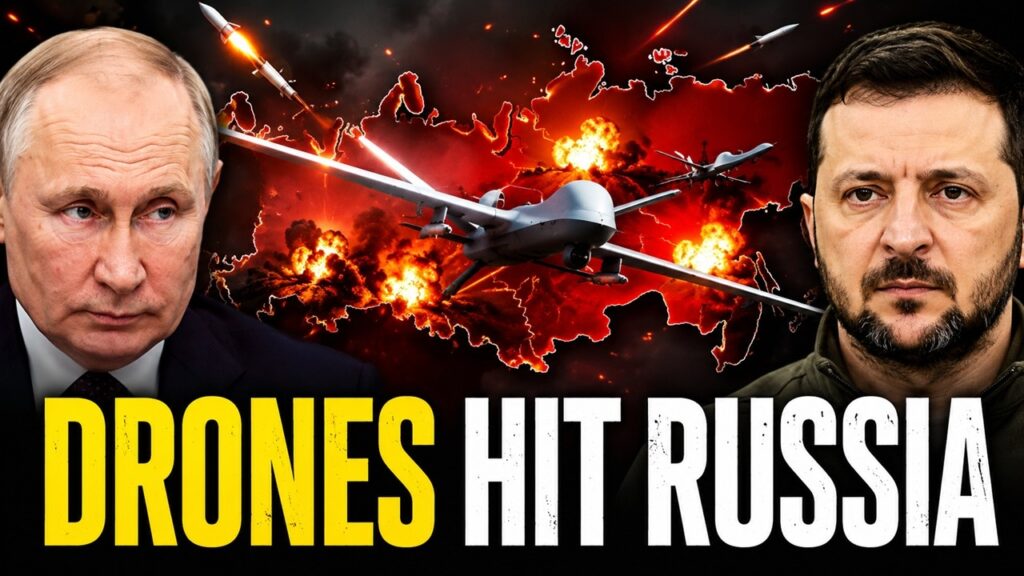
Ukraine’s drones are hitting deep inside Russia. And the war is changing because of it.
In the early hours of May 17, 2026, Ukrainian long-range drones screamed across the border and slammed into the Moscow Oil Refinery, a microchip factory near the Kremlin, and a critical fuel pumping station that feeds the Russian military. It was one of the biggest deep strikes of the war so far.
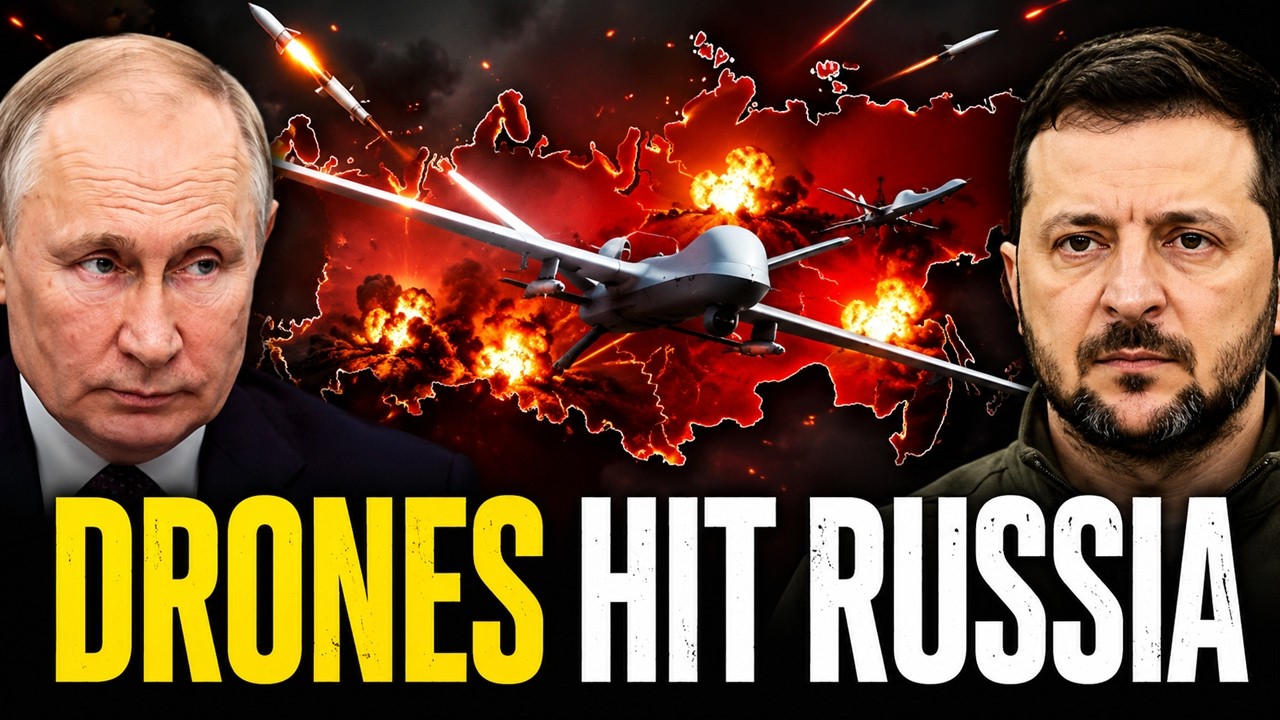
These attacks are no longer rare. They are now happening almost every night. Ukrainian drones costing as little as $55,000 are setting fire to Russian refineries, fuel depots, and supply lines hundreds of kilometers behind the front line. And they are forcing Vladimir Putin to defend a country that suddenly feels much smaller than it used to.
Here is how Ukraine’s drone war is reshaping the battlefield in 2026 — and why every military in the Indo-Pacific is paying close attention.
Ukraine Built a New Long-Range Drone Force
For most of 2022 and 2023, Ukraine’s drone strikes on Russia were limited to about 500 kilometers from the border. That is no longer the case.
Ukraine has rapidly expanded its drone industry. The most important new weapon is the FP-1, built by Ukrainian company Fire Point in Kyiv. According to Al Jazeera, the FP-1 can carry up to 120 kilograms of explosives and fly roughly 1,500 kilometers. Each unit costs about $55,000 — pocket change for a weapon that can take down a refinery worth billions.
Ukraine is also using the An-196 Liutyi, a propeller-driven cruise-style drone with a range over 1,000 kilometers, the UJ-26 Beaver, and newer systems like the RS-1 Bars and BARS-SM Gladiator. These are not high-tech missiles. Many are built with plywood frames and simple parts to keep production fast and cheap.
And the scale is now massive. According to French open-source researcher Clement Molin, cited by Radio Free Europe, Ukraine launched about 1,000 drones into Russia in August 2024. By July 2025 the number was 3,000. By March 2026, it had reached 7,000 — for the first time, more than Russia was launching into Ukraine.
Russian Oil Refineries Are Burning
Russia’s oil industry has become Ukraine’s number-one target. And the damage is now serious enough to threaten Putin’s war economy.
Bloomberg News reported that Ukraine struck Russian oil infrastructure at least 21 times in April 2026 alone, including 9 strikes on processing facilities. The Tuapse refinery on the Black Sea was hit three times in a single two-week window. Locals reported what they called “black rain” — oily droplets falling on coastal towns.
On April 28, 2026, a Ukrainian drone hit a Transneft pumping station in the Perm region — more than 1,500 kilometers from the border, deep in the Ural Mountains. Areas Russian planners once thought safe are no longer safe at all.
numbers tell the story:
Russian crude oil output is down by an estimated 300,000 to 400,000 barrels per day, according to Reuters.
Refinery throughput has fallen to its lowest level since 2009 — a 17-year low.
In one week alone (March 22–29), Russian oil exports dropped 43%, costing roughly $1 billion in lost revenue.
Ukrainian Pravda reports that since the start of 2026, drone strikes on Russian oil infrastructure have caused losses exceeding $7 billion.
In 2025, oil company losses from drone attacks topped 1 trillion rubles — about $13 billion.
“Almost commonplace.” That is how Radio Free Europe described the new sight of black smoke over Russian oil facilities.
Putin’s Hometown Can Smell the War
For the first time, ordinary Russians far from the front line are feeling this war directly.
Al Jazeera spoke with a 53-year-old asthmatic man in St. Petersburg — Putin’s hometown — who said he could smell burning crude oil from his apartment. The Baltic ports of Ust-Luga and Primorsk, which together handle about 2% of the entire world’s seaborne oil supply, were both struck within days of each other in late March 2026.
The Leningrad Oblast, about 600 kilometers from Ukraine, was officially declared a “frontline” region by its governor in April 2026 after 243 Ukrainian drones were shot down over the province in just three months.
Even the symbolism is shifting. Putin scaled down the May 9 Victory Day parade in Red Square for the first time in nearly 20 years — no heavy tanks, no intercontinental ballistic missiles. Smaller parades in other cities were cancelled outright. Security came first.
Russia Is Running Out of Gasoline
The most painful proof that the strikes are working is at the gas pump.
By late 2025, nearly 38% of Russia’s oil refining capacity was offline at peak, according to Newsweek citing analytics firm Ciala. Around 70% of those outages were directly caused by Ukrainian drones. Gas stations in more than 20 Russian regions, plus occupied Crimea, started limiting motorists to 30 liters per visit.
Russia banned gasoline exports through May 2026 and began importing fuel from China, Belarus, South Korea, and Singapore — a humiliating step for a country that calls itself an energy superpower.
https://indopacificreport.com/russia-vietnam-nuclear-deal-signals-strategic-energy-shift-in-southeast-asiaon-march-23-2026/
In February 2026, wholesale gasoline prices in Russia jumped 6.9% in a single week after fresh drone strikes hit the Volgograd refinery, one of the country’s largest, with annual capacity of 13 million metric tons.
Ukraine is producing and launching drones at oil facilities faster than Russia’s ability to repair them. — Thomas O’Donnell, energy expert, Wilson Center
Cheap Drones Are Beating Expensive Defenses
Russia spends hundreds of millions of dollars on air defense systems like the S-400. But $55,000 drones keep getting through.
Why? Two reasons.
First, Ukraine is hitting Russian air defenses themselves. According to analyst Fabian Hoffmann of the University of Oslo, Ukraine struck more than 237 air defense launchers and radars between June 2025 and March 2026. Each radar destroyed leaves a giant blind spot in Russian airspace.
Second, the math is brutally simple. A single Russian S-400 interceptor missile can cost over $1 million. A Ukrainian FP-1 drone costs $55,000. Even if Russia shoots down half the drones, it loses the economics of the exchange.
Major Robert Brovdi, Commander of Ukraine’s Unmanned Systems Forces, said the May 16–17 operation alone hit 46 strategic targets with 186 precision impacts. Swarms of 100 to 200 drones per night have become routine in 2026.
Trump, Zelenskyy, and the Political Pressure
All of this is happening while political support from Washington keeps shifting.
During a tense Oval Office meeting earlier in the conflict, U.S. President Donald Trump reportedly told Ukrainian President Volodymyr Zelenskyy, “Without us, you don’t have the cards.”
Some American politicians want stronger military backing for Kyiv. Others want to wind down U.S. involvement and push for negotiations. But while Washington debates, Ukraine has answered with action — what Zelenskyy now calls Ukraine’s own “long-range sanctions.”
As NPR’s Joanna Kakissis reported on May 18, 2026, Zelenskyy called the latest deep strikes “entirely justified.” Russia claimed it intercepted more than 550 Ukrainian drones in a single night. Many still got through.
Why This Matters for the Indo-Pacific
This is not just a European story. It is a global wake-up call.
Every military planner in Beijing, Tokyo, Manila, Seoul, and Taipei is watching what is happening to Russian refineries and asking the same question: could the same thing happen to us?
For the Indo-Pacific, the lessons are direct:
Cheap drones can disable strategic infrastructure that cost billions to build.
Air defenses can be exhausted and bypassed by sheer numbers.
Long-range one-way attack drones are now within reach of mid-sized nations — not just superpowers.
Energy infrastructure, ports, and supply hubs are now legitimate targets in any future war.
For the Philippines, which is currently building a missile shield around the West Philippine Sea using BrahMos batteries, Japanese Type 88 systems, and U.S. NMESIS launchers, Ukraine’s drone war is a clear message. Missiles alone are not enough. A serious drone and counter-drone capability is just as important.
China has watched closely too. Beijing is now mass-producing its own loitering munitions and unmanned surface vessels, while studying how Russia failed to protect its rear areas. That same playbook could be used against Taiwan, against Philippine BrahMos sites in Zambales, or against U.S. forward bases across the First Island Chain.
The Bigger Message: Warfare Has Changed
Ukraine’s deep-strike drone campaign is doing something history has only seen a few times before — degrading a major power’s war economy from the air, using weapons cheap enough to be expendable.
Some analysts have compared it to the Allied bombing campaigns against Nazi Germany’s synthetic fuel plants in 1944. The difference today is that Ukraine, a mid-sized country fighting for its survival, is doing it with drones built from plywood and consumer-grade electronics.
Large tanks. Strategic ships. Hardened bases. Oil refineries. All of these were once considered too well-defended to fall to a smaller military. That assumption is now dead.
The drone war is no longer a side story. It is the main story. And every defense ministry from Manila to Tokyo to Canberra is taking notes.
The Bottom Line
Ukraine’s long-range drone campaign has accomplished what years of Western sanctions struggled to do — it has put real, measurable pressure on the Russian war machine. Fuel shortages, lost export revenue, scaled-down parades, and growing public anxiety inside Russia all point in the same direction.
Drones did not just change the war in Ukraine. They have rewritten the rules of modern warfare for everyone.
For the Indo-Pacific, the lesson is clear. The next war in this region will not look like the wars of the past. It will be faster, cheaper, and far more unpredictable. The countries that prepare for that reality today will be the ones still standing tomorrow.
Stay Informed with Indo-Pacific Report
For more in-depth coverage of Indo-Pacific security, defense modernization, the South China Sea, and the future of warfare, visit our official platforms below.
🌐 Website
📘 Facebook
▶️ YouTube
Subscribe, follow, and share — because the next global flashpoint may already be unfolding in the South China Sea, and you deserve to see it coming.