The Philippines Didn’t Choose Sides — China Forced Its Hand
Did the Philippines really “choose” the United States or did it simply run out of places to stand? That’s the question no one wants to ask out loud. Because once you ask it, the whole “choosing sides” narrative starts to fall apart. And fast.
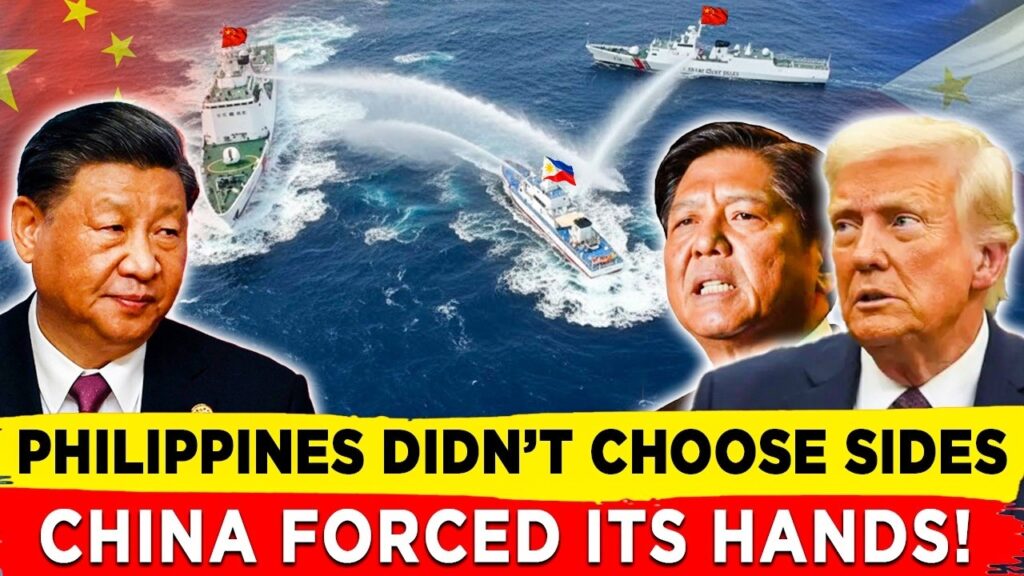
Just this week, another report surfaced of Chinese vessels shadowing, blocking, and pressuring Philippine ships in the West Philippine Sea. Again. Water cannons, radio warnings, aggressive maneuvers, the usual script. No declaration of war. No dramatic headline about invasion. Just constant pressure. The slow kind. The exhausting kind. The kind that doesn’t look like coercion until you’ve lived under it long enough.
And then, almost on cue, the familiar line appears in commentary and analysis: “The Philippines has aligned itself with Washington.” As if Manila woke up one morning, looked at a menu of great powers, and casually picked the United States like a lifestyle brand. That framing feels comfortable. Neat. Almost polite. But it’s wrong.

Alignment implies choice. It suggests freedom of movement, room to maneuver, the luxury of neutrality until you decide otherwise. What it doesn’t capture is what happens when neutrality becomes impossible, when one actor keeps pushing, inch by inch, day after day, until standing still is no longer an option.
I keep thinking about how neutrality sounds powerful in theory but feels fragile in real life. Especially for a middle power sitting next to a giant that refuses to respect lines on a map. The Philippines didn’t announce some grand pivot away from balance. It reacted. It adapted. It leaned where there was still space to breathe.
This isn’t a story about Manila abandoning neutrality out of preference or ideology. It’s about neutrality collapsing under pressure. About a country discovering, slowly and painfully, that staying “in the middle” only works when everyone agrees the middle exists. The Philippines didn’t choose sides. China forced its hand.

When Competition Becomes Coercion?
There’s a moral red line in international politics. It’s fuzzy at first. Easy to argue over. But once you cross it, everyone can feel the shift, even if they pretend not to see it. Competition, at least in its defensible form, still leaves space for choice. It’s diplomacy behind closed doors. Economic incentives that can be accepted or rejected. Soft power that persuades rather than pressures. Legal processes that are slow, frustrating, but binding. It’s messy, but it’s not violent.
Coercion feels different. You don’t debate it, you endure it. Coercion looks like water cannons fired at close range, not to “warn” but to damage. It looks like ships ramming and blocking smaller vessels until the margin for error disappears. It looks like being followed, constantly, by maritime militia that don’t wear uniforms but behave like enforcers. And it looks like dismissing binding legal rulings when they don’t deliver the outcome you want.https://indopacificreport.com/even-food-sparks-conflict-second-thomas-shoal-resupply-runs/
The difference isn’t academic. It’s physical. Take what’s been happening at sea. Philippine resupply missions to Second Thomas Shoal, routine, law-enforcement and civilian-linked operations, have been interrupted again and again. Not during combat. Not during exercises. During basic supply runs. Water cannons have caused structural damage. Ships have come within meters of collision. One bad turn of the wheel, one engine failure, and this stops being “gray zone activity” and becomes a tragedy.
And that’s the point. When pressure becomes routine, it stops being diplomacy and starts becoming governance by intimidation. No formal annexation is required. No flag needs to be planted. Control is asserted through repetition, by making resistance costly, exhausting, and dangerous enough that compliance starts to look like the safer option. This isn’t competition for influence. It’s the steady narrowing of another country’s choices, enforced not by law, but by fear and fatigue. That’s the line. And it’s already been crossed.
Law Exists — But Only If It’s Respected
There’s a comforting belief in international politics that once the law is clear, behavior will follow. Win the case. Get the ruling. History bends your way. That’s not how it played out for the Philippines. In 2016, Manila did what smaller states are always told to do. It went to court. It trusted the system. An international tribunal ruled overwhelmingly in the Philippines’ favor, affirming its maritime rights and rejecting China’s sweeping “historic rights” claims as incompatible with international maritime law. On paper, it was decisive. Clean. Almost elegant.
And yet, standing on the deck of a ship in the West Philippine Sea, that victory didn’t feel very solid. The ruling clarified what was legal. It did not change what was happening on the water. There were no patrols dispatched to enforce it. No mechanism to stop violations. No cost imposed for ignoring it. What emerged instead was a vacuum — a gap between law and reality that others were more than willing to fill.
This matters because the South China Sea isn’t some abstract chessboard for strategists. Roughly one-third of global maritime trade by value passes through these waters. That’s energy, food, manufacturing inputs, the stuff everyday life quietly depends on. And closer to home, fisheries within the Philippine exclusive economic zone support millions of livelihoods, directly and indirectly. These aren’t lines on a map. They’re paychecks. Meals. Futures.
South China Sea Skirmishes 2025 Between China and the Littoral States, Month by Month
So when ships keep coming anyway, when resupply missions are harassed despite a clear legal ruling, it sends a brutal message. The law may exist, but it won’t protect you by itself. That’s the hard truth most analysts dance around. Law without protection becomes symbolic and symbolism doesn’t stop ships.
For the Philippines, the arbitration win wasn’t the end of the story. It was the moment Manila realized that being legally right and being strategically secure are two very different things. And when the gap between them keeps widening, countries don’t abandon the law out of cynicism. They start looking for shelter.
Neutrality Is a Luxury Middle Powers Rarely Have
There’s a version of neutrality that sounds noble. Calm. Mature. Above the mess. In theory, it’s the posture of states that don’t want to be dragged into other people’s fights. In reality, it’s a position you can only hold if everyone else agrees to let you hold it.
That’s where structural realism stops being theory and starts feeling personal. Neutrality only works when a few basic conditions exist. Borders have to mean something. Rules have to be enforced by more than good intentions. And economic access can’t be quietly turned into a pressure tool. Once any one of those erodes, neutrality stops being a strategy and starts becoming a risk.
For the Philippines, all three didn’t just weaken, they were steadily worn down. Maritime boundaries were challenged in practice, even after being clarified in law. Rules were acknowledged in words and ignored at sea. Economic ties, once framed as mutual opportunity, became leverage that could be tightened or loosened depending on political mood. At that point, staying “neutral” isn’t restraint. It’s exposure.
There’s an uncomfortable comparison here that analysts don’t always like to make. States with credible deterrence, real naval power, reliable security guarantees, or both, can afford ambiguity. They can hedge. They can delay decisions. They can play for time. The uncertainty works in their favor. States without that buffer don’t get the same luxury.
They face a binary choice, whether they like it or not: absorb the pressure and hope it doesn’t get worse, or build partnerships that raise the cost of coercion. That’s not ideology. It’s survival logic.
So when people say the Philippines “gave up” neutrality, they’re missing the point. Neutrality without security is not independence, it’s exposure. And no responsible government chooses exposure for long, especially when the pressure keeps coming, day after day, wave after wave.
Why Defense Partnerships Became Inevable, Not Ideological
At some point, the conversation had to change. Not from right and wrong but from can we afford this anymore. The Philippines didn’t start looking for partners because it wanted to provoke anyone. That story is lazy. What actually happened is simpler and more uncomfortable: the balance stopped holding. And when balance breaks, morality alone doesn’t put it back together.
Partnerships became a way to breathe again. They brought eyes where there were blind spots, maritime domain awareness, surveillance, ISR that made it harder for things to happen unseen. They brought presence, not to escalate, but to prevent accidents from turning into incidents, and incidents into something worse. And they brought interoperability, the quiet, technical kind, that raises the cost of coercion without firing a shot.
Look at the exercises now being held. Search-and-rescue. Disaster response. Maritime law enforcement coordination. The unglamorous stuff. The kind of cooperation you build when you expect typhoons, ship accidents, and gray-zone pressure, not invasions. These drills are defensive, transparent, and legal. They don’t project force outward. They stabilized space that was becoming increasingly unsafe. That distinction matters, even if critics pretend it doesn’t. Deterrence is not aggression. It’s the price tag attached to intimidation. And once that price tag appeared, the pressure dynamics started to shift.
China’s Strategic Miscalculation
Beijing often says that “external forces are militarizing the region.” It’s a powerful line. It sounds convincing. But it skips the part where cause comes before effect. What we’ve actually seen is a clear pattern. Increased coercion led to increased transparency. Incidents that once disappeared into vague diplomatic language are now filmed, logged, and shared. That transparency triggered wider international concern. And concern, predictably, turned into cooperation.https://youtu.be/_hIQvFPKTlg?si=Q-468gCZ7a3tGlab
This wasn’t containment imposed from the outside. It was convergence generated from the inside. A quiet but important shift followed. Coast guard encounters that were once framed as “bilateral issues” are now documented, discussed with partners, and in some cases, jointly patrolled. Not to embarrass anyone but to make intimidation harder to deny and harder to repeat. In trying to keep things closed, China made them public. In trying to keep things bilateral, it internationalized them. That’s a miscalculation.
The Philippines Is Not an Exception — It’s a Signal
Other countries are watching. Closely. Southeast Asian states with overlapping claims see what happens when law is clarified but not enforced. Pacific island nations balancing sovereignty and dependence are paying attention to how pressure accumulates without crossing formal red lines. Even European middle powers, far from these waters, recognize the pattern, because they’ve seen what rule erosion looks like closer to home.
https://youtu.be/gcC1DRHBQ5w?si=AyxltEckG3cmI4yA
The lesson isn’t subtle. If coercion succeeds once, it becomes a template. It gets reused. Refined. Exported. That’s why alignment today isn’t really about countries. It’s about behavior. Middle powers don’t band together because they dislike someone’s flag or ideology. They do it because certain actions, left unanswered, make everyone less safe. This isn’t bloc politics. It’s damage control.
The Question That Cuts Through the Noise
So here’s the question that keeps lingering, no matter how much spin gets layered on top: If China truly wants its neighbors to remain non-aligned, why does it keep making non-alignment impossible? The Philippines didn’t pick a camp. It picked agency over silence. Law over submission. Partnership over isolation. And that choice wasn’t dramatic. It was gradual. Reluctant. Forced by repetition. Because when rules are broken at sea, friendships stop being optional, they become lifelines.https://youtu.be/VnjuZAyfNlQ?si=xjLXR_qQQLColb5z