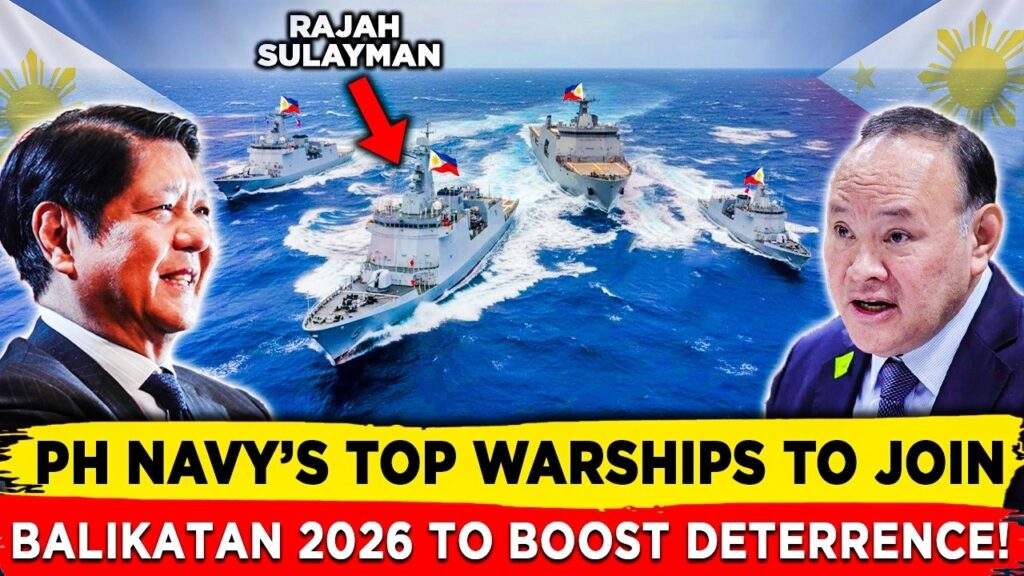
Philippine Navy’s Top Warships Join Balikatan 2026 to Boost Regional Security
Something feels different about Balikatan this year. For decades, the annual exercise between the Philippines and the United States was framed as routine alliance maintenance. Training cycles. Interoperability drills. Symbolic reassurance. Important, yes but predictable. Balikatan 2026 doesn’t feel predictable. It feels deliberate.
With the Philippine Navy deploying its top-tier warships into the exercise, this is no longer just about procedural coordination. It is about visible readiness in a region where maritime tensions have become normalized. The South China Sea has seen rising confrontations in disputed waters, increased patrols by the China Coast Guard, and a steady escalation of gray-zone tactics, water cannon incidents, aggressive shadowing, ramming maneuvers, and maritime militia swarming operations.
Against that backdrop, the optics of frontline Philippine warships operating alongside U.S. forces matter. Balikatan 2026 is not just about training, it is about readiness, deterrence, and strategic messaging in contested waters. The timing is not accidental. Maritime pressure in areas like Second Thomas Shoal and Scarborough Shoal has intensified over the past two years. Philippine resupply missions have been challenged. Coast guard vessels have faced obstruction. Surveillance activities have expanded. Every encounter carries the risk of miscalculation. In that environment, exercises become signals.
When Manila commits its most capable naval assets, modern frigates, upgraded surface combatants, and integrated ISR support, it communicates seriousness. It tells partners that the alliance is operational, not ceremonial. It tells competitors that coordination is active, not theoretical. There is also an internal dimension. For the Armed Forces of the Philippines, fielding top warships in a high-visibility multinational drill reinforces modernization momentum. It demonstrates that recent investments are translating into deployable capability. Deterrence is not built in procurement documents; it is built in exercises, presence, and demonstrated coordination.
And regionally, other Southeast Asian states are watching. Exercises of this scale influence strategic calculations far beyond bilateral ties. They shape perceptions of balance, reliability, and resolve. Balikatan 2026, therefore, is not an isolated event. It is part of a broader pattern: deepening defense integration, expanded access arrangements, improved maritime domain awareness, and increasingly synchronized operations in the Indo-Pacific. In contested waters, signaling matters. This year, the signal is clear.
Scale and Scope of Balikatan 2026
Balikatan 2026 isn’t scaling down. It’s scaling up and that alone tells you something about the direction of the alliance. The exercise is scheduled for April–May 2026, right in the window when regional maritime activity tends to intensify. Participation numbers have steadily grown over the past few years. In 2023, roughly 17,600 personnel took part. In 2024, around 16,700. Based on trend lines and expanding operational scope, projections for 2026 point toward 18,000 or more combined forces. That’s not routine maintenance. That’s sustained expansion.
The core participants remain the Armed Forces of the Philippines, the US Navy, and the US Marine Corps. But what gives this year additional weight is the likely presence of observers and participating partners from countries like Japan and Australia. Even as observers, their involvement reflects the widening security network forming in the Indo-Pacific. Balikatan is no longer purely bilateral in perception. It is increasingly viewed as a regional signaling platform.

What makes 2026 particularly notable is the naval emphasis. The Philippine Navy is deploying its most advanced platforms. That includes the Jose Rizal–class guided-missile frigates, currently the most modern and capable surface combatants in Manila’s fleet. These ships are equipped with anti-ship missile systems, modern surface warfare radars, and interoperable communications compatible with US platforms. They are designed not just for patrol, but for high-end maritime operations.
Alongside them are Offshore Patrol Vessels and fast-attack interdiction craft, expanding the tactical range of scenarios that can be exercised, from maritime interdiction and coastal defense to distributed surface operations. This combination matters. Exercises evolve over time. They can remain symbolic confidence-building measures. Or they can transition toward operational credibility. The participation of top-tier warships suggests the latter.https://indopacificreport.com/6-warships-deadlier-jets-can-the-philippines-defend-west-philippine-sea/
Balikatan 2026 is signaling a shift from procedural drills to credible warfighting preparation. Not because conflict is inevitable but because readiness reduces uncertainty. And in contested waters, uncertainty is a risk. The message embedded in the scale and scope is straightforward: coordination is real, capability is improving, and alliance commitments are being exercised in practical terms, not just declared in joint statements.
Interoperability and Modernization
Balikatan 2026 isn’t just a show of ships and numbers. It’s the visible edge of something deeper, a long-term modernization push inside the Armed Forces of the Philippines. Under the Revised AFP Modernization Program, particularly the Horizon 2 and Horizon 3 phases, Manila has committed to a multi-billion-dollar capability upgrade. The focus is clear: strengthen maritime domain awareness, expand missile systems, and build a more credible fleet. For decades, the Philippine military was structured primarily for internal security. That era is over. The strategic center of gravity has shifted outward, toward external defense and maritime deterrence.
Layered on top of that modernization is the operational infrastructure provided through nine Enhanced Defense Cooperation Agreement sites across the country. These locations expand logistical flexibility, pre-position equipment, and improve rapid deployment capacity. In practical terms, they reduce response time and increase operational endurance. Modernization without access is incomplete. Access without modernization is hollow. Together, they reinforce each other.
Philippines Commissions Its Latest Frigate, BRP Diego Silang (FFG-07)
Balikatan becomes the testing ground. This year’s exercise includes live-fire maritime strike drills, the kind that move beyond scripted maneuvers into real capability demonstration. Combined amphibious landing exercises test coordination under complex conditions. Command-and-control interoperability simulations stress communications networks, decision-making speed, and joint operational coherence. Maritime domain awareness data-sharing drills strengthen the intelligence backbone that underpins deterrence.
None of this is accidental. It is structured integration. As AFP Chief of Staff Romeo Brawner Jr. has emphasized, “Our goal is seamless interoperability. When we operate together, we operate as one force.” That line captures the core objective. Interoperability is not just compatibility of equipment. It is the compatibility of doctrine, timing, command structure, and trust.https://www.youtube.com/watch?v=OG_QpOVYgQ8
In modern maritime competition, fragmentation is vulnerable. Seamless coordination multiplies strength. Balikatan 2026 demonstrates that Philippine modernization is not occurring in isolation. It is being synchronized with alliance architecture. Ships are not just being acquired, they are being integrated. Radar systems are not just being installed, they are being networked. Exercises are not just rehearsals, they are calibration. And calibration, in contested waters, is deterrence.
Regional Security Significance
Balikatan 2026 carries weight far beyond training objectives. In today’s strategic environment, exercises are messaging platforms and this one speaks clearly. At the core is deterrence signaling under the 1951 Mutual Defense Treaty between the United States and the Philippines. Every time Philippine frontline warships operate alongside U.S. naval forces in complex drills, it reinforces a simple but powerful idea: the alliance is active, not theoretical. The treaty is not an archival document. It is operationalized through presence, coordination, and readiness.
That matters especially because U.S. officials have consistently reiterated since 2019 that an armed attack on Philippine armed forces, public vessels, or aircraft in the Pacific, including in the South China Sea, would trigger mutual defense commitments. That clarity reduces ambiguity. And reduced ambiguity strengthens deterrence.
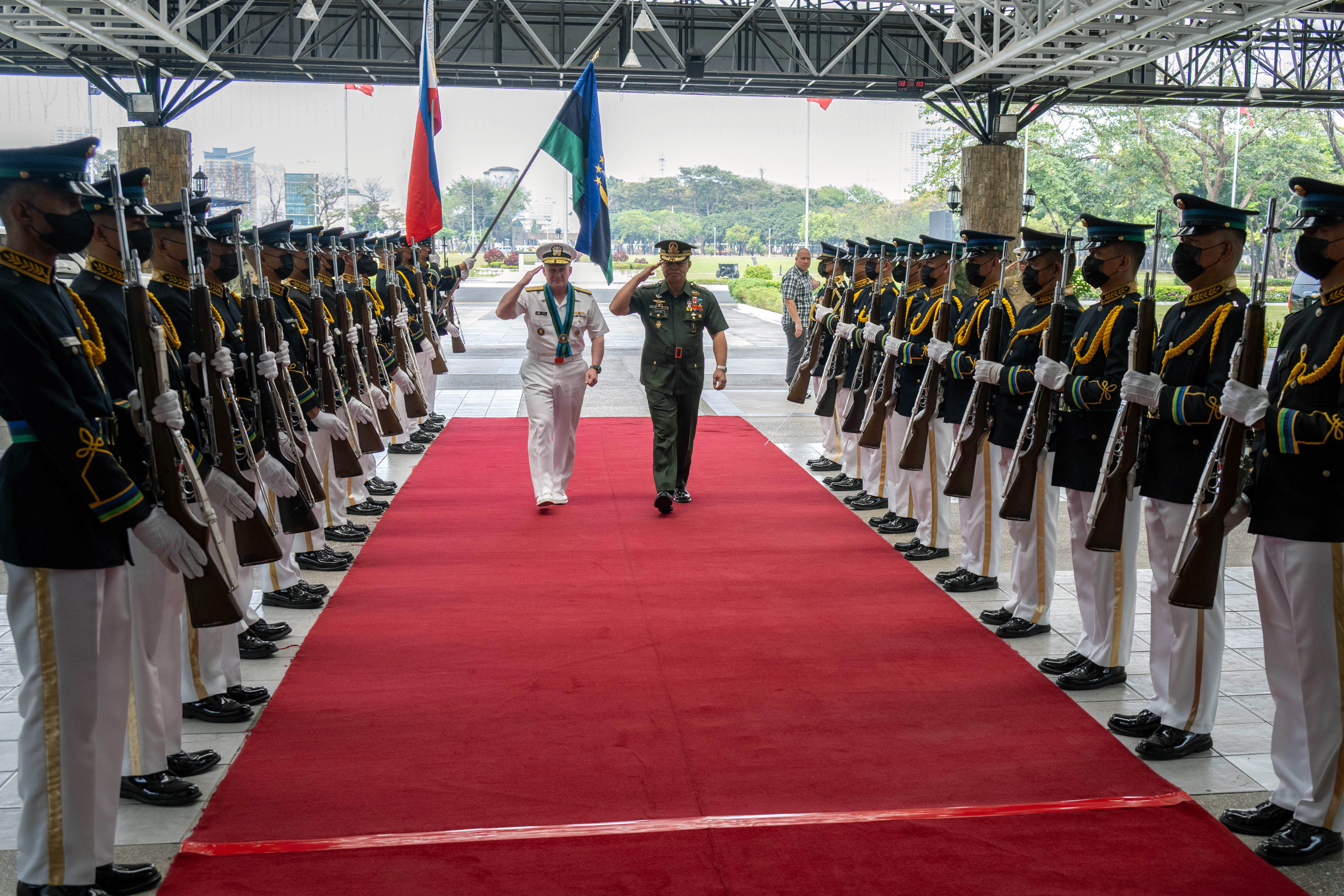
Under President Ferdinand Marcos Jr., defense alignment with Washington has become more visible and more assertive. The expansion of EDCA sites, the acceleration of joint patrols, and the steady tempo of exercises reflect a strategic recalibration. Manila is signaling that maritime coercion will not go unanswered or unobserved.
For Beijing, the message is layered.https://www.youtube.com/watch?v=O4NcU1U83GU
Since 2023, the Philippines has increased patrols in contested waters. Confrontations around Second Thomas Shoal and Scarborough Shoal have grown more frequent and more intense. Water cannon incidents, blocking maneuvers, and maritime militia presence have become recurring features of the operational landscape.
Against that backdrop, Balikatan 2026 communicates resolve. It indicates that maritime pressure will not fracture alliance cohesion. It signals that Philippine forces are not isolated in disputed waters. And it demonstrates that coordination with the United States is expanding in sophistication, not contracting.
USS Ohio Submarine Deployment in Philippines Leaves China Furious
Deterrence is ultimately about perception and calculation. If Beijing assesses that any escalation risks drawing in a prepared and interoperable alliance, the threshold for aggressive action rises. Balikatan 2026 therefore functions as both preparation and prevention. Preparation, because it builds operational capability. Prevention, because it shapes the strategic calculus of potential adversaries.
Operational Evolution of Balikatan
Balikatan didn’t start as what it is today. For years, it was heavily focused on internal security support. In 2015, the emphasis was counterterrorism. The operational profile was ground-centric. Jungle warfare drills. Small-unit coordination. Stability operations. The alliance at that time was still oriented largely around internal threats and insurgency support.
Then 2020 hit. The pandemic forced adjustments across the board. Participation was reduced. Exercises were scaled back. Operational complexity was limited. Balikatan that year reflected global disruption more than strategic ambition.
But something shifted after that. By 2023, the focus moved decisively toward territorial defense. Coastal defense missile systems were introduced into the exercise environment. That marked a conceptual transition, from counterinsurgency to external deterrence. The messaging was clear: the Philippines was reorienting toward maritime defense.
In 2024, the evolution continued. Integrated maritime operations took center stage. The first combined maritime strike drills signaled that coordination was no longer theoretical. Surface vessels, air assets, and command systems were being exercised together in more complex, high-end scenarios. The alliance was stress-testing interoperability.
Now, in 2026, the deployment of the Philippine Navy’s most advanced warships marks another milestone. This is advanced naval integration. It is not a symbolic presence. It is high-value asset participation in joint operational environments.
The pattern is unmistakable. Balikatan has transitioned from internal security support to full-spectrum territorial defense preparation. That shift reflects broader geopolitical realities. The threat environment changed. Maritime confrontations intensified. Strategic competition deepened. And the exercise adapted accordingly.https://www.youtube.com/@IndoPacific_Report
Exercises evolve when strategic priorities evolve. Balikatan 2026 represents the culmination of that evolution, an alliance exercise calibrated for contested waters, maritime deterrence, and integrated warfighting readiness.
Broader Indo-Pacific Alignment
Balikatan 2026 does not exist in isolation. It sits inside a widening web of Indo-Pacific security alignment that has been steadily tightening over the past several years. One of the most consequential developments has been increased trilateral coordination among the United States, the Philippines, and Japan. What was once largely bilateral cooperation has matured into structured maritime collaboration. Joint patrols conducted in 2023 and 2024 marked the first trilateral maritime patrols in the region, a significant precedent. It was not just symbolism. It was operational signaling that like-minded maritime states are prepared to coordinate presence in contested waters.
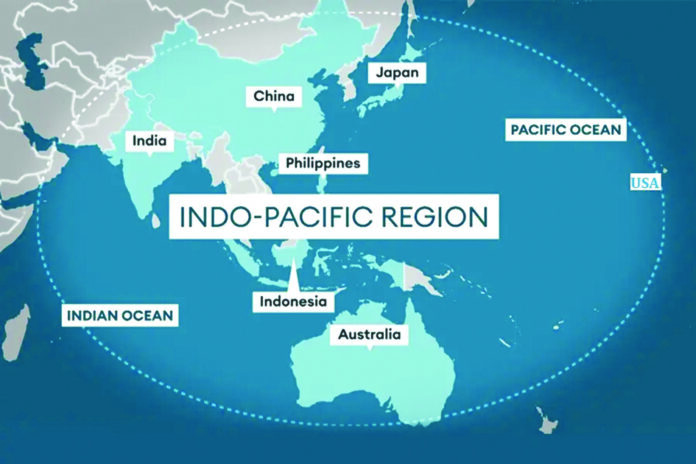
Japan’s expanding security role under its evolving defense posture has made this trilateral axis more credible. Maritime domain awareness sharing, coast guard coordination, and naval presence operations now overlap in ways that would have been politically sensitive a decade ago.
Australia’s role has also grown more visible. Canberra has increased participation in Philippine exercises, reflecting its deeper engagement under its Indo-Pacific strategic framework. The involvement of Australia adds geographic breadth and reinforces that maritime security in Southeast Asia is not a narrow bilateral issue, it is a regional stability concern.
Philippines on HIGH ALERT as 3 Chinese Warships Enter Disputed Waters
All of this aligns with Washington’s broader Indo-Pacific strategy: reinforce alliances, deepen interoperability, and create a networked security architecture rather than isolated bilateral hubs. The Philippines is increasingly positioned as a frontline maritime state within that architecture.
Geographically, the Luzon Strait and the West Philippine Sea are central. The Luzon Strait is a critical chokepoint linking the South China Sea to the broader Pacific. The West Philippine Sea remains the epicenter of maritime friction. Securing these corridors is not just about sovereignty; it is about freedom of navigation, sea lane integrity, and deterrence stability.
Balikatan 2026, viewed in this context, becomes more than an annual exercise. It becomes a node in a larger strategic alignment. The pattern suggests institutionalization, not episodic cooperation, but structured coordination designed for long-term deterrence and maritime order maintenance. In strategic terms, the alliance is no longer operating alone. It is operating within a widening coalition framework.
Strategic Takeaways
First, capability upgrade. The Philippine Navy is no longer operating purely as a constabulary or patrol-centric maritime force. Through sustained modernization under the Revised AFP Modernization Program and increasingly complex joint exercises, it is transitioning toward a credible deterrent fleet. The integration of guided-missile frigates, interoperable command systems, and live-fire maritime drills signals movement from presence-based enforcement to warfighting-capable deterrence. That evolution fundamentally alters how Manila projects maritime resolve.
Second, alliance reinforcement. Defense cooperation between the Philippines and the United States is arguably at its strongest level in decades. The operationalization of the 1951 Mutual Defense Treaty, the expansion of Enhanced Defense Cooperation Agreement sites, and the tempo of joint maritime activities demonstrate institutional depth. This is not episodic engagement. It is structured, sustained alignment with strategic clarity.
Third, regional stability. Exercises of this scale function as deterrence signaling mechanisms. They reinforce freedom of navigation principles and communicate that coercive behavior in contested waters will be observed and counterbalanced. Stability in the Indo-Pacific is not maintained through rhetoric alone. It is maintained through readiness, interoperability, and visible alliance cohesion.https://www.youtube.com/watch?v=-Kb53A2lfJc
Fourth, escalation management. High-intensity drills improve crisis response coordination. When forces train together under complex scenarios, maritime strike simulations, amphibious operations, and joint command exercises, they reduce miscalculation risk during real-world incidents. Shared operating procedures and integrated communications lower the probability of confusion under pressure. That is not just preparation for conflict; it is insurance against accidental escalation.
Closing Narrative Angle
Balikatan 2026 reflects a maturing alliance. The trajectory from counterterrorism support to advanced naval integration demonstrates strategic adaptation to a shifting maritime threat environment.
It shows commitment to a rules-based maritime order in which international law, alliance obligations, and sovereign rights are reinforced through operational credibility rather than declaratory policy alone.
It also places the Philippine Navy at the center of a broader regional deterrence architecture. Manila is no longer a peripheral actor in Indo-Pacific security dynamics. It is increasingly a frontline maritime state embedded within a networked alliance structure.
In an increasingly contested Indo-Pacific, Balikatan 2026 is less about rehearsing war and more about preventing one.https://youtu.be/Sug3wIgAPag?si=FeHOHLLbu-bBksPZ