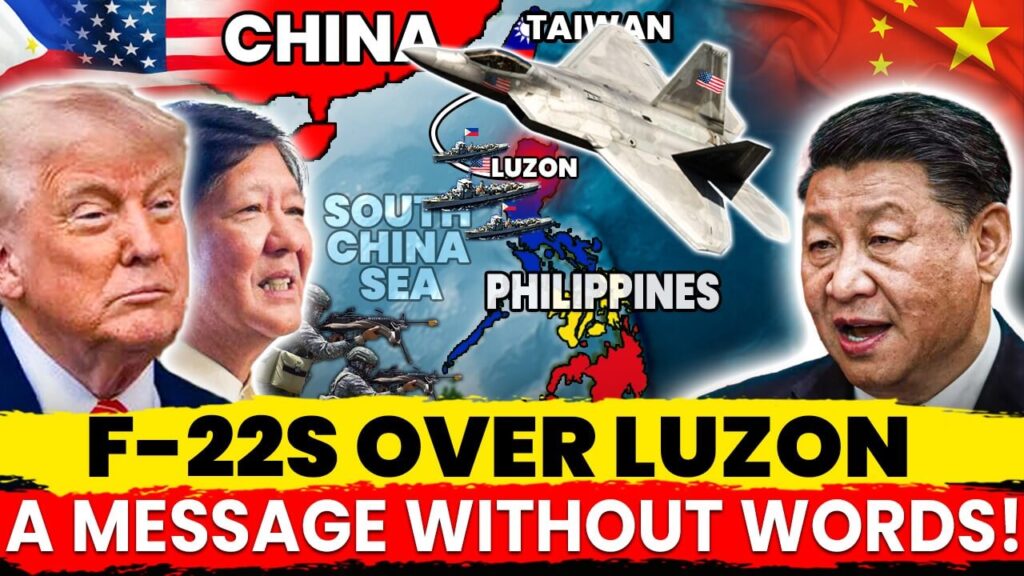
F-22 Raptors Over Luzon: Strategic Signaling, Alliance Politics, and Airpower in the South China Sea
What does it mean when the world’s most elusive fighter jet appears in the skies above a frontline region, without firing a shot, issuing a warning, or naming an adversary? When the F-22 Raptors Over Luzon, the message is not tactical. It is strategic. Invisible to most radars and unmatched in air combat, the F-22 does not need to announce its presence to be felt. Its appearance alone signals intent, capability, and resolve, especially in a region where power is increasingly measured by who can control the air in the opening hours of a crisis.
Developed by Lockheed Martin, the F-22 was designed for a singular purpose: to dominate highly contested airspace against peer adversaries. Its combination of stealth, sensor fusion, supercruise, and thrust-vector maneuverability allows it to see first, strike first, and disengage at will. Former U.S. Air Force Chief of Staff Mark Welsh once described it as “the cornerstone of America’s ability to control the skies in the opening phase of any conflict,” a telling phrase, because wars between major powers are often decided before they are publicly declared.
The timing of F-22 Raptors Over Luzon is no coincidence. Tensions in the South China Sea have intensified as confrontations at sea grow more frequent and more physical. For the Philippines, persistent maritime pressure from China has pushed deterrence beyond diplomacy and into the realm of visible military alignment. Unlike permanent basing, rotational deployments and patrols offer flexibility: they reassure allies without crossing political red lines, and they warn competitors without forcing escalation.
Comparatively, this approach mirrors how airpower has been used elsewhere. U.S. stealth bombers over the Korean Peninsula, NATO air patrols over the Baltic states, and F-35 rotations in Eastern Europe all follow the same logic: presence without permanence, deterrence without declaration. What makes Luzon different is its geography. Sitting astride the South China Sea, the Luzon Strait, and the approaches to Taiwan, the island is not just a national territory; it is a hinge point between theaters. As strategist Robert Kaplan has argued, “Geography is the permanent canvas upon which strategy is painted,” and in the Indo-Pacific, few canvases are as consequential as Luzon.
This examines why F-22 Raptors Over Luzon matter far beyond their flight paths. It analyzes the strategic logic behind their deployment, the alliance politics they reinforce, and the regional reactions they provoke, placing airpower at the center of how the South China Sea competition is being shaped, managed, and deliberately kept below the threshold of open conflict.
Background on South China Sea Tensions
The tensions that now shape the South China Sea did not emerge overnight. They are the result of decades of overlapping territorial claims layered onto one of the world’s most economically and strategically vital maritime spaces. China, the Philippines, Vietnam, Malaysia, Brunei, and Taiwan all assert claims over maritime features and exclusive economic zones that frequently overlap. These disputes converge most sharply around flashpoints such as Scarborough Shoal and the Spratly Islands, areas that sit astride sea lanes carrying roughly one-third of global maritime trade. What appears remote on a map is, in reality, central to global commerce.
Among the claimants, strategic positions differ sharply. China advances the most expansive claim, anchored in the so-called nine-dash line, a sweeping demarcation that covers much of the South China Sea. Enforcement of this claim rarely relies on naval combatants. Instead, it is carried out through the China Coast Guard and maritime militia, using sustained presence, obstruction, and coercive maneuvering to assert control without triggering open conflict. This approach allows Beijing to apply pressure while maintaining plausible deniability and narrative flexibility.
The Philippine position rests on international law rather than historical assertion. Manila grounds its claims in the United Nations Convention on the Law of the Sea, reinforced by the 2016 arbitral ruling that invalidated China’s claim to historic rights within the nine-dash line. While the ruling lacks enforcement mechanisms, it provides the Philippines with legal clarity and moral leverage, tools that become especially important when matched against a far larger power.
The United States occupies a deliberately calibrated position. Washington maintains neutrality on questions of sovereignty, but it has consistently asserted the importance of freedom of navigation, adherence to international law, and the protection of allied forces operating lawfully at sea. This balance, avoiding endorsement of claims while signaling alliance commitments, has made the United States a central stabilizing actor in an increasingly volatile environment.
Recent years have seen a clear shift in how these disputes play out. Maritime confrontations have become more frequent and more physical: water cannons fired at close range, dangerous crossing maneuvers, ramming incidents, and boarding attempts. These actions rarely make headlines individually, but collectively they represent a strategy of persistent gray-zone pressure, altering facts on the water without crossing the legal threshold of armed attack. Incredible Philippine Air Force Receives New S-70i Black Hawks from Poland
It is this pattern that has accelerated U.S.–Philippine security coordination. As pressure mounts at sea, deterrence has expanded upward into the air domain, where presence can be demonstrated quickly, visibly, and without permanence. Against this backdrop, F-22 patrols over Luzon are not an isolated military event. They are a response shaped by history, geography, and a South China Sea where competition is constant, escalation is incremental, and airpower increasingly frames the balance before the first shot is ever fired.
Strategic Importance of F-22 Raptors Over Luzon
Geography does most of the talking long before policy ever does. Luzon sits astride the Luzon Strait, a narrow but decisive corridor linking the Pacific Ocean to the South China Sea. Any naval or air force moving between these two bodies of water must account for this passage. In scenarios involving Taiwan contingencies or South China Sea escalation, access to the Luzon Strait is not optional; it is foundational.
This geographic leverage is reinforced by infrastructure. Clark Air Base and Basa Air Base provide depth, dispersal, and rapid response capability. Rather than acting as static fortresses, these bases function as nodes, places where aircraft can rotate through, refuel, integrate, and move on. Under the Enhanced Defense Cooperation Agreement, they support a model built for survivability in a missile-contested environment: distributed access instead of predictable concentration.
For alliance planners, Luzon enables what has become the preferred posture in the Indo-Pacific: proximity without permanence. Forward presence is maintained, deterrence is signaled, but political sensitivities associated with permanent basing are avoided. As Indo-Pacific Command planning concepts have emphasized, survivability now depends on mobility, dispersion, and unpredictability. Luzon offers all three.
F-22 Stealth Fighter Overview
The F-22 Raptor was never designed to be just another fighter. Its stealth reduces radar visibility across multiple frequency bands, not to make it invisible, but to delay detection long enough to dominate the engagement. Its sensor fusion integrates radar, electronic support measures, and off-board data into a single picture, turning the pilot into an airborne command node rather than a lone shooter reacting to threats.
In combat terms, the F-22 is optimized for a brutal but decisive logic: first look, first shot, first kill. That logic does not simply threaten enemy aircraft; it complicates the entire structure of an adversary’s air defense planning. Defense analyst Bryan Clark has argued that advanced stealth aircraft force opponents to rethink their entire kill chain, from detection to engagement to recovery. In effect, the F-22 reshapes the battlespace before the battle begins.
Regionally, this matters because while many Asian air forces operate capable fourth-generation fighters and some fly advanced platforms like the F-35, few possess an aircraft optimized purely for air dominance with the F-22’s combination of stealth, kinematics, and sensor authority. The Raptor remains less about networking the fight and more about owning the airspace outright.
Purpose of the Deployment
When F-22 Raptors Over Luzon, they are not there to stay. Their value lies precisely in their mobility. Patrols and rotational deployments signal readiness and resolve without creating permanent footprints. This aligns with U.S. doctrine that emphasizes forward deterrence through movement rather than entrenchment, showing that capability can appear quickly, operate effectively, and disappear just as fast. For the Philippines, joint activity with the Philippine Air Force carries significance beyond tactics. Interoperability builds confidence, shared procedures, shared airspace management, shared expectations. Each joint sortie reinforces Manila’s perception that alliance commitments are not abstract promises but operational realities. There is also a quieter purpose. Deployments like these improve intelligence collection, environmental familiarity, and readiness under real-world conditions. They stress-test logistics, command integration, and decision-making, not in simulations, but in the actual geography where a future crisis would unfold.
Military and Diplomatic Implications
To Beijing, the presence of high-end airpower sends a clear but calibrated message. Deterrence does not require confrontation; it requires credibility. As strategist Thomas Schelling famously argued, deterrence rests on “the power to hurt being visibly held in reserve.” The F-22 embodies that reserve, present enough to be noticed, restrained enough to avoid provocation. That visibility, however, comes with risk. Increased patrols can invite reciprocal deployments, sharper rhetoric, or more aggressive signaling. Escalation is not automatic, but it is always possible when forces operate in proximity. This makes calibration essential, enough presence to deter, not enough to corner. For U.S.–Philippine relations, these deployments represent continuity rather than rupture. They reinforce commitments under the Mutual Defense Treaty and EDCA, embedding deterrence within alliance management rather than treating it as an episodic response.
Regional Reactions
Manila has been deliberate, almost surgical, in how it frames the presence of advanced U.S. airpower over Luzon. Philippine officials consistently emphasize that these activities are defensive in nature, rooted in sovereignty protection and regional stability rather than power projection. Public statements avoid triumphal language and instead stress legality, alliance cooperation, and deterrence as a means of preventing conflict, not inviting it. This restraint reflects hard-earned experience: overly aggressive messaging risks reinforcing Beijing’s narrative, while silence risks normalization of pressure. The result is a careful balance, visible cooperation without rhetorical escalation. China Is Watching the 9th U.S.–Philippines Patrol Very Closely!
Beijing’s response follows a well-worn script. Chinese officials routinely condemn increased U.S. military activity as destabilizing, framing it as outside interference that militarizes what China describes as regional disputes. In this telling, American deployments are not reactions to coercion but the cause of rising tensions. The narrative serves multiple audiences simultaneously. Domestically, it reinforces the image of China as a responsible power resisting containment. Regionally, it appeals to Southeast Asian states that remain cautious about being drawn into great-power rivalry. Internationally, it seeks to shift blame, casting China as reactive rather than revisionist.
Across ASEAN, reactions remain restrained, reflecting both institutional culture and strategic reality. ASEAN statements typically call for dialogue, restraint, and adherence to international law, avoiding explicit endorsement of either side. This caution is not indifference. Many member states privately share concerns about the normalization of coercive maritime behavior and the precedent it sets. However, ASEAN’s consensus-based structure limits collective action, and differing national threat perceptions make unified responses difficult. For some states, economic ties with China encourage moderation; for others, unresolved disputes make silence a tactical choice.
What emerges is a region watching closely but speaking softly. Philippine–U.S. air cooperation reassures some partners that deterrence is being reinforced without permanent militarization. At the same time, it sharpens underlying anxieties about escalation spirals, miscalculation, and the shrinking space between reassurance and provocation. In this environment, reactions are shaped less by ideology than by risk management, how to benefit from stability without becoming the next flashpoint.
Ultimately, regional reactions show a central truth of the Indo-Pacific security landscape: deterrence is increasingly collective, but escalation remains deeply individual. States may welcome the stabilizing effect of allied presence, yet few are willing to say so loudly. Silence, caution, and carefully chosen words have become strategic tools in their own right.
Historical Precedents and Case Studies
Earlier F-22 Raptors Over Luzon integration flights with the Philippines marked a quiet but consequential milestone. For the first time, fifth-generation air superiority fighters operated from Philippine territory, integrating with local airspace management, logistics, and command structures. These deployments were deliberately framed as temporary and rotational, not as the return of permanent U.S. basing. That distinction mattered politically. It reassured domestic audiences in the Philippines, reduced friction within ASEAN, and signaled to China that the move was about capability demonstration rather than territorial entrenchment.
Operationally, the emphasis was on interoperability. Philippine and U.S. air forces focused on shared procedures, airspace coordination, and communication standards rather than combat simulation alone. The lesson was subtle but powerful: modern deterrence does not require large numbers or permanent infrastructure. It requires integration, the ability to plug advanced systems into local geography quickly and operate as a coherent force. These early F-22 activities helped establish a template that later deployments could scale without reopening political debates each time.
Looking beyond Southeast Asia, F-22 deployments in other theaters reinforce the same logic. In the Middle East, Raptors have been used for air defense patrols, escort missions, and deterrence signaling against state and non-state threats alike. These missions were not about air dominance in the classic sense, but about stabilizing contested airspace, reassuring partners, and deterring escalation through visible capability. Similarly, in homeland air defense roles, F-22s have been tasked with intercepts and rapid-response missions, demonstrating their adaptability beyond peer-state warfare.
What unites these cases is flexibility. The F-22 has repeatedly been employed as a strategic instrument, not just a tactical platform. Its presence alone reshapes adversary planning, even when rules of engagement are tightly constrained. However, these precedents also highlight a consistent limitation: military presence, no matter how advanced, is insufficient on its own. Where deployments succeeded in reinforcing stability, they were paired with active diplomacy, alliance management, and clear messaging. Where communication lagged, deployments risked being misinterpreted as escalation rather than reassurance.
The cumulative lesson is clear. Rotational presence enhances readiness and deterrence, but only when embedded within a broader political strategy. Advanced airpower can buy time, signal resolve, and raise the cost of aggression but it cannot substitute for diplomacy. In the Indo-Pacific, where history, geography, and perception intersect sharply, past F-22 deployments suggest that success lies not in how long aircraft stay on the ground, but in how deliberately they are used, explained, and integrated into alliance strategy.
Strategic Analysis and Forecast
In the short term, F-22 patrols enhance deterrence signaling and sharpen allied coordination. In the longer term, they contribute to something more structural, the institutionalization of alliance interoperability and the gradual shaping of the regional balance through persistence rather than shock. Policy implications follow naturally: maintain transparency, expand joint exercises, and balance deterrence with confidence-building measures. In the Indo-Pacific, power must be shown but it must also be managed.
Conclusion
F-22 Raptors Over Luzon are not about dominance for its own sake. They represent a calibrated demonstration of alliance capability, shaped by geography, constrained by diplomacy, and focused on deterrence rather than escalation. In a South China Sea defined by gray zones and incremental pressure, such a balance is no longer optional; it is essential.