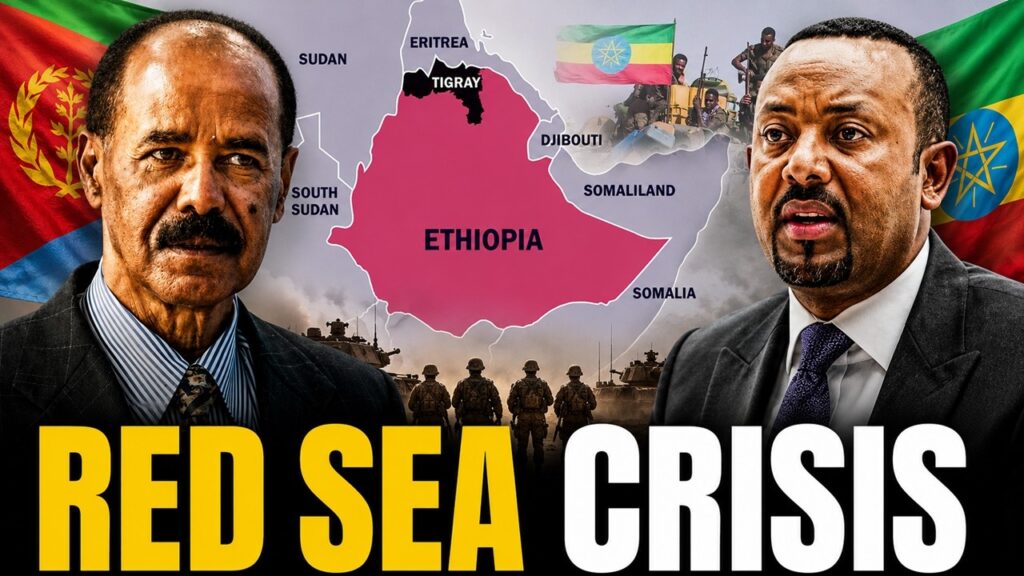
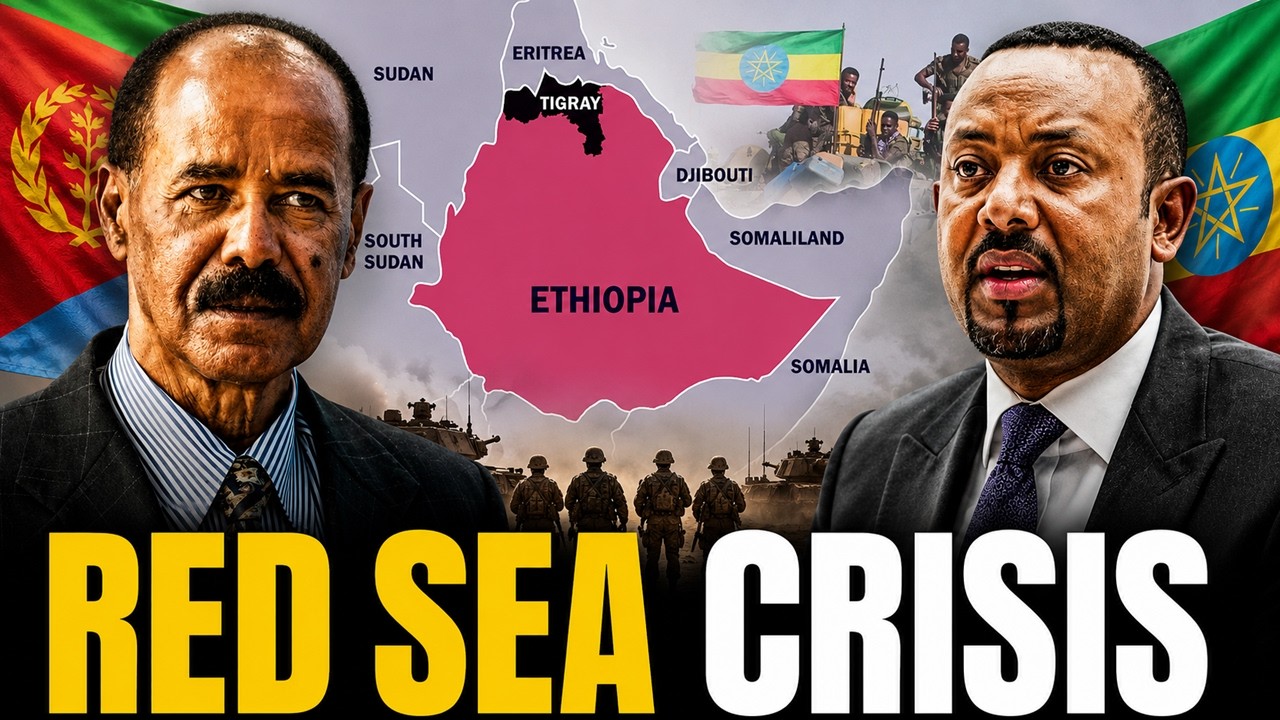
Ethiopia and Eritrea Are Moving Toward Another War
Published by Indo-Pacific Report | Horn of Africa | Ethiopia Eritrea Conflict | Red Sea Security | African Geopolitics
The Horn of Africa is moving toward a crisis that most of the world is not watching closely enough. Ethiopia and Eritrea — two countries that fought one of Africa’s bloodiest wars between 1998 and 2000, and whose forces clashed again during the devastating Tigray conflict from 2020 to 2022 — are now showing all the warning signs of sliding toward direct confrontation once more.
Internal armed conflicts are spreading across multiple Ethiopian regions simultaneously. Proxy groups backed by both governments are actively fighting inside Ethiopian territory. Ethiopian Prime Minister Abiy Ahmed is making increasingly pointed statements about his landlocked country’s need for Red Sea access — a declaration that Eritrea, which controls the critical port of Assab, hears as a potential territorial threat.
And the elections Ethiopia needs to hold are becoming a flashpoint rather than a solution.
The last major war between these two countries killed between 70,000 and 100,000 people and ended without resolving the underlying disputes. The Tigray conflict that drew Eritrea back in cost hundreds of thousands of lives and produced one of the world’s worst humanitarian disasters. Another round of large-scale conflict in the Horn of Africa would not just devastate the countries involved. It would ripple outward into Red Sea shipping, Gulf geopolitics, and the broader security of a region already under severe strain.
Here is what is actually happening, why it is escalating, and what could push this situation over the edge.
Ethiopia’s Internal Crisis: Fighting on Multiple Fronts at Once
Before getting to the Ethiopia-Eritrea dimension, it is essential to understand how severely fractured Ethiopia itself has become. The country is not simply dealing with one insurgency or one restive region. It is simultaneously managing armed conflicts across three major theaters, each with its own political logic and each capable of spiraling independently.
Tigray: The Peace That Did Not Hold
The 2022 Pretoria Agreement was supposed to end the Tigray war and bring the Tigray People’s Liberation Front (TPLF) back into a workable relationship with the federal government. It has not done that. The TPLF is now openly challenging Addis Ababa again, demanding the restoration of its political status, recognition of its regional authority, and the return of disputed territories that federal and Eritrean forces occupied during the war.
The federal government’s response has been escalatory rather than conciliatory. Troop redeployments to Tigray have intensified. Flights between the regional capital Mekelle and Addis Ababa have been disrupted. Residents are reporting serious disruptions to banking services — the kind of economic pressure that looks less like an oversight and more like deliberate policy. The ceasefire is holding on paper. On the ground, the situation is deteriorating.
Amhara: Former Allies Now Fighting the Government
In the Amhara region, Fano militias — irregular fighters who fought alongside federal forces during the Tigray war — have turned their weapons against Addis Ababa. The cause of this reversal is straightforward: the federal government attempted to disband and disarm regional militias after the Tigray conflict ended. The Fano refused. What followed was a new armed conflict in a region that was supposed to be on the government’s side.
The Fano campaign has not been contained. It has expanded. Federal drone strikes and military operations in Amhara have produced significant civilian casualties and generated further recruitment into the militia ranks. The government is fighting harder for control and losing ground politically with every strike.
https://indopacificreport.com/5-major-issues-haunting-the-south-china-sea-in-2026/
Oromia: The Longest-Running Insurgency
In Oromia, federal troops continue fighting the Oromo Liberation Army (OLA), an armed group that has been in conflict with the central government for years. Abiy Ahmed himself is ethnically Oromo, which makes the political dimensions of this conflict particularly complex. The OLA disputes the federal government’s legitimacy and continues to control significant territory in parts of the region.
What is new and particularly alarming is that credible reports now suggest some of these groups — the TPLF in Tigray, Fano in Amhara, OLA in Oromia — are beginning to coordinate indirectly with each other and, critically, with actors in Eritrea. Ethiopia is not just fighting a multi-front internal war. It is becoming a proxy battlefield in which external actors can amplify and sustain instability.
When a government is simultaneously fighting insurgencies in three regions and losing political ground in all of them, the temptation to find an external enemy to unite the country against becomes very real. That is one of the most dangerous dynamics in Ethiopian politics right now.
For comprehensive analysis of the Horn of Africa security crisis, visit Indo-Pacific Report.
The Ethiopia-Eritrea Proxy War That Is Already Underway
Even before any direct military confrontation, Ethiopia and Eritrea are already fighting each other — through proxies, through accusations, and through the competing armed factions that both governments are supporting inside Ethiopian territory.
The pattern is familiar from the Horn of Africa’s long history of regional interference. Ethiopia accuses Eritrea of providing weapons, training, and sanctuary to armed groups operating inside Ethiopia, particularly factions of the TPLF. This is a serious accusation because Eritrean President Isaias Afwerki has a long and documented history of hostility toward the TPLF, which fought a brutal border war against Eritrea in the late 1990s and which Asmara has never forgiven.
But the accusations run in both directions. Eritrea accuses Ethiopia of supporting anti-government factions inside Eritrean territory — groups that could threaten the Isaias government’s grip on power. Eritrea is one of the world’s most tightly controlled states, with no independent press, no opposition parties, and a government that has ruled without elections since independence in 1993. The Isaias government is acutely sensitive to any external support for internal dissent.
The result is a proxy conflict that is already active on both sides. Armed groups are being used as instruments of inter-state competition. Each provocation justifies the next. And the space between proxy warfare and direct military confrontation has historically been very narrow in this part of the world.
Proxy wars in the Horn of Africa do not usually stay proxy wars. The history of this region is full of conflicts that started with armed groups crossing borders and ended with armies doing the same.
The Red Sea Question: The Issue That Could Turn Competition Into War
Of all the factors driving the current tension, the one that carries the highest risk of triggering direct military conflict is the one that sounds most like a political speech: Ethiopia’s demand for Red Sea access.
This is not a new grievance. When Eritrea gained independence from Ethiopia in 1993 following a long liberation struggle, Ethiopia became one of the world’s largest landlocked countries — a nation of over 120 million people with no coastline, no ports, and no direct access to global maritime trade routes. Ethiopia currently depends heavily on Djibouti for access to international shipping, a dependency that carries enormous economic and strategic costs.
Abiy Ahmed has been increasingly explicit about his view that this situation is unsustainable. In speeches and public statements, he has argued that Ethiopia has a historical and practical claim to Red Sea access and that the country cannot remain permanently cut off from the sea. He has specifically referenced the port of Assab — which was Ethiopia’s main port before Eritrean independence and which now sits largely unused inside Eritrean territory — as a strategic asset Ethiopia needs.
In Asmara, these statements are not heard as abstract political rhetoric. They are heard as territorial threats. Eritrea’s entire post-independence national identity is built around the idea of sovereignty over its coastline and ports. The suggestion that Ethiopia might seek to reclaim Assab — even diplomatically, even through negotiated access agreements — triggers deep and visceral alarm in a country that spent 30 years fighting for its independence and views Ethiopia with profound historical suspicion.
Abiy denies planning a military campaign to seize Assab. But his denials have not been reassuring, because his public statements continue to frame Red Sea access as an existential necessity for Ethiopia, not a preference. When a leader of a militarily powerful country uses language of existential necessity about territory controlled by a neighbor, that neighbor takes notice.
Ethiopia has a population exceeding 120 million people with zero coastline
Over 95 percent of Ethiopian trade currently moves through the single port of Djibouti
The port of Assab, now inside Eritrea, was Ethiopia’s primary maritime gateway before 1993
Abiy has publicly described sea access as strategically essential, not merely desirable
Eritrea has formally condemned these statements as threats to its sovereignty
Watch our breakdown of the Red Sea geopolitics and Horn of Africa tensions on the Indo-Pacific Report YouTube channel.
Ethiopia’s Military Is Already Overstretched
One of the most important factors in assessing the risk of a new Ethiopia-Eritrea war is the actual state of the Ethiopian military — and the picture is sobering for Addis Ababa.
The Tigray war left the Ethiopian National Defence Force severely battered. Casualties were high on all sides. Equipment losses were significant. The military spent the better part of three years fighting a grinding counterinsurgency in difficult terrain against a well-organized adversary. The peace deal that ended that conflict provided a pause but not a restoration.
Now that same military is simultaneously managing:
Active counterinsurgency operations against Fano militias across the Amhara region
Ongoing conflict with the Oromo Liberation Army in Oromia
Renewed tensions and force deployments in Tigray
Border monitoring along the Eritrean frontier
Logistical strain from fuel shortages affecting military mobility and operations
Fighting a major conventional war against Eritrea — a country that has maintained one of Africa’s most militarized societies for decades, with universal conscription, a battle-hardened military culture, and years of preparation for exactly this kind of conflict — while simultaneously managing three active internal insurgencies would push the Ethiopian military to its absolute limits and potentially beyond them.
This creates a dangerous paradox. Ethiopia’s internal weakness makes an external conflict more politically tempting as a rallying tool, while simultaneously making it far more militarily risky. Leaders who start wars they cannot win have a long and tragic history in this part of the world.
The Ethiopian military is fighting too many conflicts with too few resources. That is not a recipe for restraint. It is a recipe for miscalculation.
The Regional Powers Watching from the Sidelines — Who Could Be Pulled In
An Ethiopia-Eritrea war would not stay contained within those two countries. The Horn of Africa sits at the intersection of African, Middle Eastern, and global interests, and the surrounding powers all have stakes in the outcome.
Sudan
Sudan has its own complicated relationship with both Ethiopia and Eritrea, including a border dispute with Ethiopia over the Al-Fashaga region that has already produced intermittent clashes. A destabilized Ethiopia would remove a major regional power from the equation in ways that could benefit Sudanese interests in the short term. Sudan’s own internal situation — currently torn by a brutal civil war between the Sudanese Armed Forces and the Rapid Support Forces — complicates its role, but Khartoum has historically been willing to play a spoiling role in Ethiopian politics when the opportunity arises.
The UAE and Gulf States
The United Arab Emirates has deep economic and strategic investments across the Horn of Africa. Abu Dhabi has military facilities in Eritrea, has invested heavily in Ethiopian infrastructure and agriculture, and has been a significant diplomatic actor in the region. A new Ethiopia-Eritrea war would threaten those investments and force the UAE into difficult choices about where its loyalties and interests lie. Gulf states more broadly are acutely sensitive to anything that threatens Red Sea shipping — the waterway through which a significant portion of Gulf trade moves.
Turkey
Turkey has been building influence across the Horn of Africa through a combination of military cooperation agreements, infrastructure investment, and diplomatic engagement. Ankara has defense relationships with several regional governments and is unlikely to remain passive if a major conflict erupts. Turkey’s involvement adds another layer of external complexity to what is already a deeply complicated regional security environment.
The Red Sea Dimension
Any conflict that draws in the port of Assab and the Eritrean coastline has direct implications for Red Sea shipping. The Red Sea is one of the world’s most critical maritime trade corridors, connecting the Mediterranean to the Indian Ocean through the Suez Canal. It is already under stress from the Houthi campaign in Yemen that has been attacking commercial vessels. A new conflict zone on the western shore of the Red Sea involving two militarized states would add another layer of risk to a waterway that global trade cannot afford to lose.
Follow daily updates on African security and Red Sea geopolitics on our Facebook page.
The Elections That Could Trigger a Broader Explosion
Layered on top of all these military and geopolitical tensions is a political time bomb: Ethiopia’s upcoming national elections.
Elections in deeply divided, multi-ethnic states with active armed insurgencies are inherently destabilizing. But the specific circumstances of Ethiopia’s elections make the risk particularly acute.
The TPLF’s legal and political status remains formally unresolved under the Pretoria Agreement framework. If elections cannot be held in Tigray — because of security conditions, because of the TPLF’s disputed status, or because federal-regional relations have deteriorated too far — the legitimacy of any election outcome will be challenged. A national government elected without Tigrayan participation will face immediate questions about its mandate to govern a deeply diverse federal state.
The scenario that analysts fear most is not simply that elections are held badly. It is that a disputed electoral outcome provides the political trigger for armed factions across multiple regions to simultaneously escalate their campaigns, that Eritrea sees the resulting chaos as an opportunity to settle old scores or prevent an Ethiopian government from consolidating enough power to threaten Assab, and that what began as a domestic political crisis spirals into regional war within weeks.
This is not a far-fetched scenario. It is the kind of cascade that the Horn of Africa’s history has produced before. And the preconditions for it are currently in place.
What Another War Would Actually Cost
It is worth being concrete about what a new large-scale conflict between Ethiopia and Eritrea would mean in human and strategic terms, because the numbers from past conflicts in this region should give everyone pause.
The 1998-2000 Ethiopia-Eritrea border war killed an estimated 70,000 to 100,000 soldiers on both sides, displaced over a million civilians, and ended with a peace agreement that resolved nothing — the border was never formally demarcated, and the underlying hostility remained frozen rather than resolved.
The Tigray war from 2020 to 2022, in which Eritrea was a direct participant fighting alongside Ethiopian federal forces against the TPLF, produced casualties that the United Nations estimated in the hundreds of thousands when including war-related famine and disease mortality. It created one of the world’s worst humanitarian disasters, with millions of people facing food insecurity across northern Ethiopia. Devastate civilian populations across northern Ethiopia and Eritrea who have barely recovered from the last round of fighting
Produce refugee flows into Sudan, Djibouti, and Somalia, all of which are already managing their own severe humanitarian crises
Destroy whatever economic recovery Ethiopia has managed since the Tigray ceasefire
Potentially draw in external actors whose involvement would internationalize and prolong the conflict
Threaten Red Sea shipping at a moment when that waterway is already under pressure from the Houthi campaign
Set back regional development and stability across the Horn of Africa by a decade or more
The Horn of Africa cannot absorb another major war. The last one left wounds that have not healed. The one before that left wounds that are still open. A third round could produce consequences that the region simply does not have the resilience to recover from.
The Warning Signs Are Clear. The Window to Prevent This Is Narrow.
Ethiopia and Eritrea are not inevitably going to war. Conflicts that look inevitable have been averted before when the political will and external pressure to prevent them were sufficient. But the current trajectory is alarming, and the warning signs are accumulating faster than the diplomatic responses to them.

Ethiopia is fighting internal conflicts on three fronts, with a military that is overstretched, a political system under pressure, and a leader making increasingly provocative statements about Red Sea access. Eritrea is watching those statements, backing proxy forces inside Ethiopian territory, and preparing its own military for the possibility of confrontation. Regional powers are positioning themselves. External actors are hedging their bets.
The elections that are supposed to provide Ethiopia with democratic legitimacy and political stability could instead become the trigger for a much wider explosion. And the international community — distracted by Ukraine, the Middle East, and tensions in the Indo-Pacific — is paying insufficient attention to a region where the consequences of getting it wrong are measured in hundreds of thousands of lives.
The Horn of Africa has been here before. The cost of ignoring the warning signs has always been catastrophic. This time, the window to act is still open. But it is narrowing.
Stay Informed on African Security and Global Geopolitics
For clear, consistent analysis of the Horn of Africa crisis, Red Sea security, and global geopolitical developments, visit Indo-Pacific Report — strategic intelligence from the world’s most critical regions.
► Subscribe on YouTube
► Follow us on Facebook