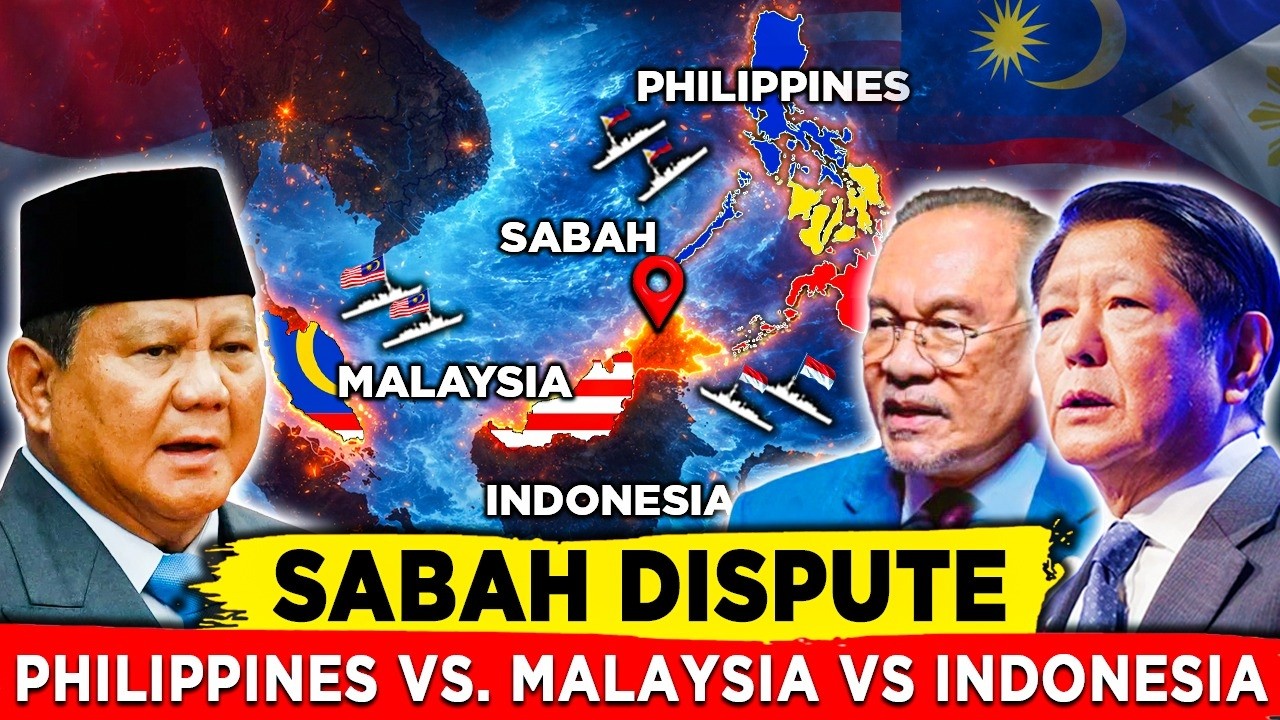
Does Indonesia Also Have a Stake in Sabah?
Last week, when headlines once again mentioned “heightened patrols near Sabah” and quiet diplomatic conversations in Kuala Lumpur, something struck me. Not what was said. But what wasn’t. Every time Sabah makes the news, the script feels familiar. It’s always framed as Malaysia versus the Philippines. The old claim of the Sultanate of Sulu gets dusted off. Commentators rehearse the same lines. And Indonesia? It’s usually treated like a bystander. A neighbor watching from across the maritime fence.
But here’s the uncomfortable question no one really asks out loud: Is Indonesia truly just a spectator in Sabah or is it a silent stakeholder with far more at stake than we admit? Because geography doesn’t lie. And history doesn’t forget. Sabah sits on the northern edge of Borneo, facing the Sulu Sea and the Celebes Sea, waters that directly touch Indonesia’s Kalimantan. To pretend Indonesia has no stake is like saying a fire next door isn’t your concern because your name isn’t on the property title. Maybe you don’t own the house. But the smoke still drifts into your window.
Officially, Indonesia has no legal claim to Sabah. Unlike the Philippines, Jakarta does not assert historical sovereignty rooted in the old Sultanate structures. Malaysia administers Sabah. End of story, at least on paper. But sovereignty on paper and security in practice are two very different things. Think about it.
Tens of thousands of Indonesian workers live in Sabah. Many cross legally. Some don’t. Families stretch across invisible maritime lines. Fishing routes blur. Smuggling routes blur even more. Armed groups in the past have exploited the porous maritime border between Mindanao, Sabah, and Indonesian territory. The Sulu–Celebes Seas have long been a corridor of trade and occasionally, a corridor of instability. If Sabah sneezes, eastern Indonesia doesn’t just hear it. It feels like it.
And that’s where the distinction becomes crucial. There’s a difference between being a claimant state and being a strategic stakeholder. Indonesia is not knocking on Sabah’s door demanding ownership. But it absolutely has material interests tied to what happens there. Maritime security. Counterterrorism coordination. Labor migration flows. Fisheries management. Border control. Even prestige and regional balance inside ASEAN dynamics.
I remember speaking with a regional analyst who once told me, half-jokingly, “In Southeast Asia, proximity is destiny.” That line stayed with me. Because it explains so much of the Sabah dynamic.
Indonesia’s entire doctrine of territorial integrity, born from its own long and painful post-colonial consolidation, makes it deeply sensitive to questions of secession, cross-border insurgency, and gray-zone ambiguity. Jakarta has spent decades guarding against fragmentation within its own archipelago. The last thing it wants is instability festering right along its maritime frontier. And then there’s the demographic reality.
https://indopacificreport.com/will-the-philippines-claim-sabah-from-malaysia/
Sabah is not some distant corner of the map for Indonesia. It’s practically within arm’s reach of Kalimantan. With Indonesia currently investing heavily in its new capital Nusantara in East Kalimantan, the strategic gravity of that region is shifting. The eastern maritime flank is no longer peripheral. It’s central. That changes how Jakarta calculates risk. So maybe the real issue isn’t whether Indonesia has a claim to Sabah. It doesn’t.

The deeper question is whether we’ve underestimated how much Indonesia cares about what happens there and how quietly it works to ensure the status quo doesn’t unravel. Because in Southeast Asia, sovereignty may be defined by treaties. But stability? Stability is defined by proximity, memory, and hard-earned lessons about what happens when borders become fluid. Sabah may not be Indonesia’s territory.
Why Malaysia Thinks Philippines is the Most Dangerous Country
But it is absolutely within Indonesia’s strategic horizon. And that distinction, subtle, often ignored, might be far more important than the legal debate everyone keeps repeating.
Historical Context: Did Indonesia Ever Have Grounds?
When people ask whether Indonesia ever had “grounds” over Sabah, I think the real issue is this: are we talking about history as it actually unfolded, or history as we wish it had been drawn on a map? Because if we go far enough back, the map looks completely different.
Long before Indonesia or Malaysia existed as nation-states, the Sulu Sea and the Celebes Sea functioned as one interconnected economic space. They weren’t frontiers. They were corridors. Trade moved constantly between Sulawesi, Mindanao, and North Borneo. Maritime Southeast Asia operated like a living network, ports linked by wind patterns and kinship ties rather than customs checkpoints.
Bugis and Makassarese traders from Sulawesi were deeply embedded in this world from the seventeenth to nineteenth centuries. They sailed widely, established trading communities, forged alliances, and in some cases settled in parts of North Borneo, including what is now eastern Sabah. Their presence was commercial and social. It was influenced through mobility, not conquest through formal annexation. And this is where we need to be careful with modern vocabulary.
Pre-colonial Southeast Asia didn’t operate on strict territorial sovereignty. It functioned through what scholars describe as a mandala-style system of authority. Power radiated outward from political centers. Influence overlapped. Allegiances could shift. Coastal zones were often layered spaces of shared interaction rather than fenced-off territories.
Sabah Dispute: Will Indonesia Stand With the Philippines or Malaysia?
If you were a sailor from southern Sulawesi docking in eastern Sabah in the eighteenth century, you were not crossing into a clearly demarcated foreign state. You were moving within a maritime ecosystem. Migration flows between Sulawesi and eastern Sabah long predated colonial boundaries. Families moved for fishing, seasonal labor, trade, or marriage. Some returned home. Some stayed. Communities developed across what later became international lines. These movements were normal, not exceptional.
But, and this distinction matters, historical connectivity is not the same as sovereign control. There was no Indonesian republic exercising administrative authority over North Borneo. There was no formal Indonesian claim because there was no Indonesian state yet. The modern concept of exclusive territorial sovereignty simply didn’t apply to that earlier system. Then Europe intervened and everything hardened.
The 1824 Anglo-Dutch Treaty divided British and Dutch spheres of influence in the region. It was a geopolitical bargain made far from the waters it affected. The Dutch consolidated control over the southern part of Borneo, integrating it into what became the Dutch East Indies. The British expanded influence northward.
By 1881, the British North Borneo Company was administering Sabah under a charter. North Borneo was placed firmly within a British imperial structure, separate from Dutch-controlled territories to the south. The once-fluid maritime world was segmented into colonial jurisdictions.
Those colonial borders would prove decisive. When Indonesia gained sovereignty in 1949, it inherited the territorial boundaries of the former Dutch East Indies. That inheritance did not include North Borneo. Legally and diplomatically, there was no transferred Dutch claim to Sabah that Jakarta could inherit. The border lines drawn under colonial rule became the starting point of Indonesia’s international legal identity.https://youtu.be/WA9zZ9TnXMs?si=Dg-4dKJ1O3FTwsgH
So by mid-twentieth-century standards, Indonesia had no inherited territorial claim to North Borneo. But then came the episode that often complicates this discussion: Konfrontasi. Between 1963 and 1966, Indonesia under President Sukarno opposed the formation of Malaysia. Jakarta viewed the new federation, which included Malaya, Sabah, Sarawak, and Singapore, as a British-backed neo-colonial construct. In 1964, Sukarno famously declared, “Malaysia is a neo-colonial project.”
The Confrontation period saw cross-border incursions into Sabah and Sarawak. Roughly 590 armed incidents were recorded during the conflict. Casualty estimates vary, but approximately 114 Indonesian personnel and around 590 Commonwealth forces were killed.
Philippines vs. Malaysia: A Tale of Two Militaries – From Sabah to the South China Sea
It was tense. It was real. It involved military activity on and around Sabah’s territory. But here is the crucial analytical clarification: Indonesia’s opposition was ideological and geopolitical, not territorial in the sense of seeking to annex Sabah.
Jakarta never formally asserted sovereignty over Sabah. It did not claim Sabah as Indonesian territory. The objective was to challenge and destabilize what it saw as a Western-sponsored federation on its periphery, not to absorb North Borneo into Indonesia. That distinction matters.
Konfrontasi demonstrated that Indonesia cared deeply about the political configuration of its neighborhood. It was willing to use force to contest what it perceived as neo-colonial influence. But even at the height of confrontation, Jakarta did not transform its position into a legal claim over Sabah. So if we step back and assess the historical record with precision:https://youtu.be/Sug3wIgAPag?si=04RB9X5JB5N0YaZB
Pre-colonial linkages created deep maritime connectivity and demographic overlap. Colonial treaties formalized territorial divisions that excluded North Borneo from Dutch control. Post-independence Indonesia inherited those Dutch-defined borders. And during Konfrontasi, Indonesia challenged Malaysia’s formation but did not claim Sabah as its own. The conclusion may not be dramatic, but it is clear.
Indonesia has historical connectivity with Sabah’s maritime zone. Indonesia has demonstrated geopolitical sensitivity to developments there. But it has never possessed, inherited, or formally asserted sovereign grounds over Sabah. History shows influence, proximity, and confrontation. It does not show a territorial claim.
Legal Position: Does Indonesia Have a Claim?
Alright. Let’s strip this down to brass tacks. If we’re talking strictly legal positions, not history, not emotion, not geopolitics but law, documents, signatures, filings, then the answer is actually very clear. Indonesia does not have a territorial claim over Sabah. Full stop.
Jakarta formally recognizes Sabah as part of Malaysia. There has been no submission to the International Court of Justice, no UN filing asserting competing sovereignty, no diplomatic campaign suggesting otherwise. Bilateral agreements between Indonesia and Malaysia operate on the assumption that Sabah is Malaysian territory. That’s the baseline. And in international law, what you don’t claim matters just as much as what you do.https://www.youtube.com/watch?v=lgyJA351Pis
This isn’t ambiguous. It isn’t a coded language. Indonesia’s legal position is straightforward: there is no Indonesian territorial claim to Sabah. Now, where things get more complex and honestly more interesting, is at sea. Because while Indonesia does not contest Sabah as land territory, maritime boundaries in the Celebes Sea, which Indonesia calls the Sulawesi Sea, have long been sensitive. Overlapping claims in parts of the seabed and Exclusive Economic Zones created friction for decades.
The 2002 International Court of Justice decision over Sipadan and Ligitan is important here. The Court awarded both islands to Malaysia. Indonesia accepted the ruling. That acceptance was significant. It reinforced Jakarta’s commitment to legal resolution rather than territorial escalation.
Then in 2023, Indonesia and Malaysia reached a maritime boundary agreement resolving part of their overlapping EEZ claims in the Sulawesi Sea. It didn’t eliminate every technical issue, but it reduced ambiguity. That’s not the behavior of a state quietly preparing a sovereignty challenge. That’s the behavior of two neighbors trying to stabilize their maritime interface.
But here’s where the strategic math kicks in. Indonesia has the second-longest coastline in the world, roughly 54,700 kilometers. It is the world’s largest archipelagic state. Maritime space isn’t peripheral to Indonesia. It is central to its identity, economy, and security doctrine.
And Sabah sits right along that maritime equation. Under UNCLOS, Exclusive Economic Zones extend 200 nautical miles from baselines, unless overlapping with another state. When Sabah’s coast projects outward, it shapes Malaysia’s EEZ footprint. And that footprint directly intersects with Indonesia’s.
So while Indonesia does not care about Sabah as land to annex, it absolutely cares about how Sabah’s coastline affects maritime delimitation. That’s the real stake. Fishing rights. Energy exploration. Seabed resources. Sea lanes. Naval movement corridors. All of that flows from maritime boundaries, not flags planted on hills.
Sometimes I think people get distracted by the dramatic version of sovereignty disputes, the idea of tanks crossing borders or politicians waving maps. But in maritime Southeast Asia, power is often quieter. It’s measured in nautical miles, hydrocarbon blocks, and fisheries enforcement patrols. Indonesia’s position is actually disciplined.
No territorial claim. Clear recognition of Malaysian sovereignty over Sabah. Commitment to legal frameworks, including ICJ rulings and UNCLOS mechanisms. But at the same time: intense sensitivity to maritime geometry. Sabah’s proximity matters because it shapes Indonesia’s EEZ calculations. It affects where Indonesian patrol boats sail, where fishing vessels operate, where potential offshore energy concessions can be granted.
So when we ask, “Does Indonesia have a claim?” The honest answer is no, not territorially, not legally, not diplomatically. But does Indonesia have interests tied to Sabah’s geographic position? Absolutely. And those interests are maritime, not territorial. That distinction isn’t semantic. It’s structural. One is about sovereignty over land. The other is about managing shared seas in one of the most strategically dense maritime corridors in the Indo-Pacific.
Indonesia’s stake isn’t about owning Sabah. It’s about ensuring that what happens along Sabah’s coast doesn’t compromise Indonesia’s own maritime domain. That’s a very different kind of leverage and a very different kind of calculation.
Security Stake: Why Sabah Matters to Jakarta
If you stand in Jakarta and look north, Sabah isn’t some distant political abstraction. It sits right across a maritime corridor that Indonesia cannot afford to ignore. The sea boundary in that sector stretches more than a thousand kilometers. And this isn’t a fenced land border with checkpoints and guard posts. It’s open water. Wind, currents, fishing fleets, small cargo vessels. Beautiful but porous.
For years, that porosity created problems. Smuggling routes ran through it. Human trafficking networks exploited it. Illicit arms moved quietly between islands. The geography made enforcement hard, and non-state actors knew it.
Then came the kidnappings. Between 2016 and 2018, militants linked to Abu Sayyaf carried out abductions in and around Sabah waters. Dozens of Indonesian sailors were taken hostage in cross-border attacks. These were tugboat crews and fishermen, not soldiers. Watching those headlines at the time, you could feel the anxiety building inside Indonesia. It wasn’t theoretical. It was immediate. Citizens were being pulled off boats.
Philippines Beefs Up Air Power with FA-50 Fighter Jet Acquisition
That’s when the security logic sharpened. In 2017, Indonesia, Malaysia, and the Philippines launched coordinated trilateral maritime patrols, widely known as INDOMALPHI. The goal was simple: close the gaps. Share intelligence. Increase naval and air presence. Make it harder for armed groups to exploit jurisdictional seams.
And it worked. According to ReCAAP reporting, piracy and kidnapping incidents in the Sulu–Celebes Seas dropped sharply after coordinated patrols intensified. The sea lanes didn’t become perfectly safe overnight, but the difference was measurable. That’s the key implication: stability in Sabah directly affects Indonesian national security. Not symbolically. Operationally.
Sabah isn’t a distant diplomatic talking point for Jakarta. It’s part of the same maritime ecosystem that touches eastern Kalimantan and Sulawesi. When instability grows there, Indonesia absorbs the shock.
Economic and Demographic Interdependence
Security is only one layer. The deeper layer is people. Estimates suggest between 300,000 and 800,000 Indonesians live in Sabah both documented and undocumented. That’s not a small migrant community. That’s one of the largest concentrations of Indonesian workers abroad. They work in palm oil plantations. Construction. Fisheries. Some of the hardest and least visible jobs in Sabah’s economy are done by Indonesian labor.
And the money flows back. Remittances from Malaysia contribute billions of dollars annually to Indonesia’s economy. For certain provinces in eastern Indonesia, those transfers are not marginal, they are lifelines. Families depend on them. Local economies factor them in.
Sabah’s stability, then, is directly tied to Indonesian labor welfare. If there is unrest, mass deportations, or economic contraction in Sabah, Jakarta feels it almost immediately, socially and economically. There’s also the cross-border economy that doesn’t always show up neatly in customs data.
Tawau in Sabah and Nunukan in Indonesia have long been linked by trade flows that predate modern enforcement systems. Informal economic integration existed long before bureaucracies tried to regulate it. Boats move daily. Goods move daily. The rhythm is older than the paperwork. You can’t switch that off without consequences.
Geopolitical Positioning
Indonesia also views the issue through a doctrinal lens. For decades, Jakarta has positioned itself as ASEAN’s de facto anchor state. Its foreign policy doctrine, famously described as “bebas dan aktif” (free and active), emphasizes territorial integrity, non-interference, and peaceful dispute settlement.
Reopening or revisiting Sabah’s sovereignty would contradict Indonesia’s own foundational principles. It would weaken the very norm Jakarta relies on to defend its own territorial cohesion. And this is where the contrast with the Philippines becomes striking.
The Philippines maintains a dormant but formal claim to Sabah rooted in the Sulu Sultanate. Indonesia does not. Manila’s exposure is political and historical. Indonesia’s exposure is material. Indonesia has a massive migrant population in Sabah. It faces high security spillover risk. Its maritime calculations are directly affected. In many ways, Indonesia has greater practical exposure to Sabah than the Philippines but far less incentive to challenge sovereignty. That’s not a weakness. That’s structural logic.
Could Indonesia’s Position Ever Shift?
Hypothetically, yes but only under extreme conditions. If Sabah experienced major internal instability. If Malaysia–Philippines tensions escalated dramatically. If maritime boundary disputes spiraled into sustained confrontation. Even then, escalation would run against Indonesia’s core interests. Indonesia’s archipelagic doctrine depends on the sanctity of inherited borders. Undermining that principle would set uncomfortable precedents, especially when Jakarta is already sensitive about peripheral regions like Papua.
There’s also hard economics. Bilateral trade between Indonesia and Malaysia exceeds $20 billion annually. The relationship is dense, layered, and mutually dependent. Risking that over a territory Indonesia has never legally claimed would contradict Jakarta’s strategic culture. Structurally, escalation is unlikely.
PH Air Force Could Get Deadly New Turkish Attack Helicopters
The Strategic Reality
Indonesia is best understood as a silent stakeholder. Its interests in Sabah operate across three domains: Security exposure. Labor migration and remittance flows. Maritime boundary stability. Sabah is not an irredentist cause for Indonesia. There are no mass movements demanding annexation. No official maps shading it red. But it is a strategic buffer zone critical to eastern Indonesian security. That’s the nuance people often miss.
Claim vs. Consequence
The conclusion, when stripped of drama, is precise. Indonesia does not possess a legal or historical sovereignty claim to Sabah. It has never formally asserted one. It recognizes the Malaysian administration. But Indonesia has tangible strategic stakes, security, demographic, and maritime, that make it an indispensable secondary actor in any Sabah-related instability. In other words: Indonesia may not claim Sabah but Sabah unquestionably shapes Indonesia’s security calculus.https://youtu.be/7TyGTGqG-yw?si=zqgvwyb2FP1X010R