China PANICS After Philippines Draws New Scarborough Baselines
The South China Sea remains one of the world’s most strategically sensitive regions, where legal decisions, territorial claims, and military activities often overlap. The latest development involves the Philippines’ decision to establish new baselines around Scarborough Shoal and submit them to the United Nations. While Manila describes the move as a legal step to reinforce its maritime rights under international law, Beijing has rejected it outright, calling the baselines “illegal and invalid.”
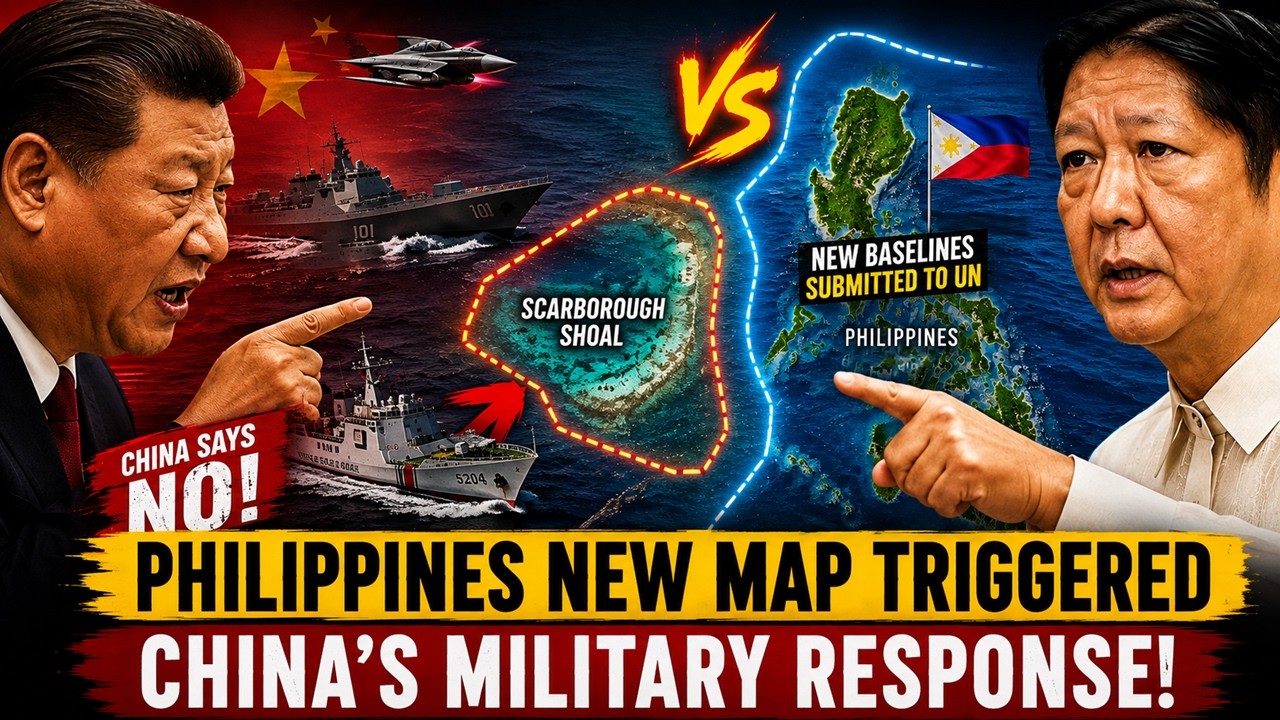
China’s response went far beyond diplomatic criticism. Within days, it launched joint naval and air patrols around the disputed shoal, sending a clear signal that the disagreement extends beyond legal interpretation. The incident highlights how even administrative or legal actions can rapidly escalate into geopolitical tensions in the South China Sea.
What Exactly Did the Philippines Do?
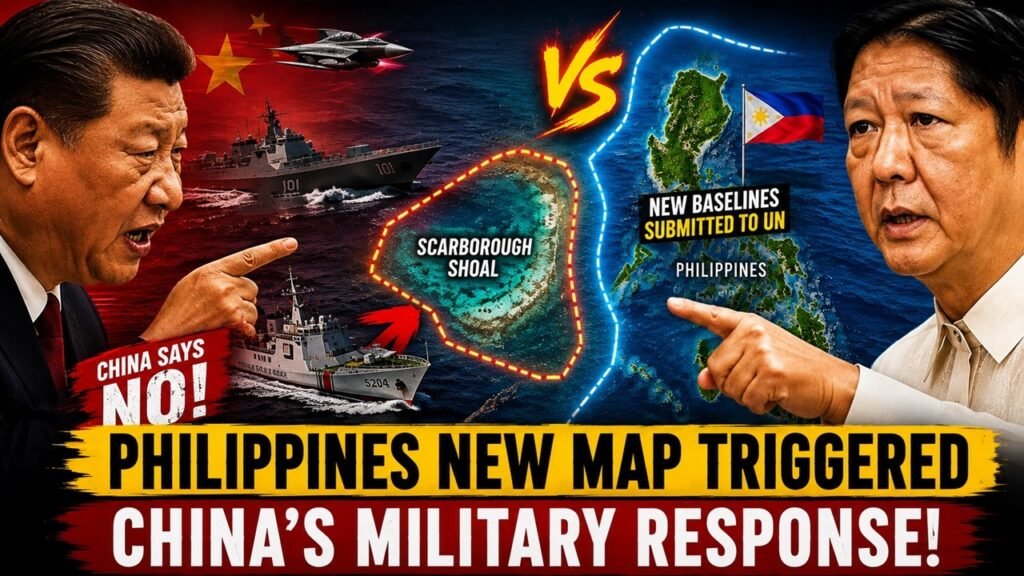
At first glance, the Philippines’ latest move appeared to be a routine legal procedure rather than a major geopolitical event. Instead of deploying additional naval forces or announcing a new military operation, Manila submitted an official nautical chart of Scarborough Shoal to the United Nations. The document outlines what the Philippine government considers the normal baselines surrounding the shoal, including its 12-nautical-mile territorial sea and a 24-nautical-mile contiguous zone under the United Nations Convention on the Law of the Sea (UNCLOS).
According to Philippine officials, the submission does not represent an attempt to expand the country’s territory. Instead, it is intended to reinforce the legal certainty of the Philippines’ existing maritime entitlements under international law. By officially documenting these baselines, Manila seeks to clarify how it measures its maritime zones and demonstrate that its claims are consistent with UNCLOS.
However, China interpreted the move very differently. Beijing immediately rejected the new baselines, describing them as “illegal and invalid” and accusing the Philippines of violating Chinese sovereignty. Chinese authorities reiterated that Scarborough Shoal—known in China as Huangyan Dao—has always been Chinese territory and insisted that Manila has no legal authority to establish maritime baselines around the disputed feature.
The response was not limited to official statements. Shortly after the announcement, the People’s Liberation Army and the China Coast Guard conducted joint naval and air patrols around Scarborough Shoal. Chinese officials stated that these operations were intended to safeguard China’s territorial sovereignty and maritime rights, while also demonstrating its readiness to respond to actions it considers provocative.
The episode illustrates how legal actions in the South China Sea can quickly take on military and strategic significance. What began as a formal submission to the United Nations rapidly evolved into a visible display of military presence, reinforcing the sensitivity of maritime disputes in the region.
Philippines Challenges China AGAIN at the U.N Over the South China Sea
What Are Baselines and Why Do They Matter?
To understand China’s strong reaction, it is important to first understand what maritime baselines actually are. Under international law, a baseline is the reference line from which a coastal state measures its maritime zones. These measurements determine the extent of a country’s territorial sea, contiguous zone, Exclusive Economic Zone (EEZ), and, in some cases, parts of its continental shelf.
The Philippines’ submission to the United Nations outlines the baselines it believes should apply to Scarborough Shoal. From these baselines, Manila calculates the maritime zones that it considers consistent with its rights under UNCLOS. These zones are important because they influence fishing rights, maritime law enforcement, resource exploration, environmental management, and navigation.
One of the most common misconceptions is that drawing baselines automatically determines ownership of disputed territory. In reality, baselines do not settle questions of sovereignty. Instead, they provide a legal framework for measuring maritime zones around territory that a state already claims. Ownership disputes remain separate and must be resolved through diplomatic negotiations, international legal processes, or mutual agreements between the parties involved.
This distinction is central to understanding the disagreement between China and the Philippines. While Manila argues that the new baselines simply clarify its existing maritime entitlements under international law, Beijing believes that the action could strengthen the Philippines’ legal and diplomatic position in the future. From China’s perspective, accepting these baselines without objection could be interpreted as weakening its long-standing claim over Scarborough Shoal.
As a result, what appears to be a technical legal procedure has become a strategic issue with wider implications for regional security, diplomacy, and the balance of power in the South China Sea. The disagreement demonstrates that in maritime disputes, even the drawing of lines on a map can carry significant geopolitical consequences.
Military Presence in the Region
China has gradually increased its military and coast guard presence around Scarborough Shoal over the past decade. Regular patrols, surveillance missions, and maritime law enforcement operations have become part of Beijing’s broader strategy to reinforce its territorial claims. The Philippines has also strengthened cooperation with allies through joint military exercises and maritime patrols, increasing the strategic importance of the area.
The South China Sea is believed to contain significant reserves of oil and natural gas beneath its seabed. Although the exact amount of resources near Scarborough Shoal remains uncertain, energy security is a major reason why claimant states continue to defend their positions. Access to potential offshore resources could play an important role in meeting future energy demands and reducing dependence on imported fuels.
The Role of the United States and Regional Allies
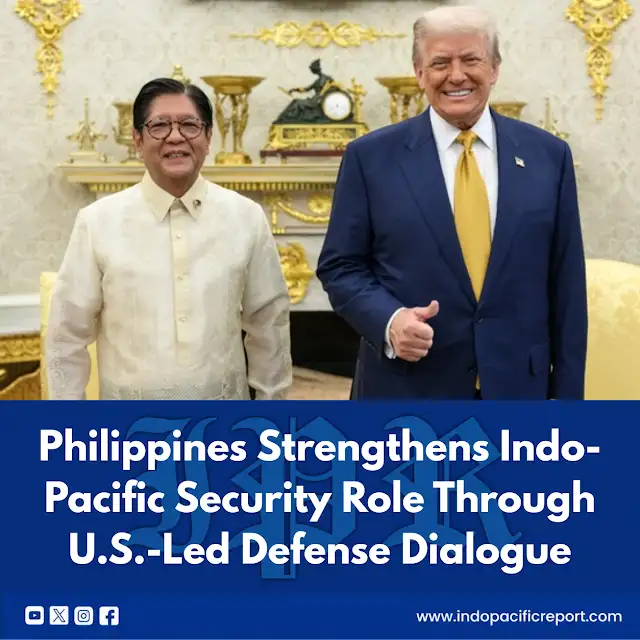
The South China Sea dispute is no longer limited to China and the Philippines. Countries such as the United States, Japan, Australia, and several ASEAN members closely monitor developments in the region. The United States has reaffirmed its commitment to supporting the Philippines under their Mutual Defense Treaty, while Japan and Australia have expanded security cooperation with Manila. This growing international involvement highlights the wider geopolitical implications of the dispute.
One of the biggest challenges in the South China Sea dispute is the difference between international legal principles and competing sovereignty claims. While UNCLOS provides rules for measuring maritime zones and defining maritime rights, it does not automatically resolve disputes over territorial ownership. As a result, legal interpretations and historical claims often clash, making peaceful resolution more complicated.
Can Diplomacy Prevent Future Tensions?
Despite rising tensions, diplomacy remains one of the few viable paths toward reducing the risk of conflict. ASEAN and China have continued negotiations on a Code of Conduct for the South China Sea, aiming to establish clearer rules for managing encounters at sea. Although such an agreement would not settle sovereignty disputes, it could reduce misunderstandings and help prevent dangerous incidents between naval and coast guard vessels.
How This Dispute Affects Regional Security
The dispute over Scarborough Shoal has implications far beyond the immediate area. Continued tensions influence regional security, international trade, freedom of navigation, and military planning across the Indo-Pacific. As competition between major powers intensifies, developments in the South China Sea are increasingly viewed as part of a broader strategic rivalry that could shape the future security architecture of Asia.
The latest developments around Scarborough Shoal demonstrate that the South China Sea will remain a critical geopolitical hotspot for years to come. Legal actions, military patrols, diplomatic negotiations, and international partnerships will continue to shape the evolving balance of power in the Indo-Pacific. Whether the dispute moves toward greater cooperation or deeper confrontation will depend on how regional actors manage their competing interests while avoiding unintended escalation.
About Indo-Pacific Report
For more geopolitical analysis, strategy coverage, and Indo-Pacific security reporting, visit Indo-Pacific Report:
Website
Facebook
YouTube
China PANICS After Philippines Draws New Scarborough Baselines