Australia Is Quietly Building a New Defense Alliance with the Philippines
The Philippines is preparing for one of the most significant changes in its naval capability: the possible acquisition of its first two diesel-electric submarines. The planned program is estimated at around ₱80 billion to ₱110 billion. At first glance, that figure may look like the price of two submarines. In reality, however, Manila is preparing to build an entirely new undersea capability from the ground up.
The Armed Forces of the Philippines says the program includes not only the submarines but also the basing and logistical requirements needed to operate them. That means the investment has to cover much more than the vessels themselves. The Philippines will need trained submarine crews, specialized maintenance facilities, spare parts, training systems, simulators, infrastructure, operational procedures and long-term support.
This distinction is important because the Philippines has never operated a submarine fleet. Manila is therefore not simply purchasing a new class of warship. It is learning how to operate in an entirely different part of the maritime battlespace. The real question is not just which submarine the Philippines will buy, but whether it can build a sustainable submarine force around those first two boats.
Why Does the Philippines Want Submarines?
The strongest argument begins with geography. The Philippines is an archipelago made up of thousands of islands and surrounded by a vast maritime area. Its exclusive economic zone extends 200 nautical miles from its coasts, meaning that a large part of the country’s strategic interests exists at sea. The Philippines already operates surface ships and aircraft that can patrol, monitor and respond to maritime activity. However, these platforms are generally easier to detect than a submarine operating beneath the surface. A conventional submarine can remain concealed for long periods, gather information and create uncertainty about its exact location.
That capability fits the Philippines’ changing defense priorities. The original Horizon 3 modernization period was later reworked through Re-Horizon 3, approved in January 2024 and planned to run for ten years. The revised approach places greater emphasis on external and archipelagic defense, including the ability to defend the country’s maritime domain farther from its coastline. AFP chief Gen. Romeo Brawner Jr. has described the concept in terms similar to forward defense and has identified submarines as one of the capabilities that can help project defense into the maritime environment. For a country whose geography is dominated by water, an undersea capability can therefore add a layer of defense that surface ships and aircraft cannot completely replicate.
Philippine Navy’s Counter Strategy to Deter China’s Massive Fleet in SCS
Stealth, Surveillance and Sea Denial
The strategic value of a submarine comes from three closely connected capabilities: stealth, surveillance and sea denial. A submarine is not invisible, and modern navies have sophisticated methods for detecting underwater vessels. However, a quiet conventional submarine can still be difficult to locate, particularly when operating carefully and using the surrounding environment to its advantage. That uncertainty can be strategically valuable. An opposing force may know that a Philippine submarine could be operating in an area without knowing exactly where it is. This forces the opposing force to spend additional resources searching for it, tracking it and protecting its ships.
A submarine can also serve as a surveillance platform. It can observe maritime activity while attempting to keep its own position concealed. In a region where maritime domain awareness is increasingly important, this can complement aircraft, ships, radar and other intelligence systems. The third element is sea denial. The Philippines would not need two submarines to control the South China Sea, and such a goal would be unrealistic against a much larger naval power. A more practical objective would be to make selected waters more difficult and costly for an adversary to dominate. The purpose is not necessarily to control the sea, but to make an opponent think carefully before operating there.
Why the South China Sea Matters
The timing of the Philippine submarine program is closely connected to the increasingly contested maritime environment around the country. In May 2026, the Armed Forces of the Philippines reported monitoring 35 Chinese naval and coast guard vessels around four key West Philippine Sea features, including Ayungin Shoal, Bajo de Masinloc, Escoda Shoal and Pag-asa.
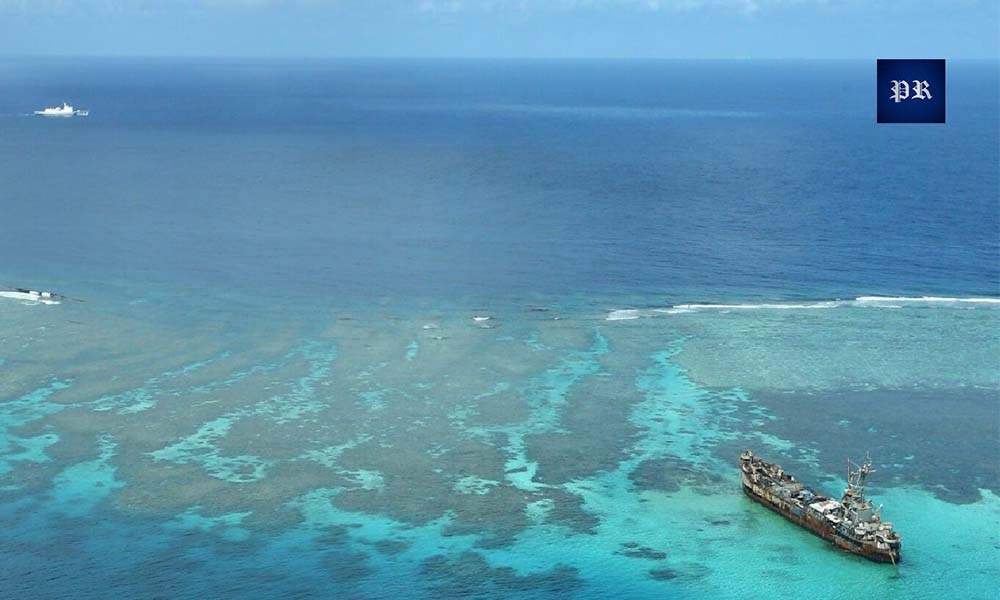
The pressure is not limited to one location. Philippine resupply missions to the BRP Sierra Madre at Second Thomas Shoal have continued under intense Chinese pressure, while Chinese maritime forces maintain a persistent presence around Scarborough Shoal. The source material also records confrontations in July 2026, including water-cannon incidents near Scarborough Shoal. This is the maritime environment in which Manila is considering its first submarines. The Philippines is already developing surface ships, aircraft, missiles and surveillance capabilities. A submarine would add something different: an underwater presence that may remain concealed while operating in the same contested maritime space. Its strategic value would not necessarily depend on immediately attacking another navy. The mere possibility that a Philippine submarine could be operating beneath the surface could force an opposing force to devote more resources to anti-submarine warfare, surveillance and force protection. That is the basic logic behind using submarines as part of a sea-denial strategy.
Who Could Build the Philippine Submarines?
The competition for the Philippine submarine program involves several major international defense companies. The source material identifies Hanwha Ocean, Naval Group, Navantia, and the Fincantieri–thyssenkrupp Marine Systems partnership as major contenders. Hanwha Ocean of South Korea has an important advantage because Manila already has significant experience working with South Korean defense companies. Its proposal has been described as extending beyond the submarines themselves to include a submarine base, maintenance facilities, training, simulators and technology transfer. For a country starting from zero, that broader package could be highly significant. France’s Naval Group is offering the Scorpène submarine, a conventional design already operated by several navies, including India, Brazil, Chile and Malaysia. Its proposal has also emphasized infrastructure, training and long-term support, including the possibility of developing Subic Bay for submarine operations.
Spain’s Navantia is offering the S-80, while the Fincantieri–thyssenkrupp Marine Systems partnership is offering the U212 NFS. Both bring long-established European submarine expertise. For Manila, however, the final decision is unlikely to depend only on which submarine has the most attractive specifications. The Philippines will also need to consider who can train Filipino crews, provide maintenance support, transfer useful technology, supply spare parts, manage upgrades and support the Philippine Navy over several decades. In other words, the Philippines is not simply selecting a submarine. It is selecting a long-term partner that can help build its first submarine force.
What Would Two Philippine Submarines Mean for China?
Two Philippine submarines would not balance China’s navy. China’s maritime forces are vastly larger, and the People’s Liberation Army Navy already operates a substantial submarine fleet. Manila is therefore not attempting to match China ship for ship. The more realistic objective is to make Philippine waters harder to dominate. China already has to consider Philippine surface ships, aircraft, missiles and surveillance systems. Adding submarines would introduce another layer of uncertainty.
A Chinese force may be able to identify Philippine ships and track aircraft, but it may not know whether a Philippine submarine is operating somewhere beneath the same waters. That creates additional demands for search, tracking and protection. This is the essence of sea denial. A smaller navy does not necessarily need to dominate a much larger opponent. It can instead try to make the opponent’s operations more complicated, more expensive and more uncertain. During Balikatan 2026, Philippine and allied forces conducted anti-submarine warfare training in the West Philippine Sea and successfully detected and tracked a subsurface contact. That demonstrates that underwater warfare is becoming part of the Philippines’ practical defense training rather than remaining a purely theoretical capability. The strategic value of the submarines may therefore be measured not only by what they can destroy, but also by the decisions they can force an adversary to reconsider.
A Submarine Cannot Fight Alone
One of the most important points about the Philippine submarine program is that the submarines cannot operate effectively in isolation. A submarine may be hidden, but it still needs intelligence, sensors, communications, logistics and supporting forces.
The Philippine Navy therefore needs to build a wider underwater warfare network around the submarines. That network can include frigates and other surface vessels, anti-submarine helicopters, maritime patrol aircraft, sonar, underwater sensors, intelligence systems, maritime surveillance and secure communications. The broader defense architecture can be understood as several connected layers. Aircraft provide surveillance from the air. Surface ships provide presence and support on the water. Coastal-defense missiles create another layer of deterrence and sea denial. Radar, intelligence and maritime domain awareness provide information. Submarines and anti-submarine warfare capabilities add the underwater layer.
The submarine becomes most valuable when these systems can exchange information and operate as part of the same defense network. An aircraft may detect a contact, a surface ship may help track it, sensors may provide additional information, and a submarine may operate beneath the same battlespace without revealing its own position. This means the Philippines is not simply trying to buy two submarines. It is attempting to connect air, surface, information and underwater warfare into a more integrated defense system.
Is the ₱80–₱110 Billion Submarine Program Worth It?
The cost is one of the biggest questions surrounding the program. Spending ₱80 billion to ₱110 billion on two submarines and the associated capability represents a major defense investment. Every peso committed to the program is money that cannot be spent on other priorities such as frigates, aircraft, missiles, drones or surveillance systems.
The argument in favor of submarines is that they provide a combination of stealth, surveillance, sea denial and strategic uncertainty that is difficult to reproduce with surface platforms. For a smaller navy facing a much larger regional maritime power, the ability to operate without constantly revealing a force’s position can have significant strategic value. However, the disadvantages are equally important. Submarines require specialized crews, infrastructure, maintenance, training, logistics and long-term modernization. The cost continues after the vessels are delivered.
Fleet size also matters. With only two submarines, availability can become a serious issue. If one submarine is undergoing maintenance and the other is training or being repaired, the Philippines could temporarily have no operational submarine available. This is one reason why building a submarine force is more complicated than simply purchasing two boats. The real policy question is therefore not whether submarines are better than every other defense capability. The question is whether the Philippines needs an undersea capability badly enough to justify the long-term investment required to create and sustain one.
What Happens Next for the Philippine Submarine Program?
The next stage of the program will determine whether Manila simply acquires two submarines or builds the foundation of a sustainable submarine force. Several decisions will be critical, including the selection of a supplier, submarine basing, crew training, weapons and sensors, maintenance arrangements, technology transfer and long-term sustainment.
The Philippines will also need to determine how many submarines it ultimately wants. Two boats cannot guarantee that two will always be available for operations. One could be undergoing maintenance while the other is training. Over time, Manila may have to decide whether two submarines are sufficient or whether the fleet should eventually expand.
That distinction is crucial because having submarines is not the same as having a submarine force. A genuine submarine force requires trained personnel, doctrine, infrastructure, maintenance capacity, operational experience and a reliable support chain. If Manila successfully develops those foundations around its first two submarines, the program could become much more significant than a single procurement project. The first boats could serve as the foundation for a permanent Philippine undersea capability.
Conclusion: The Beginning of a New Philippine Naval Capability
The ₱80 billion to ₱110 billion figure is easy to describe as the price of two submarines. But that description does not capture the full strategic decision facing Manila. The investment represents the beginning of a new military capability: submarine crews, bases, training systems, maintenance, logistics, weapons, doctrine and the wider network required to operate beneath the surface. Two submarines will not turn the Philippines into a naval superpower. They will not balance China’s much larger fleet, and they will not solve every problem in the South China Sea. But they could give Manila something it has never possessed before: an indigenous undersea capability that can support the defense of its maritime domain and create uncertainty for a much larger potential adversary.
The most important question is therefore not simply whether the Philippines can purchase two submarines. It is whether Manila can build everything around them that will allow those submarines to remain operational and strategically useful for decades. If it succeeds, the first two submarines could be more than a procurement program. They could become the foundation of the Philippines’ first permanent submarine force. Frequently Asked Questions About the Philippine Submarine Program How much will the Philippines spend on submarines? The source material places the planned investment at approximately ₱80 billion to ₱110 billion for two diesel-electric submarines together with associated basing and logistical requirements. Why does the Philippines want submarines? The main reasons are the country’s archipelagic geography, its large maritime domain, and the need for stealth, surveillance and sea-denial capabilities.
Does the Philippines already operate submarines? No. The source material states that the Philippines has never operated a submarine fleet. This makes crew training, infrastructure and sustainment especially important. Will two submarines balance China? No. The objective is not to match China’s much larger navy. The more realistic purpose is to make Philippine waters harder to dominate and increase uncertainty for an opposing force. Which companies are competing to supply the submarines? The source identifies Hanwha Ocean, Naval Group, Navantia, and the Fincantieri–thyssenkrupp Marine Systems partnership as major contenders. Why are anti-submarine capabilities important? A submarine cannot operate effectively in isolation. Aircraft, ships, sensors, intelligence, communications and anti-submarine warfare capabilities are needed to build a functioning underwater warfare network.
About Indo-Pacific Report
For more geopolitical analysis, strategy coverage, and Indo-Pacific security reporting, visit Indo-Pacific Report:
Website
Facebook
YouTube
Australia Is Quietly Building a New Defense Alliance with the Philippines