After the Frigates: Charting the Philippine Navy’s Corvette Crossroads in Re-Horizon 3
What happens after the flag-raising ceremonies end, and the sea stops being forgiving? As headlines once again fill with reports of tense encounters in the West Philippine Sea, close-in maneuvering, water cannons, and steel hulls brushing against steel hulls, a far more consequential question quietly hangs over Manila: Was the Philippine Navy’s modernization merely about catching up, or is it finally about holding ground? The commissioning of modern frigates was celebrated as a long-overdue comeback, but history is brutal to navies that stop halfway. In the unforgiving geometry of maritime power, recovery is not deterrence, and symbolism does not survive first contact.
Only months ago, Philippine leaders were publicly affirming a hard truth that had long been whispered behind closed doors: the era of presence without protection is over. As one senior AFP official bluntly put it, deterrence today is no longer about showing up, it is about the ability to fight, survive, and come back. That statement was not rhetoric; it was a quiet admission that the Navy now stands at a crossroads. The frigates proved the Philippines could modernize again. The corvettes will decide whether it can actually defend itself.
This is why “after the frigates” is not a procurement debate, it is a strategic inflection point. The first modern surface combatants since independence marked a recovery phase after decades of neglect, but recovery is only meaningful if it leads somewhere. Re-Horizon 3 fundamentally rewires the Armed Forces of the Philippines away from internal security and toward Territorial Defense Operations, placing the Navy, not the Army, at the center of national survival calculus. In the West Philippine Sea, sovereignty is not asserted through statements; it is negotiated daily by sensors, missiles, endurance, and escalation control. Without capable mid-tier combatants to bridge patrol vessels and frigates, the fleet risks becoming a hollow force, modern on paper, brittle at sea.
Think of the corvette question as the difference between locking your front door and installing a security system. The frigates closed the door; the corvettes determine whether intrusions are deterred or merely documented. They are the ships that will escort, screen, absorb pressure, and stay on station when crises stretch from hours into weeks. Get this decision right, and Philippine naval modernization matures into credible deterrence. Get it wrong, or delay it, and the entire Re-Horizon 3 vision risks collapsing into symbolism, impressive in parades but irrelevant in confrontation.
The Philippine Navy has already proven it can rise from neglect. What comes next will prove whether it can stand firm. The frigates were the comeback story. The corvettes will decide the ending.
Fleet Baseline: Where the Philippine Navy Actually Stands (2025–2026)
Strip away the ceremonies, the commissioning photos, and the glossy defense briefings, and this is where the Philippine Navy actually stands in 2025–2026. On paper, the fleet looks modern for the first time in generations. In practice, it is still dangerously thin. The surface combatant force today rests almost entirely on four modern frigates: two Jose Rizal-class ships displacing around 2,600 tons, and two larger Miguel Malvar-class frigates at roughly 3,200 tons. These vessels represent a historic leap forward but they also reveal an uncomfortable truth. There are no dedicated corvettes, no true mid-tier combatants, and no margin for attrition, rotation, or sustained pressure.
This gap matters because modernization has not yet translated into balance. Despite the leap in capability, the fleet still lacks a single full-spectrum anti-submarine warfare surface combatant. Area air defense remains limited, with no layered naval shield capable of protecting task groups against saturation threats. In an era where submarines, drones, and long-range missiles define sea control, the Philippine Navy’s surface force is modern but not complete.
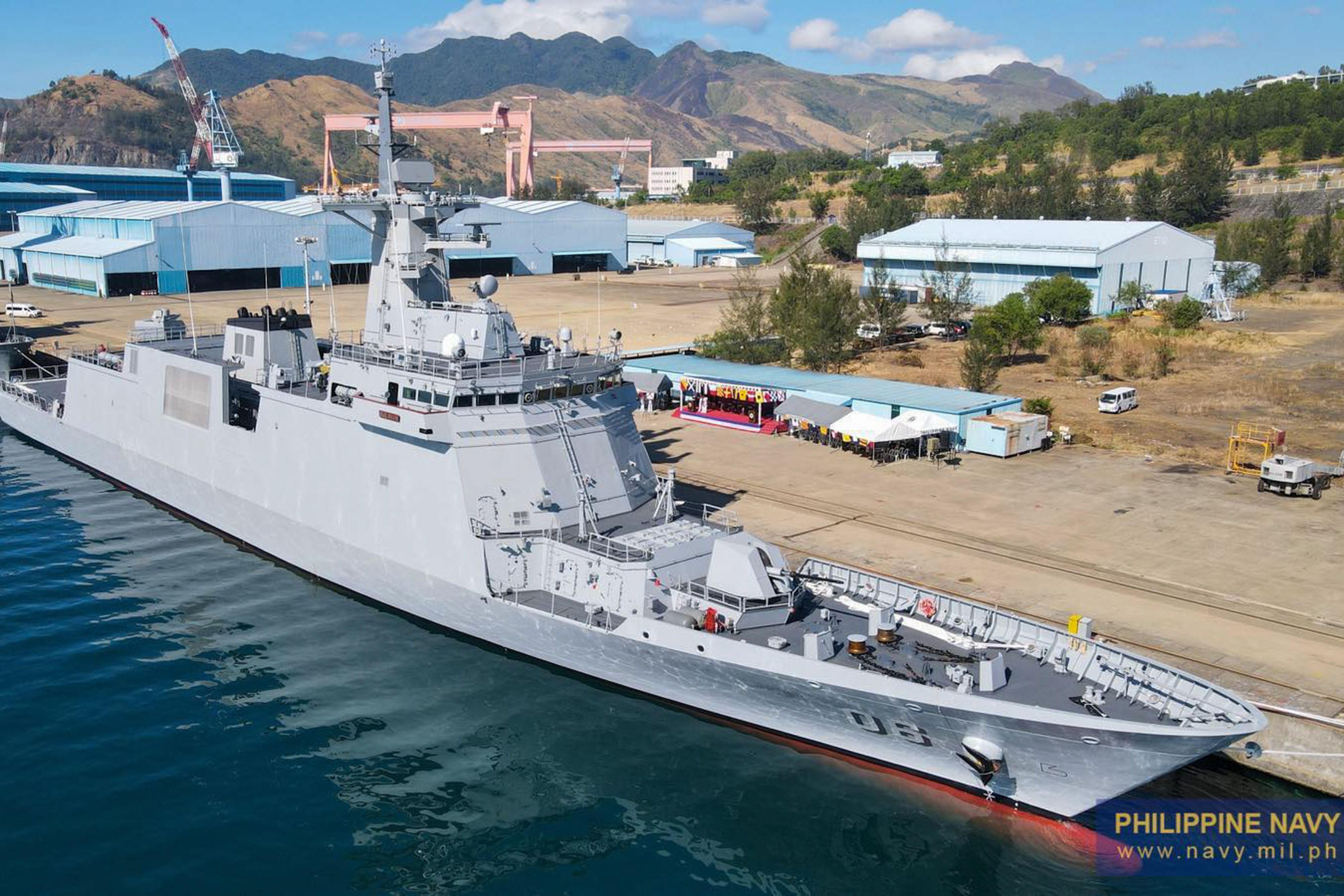
To be clear, progress has been real and hard-won. The transition away from aging, hand-me-down hulls, some tracing their lineage to World War II, marks a structural break from the past. Today’s warships carry modern combat management systems, contemporary radars, and digital datalinks that finally allow the Navy to fight as a networked force rather than isolated platforms. Just as importantly, surface warfare crews are more professional, better trained, and increasingly accustomed to operating complex systems under demanding conditions. This is not the Philippine Navy of the 1990s.
Yet capability gaps loom precisely because everything now rests on so few hulls. There is still no meaningful layered air defense at sea. Organic anti-submarine warfare remains minimal, leaving surface units exposed in contested waters. Fleet depth is insufficient for high-tempo operations, where ships must rotate, refit, and recover while maintaining presence. In a real crisis, every deployment would come at the cost of readiness elsewhere, a classic sign of a force stretched too thin.
The bottom line is uncomfortable but unavoidable. The Philippine Navy looks modern today but it does not yet look resilient. It can show the flag, patrol contested waters, and signal resolve. What it cannot yet do is sustain pressure, absorb losses, or dominate escalation ladders. That is the gap the corvette question must fill.
Re-Horizon 3 Explained: Ambition Under Constraint
Re-Horizon 3 is where aspiration collides with arithmetic. On paper, it is the most ambitious defense modernization effort the Philippines has ever attempted, with an estimated funding envelope of roughly USD 30–35 billion stretching into the mid-2030s. In reality, that number is not a blank check, it is a ceiling, and every peso under it is already contested. What makes Re-Horizon 3 different from earlier plans is not just scale, but intent. For the first time, the Armed Forces of the Philippines are openly reorganizing around an external threat environment rather than internal security. The center of gravity is shifting decisively away from counterinsurgency and toward maritime defense, with the Navy and Air Force prioritized over the Army in both funding and strategic attention.https://indopacificreport.com/subic-bay-philippines-power/
This shift is not theoretical. Re-Horizon 3 is explicitly designed around defending the Exclusive Economic Zone, exerting sea control in limited but critical maritime spaces, and ensuring interoperability with allies during real-world contingencies. The language itself is telling. Gone is the vague emphasis on “capability development.” In its place is a harder vocabulary of denial, control, and coalition warfare. This reflects a sobering recognition that the West Philippine Sea is no longer a diplomatic problem with military implications, it is a military problem with diplomatic consequences.
Yet the structure of Re-Horizon 3 reveals an even deeper truth. This is not a plan to build a blue-water navy capable of projecting power across oceans. There are no illusions of carrier strike groups or expeditionary dominance. Instead, the program is about something far more realistic and far more dangerous: raising the cost of coercion. The goal is not to win a naval war outright, but to complicate an adversary’s calculations, slow escalation, and deny easy victories in contested waters. In other words, it is about making aggression expensive, uncertain, and politically unattractive.
This is where constraint becomes strategy. Every procurement choice under Re-Horizon 3 now carries escalation logic baked into it. A radar is not just a sensor; it signals awareness. A missile is not just a weapon; it alters risk tolerance. A corvette is not just a ship; it defines how far the Navy can go before a crisis tips into conflict. There is no such thing as a neutral acquisition anymore. Each platform either strengthens deterrence or exposes its limits.
Re-Horizon 3, then, is not a shopping list. It is a statement of intent under pressure. The ambition is real, but so are the limits. And within those limits, the choices the Philippines makes, especially at sea, will determine whether deterrence is credible, or merely hoped for.
Why Corvettes Are the Real Crossroads (Not Frigates)
The Philippine Navy has crossed a quiet but decisive line: the debate is no longer about buying more frigates. It’s about choosing what kind of navy it wants to be and whether deterrence will be real or just ceremonial. Frigates may have captured headlines, but they are expensive, demanding on crews, and politically difficult to multiply. Two frigates can patrol, show the flag, and serve as national symbols but they cannot saturate the maritime space, escort other ships, or absorb losses without leaving gaps in coverage. In short, more frigates alone cannot solve the Navy’s real operational problem: credible presence that can actually fight.
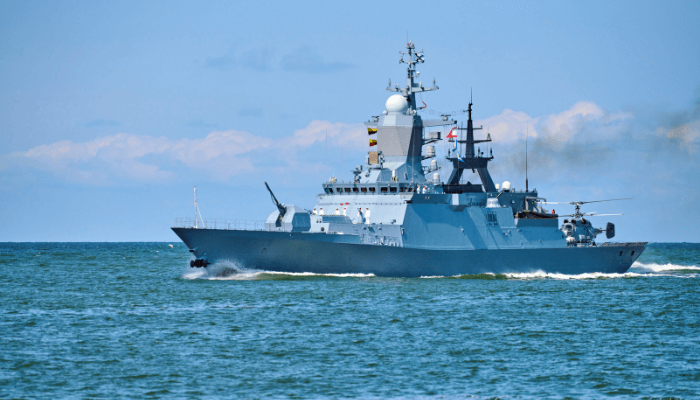
Enter the corvette. In the 2,000–3,000 ton range, corvettes are the Goldilocks solution: big enough to carry missiles, sensors, and serious firepower, yet small enough to buy in pairs or batches without bankrupting the budget. They are optimized for the Philippine context: patrolling an EEZ that stretches across thousands of kilometers, navigating tight archipelagic waters, and fighting in missile-centric scenarios that define modern naval confrontations. Where frigates are symbols, corvettes are tools and tools that can be multiplied.
Current reports suggest Manila is moving cautiously but deliberately: two guided-missile corvettes are on the table for delivery in the late 2020s, with room for upgrades like vertical launch systems, towed or variable-depth sonar, and medium-range surface-to-air missiles. These are not just acquisitions, they are decisions with strategic gravity. For the first time, the Philippine Navy faces a real crossroads: it must choose between “presence ships” that patrol, parade, and look modern, and “war ships” that actually shift the balance of risk at sea. The corvettes, small by global standards but enormous in impact for the Philippine fleet, will decide whether Re-Horizon 3 translates into credible deterrence or remains an aspirational plan framed by photos and speeches.
Capability Thresholds: What These Corvettes Must Do
These corvettes are not just another line item in a budget, they are the Philippine Navy’s litmus test for credibility at sea. At a moment when every ship purchased carries strategic consequences, what Manila decides to buy must be more than symbolic. There are non-negotiables, and they are unforgiving. First, the ships must carry credible air defense. Even a modest suite of short-range surface-to-air missiles can radically alter an adversary’s calculations, forcing them to pause before aggression escalates. Second, they must bring real anti-submarine warfare capability to the table: hull-mounted sonar alone isn’t enough. True ASW requires the flexibility of towed or variable-depth sonar, because undersea threats don’t announce themselves in advance. Finally, survivability cannot be an afterthought. Electronic warfare systems, decoys, and robust damage control measures are just as vital as the missiles that catch the eye.https://youtu.be/iH_S89Kc15c?si=8V8n33oftiXQBUJc
The stakes are stark. If these corvettes cannot track submarines, defend themselves from aerial threats, or share targeting data with the rest of the fleet, then they are nothing more than armed patrol vessels, good for showing the flag, but useless in a fight. In short, they must be combatants, not ornaments. The line between deterrence and theater is drawn in their hulls, and the Philippine Navy cannot afford to cross it lightly. These ships will determine whether Re-Horizon 3 is credible power, or simply a story told in press releases and commissioning photos.
Case Study 1: Vietnam’s Corvette Logic
Vietnam’s approach to naval modernization is a masterclass in quality over quantity. Rather than chasing a fleet of dozens of lightly armed ships, Hanoi invested early in Gepard-class frigates and missile corvettes, pairing them with a deliberate focus on anti-submarine and anti-surface warfare. The logic was clear: each platform had to matter. The result? A fleet that may be small, but it is dangerous, capable of forcing regional adversaries to think twice before acting. Numbers alone do not define power; capability does. For Manila, the lesson is stark: credible deterrence scales with lethality, not hull count. A few well-armed, well-trained ships can achieve what dozens of patrol vessels cannot.
Case Study 2: Indonesia’s “Many Hulls” Trap
Indonesia, by contrast, offers a cautionary tale in the perils of quantity over quality. Jakarta pursued a large number of surface combatants, many lightly armed, with mixed combat systems and sprawling logistics chains. On paper, the fleet looked impressive. In practice, presence without punch proved hollow. Sustainment became complex, readiness uneven, and operational cohesion suffered. The lesson for Manila is brutally simple: having many ships does not guarantee control of contested waters. Without meaningful combat power embedded in each hull, numbers can deceive, giving the illusion of strength while leaving critical gaps exposed.
The Takeaway for the Philippines
These case studies crystallize the stakes of Re-Horizon 3. The Navy is at a decision point: it can emulate Vietnam’s logic and field fewer, highly capable corvettes that genuinely complicate an adversary’s calculus or it can fall into the trap of Indonesia’s model, where quantity masks vulnerability. In the West Philippine Sea, illusions of strength are a dangerous gamble. True deterrence is written in sensors, missiles, and survivable hulls, not in parade formations or procurement press releases.https://www.youtube.com/watch?v=apSysHJHVgQ
The Partner Question: 
In modern naval procurement, the choice of a shipbuilder is never just about steel and engines, it is about shaping the Navy’s strategic DNA for decades to come. Today, Manila faces a hidden calculus: South Korea offers the status quo, with a proven delivery record, familiar logistics pipelines, and competitive pricing. The risk is low, the process predictable, and crews can be trained without major disruption. It is safe, reliable but safe alone does not guarantee strategic advantage.
Look further afield, and Japan or European shipbuilders bring something entirely different to the table. Their platforms offer higher-end systems, cutting-edge sensors, and combat management suites that can dramatically boost lethality. There is also a political dimension: choosing these partners sends a clear signal to regional actors and allies alike that the Philippines is serious about deterrence. But this sophistication comes with higher costs, longer lead times, and steeper training and sustainment requirements.
The strategic reality is uncompromising. Every procurement decision today quietly determines interoperability tomorrow, upgrade paths in the 2030s, and wartime sustainment options when the stakes are highest. Choosing a shipbuilder is no longer just a technical or financial decision, it is a bet on how the Navy fights, survives, and evolves in the decades ahead. The wrong choice could create dependencies, bottlenecks, or capability gaps at the exact moment deterrence is tested. The right choice could make the difference between a credible combat force and a fleet that looks modern but cannot hold the line.https://youtu.be/Z_g9v02gkRs?si=-h5D9PK0Bau6uWFk
Numbers vs Capability: The Decision That Shapes the 2030s Fleet
The Philippine Navy stands at a stark choice, and the stakes could not be higher. On one hand, two high-capability corvettes promise real deterrence, they can fight, survive, and shape adversary calculations, but coverage will inevitably be limited. On the other hand, four lightly armed ships offer greater presence, but little in the way of escalation control or true combat power. Delay is also an option, but one fraught with risk: every month spent hesitating widens the capability gap, allowing potential adversaries to test boundaries and erode strategic leverage. The hard truth is unflinching: postponement is itself a strategic decision and usually the worst one. In the calculus of deterrence, indecision can be as costly as weakness.
Strategic Impact in the West Philippine Sea
Every ship the Navy fields communicates more than its displacement; it communicates intent, seriousness, and sustainability. Adversaries read the type of ship as a statement of strategy, the weapons it carries as a measure of commitment, and the fleet’s overall numbers as a proxy for whether the Philippines can sustain operations under pressure. Corvettes, small by global standards but potent in capability, change the equation. They allow continuous patrols with real teeth, enable joint operations with allies, and make crisis response possible without immediately triggering escalation. This is how middle powers preserve relevance in contested seas: by shaping perceptions and calculations through credible, survivable, and networked platforms rather than sheer quantity.
End State: What Success Looks Like by 2035
By 2035, a successful Philippine Navy will be defined not by parade appearances, but by balance and depth. Frigates will serve as command-and-control centers, corvettes will dominate denial and patrol missions, and offshore patrol vessels will handle constabulary duties. Beyond platforms, institutional anti-submarine warfare competence must be ingrained, ensuring that lethality is embedded in doctrine, not bolted onto hulls. True success will be a fleet whose credibility matches Manila’s diplomatic rhetoric: a Navy capable of sustaining operations, defending national waters, and complicating adversary calculations across the full spectrum of maritime conflict.
Conclusion: The Real Meaning of “After the Frigates”
The commissioning of the frigates proved that the Philippine Navy can modernize. The corvettes will determine whether it can actually deter. This is not a procurement decision; it is a generational choice about relevance, resolve, and risk. Every choice now, what to buy, when, and from whom, will define whether the Navy can hold its waters in the West Philippine Sea or whether modernization will remain a symbol without substance. After the frigates, there is no middle ground: the future of deterrence, credibility, and strategic autonomy rests on the decisions Manila makes today.https://youtu.be/Z_g9v02gkRs?si=DIFXFr9l20QMj-G-