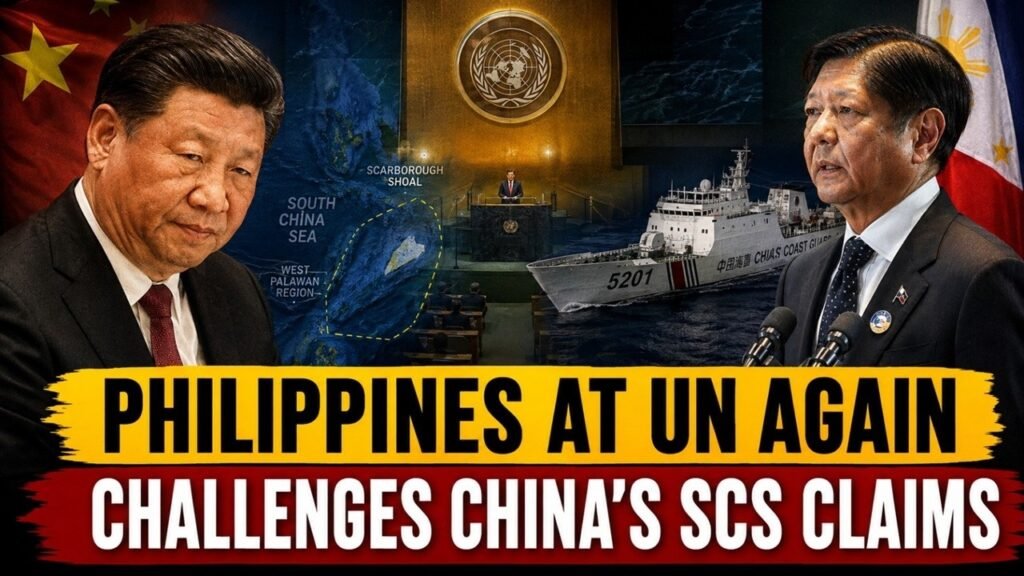
Philippines Challenges China AGAIN at the U.N Over the South China Sea
The South China Sea has once again become the center of international attention after the Philippines submitted new baselines around Scarborough Shoal to the United Nations. Although the move was presented as a legal step under international law, China responded with military aircraft, naval vessels, and coast guard patrols around the disputed area. This reaction shows that in the South China Sea, legal actions can quickly turn into strategic and military confrontations. Understanding this dispute requires looking at international law, maritime claims, regional security, and the growing competition between China and the Philippines.
Philippines Draws New Baselines at Scarborough Shoal
The Philippine government officially submitted a nautical chart of Scarborough Shoal to the United Nations, stating that the move was intended to strengthen its maritime rights under the United Nations Convention on the Law of the Sea (UNCLOS). According to Manila, the submission was not an attempt to expand its territory but rather to reinforce the legal certainty of its existing maritime entitlements. The chart defines what the Philippines considers the normal baselines around the shoal, along with its 12-nautical-mile territorial sea and 24-nautical-mile contiguous zone.
China rejected the submission almost immediately. Beijing described the new baselines as illegal and invalid, accused the Philippines of violating Chinese sovereignty, and insisted that Scarborough Shoal—known in China as Huangyan Dao—has always been Chinese territory. Within a day, China launched joint naval and air patrols around the disputed shoal, turning what began as a legal filing into a clear demonstration of military and strategic signaling.
What Are Baselines and Why Do They Matter?
To understand why China reacted so strongly, it is important to understand the concept of baselines. A baseline is the starting line from which a coastal state measures its maritime zones under international law. These measurements determine the territorial sea, the contiguous zone, the Exclusive Economic Zone (EEZ), and, in some cases, parts of the continental shelf. Baselines are therefore essential for defining maritime jurisdiction, fisheries management, resource exploration, and law enforcement at sea.
However, baselines do not determine who owns a disputed island, reef, or shoal. They only establish how maritime zones are measured from territories that a country already claims. The Philippines was not asking the United Nations to grant it new territory; it was presenting the legal framework through which it measures maritime zones around Scarborough Shoal. Nevertheless, China viewed the move as a challenge to its own sovereignty claims and broader strategic interests in the South China Sea.
Why Did China Respond So Forcefully?
For Beijing, the Philippine submission was not merely a technical legal document. China believes that Scarborough Shoal is part of its sovereign territory, and any attempt by another country to define maritime zones around the feature is viewed as a challenge to that claim. Chinese officials argued that the baselines could create the impression that the Philippines has legal authority over the area, which Beijing strongly rejects.
China’s response was therefore designed to reinforce its position both legally and strategically. In addition to diplomatic protests, Beijing deployed military aircraft, naval vessels, and coast guard units around Scarborough Shoal. These operations were described as necessary measures to defend China’s territorial sovereignty and maritime rights. The rapid military response demonstrated that the dispute is not only about legal documents but also about control, presence, and influence in one of the world’s most contested maritime regions.
China-Philippines CLASH Triggers Major U.S. Naval Response in the South China Sea!
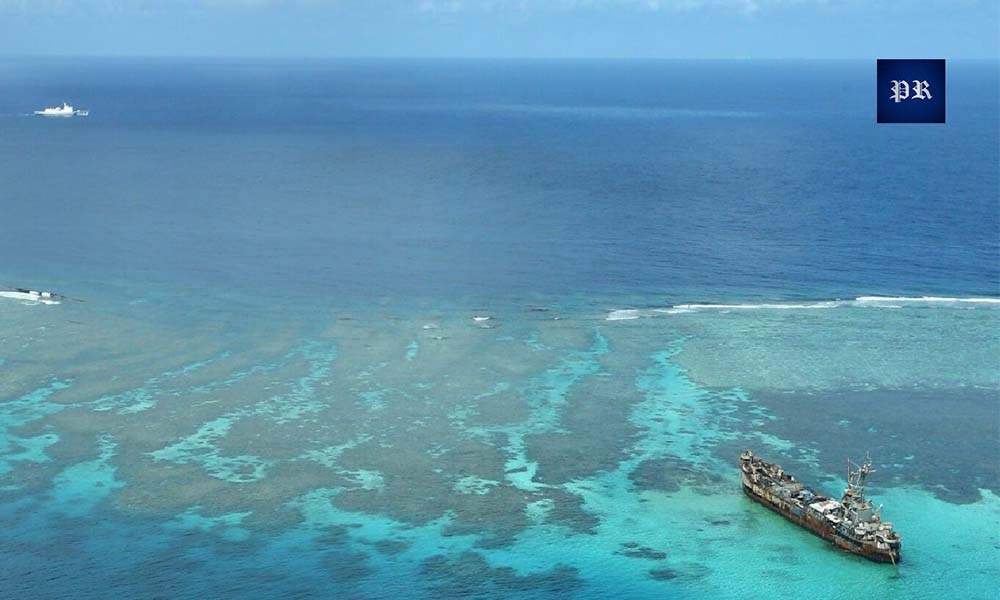
Scarborough Shoal may appear to be a small collection of reefs and rocks, but its strategic value is considerable. The shoal is located relatively close to the Philippine island of Luzon while also falling within the broader area claimed by China. This location places it near major shipping routes through which a significant portion of global trade passes every year.
The waters surrounding the shoal are also among the richest fishing grounds in the South China Sea, making the dispute economically important for coastal communities. In addition, the wider region is believed to contain substantial oil and natural gas resources, increasing its long-term strategic value. For China, maintaining a continuous presence around Scarborough Shoal strengthens maritime surveillance and military operations, while for the Philippines, the shoal represents an important part of its maritime rights and national security interests.
What Does International Law Actually Say?
International law has not settled the question of who owns Scarborough Shoal. Both China and the Philippines claim sovereignty over the feature, and neither side has accepted the other’s claim. The 2016 South China Sea arbitration ruling did not determine ownership of the shoal. Instead, it ruled that China’s claim to historic rights within the so-called Nine-Dash Line has no legal basis under UNCLOS and that Scarborough Shoal cannot generate a full 200-nautical-mile Exclusive Economic Zone.
The Philippines argues that its new baselines strengthen its existing maritime rights under international law, while China argues that the baselines violate its sovereignty. As a result, the dispute continues through diplomatic protests, coast guard patrols, military operations, and competing legal interpretations rather than through a final legal settlement.
What Are Baselines and Why Are They Important?
Before understanding the latest dispute between China and the Philippines, it is important to understand what maritime baselines actually are. Under the United Nations Convention on the Law of the Sea (UNCLOS), baselines serve as the starting point from which a country’s maritime zones are measured. These zones include the territorial sea, contiguous zone, and Exclusive Economic Zone (EEZ). In simple terms, baselines help determine where a country’s maritime rights begin and how far they extend into surrounding waters.
The importance of baselines goes far beyond legal definitions. They influence fishing rights, maritime law enforcement, resource exploration, and national security policies. However, one common misunderstanding is that baselines determine ownership of disputed territory. In reality, they do not settle sovereignty disputes. Instead, they establish the legal framework through which maritime zones are measured around territories that a country already claims.
What Exactly Did the Philippines Do?
The Philippines recently submitted an official nautical chart of Scarborough Shoal to the United Nations. This chart outlines what Manila considers the normal baselines surrounding the shoal, as well as the maritime zones that extend from those baselines under UNCLOS. Philippine officials stated that the move was intended to reinforce the country’s existing maritime rights and provide greater legal certainty regarding its maritime entitlements.
According to Manila, the submission was not an attempt to expand territory or create new claims. Rather, it was a legal measure designed to clarify how the Philippines interprets and applies international maritime law in relation to Scarborough Shoal. Nevertheless, the action immediately attracted international attention because of the area’s disputed status and China’s longstanding claims over the same feature.
Why Did China React So Strongly?
China viewed the Philippine submission very differently. Beijing quickly declared the new baselines “illegal and invalid,” arguing that Scarborough Shoal, which China calls Huangyan Dao, has always been Chinese territory. From China’s perspective, allowing the Philippines to formally establish baselines around the shoal could create the impression that Manila has legal authority over an area that Beijing considers part of its sovereign territory.
China’s reaction was not limited to diplomatic statements. Shortly after the submission, the People’s Liberation Army and the China Coast Guard conducted joint naval and air patrols near Scarborough Shoal. These operations were described as measures to safeguard China’s sovereignty and maritime rights. The swift response demonstrated how legal actions in the South China Sea can quickly become matters of strategic and military significance.
At first glance, Scarborough Shoal appears to be little more than a collection of reefs and rocks. However, its strategic value is far greater than its physical size suggests. The shoal is located relatively close to the Philippine island of Luzon and sits within waters that are crucial for regional trade, fishing, and security.
The surrounding area is among the richest fishing grounds in the South China Sea, supporting the livelihoods of many Filipino fishermen. In addition, the broader region is believed to contain significant oil and natural gas reserves, making it economically important for all claimants. From a military perspective, maintaining a presence near Scarborough Shoal provides strategic advantages for monitoring maritime activity and projecting influence across one of the world’s busiest waterways.
What Does International Law Actually Say?
Despite frequent references to international law, the legal situation surrounding Scarborough Shoal remains complex. Both China and the Philippines claim sovereignty over the shoal, and international law has not definitively resolved the ownership question. This is an important distinction because many people mistakenly believe that the dispute was settled by the 2016 South China Sea arbitration ruling.
In reality, the tribunal did not determine who owns Scarborough Shoal. Instead, it ruled on certain maritime rights and concluded that China’s claims to historic rights within the so-called Nine-Dash Line lacked legal basis under UNCLOS. The tribunal also found that Scarborough Shoal does not generate a full 200-nautical-mile Exclusive Economic Zone. However, because sovereignty issues were outside its jurisdiction, ownership of the shoal remains disputed.
What Could Happen Next?
The dispute over Scarborough Shoal is unlikely to disappear anytime soon. Both China and the Philippines continue to strengthen their positions through legal measures, diplomatic initiatives, and increased maritime activities. As a result, the region may experience more coast guard encounters, military patrols, and diplomatic protests in the months ahead.
At the same time, efforts to manage tensions remain ongoing. Negotiations between ASEAN and China on a Code of Conduct for the South China Sea could help reduce the risk of misunderstandings and dangerous incidents at sea. While such an agreement would not resolve sovereignty disputes, it could establish clearer rules for managing competition in one of the world’s most strategically important maritime regions.
Conclusion
The Philippines’ submission of new baselines around Scarborough Shoal demonstrates how a legal action can trigger significant geopolitical consequences. While Manila views the move as reinforcing its maritime rights under UNCLOS, Beijing sees it as a challenge to its sovereignty claims and has responded by strengthening its military, coast guard, and administrative presence around the disputed area. Scarborough Shoal has become a symbol of the broader struggle over sovereignty, security, international law, and strategic influence in the Indo-Pacific. The future of this dispute will depend not only on legal arguments and diplomatic negotiations but also on whether both sides can prevent competition from escalating into a more dangerous confrontation.
About Indo-Pacific Report
For more geopolitical analysis, strategy coverage, and Indo-Pacific security reporting, visit Indo-Pacific Report:
Website
Facebook
Philippines Challenges China AGAIN at the U.N Over the South China Sea