China Just Built a Giant Island on Antelope Reef in 5 Months
By Indo-Pacific Report | May 2026
A year ago, Antelope Reef was barely worth marking on a map. It was a ring of coral in the Paracel Islands, a small sandbar with a few scattered structures, and mostly empty ocean around it. Today, it is one of the largest man-made islands in the South China Sea.
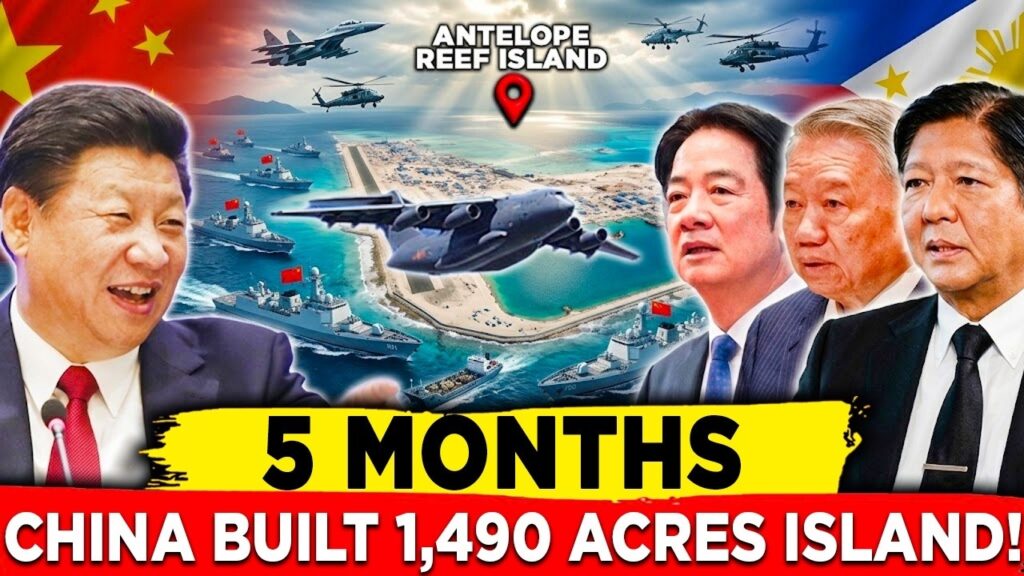
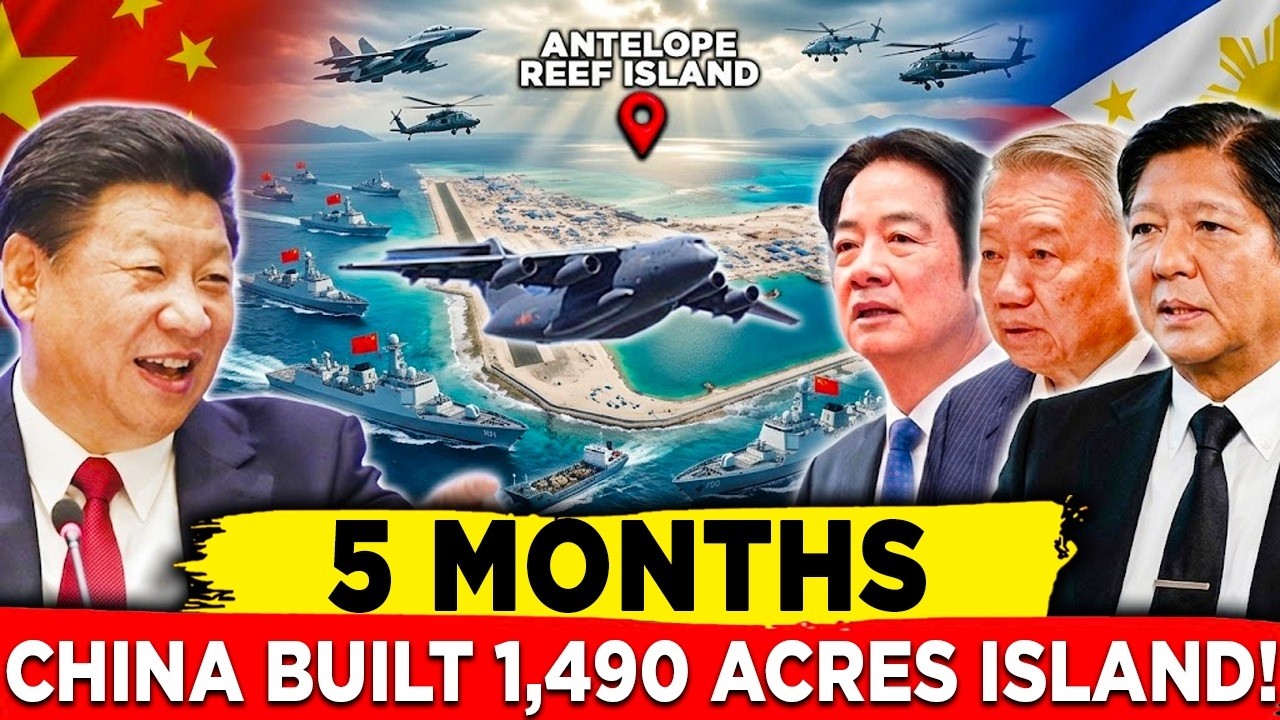
Between October 2025 and March 2026, China deployed dozens of dredging ships to Antelope Reef and pumped roughly 1,490 acres of new land out of the sea floor. That is nearly the size of Mischief Reef — China’s largest military outpost in these waters — and China built it in about five months.
This is the biggest island-building project China has completed in the South China Sea since 2017. And the location, the timing, and the speed all raise serious questions about what Beijing is planning next.
What Happened at Antelope Reef — and How Fast
Antelope Reef sits in the northern part of the South China Sea, inside the Paracel Islands chain. Vietnam also claims the Paracels, and for years both countries have maintained a presence there. China has controlled Antelope Reef for decades, but until recently it was one of its smallest and least developed outposts.
The Asia Maritime Transparency Initiative (AMTI), a research program at the Washington think tank CSIS that tracks South China Sea activity using satellite imagery, described the old Antelope Reef as “little more than a sandbar.”
That changed in October 2025. Satellite images tracked the arrival of large dredging ships — vessels that suck up sand and crushed coral from the seabed and deposit it on top of a reef to create dry land. By the end of December 2025, the work was clearly underway. By February 2026, permanent structures were already rising. By March, the new island measured roughly 1,490 acres, or about six square kilometers.
To put that in scale: Woody Island, China’s administrative center in the Paracels and a site that even hosts a small civilian town, covers about 890 acres. Antelope Reef is now nearly twice that size. And it is approaching the 1,504 acres of Mischief Reef — China’s largest outpost in the entire South China Sea, which took years to build during the previous island-building campaign of 2013 to 2016.
AMTI analysts say the new island is large enough to support a 9,000-foot runway — long enough for fighter jets and long-range military aircraft. Their assessment also notes the island could eventually hold diesel power plants, underground fuel and ammunition storage, coastal defense artillery, surface-to-air missiles, anti-ship missiles, and radar and electronic warfare systems.
This is not a fishing station. It is the foundation of a military base.
https://indopacificreport.com/china-just-sent-35-warships-into-philippine-waters/
Why This Location, and Why Now
China did not choose Antelope Reef randomly. The reef sits about 162 nautical miles from Sanya, China’s major naval base on Hainan Island in the South China Sea. But it also sits just 216 nautical miles from Da Nang, a key coastal city in Vietnam.
That proximity to Vietnam is significant. AMTI analysts say the new base extends China’s reach further south and gives its air and naval forces an additional operating point in the northern part of the South China Sea, closer to Vietnam’s coast than most of China’s other outposts.
The Timing Was Not an Accident
The pace of construction accelerated during a period when global attention was pointed elsewhere. In early 2026, the United States was managing a serious military confrontation with Iran in the Middle East, with aircraft carriers and air assets concentrated in the Persian Gulf.
According to tracking data reported by Asia Times, US military reconnaissance flights over the South China Sea dropped noticeably — from approximately 102 flights in the December-to-January window down to around 72 in February 2026. That is a meaningful reduction in one of the key surveillance tools the US uses to monitor Chinese activity in the region.
China appears to have used that moment to push construction forward at maximum speed. When the dominant outside power is stretched thin elsewhere, the building accelerates. That is the pattern, and it held again in 2026.
It is also worth noting the broader historical context. China completed more than 3,200 acres of artificial islands across the Spratly Islands between 2013 and 2016 — a campaign that drew international condemnation and a landmark ruling from an international tribunal that found China’s territorial claims had no legal basis under international law. After that, large-scale island building mostly paused. Now, nearly a decade later, it has resumed. The dredgers are back.
Vietnam’s Response: Protests and Its Own Construction
Vietnam reacted to the Antelope Reef developments immediately and forcefully. In March 2026, Vietnam’s foreign ministry spokeswoman Pham Thu Hang issued a formal protest, stating that Vietnam considers the Paracel Islands part of its sovereign territory and that any foreign construction there without Vietnamese permission is “completely illegal and invalid.”
But Vietnam is not limiting itself to diplomatic statements. It is building too.
Since 2022, Vietnam has been running its own major land reclamation program in the Spratly Islands, which lie further south. According to CSIS, Vietnam has expanded construction across all 21 of the island features it currently controls. By early 2025, Vietnam had created roughly 70 percent as much new land in the Spratlys as China had during its entire 2013-to-2016 campaign. Some analysts now project Vietnam may eventually match or even exceed China’s total reclamation in that specific area.
Vietnam is also building a 10,000-foot airstrip on Barque Canada Reef, one of its Spratly outposts. In an ironic twist, China has formally protested Vietnam’s construction, accusing it of building on “illegally occupied” islands. Both countries are accusing each other of the same behavior, using the same language.
One analyst at Chatham House warned this dynamic could trigger a broader cycle of competitive island building across the South China Sea — a situation where, with no one enforcing shared rules, every claimant state simply starts dredging. That warning appears to already be playing out.
The Philippines Is Also Expanding Its Presence
The Philippines, which has the most active territorial disputes with China in the South China Sea, is responding as well. Satellite imagery from May 2026 shows the Philippines is extending the runway on Thitu Island — known locally as Pag-asa Island — its most important outpost in the Spratlys. The extension runs roughly 200 meters over an area that was previously underwater.
Manila is also investing more than one billion pesos, approximately 27 million US dollars, to build a deeper and larger port facility on nearby Nanshan Island. The current port cannot accommodate the larger coast guard and navy vessels the Philippines needs to regularly resupply its South China Sea outposts. A better port means a more sustained, capable presence.
The United States is directly involved in this picture. Washington now has access to nine Philippine military bases under a bilateral defense agreement. The Balikatan 2026 joint military exercises brought together around 17,000 US and Philippine troops for combined training. That level of military cooperation gives the United States significantly more flexibility in the region, particularly in scenarios involving Taiwan or a South China Sea conflict.
Three countries are now actively building and reinforcing positions in the same body of water at the same time. Each move seems to prompt the next. This is what a slow-motion military competition looks like before it becomes something more serious.
Why This Matters Beyond the Region
It is easy to read South China Sea news as a distant regional dispute with limited relevance to daily life. That impression is wrong. Here are three concrete reasons this matters everywhere.
1. Global Trade Runs Through This Water
Approximately one-third of all global maritime trade passes through the South China Sea each year. That represents trillions of dollars in goods — electronics, oil, clothing, food, raw materials — moving between Asia, the Middle East, Europe, and the Americas. Any serious disruption to navigation in these waters would immediately affect global supply chains and prices.
2. China Is Building a Military Network
China now maintains an estimated 27 outposts across the South China Sea, with somewhere between 5,000 and 10,000 military personnel stationed across them. These positions are equipped with fighter aircraft, missile systems, and advanced radar that can monitor vast stretches of ocean. Antelope Reef adds another node to that network — one that is specifically positioned to cover the northern sea lanes and the Vietnamese coast. A 9,000-foot runway there changes the strategic geometry of the region.
The Taiwan Connection
Many security analysts argue that the real strategic function of China’s South China Sea bases is not just about the sea itself. The bases are designed to raise the cost and complexity of US military operations in the western Pacific — especially in a potential conflict over Taiwan. Every additional runway, radar station, and missile battery pushes the effective perimeter outward and complicates any outside response to a crisis. Antelope Reef, fully developed, fits that logic precisely.
For in-depth analysis of how these developments connect to broader Indo-Pacific security, visit IndoPacificReport.com.
Diplomacy Is Moving Too Slowly
There are ongoing diplomatic efforts to manage the South China Sea situation. China and the ten-member ASEAN group of Southeast Asian nations have been negotiating a Code of Conduct for the South China Sea for years, with a stated goal of finalizing it by the end of 2026. The Philippines, which currently holds the ASEAN chairmanship, is pushing to get it done.
The problem is structural. Diplomatic negotiations move slowly. Construction moves quickly.
By the time any Code of Conduct is signed and takes effect, Antelope Reef will already be a finished military installation. The same is likely true for the runways and ports going up across Vietnam’s and the Philippines’ outposts. The rules are arriving after the facts on the ground have already been established.
You cannot negotiate away an island that already exists. That is the quiet central problem of South China Sea diplomacy right now.
What Comes Next
In five months, China transformed a sandbar into one of the largest islands in the South China Sea. Vietnam is building across all 21 of its reef positions. The Philippines is extending runways and ports with American backing. A sea that millions of people depend on for food, trade, and security is filling up, slowly but steadily, with military infrastructure.
None of the parties involved wants to be the one that falls behind. So the building continues. With every new acre of land, the space for diplomatic flexibility shrinks a little more.
The big open question is whether the ASEAN Code of Conduct arrives in time to establish any meaningful guardrails — or whether the South China Sea continues filling with islands until no country has room to step back.
Antelope Reef barely existed as dry land twelve months ago. Today, it could become the largest island in the South China Sea. That single data point tells you a great deal about the direction this region is heading.
In the South China Sea, the side that builds first tends to set the terms for everyone else.
Follow Indo-Pacific Report
For ongoing coverage of South China Sea tensions, Indo-Pacific security, and Philippine-China-US dynamics, follow Indo-Pacific Report across all platforms:
Website
Facebook
YouTube