Why the Philippines Is Looking at Japan’s Tanks Instead of Israel’s
In February 2026, Philippine Army Commander Lt. Gen. Antonio Nafarrete stood before reporters at Fort Bonifacio and made an admission that quietly shifted the country’s armor story. Out of 28 Sabrah light tanks ordered from Israel’s Elbit Systems, only nine were in service. Eighteen more were still waiting. “This is a big item, negotiations are still ongoing,” he said. “And we hope within this year matatapos na yun delivery natin.”
That one line carries weight. The Sabrah deal was signed in 2020. The first tank rolled in by late 2022. The full induction was supposed to happen years ago. Yet by early 2026, the Philippine Army’s Armor Division is still operating at less than half strength.
Now, just three months after that admission, a new door has opened. On May 5, 2026, Japanese Defense Minister Shinjiro Koizumi flew into Manila and signed a fresh defense equipment and technology cooperation deal with Defense Secretary Gilberto Teodoro Jr. For the first time in nearly 80 years, Japan can now sell lethal weapons abroad. And the Philippines is at the front of the line.
That has put two Japanese platforms back into the conversation. The Type 10 main battle tank. And the Type 16 maneuver combat vehicle. Both are built for exactly the kind of fight Manila is preparing for.
The Sabrah Problem No One Wants to Say Out Loud
The Sabrah is not a bad tank. Built on the Spanish ASCOD 2 tracked chassis and the Czech Pandur II 8×8 wheeled chassis, it carries a 105mm gun, an Elbit fire control system, and NATO STANAG 4569 Level 4 armor protection. The contract is worth around 9.4 billion pesos, and the gun has a range of 3,600 meters.
On paper, it ticks the boxes. In practice, the rollout has crawled. The first nine ASCOD-based Sabrahs were inducted into the 1st Tank Battalion at Camp O’Donnell in Tarlac on March 5, 2024. Almost two years later, the remaining 18 are still in negotiation. For a country that watches Chinese coast guard ships push into the West Philippine Sea every month, that pace is hard to explain.
There is also a deeper issue. The Philippine Army has long said it wants around 144 medium battle tanks. The Sabrah order of 28 vehicles does not even come close. So whether the Sabrah deliveries finish this year or next, Manila will still need a much bigger answer. That answer is now coming from Tokyo.
Why Japan, Why Now
For most of the postwar era, Japan could not sell weapons. Article 9 of its constitution and a self-imposed three-principles policy kept its defense industry locked inside its own borders. Equipment could only go abroad in five categories: rescue, transport, warning, surveillance, and minesweeping.
That changed on April 21, 2026. Tokyo revised its “Three Principles on Transfer of Defense Equipment and Technology.” Lethal systems can now be exported under strict approval. Two weeks later, Koizumi was in Manila signing the new framework with Teodoro.
Japan Fires Missiles in Philippines & Donates 6 Warships to Manila
“We agreed to move forward with discussions aimed at realizing comprehensive equipment cooperation… with a view to the early transfer of Abukuma-class destroyers and TC-90 aircraft as well as other defense equipment.” — Defense Minister Shinjiro Koizumi, Manila, May 5, 2026
Teodoro put it even more plainly. “Now we can buy defense equipment from them,” he told reporters, adding that he was “excited” by the chance for joint and co-production with Japanese industry. The two ministers also agreed to set up a working group between policy, operations, and equipment divisions of both defense departments.
The naval items, the Abukuma-class destroyer escorts and the TC-90 patrol aircraft, are the headline. But the framework is wider than that. It explicitly covers “other defense equipment.” And in a country fighting an island war, that almost has to mean armor.
The Type 10: A Tank Built for Islands, Not Plains
Most main battle tanks weigh between 55 and 65 tons. The American M1 Abrams sits at around 60 tons. The German Leopard 2 is similar. These tanks were designed to roll across the open fields of central Europe, not to cross old bridges in tropical island countries.
The Type 10 is different. Built by Mitsubishi Heavy Industries and in service with the Japan Ground Self-Defense Force since 2012, the Type 10 weighs only 40 tons in its base setup, and 48 tons fully loaded. That is six tons lighter than its predecessor, the Type 90.
Why does that weight matter? Numbers tell the story. Around 84 percent of Japan’s 17,920 bridges can carry the Type 10. Only 65 percent could carry the Type 90. For most other Western tanks, the figure drops to about 40 percent. In a country full of narrow roads, rivers, and coastal bridges, that is the difference between a tank that fights and a tank that gets stuck.
The Philippines has the same problem. It is an archipelago of more than 7,600 islands. Many roads were never built for 60-ton vehicles. A heavy Western tank in Cagayan or Palawan would be a logistics nightmare. The Type 10 was designed for exactly this kind of geography.
It is not a light tank either. The Type 10 carries a 120mm gun built by Japan Steel Works, an autoloader that fires every 3.5 seconds, modular composite armor, and a continuously variable transmission that lets it move at 70 km/h forward and 70 km/h in reverse. It accelerates from 0 to 30 km/h in 2.5 seconds. Its C4I system, called 10NW, links every tank into a real-time data network with infantry units.
The price tag, according to Forecast International, is around 13.57 million US dollars per unit in 2024 dollars. That is more expensive than a Sabrah. But it is a full main battle tank, not a light tank with a 105mm gun.
https://indopacificreport.com/japan-fires-missiles-in-philippines-donates-6-warships-to-manila/
The Type 16: Wheels, Speed, and a Big Gun
The Type 10 is the heavyweight. The Type 16 maneuver combat vehicle is the rapid responder. It rides on eight wheels instead of tracks. It weighs only 26 tons. And it can hit 100 km/h on roads.
That speed is not a marketing line. Japan designed the Type 16 to defend its southern islands from a possible Chinese amphibious assault. Tanks are slow to move between islands. The Type 16 is light enough to be carried by a Kawasaki C-2 transport aircraft and small enough to drive on civilian highways without tearing them up.
Its main gun is a 105mm rifled cannon, a licensed copy of the British Royal Ordnance L7. It is fully compatible with standard NATO 105mm ammunition, which means logistics chains shared with the Sabrah and even older M113 family vehicles. The turret is rolled steel with modular and spaced armor that can shrug off frontal hits from 20 to 30mm cannons and most portable anti-tank weapons.
The Japan Ground Self-Defense Force plans to procure 250 Type 16 vehicles. Around 100 are already in service. Three Mitsubishi-based variants are now being added to the family, including a wheeled infantry fighting vehicle, a 120mm self-propelled mortar, and a reconnaissance variant. That is a deep, mature production line, exactly the kind of supplier the Philippine Army wants.
Why It Fits the Philippine Fight
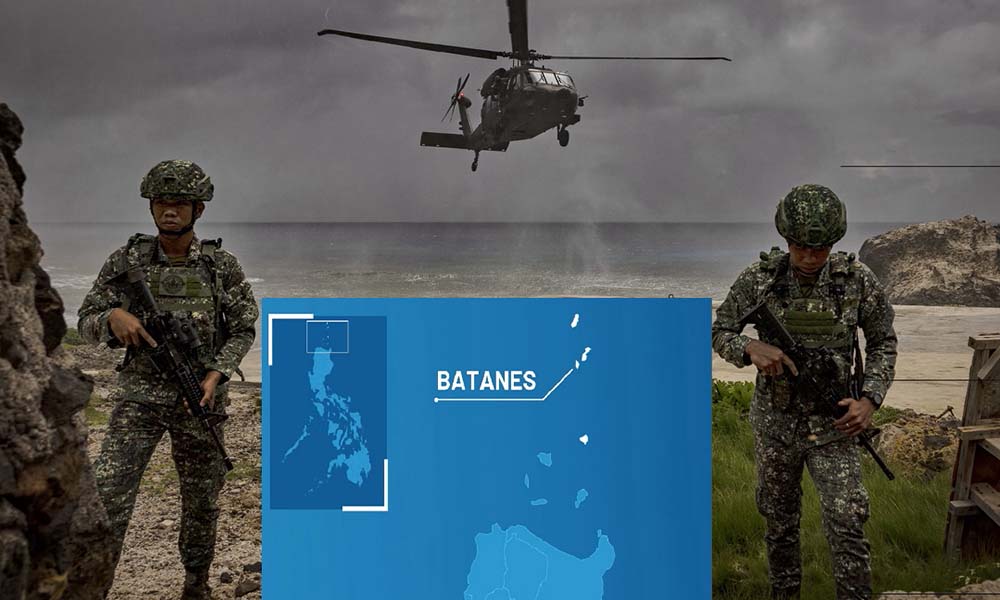
Think about how the Philippine Army actually has to operate. It cannot fight a single big land war. It has to be ready to defend many small spaces at once: Batanes, Palawan, the western coast of Luzon, the Sulu archipelago. Each of those places has tight roads, weak bridges, and short distances between landing zones.
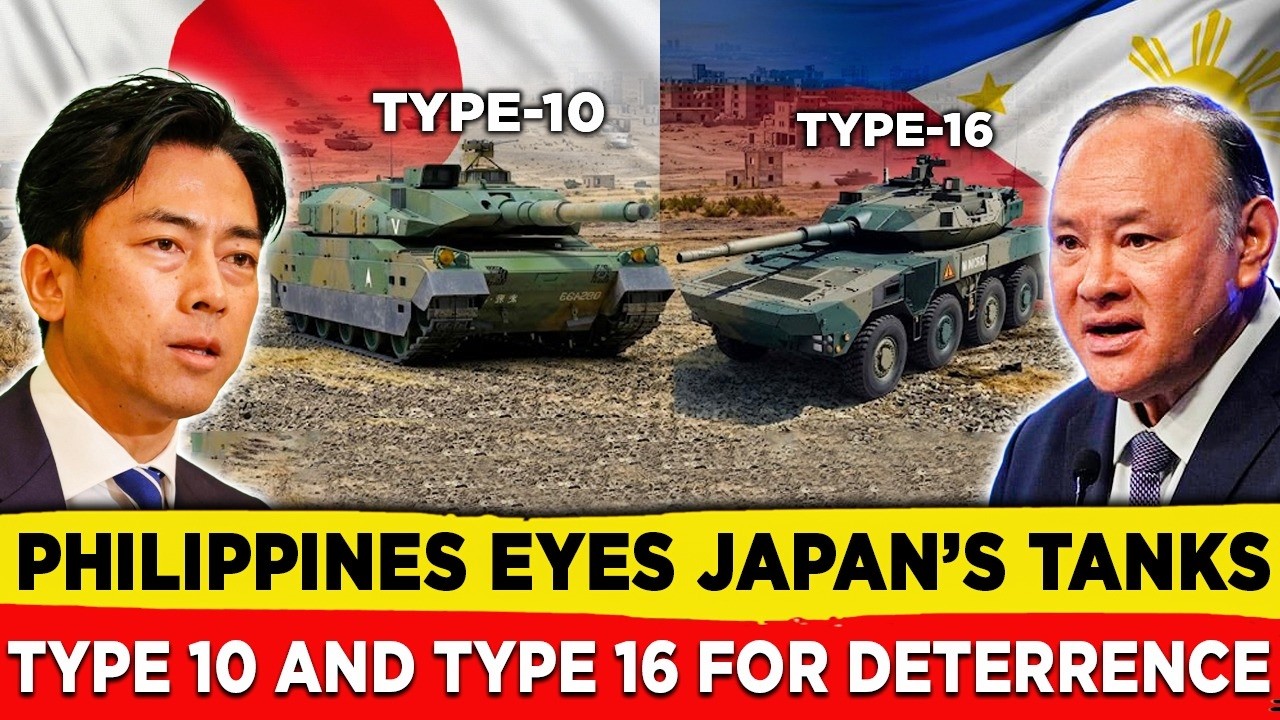
A 60-ton Western tank cannot fly there. A Type 10, at 40 tons, can be moved by ship and even by some heavy-lift aircraft. A Type 16, at 26 tons, can be airlifted in a C-2 and hit a beachhead within hours. That kind of speed matches the Philippine Army’s shift toward distributed deterrence and the broader Comprehensive Archipelagic Defense Concept.
There is also the language of joint training. Japanese forces are no longer outsiders in the Philippines. Under the Reciprocal Access Agreement that entered into force in 2025, around 1,400 Japanese personnel joined the 2026 Balikatan exercises in Ilocos Norte. Japan even fired its Type 88 surface-to-ship missile at a retired Philippine Navy vessel during a sinking drill on May 6, 2026. That is the first time the Type 88 has ever been fired outside Japan.
If Japanese troops can shoot missiles next to Filipino troops in northern Luzon, exporting a tank to that same army is not a leap. It is the next step.
The Roadblocks Manila Cannot Ignore
None of this is automatic. Three real obstacles stand in the way. First, cost. A Sabrah is roughly 6 to 7 million US dollars per unit. A Type 10 is more than double that. The Philippine defense budget under the “Re-Horizon 3” program runs through 2033 with about two trillion pesos in projected spending, but the Army still has to fight for its share against the Navy’s frigate program and the Air Force’s multi-role fighter plan.
Second, training and sustainment. Japanese platforms come with Japanese manuals, Japanese spare parts, and a defense industrial base that has almost never exported. Building that pipeline from scratch takes years. The Diplomat noted in May 2026 that for the Philippines, “the decision will involve balancing immediate operational needs against long-term sustainability and interoperability.”
Third, Japan’s own laws. Even after the April 2026 revision, transferring lethal systems for free or at deep discount still requires further changes to Japanese self-defense law. A grant-based deal could happen, but Tokyo has to clear that legal hurdle first.
The Bigger Picture: A Shift in Indo-Pacific Armor
Step back from the hardware for a moment. What is really happening is a quiet realignment. For decades, the Philippines bought armor from the United States, then from Israel. Japan was a development partner and a coast guard donor, never a supplier of tanks or warships.
That world is over. Tokyo describes Manila in policy circles as a “quasi-ally.” The two countries already share a Reciprocal Access Agreement, a fuel and ammunition resupply pact, and now a defense equipment framework. Add the Abukuma transfer talks, the TC-90 aircraft, and a possible armor track, and you are looking at the foundations of a new kind of partnership in Southeast Asia.
China has 27 outposts and roughly 10,000 troops in the South China Sea. The First Island Chain runs straight through Philippine territory. The strategic logic that pushed Japan to design the Type 10 and the Type 16 is the same logic now pushing the Philippines to want them. Both countries are island nations facing the same neighbor.
Whether the Type 10 and Type 16 actually end up in Camp O’Donnell next to the Sabrah is still an open question. No contract has been signed. No notice of award has been issued. But the road is now clearer than it has ever been. The Sabrah delays have created the gap. Tokyo’s policy shift has opened the supply line. Balikatan 2026 has put Japanese boots and missiles on Philippine soil. The pieces are on the board.
The next move belongs to Manila.
Stay With IndoPacific Report
For deeper analysis, daily updates, and full-length defense breakdowns, follow IndoPacific Report across our three platforms:
🔗 Website — indopacificreport.com
🔗 Facebook — IndoPacific Report (IPR)
🔗 YouTube — @IndoPacific_Report
© IndoPacific Report — Indo-Pacific Defense and Security Analysis