Can Japan, Taiwan, and the Philippines Deter China?
Can Japan, Taiwan, and the Philippines Really Deter China? That’s the question sitting quietly behind almost every strategic conversation in East Asia right now. Not “can they defeat China.” Not “can they outspend China.” But can they deter it? Can three very different actors, one economic heavyweight, one frontline island democracy, and one Southeast Asian maritime state, together create enough friction to make Beijing pause?
Because deterrence isn’t about theatrics. It’s about calculation. It’s about whether the cost of action starts to look uncomfortably high. And if there is a backbone in this emerging triangle, it’s Japan. Japan is the only one of the three with full-spectrum advanced military capability. That matters. It fields a highly modern navy, advanced air assets, missile defense systems, and increasingly sophisticated counterstrike capabilities. It operates in the same technological league as top-tier Western militaries. That gives the triangle structural depth.
Economically, Japan is still a giant. With a GDP of roughly $4.2 trillion, it remains one of the largest economies in the world. And unlike smaller regional actors, Japan has the fiscal capacity to sustain prolonged competition. Defense spending is on a clear upward trajectory, projected around $70–75 billion in 2025, with a commitment to reach 2% of GDP by 2027. That shift alone represents one of the most significant strategic pivots in post-war Japanese history.

But what really sets Japan apart is its industrial base. Shipbuilding. Aerospace engineering. Advanced missile systems. Radar technologies. Semiconductor production. These aren’t abstract strengths. They translate directly into military resilience and supply chain security. In long-term competition, the side that can manufacture, repair, and innovate consistently tends to endure.
And here’s something important: Japan isn’t just building for itself anymore. It’s increasingly enabling partners. Through security assistance, defense technology cooperation, and operational integration, Tokyo is multiplying capability across the region. That’s a quiet force multiplier.
If deterrence in East Asia is going to work, it requires credibility. Japan provides that credibility. It has alliance depth with the United States, growing operational alignment with the Philippines, and strategic stakes tied directly to Taiwan’s security. Instability in the Taiwan Strait would immediately impact Japan’s southwestern islands and its sea lines of communication.https://youtu.be/rZqXK_aV2As?si=c5h5AQc1kd1fbEEA
So when we ask whether this triangle can deter China, the first variable is whether Japan remains committed, capable, and strategically steady.
Right now, the answer appears to be yes. The deeper question is whether Japan’s strength, when combined with Taiwan’s geographic centrality and the Philippines’ maritime positioning, creates enough integrated resistance to shift Beijing’s risk calculus. That’s where this becomes interesting.
Military Capabilities
Now let’s get specific about the hard power because when we talk about deterrence, ships and submarines matter. A lot. The Japan Maritime Self-Defense Force isn’t symbolic. It’s operationally serious. Japan fields roughly 50 major surface combatants. That’s not a token fleet. These are modern destroyers and frigates equipped with advanced sensors, anti-submarine warfare systems, and integrated air defense capabilities. They are built for high-end maritime conflict, not just patrol duty.
Then there are the eight Aegis-equipped destroyers. That’s a big deal. Aegis systems provide ballistic missile defense capability, meaning Japan can detect, track, and potentially intercept incoming missile threats. In a regional environment where missile inventories are expanding rapidly, that defensive layer is crucial. It complicates any adversary’s first-strike assumptions.

Below the surface, Japan operates around 22 advanced diesel-electric submarines, including the Sōryū and newer Taigei classes. These boats are quiet. Extremely quiet. Optimized for operating in the complex undersea geography of the East China Sea and surrounding waters. In maritime deterrence, submarines are psychological weapons as much as physical ones. You don’t know exactly where they are, and that uncertainty forces caution.
China Is Watching the 9th U.S.–Philippines Patrol Very Closely!
And then there are the two Izumo-class helicopter carriers. They’re being modified to operate F-35B short takeoff and vertical landing fighters. That transformation effectively gives Japan light aircraft carrier capability. It extends air power projection beyond land-based airfields and enhances flexibility in crisis scenarios, especially around the Ryukyu island chain and potentially in support of broader regional contingencies.
Put simply, Japan operates one of the most capable navies in Asia outside the United States. That’s not hype. It’s structural reality. For any deterrence framework involving Japan, Taiwan, and the Philippines, Japan provides the blue-water backbone. It brings advanced anti-air, anti-submarine, and missile defense capabilities. It brings logistics depth. It brings industrial sustainment.
Without Japan, the triangle would feel fragile. With Japan, it becomes something much harder to ignore. Japan’s air power is another critical piece of the deterrence puzzle, and it’s easy to underestimate just how capable it is.
The Japanese Air Self-Defense Force fields over 300 modern fighters, and that number is not static. Japan is actively acquiring F-35s, both the A and B variants, with plans for over 140 in total. That’s stealth-capable, multirole aircraft with sensor fusion, long-range strike capability, and survivability in contested airspaces. The F-35B, in particular, when deployed from the Izumo-class carriers, allows Japan to project air power beyond the mainland, which is a game-changer for regional flexibility.https://indopacificreport.com/philippines-and-taiwan-maritime-security-cooperation/
On top of that, Japan has advanced ISR and early-warning systems integrated into its air defense network. Think radar, airborne warning and control, satellite intelligence, and electronic warfare assets all connected in near real-time. This gives Japan not just fighters but situational awareness, the ability to detect, track, and respond to threats before they become crises.https://www.youtube.com/watch?v=b2u-Ud4CCGQ
Japan’s air power complements its naval capabilities perfectly. Destroyers and submarines control the seas, carriers and fighters control the skies, and ISR systems tie everything together. For deterrence, it’s the combination of visibility, rapid response, and strike credibility that really counts. In short, Japan doesn’t just have planes; it has the eyes, the reach, and the teeth to make any adversary think twice before escalating.
Japan’s Strategic Posture
Japan’s security posture has shifted dramatically in recent years. The 2022 National Security Strategy signaled a move from reactive defense to structured deterrence. Tokyo is now acquiring counterstrike capabilities, including Tomahawk land-attack missiles, and expanding its long-range missile arsenal. This isn’t just about defense; it’s about signaling that Japan can respond to threats with credible, preemptive precision if necessary.
Japan’s deep alliance with the United States remains central. It ensures operational interoperability, access to advanced technology, and extended deterrence. Beyond the bilateral U.S.-Japan axis, Tokyo is increasingly engaging in trilateral exercises with the Philippines, often in waters adjacent to Taiwan. These exercises test coordination, strengthen readiness, and send clear signals to potential adversaries: regional maritime security is a shared responsibility.
Japan Plans to Export Military Command & Control System to the Philippines
Japan is actively transitioning from decades of reactive pacifism to a posture built on integrated deterrence, combining advanced hardware, operational alliances, and strategic signaling.
Taiwan’s Power: The Denial Fortress
Unlike Japan, Taiwan isn’t focused on projecting power across oceans. Its strategy is denial, making any potential invasion so costly and risky that an adversary would hesitate before acting.
1. Economic Significance
Taiwan’s economy is smaller than Japan’s, with a GDP of roughly $800 billion, but it punches far above its weight globally. Over 60% of the world’s semiconductors come from Taiwan, and TSMC alone controls more than 90% of advanced chip production (<7nm). That makes Taiwan not just a regional player, but a linchpin in the global technology supply chain. Conflict here would ripple worldwide, making Taiwan’s security a matter of international economic interest.
2. Military Capabilities
Personnel: Taiwan maintains an active force of about 170,000, supported by a reserve system that is currently being restructured. Conscription has been extended to one year, reflecting a push to improve readiness and build a more capable force.
Air & Missile Defense: Taiwan fields Patriot PAC-3 systems and indigenous Sky Bow (Tien Kung) air defense, while expanding its stockpile of anti-ship missiles like the Hsiung Feng II and III. These systems are designed to protect critical infrastructure, ports, and airfields from long-range attack.
Naval & Asymmetric Capabilities: Taiwan operates four submarines with new indigenous programs underway, maintains a large inventory of anti-ship cruise missiles, mobile coastal defense units, sea mines, and fast attack craft. The overall doctrine is clear: deny access, raise the cost of invasion, and exploit geography and asymmetric tools to make aggression prohibitively expensive.
In essence, Taiwan is a fortress built not for global reach, but for strategic denial. Its geography, technology, and military posture create a multilayered shield designed to make any adversary think twice before attempting a landing. This combination of economic centrality and defensive military capability makes Taiwan a uniquely high-stakes actor in the deterrence triangle with Japan and the Philippines.
Geographic Advantage
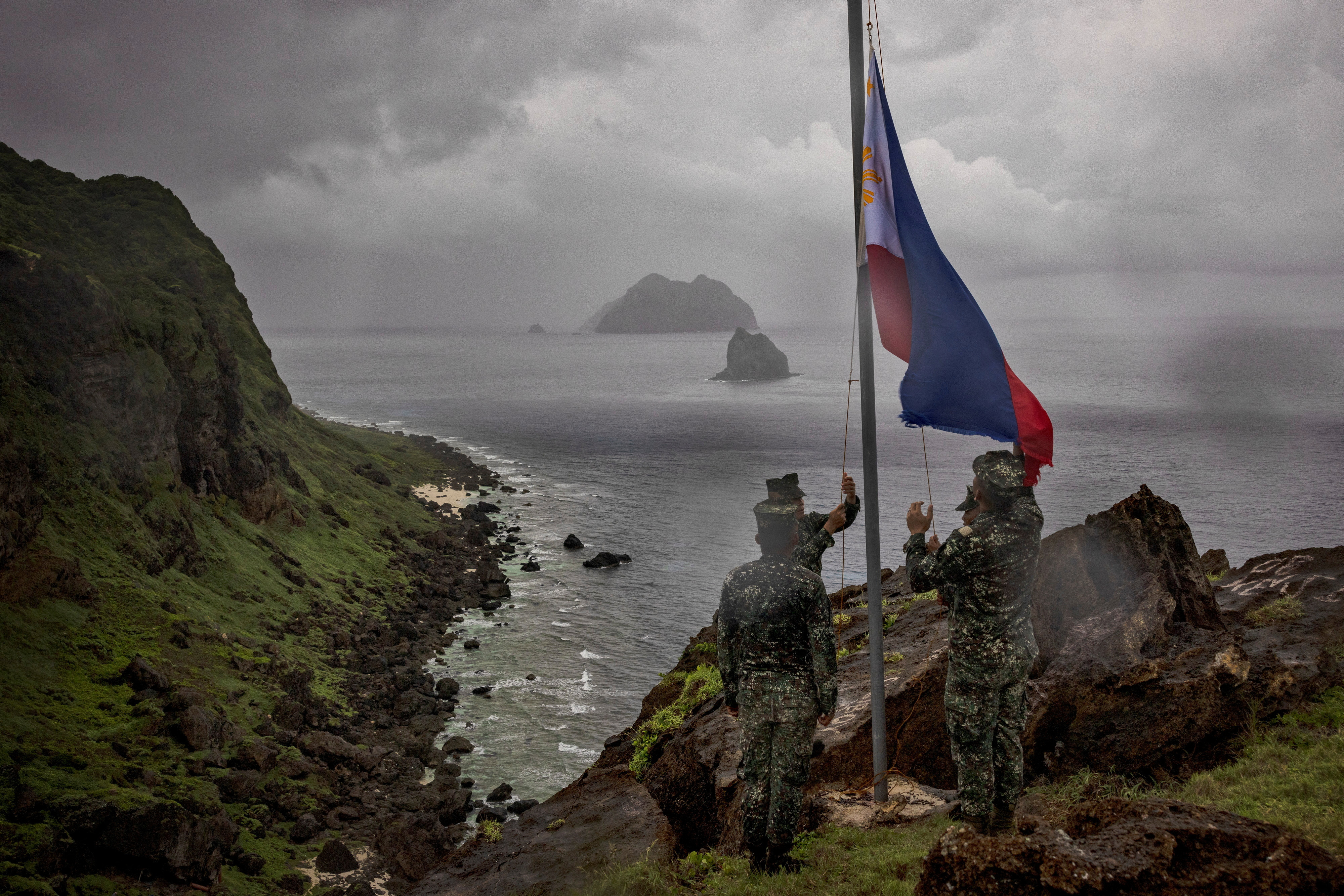
The Philippines doesn’t have the firepower of Japan or the high-tech defenses of Taiwan, but its strategic value is undeniable. Its strength lies in geography, controlling key maritime chokepoints that connect the South China Sea, the Philippine Sea, and the Bashi Channel. In a conflict scenario, this location can complicate Chinese naval movements and provide a critical advantage to allied forces coordinating in the region.
Economically, the Philippines is smaller, with a GDP around $440 billion and a defense budget of roughly $4–5 billion, though it’s gradually rising. Through the AFP Modernization Program, Manila is improving capabilities incrementally. It may not be able to project high-end power, but it is steadily building a force capable of layered deterrence and operational integration with partners.
Militarily, the Philippines remains limited. Its navy has few surface combatants, and its air force relies on FA-50 light fighters from South Korea. But recent investments in coastal radar and ISR systems, especially with Japanese assistance, are enhancing maritime domain awareness. Alongside nine EDCA access sites with the U.S., these upgrades increase flexibility, readiness, and coordination with allied forces.
Ultimately, the Philippines’ geographic position is its true leverage. Sitting astride critical sea lanes, it can shape naval operations, influence the movement of forces, and serve as a crucial node in a broader trilateral deterrence framework alongside Japan and Taiwan. In strategic terms, location and cooperation can outweigh raw capability.https://www.youtube.com/watch?v=83tErAXyq10
China’s Power: The Structural Giant
China sits at the center of gravity in this regional equation. Its economy alone, with a GDP around $17–18 trillion, dwarfs its neighbors, and it is the largest trading partner for most of Asia. That economic reach translates into deep financial leverage across ASEAN, giving Beijing tools to influence policy and stability without firing a shot.
Militarily, the People’s Liberation Army is massive and rapidly modernizing. The PLAN is the largest navy in the world by ship count, with over 370 vessels, including three aircraft carriers, Liaoning, Shandong, and Fujian, dozens of destroyers and frigates, and an expanding submarine fleet, including nuclear-powered boats. Its missile arsenal, from DF-21D “carrier killers” to DF-26 intermediate-range missiles, forms a robust anti-access/area denial umbrella that complicates any approach. In the air, China fields more than 2,000 combat aircraft, including J-20 fifth-generation stealth fighters, giving it escalation dominance in localized conflicts near its coast.
Bridge Analysis: Can the Triangle Deter China?
Deterrence depends on three variables: capability, credibility, and cohesion. Individually, Japan, Taiwan, or the Philippines cannot deter China. Japan brings high-end naval and air power, Taiwan brings hardened denial defenses, and the Philippines offers critical geographic chokepoints. Together, they don’t match China’s raw scale, but they create a complex operational puzzle, forcing Beijing to allocate resources across multiple fronts.
The U.S. factor is decisive. Without Washington’s backing, the triangle’s deterrence potential drops dramatically. With U.S. integration, Japan’s navy combines with American naval strength, the Philippines becomes a staging and logistics hub, and Taiwan’s denial strategy gains credibility. The triangle only becomes a credible deterrent within a broader alliance framework.

Operational geography further amplifies this. If coordinated, Japan controls northern access, Taiwan blocks the central Taiwan Strait, and the Philippines threatens the southern approach through the Bashi Channel. Multi-axis pressure increases costs and uncertainty for China, the very essence of deterrence.https://www.youtube.com/watch?v=lgyJA351Pis
Yet the triangle has clear weaknesses. There is no formal trilateral defense treaty, political volatility in the Philippines, Taiwan’s diplomatic isolation, Japan’s constitutional constraints, and China’s economic leverage over all three. Cohesion remains fragile, and maintaining a consistent, coordinated posture is a challenge.
Strategic Conclusion
So, can Japan, Taiwan, and the Philippines deter China? Not independently. Possibly collectively. Credibly, only with U.S. integration. Deterrence here is not about defeating China outright. It is about raising the costs of aggression, complicating PLA operational planning, increasing escalation risks, and making conflict unpredictable and prolonged. The triangle’s advantage is structural and layered, not symmetrical: geography, alliance networks, asymmetric defense, maritime chokepoints, and integrated ISR and missile denial create friction. The real question isn’t whether they can overpower China, it’s whether they can make aggression irrational. And that, strategically, is exactly what deterrence is supposed to do.
https://youtu.be/NyuNRV1Xnqw?si=43S1NI7fEtPVyFiq