The Sulu Sea: How Subsidized Fuel Is Powering Southeast Asia’s Grey-Zone Economy
The Core Transaction
Start with the math. Everything else flows from it.
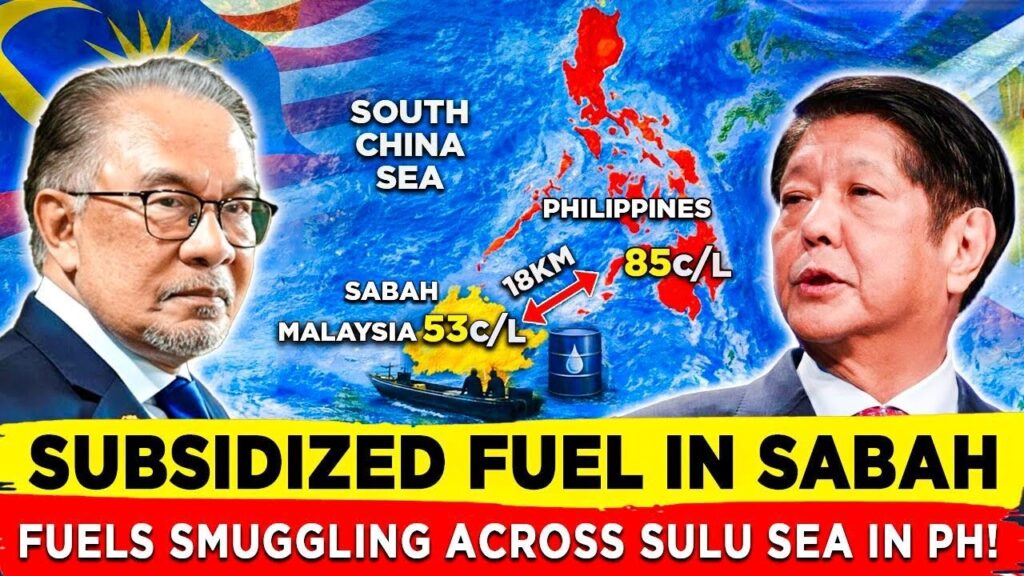
In Malaysia’s Sabah state, fishermen can legally buy subsidized diesel for 2.10 ringgit per liter—about 53 U.S. cents.
Now cross the Sulu Sea.
In the southern Philippines, the same fuel sells for roughly 50 pesos per liter, or 85 U.S. cents.
That is a 32-cent gap on every liter.
On land, this difference barely registers. At sea, it matters. A lot.
Fuel moves in bulk. Demand never stops. Oversight thins out quickly once you leave the shoreline. In that environment, even a modest margin becomes profitable.
This is not theft born of desperation.
It is arbitrage created by policy.
Fuel gains value simply by crossing water.
There is no refining.
No transformation.
Just distance, borders, and mismatched prices.

And fuel has three advantages that make it ideal for this kind of economy:
- it stores easily
- it is difficult to trace
- and it is essential to everyday life
Small margins, repeated often enough, scale fast.
This is the core transaction.
It is the engine of the system.
The boats, the routes, the informal networks—they all exist because this price gap exists.
The Sulu Sea smuggling economy does not begin with criminals or ideology.
It begins with numbers that fail to align across borders.
-
Scale of the Trade
Once the incentive is clear, the next question is scale.
How large is this trade, in real terms?
According to Malaysian authorities, marine police seized the following last year alone:
- roughly 90,000 liters of petrol
- nearly 1 million liters of diesel
The estimated value of these seizures was 88 million ringgit, or about 22 million U.S. dollars.
That number matters. But not for the reason it first appears.https://en.wikipedia.org/wiki/Economies_of_scale
These figures do not represent the total trade.
They represent what was intercepted.
Seizures tell us three things.
First, this is not small-time smuggling. Moving close to a million liters of diesel requires planning, storage, vessels, and coordination. This is organized activity, not opportunism.https://youtu.be/McJ5qs4TOD8?si=nIaOh-9pzuKCI1qw
Second, the trade is persistent. Authorities speak of dozens of cases. These are patterns, not exceptions.
And third—and most important—interceptions capture only a fraction of what is actually moving.
In maritime smuggling, seizures are a lagging indicator. They show activity, not control.
If this much fuel is being caught, far more is getting through. Quietly. Routinely. Profitably.
The scale of the seizures does not prove enforcement is succeeding.
It suggests the system has already become industrial.
-
Geography: Why the Sulu Sea Makes Enforcement Hard
To understand why this trade continues, you have to look at the water itself.
Sabah’s eastern coast sits less than 120 kilometers from the southern islands of the Philippines. At its narrowest point, near the Semporna island chain, the distance shrinks to just 18 kilometers.
That is not a sea barrier.
It is a short boat ride.
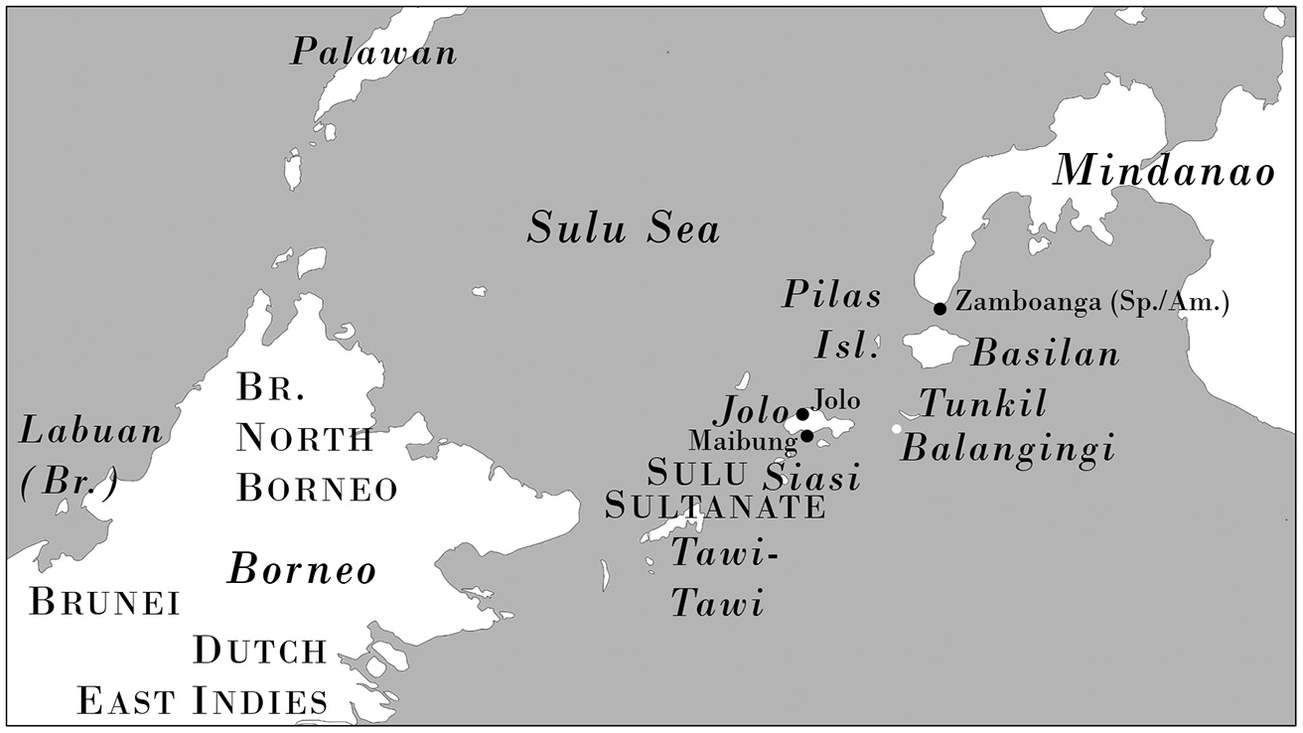
The Sulu Sea is crowded with small islands, shallow channels, and narrow straits. Fishing routes have run through these waters for generations.
For local fishermen, this is familiar ground.
For enforcement agencies, it is a maze.
Large patrol vessels struggle to operate here. Radar coverage breaks down. Small boats move easily, disappear quickly, and blend into legitimate traffic without effort.
The geography naturally favors speed over surveillance. Local knowledge over state authority. Informality over regulation.
In effect, the sea itself works against enforcement
The key point is this:
The Sulu Sea is not difficult to police because states are weak.
It is difficult to police because the geography is stronger.
-
Borders That Exist on Paper, Not at Sea
On a map, the maritime boundary between Malaysia and the Philippines looks clear.
At sea, it rarely is.
The Sulu Sea is a patchwork of overlapping patrol zones, unclear boundaries, and fragmented enforcement authority. Multiple agencies operate in the same waters, often with limited coordination and slow information sharing.
This creates gaps. And smugglers understand those gaps far better than states do.

Fuel can move from one jurisdiction to another in minutes. Legal responsibility follows much more slowly, tangled in paperwork and radio calls.
Malaysian authorities have pointed to fuel storage sites on small islands near the maritime boundary. These locations sit in a regulatory grey area. Storage limits are unclear. Inspections are limited. Oversight is uneven.
Once fuel is staged on these islands, monitoring becomes far more difficult.
The result is a border that exists in law but fades in practice the farther you move from shore.
At sea, sovereignty weakens with distance.
Grey-zone actors operate precisely in that space.https://youtu.be/Xd1XxCi6-LU?si=BEHVpD3-C8F_5vP_
-
Official Admissions: How the System Is Being Exploited
What sets this case apart from routine smuggling is the level of official candor.
Authorities are not guessing how this happens. They are describing it.
Malaysia’s Agriculture and Food Security Minister, Mohamad Sabu, has acknowledged that fishermen can legally purchase their full subsidized fuel quotas, even when they do not need all of it.
The unused fuel does not vanish.
It is resold.
Not stolen.
Not siphoned.
But redirected into the black market.
That distinction matters. It shows the core problem is not a failure of enforcement. It is a flaw in policy design.
Sabah’s regional marine police commander, Ahmad Amri Abdul Rahman, has echoed this point. He notes that enforcement is made harder by the dense spread of islands near international borders.
Taken together, these statements reveal something important.
The state understands how fuel exits the legal system. It knows where the fuel goes. And it understands why stopping the trade is so difficult.
Yet the structure remains unchanged.
This grey-zone economy is not hidden.
It operates in plain sight, inside loopholes that are openly acknowledged.
-
From Subsidy Policy to Grey-Zone Economy
Malaysia introduced fuel subsidies for fishermen in 2006. The goal was simple: protect livelihoods from rising fuel costs and keep coastal communities afloat.
On paper, the policy worked.
Fishermen gained reliable access to cheap diesel. Operating costs fell. Incomes became more predictable.
But in the Sulu Sea, the subsidy did not stay national.
It became portable value.

Once fuel is subsidized at the point of purchase, it stops being just an input. It turns into a tradeable asset. A liter of diesel bought legally in Sabah gains value the moment it enters a different pricing system.
No law is broken at the point of sale.
The distortion appears only after the fuel starts moving.
This is how a welfare policy slides into a grey-zone economy:
- legal purchase
- informal transfer
- cross-border resale
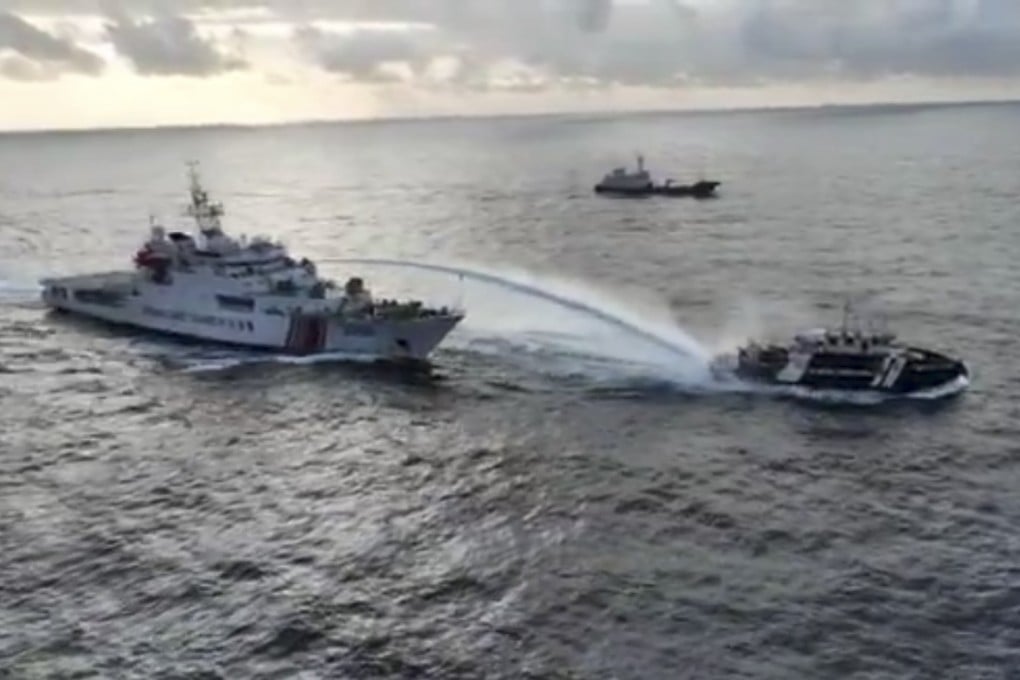
All of it enabled by geography and uneven prices.
Subsidies work inside borders.
Markets do not respect them.
-
Why Demand Exists in the Southern Philippines
Smuggling does not survive on supply alone.
It survives because there is demand on the other side.
In the southern Philippines, fuel prices are consistently higher than in Sabah. Diesel sells for around 50 pesos per liter, or roughly 85 U.S. cents.
For coastal communities and small operators, fuel is not optional. It powers fishing boats, small transport vessels, and generators in off-grid areas.
But fuel distribution in the region is uneven. Infrastructure is weaker. Supply chains are longer. State presence fades as you move farther from major ports.
Philippines Teams Up With East Timor Against China in the South China Sea
Smuggled fuel fills that gap. It arrives by sea. It is sold locally. And it is often cheaper—or simply more available—than official supplies.
This is the critical point.
For many communities, the black market is not a luxury or a convenience.
It is the most functional energy system available.
Smuggled fuel persists not because demand is criminal,
but because access is structural.
-
Why Enforcement Alone Fails
When governments respond to smuggling, the instinct is almost always the same. Add more patrols. Make more seizures. Put more boats at sea.
In the Sulu Sea, enforcement has not been absent. Fuel has been seized. Smuggling runs have been disrupted. Networks have been broken, at least temporarily.
Yet the trade continues.
That is because enforcement targets movement, not motivation.
As long as fuel in Sabah remains subsidized, prices in the southern Philippines remain higher, and maritime borders remain porous, the incentive structure stays intact.
Every seizure removes cargo. It does not remove the reason that cargo exists.
In some cases, enforcement even raises profits. Higher risk makes successful runs more valuable.
Without changes to subsidy design, quota controls, and regional coordination, patrols become repetitive and reactive.
The key takeaway is simple:
You can intercept boats.
You cannot patrol away a price gap.
-
The Bigger Picture: The Sulu Sea as a Grey-Zone System
What is happening in the Sulu Sea is not just smuggling.
It is a functioning grey-zone system.
Grey zones exist between war and peace, legality and illegality, state control and state absence. They are low in visibility, non-ideological, economically rational, and politically deniable.
Fuel smuggling in the Sulu Sea fits this pattern almost perfectly.
No flags are raised. Borders are not openly challenged. There is no military escalation. And yet, state authority is quietly worn down.
The same routes used to move subsidized diesel can—and often do—support arms trafficking, narcotics flows, and human smuggling.
Fuel is simply the most visible and least controversial cargo.
That is what makes it dangerous.
Grey-zone economies normalize cross-border illegality without forcing states to respond forcefully. They persist because they stay below the threshold of crisis.
The Sulu Sea is not unstable because of open conflict.
It is unstable because informal systems are working better than formal ones.
-
Closing: Why This Keeps Happening
So, why does this keep happening—year after year, seizure after seizure?
Because nothing at the core has changed.
Fuel in Sabah remains subsidized. Fuel in the southern Philippines remains more expensive. And the Sulu Sea remains what it has always been: a maze of islands, short crossings, and weak coordination.
This is not a failure of patrols.
It is a mismatch between policy, geography, and regional integration.
As long as price gaps move faster than regulation, grey-zone actors will continue to profit.
The lesson is straightforward.
Smuggling in the Sulu Sea is not an anomaly. It is a rational response to structural conditions.
Until subsidies are redesigned, borders are managed cooperatively, and peripheral regions are economically integrated, enforcement will remain reactive—and the grey zone will remain active.
The Sulu Sea does not reward lawlessness.
It rewards alignment with reality.https://youtu.be/5DrJ59vp_v4?si=zkY_FGifzxYGpvaA