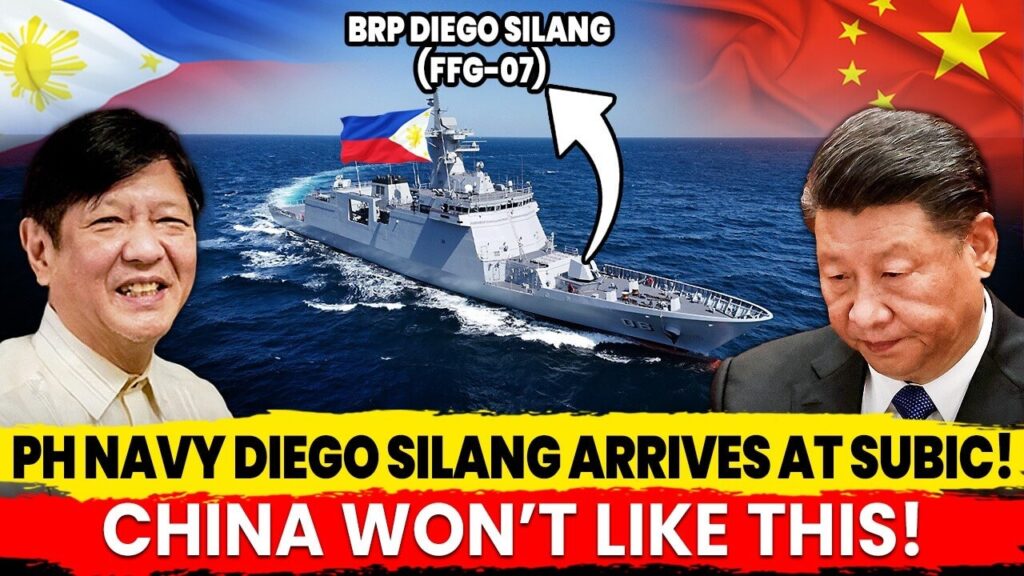
Philippines Commissions Its Latest Frigate, BRP Diego Silang (FFG-07)
What does a modern warship named after a revolutionary icon mean in today’s Indo-Pacific? For the Philippines, it means everything. On December 2, 2025, the Philippine Navy commissioned BRP Diego Silang (FFG-07), a missile-armed, radar-equipped, multi-role frigate into a region on the brink of open confrontation. While Vietnam is rolling out Russian-designed corvettes, Australia is deploying nuclear-powered submarines, and China now conducts near-daily incursions into the West Philippine Sea, the Philippines has just answered with steel, strategy, and symbolism. This is no ordinary ship. It’s the nation’s boldest maritime statement in years.
And the timing could not be more dramatic. In November alone, 19 Chinese destroyers and frigates were spotted circling Philippine waters. Filipino sailors are being blasted with water cannons, boxed in by militia ships, and harassed by electronic jamming near key outposts like Second Thomas Shoal. Amid this rising pressure, the Diego Silang doesn’t just join the fleet, it leads it, symbolizing a long-awaited transition from patrol boats to credible naval deterrence.
Named after an 18th-century revolutionary who stood against colonizers, BRP Diego Silang now sails into modern-day conflict zones, bearing not just weapons, but history, defiance, and a sovereign flag. In an Indo-Pacific where assertiveness is rewarded and weakness exploited, this warship tells the region: The Philippines will not be pushed around.
More than a milestone, this commissioning represents a shift in doctrine. The Armed Forces of the Philippines (AFP) is no longer simply reacting. It’s recalibrating. It’s integrating with U.S., Japan, and Australian forces. It’s preparing for multi-domain warfare, with this frigate as a forward shield. In the chessboard of contested waters, this is Manila’s queen piece, fast, armed, and built for 21st-century maritime defense. Not just a new ship, a new strategy, a new signal, a new era.
STRATEGIC CONTEXT — WHY THE PHILIPPINES NEEDS THIS FRIGATE NOW
BRP Diego Silang (FFG-07) enters service at a moment when the Philippines is facing the most intense maritime pressure in its modern history. Over the past year, China has dramatically escalated its presence and activities in the West Philippine Sea, with Philippine surveillance teams detecting nineteen Chinese frigates and destroyers operating in or near Manila’s Exclusive Economic Zone in November alone. This naval concentration is not routine transit; these vessels linger, maneuver aggressively, and reinforce a broader posture of coercion that includes water-cannon attacks on resupply missions, ramming incidents, dangerous close-quarters maneuvers, and the deployment of maritime militia swarms numbering between 40 and 100 vessels at a time. Even more alarming, Philippine aircraft and ships have reported episodes of communications jamming and electronic interference, signaling that China is increasingly willing to extend gray-zone pressure into the electromagnetic domain.
In this environment, the Philippines cannot rely on diplomacy or legal victories alone. The 2016 arbitral ruling remains a powerful legal anchor, but Beijing continues to ignore it, making it clear that only credible deterrence can reinforce Manila’s maritime rights. A modern frigate like BRP Diego Silang provides exactly that: the ability to track multiple threats simultaneously, extend radar coverage far beyond coastal sensors, operate confidently in high-sea states, and support joint missions with air and naval assets. Deterrence today depends on capability, the capacity to impose costs, maintain persistent presence, and respond decisively when challenged. Without major surface combatants, the Philippines simply cannot enforce its sovereign rights or protect its EEZ against a larger, more aggressive navy.
The commissioning of Diego Silang also reflects a deeper transformation within the Armed Forces of the Philippines. After decades focused on internal security, Manila is now shifting decisively toward external defense, investing in warships, fighter aircraft, missiles, and surveillance networks. The frigate is part of a broader blueprint that includes land-based anti-ship missiles, new corvettes, upgraded maritime patrol assets, and a growing network of alliances with the United States, Japan, and Australia. This is not merely modernization, it is a strategic reorientation shaped by necessity. The Philippines is moving from a reactive, fragmented maritime posture toward a coherent, layered defense strategy designed to protect sea lanes, uphold the arbitral ruling, and ensure that Philippine sovereignty is backed by a force capable of defending it. In this new strategic reality, BRP Diego Silang is more than an addition to the fleet. It is a symbol of a nation adapting to a sharper maritime environment, asserting its rights with modern capability, and preparing for a future in which presence, readiness, and resilience matter more than ever.
THE SHIP ITSELF — BRP DIEGO SILANG (FFG-07) AT A GLANCE
BRP Diego Silang (FFG-07) represents the newest and most advanced surface combat capability in the Philippine Navy, crafted by HD Hyundai Heavy Industries of South Korea, a shipbuilder renowned for producing some of Asia’s most capable naval vessels. As the second ship in the Miguel Malvar-class of guided-missile frigates, Diego Silang carries forward the design philosophy of its lead ship: fast, lethal, and optimized for multi-domain operations in contested waters. After her delivery to Subic Bay in September 2025, the frigate underwent weeks of rigorous acceptance trials, systems calibration, and crew integration drills to ensure all combat, propulsion, and electronic suites were fully mission-ready. On December 2, 2025, she was formally commissioned into service, an event that marked not only the birth of a new warship, but the strengthening of a fleet preparing for a dramatically more complex maritime environment.
Strategically, BRP Diego Silang is designed as a true multi-role combat platform, giving the Navy capabilities it has long lacked. She is built to conduct anti-air warfare through advanced radar and missile systems capable of tracking and engaging incoming aerial threats; anti-surface warfare through precision-guided missiles and naval guns that can respond to hostile ships or gray-zone vessels; anti-submarine warfare, enabled by hull-mounted sonar, decoys, and shipborne helicopter support; and electronic warfare, allowing the frigate to detect, monitor, and potentially counter attempts at jamming or hostile signal activity, an increasingly common challenge in the West Philippine Sea. In essence, the ship is not just a patrol asset; it is a floating, integrated combat system designed to fight and survive in the modern maritime battlespace. With Diego Silang now in the fleet, the Philippines takes another major step toward building a Navy that can deter threats, defend maritime rights, and operate with confidence alongside its allies in one of the world’s most contested seas.
CAPABILITIES & ARMAMENT — THE MODERN PHILIPPINE NAVY’S MOST ADVANCED WARSHIP
BRP Diego Silang (FFG-07) enters the fleet as the most capable surface combatant the Philippines has ever operated, a 3,200-ton guided-missile frigate built for endurance, precision, and survivability in one of the world’s most contested maritime zones. Powered by a modern propulsion system that pushes her to 25 knots and gives her a cruising range of 4,500 nautical miles, she can patrol vast stretches of the Exclusive Economic Zone (EEZ) without refueling, a crucial requirement in a nation of 7,641 islands. Her weapons suite finally gives the Philippines a credible deterrent punch. At the heart of her offensive systems lies a 16-cell Vertical Launch System loaded with VL MICA surface-to-air missiles, giving the Navy its first real medium-range air defense umbrella against aircraft, drones, and precision-strike threats. For maritime firepower, she carries eight C-STAR anti-ship missiles, capable of striking hostile vessels far beyond visual range with sea-skimming trajectories designed to evade radar. Defensively, Diego Silang is protected by the Gökdeniz 35mm Close-In Weapon System, a fast-firing shield against incoming missiles, drones, and small-boat attacks, a critical asset in gray-zone encounters. Her 76mm Oto Melara main gun provides versatile fire support, while two triple torpedo launchers give her true anti-submarine capability, allowing her to track and engage underwater threats as China increases submarine patrols in the region. All of this is tied together by an advanced AESA radar, a next-generation sensor suite capable of scanning hundreds of targets simultaneously and giving the ship the level of situational awareness needed to operate in complex, congested, and contested seas. In practical terms, BRP Diego Silang becomes Manila’s frontline asset for EEZ patrols, anti-smuggling operations, maritime interdiction, high-end surveillance, and combat missions in disputed waters, giving the Philippine Navy a platform finally worthy of a modern external defense strategy.
OFFICIAL STATEMENTS — THE GOVERNMENT’S MESSAGE TO THE REGION
The commissioning of BRP Diego Silang echoed far beyond the ceremony, amplified by strong statements from the country’s top defense leaders. Rear Admiral Roy Vincent Trinidad, the Philippine Navy’s point man for West Philippine Sea operations, called it “the most modern warship we will have,” emphasizing that its arrival finally gives the Philippines the endurance and firepower to patrol the full breadth of its Exclusive Economic Zone and even operate beyond it when allies call for joint missions. Defense Undersecretary Salvador Melchor Mison Jr. framed the commissioning as a clear affirmation of the government’s commitment to naval modernization, describing the frigate as both a symbol of national resolve and a practical tool of deterrence in waters where the rule of law is constantly challenged. He showed that this capability upgrade sends a message to the region: the Philippines is no longer a passive observer but an active defender of its maritime rights. The presence of the Flag Officer-in-Command, the Fleet Commander, and the ship’s Commanding Officer, all at the forefront of the ceremony, reinforced a unified front within the military leadership. Their attendance was not just tradition; it was a deliberate signal of institutional solidarity and readiness, showing allies and adversaries alike that the Philippines stands firm, cohesive, and prepared to defend its sovereignty with modern capabilities.
PART OF A BIGGER MODERNIZATION ROADMAP — WHAT COMES NEXT
The commissioning of BRP Diego Silang is not an isolated milestone but a key piece of a sweeping naval modernization roadmap that is rapidly transforming the Philippine Navy into a credible seapower. This frigate completes the pair of advanced surface combatants under the $554 million 2021 contract, following the commissioning of BRP Miguel Malvar (FFG-06) in May 2025, together forming the Navy’s new frontline anti-air, anti-surface, and anti-submarine strike capability. Beyond these frigates, the fleet is set to expand with six Offshore Patrol Vessels (OPVs) from HD Hyundai under a $537 million program, with PS-20 Rajah Solayman launched in June 2025 and PS-21 Rajah Lakandula in November 2025, and the first operational deliveries expected in 2026. Parallel to this, Manila is planning another two frigates under a $585 million package, currently awaiting budget allocation for missiles and ammunition, which would further strengthen the Navy’s high-end warfighting fleet. Underpinning all of this is South Korea’s growing role as the Philippines’ primary naval development partner, supplying frigates, corvettes, OPVs, and missile systems, and gradually evolving the relationship into a long-term, strategic seapower collaboration. Diego Silang’s entry into service is therefore not the end of a project, but the beginning of a new chapter in a multi-year modernization effort that aims to give the Philippines the naval strength it has long lacked in defending an increasingly contested maritime domain.
WHY THIS FRIGATE MATTERS — BROADER GEOPOLITICAL IMPLICATIONS
BRP Diego Silang matters far beyond its technical specifications because it reshapes the strategic geometry of the West Philippine Sea at a time when Manila urgently needs credible deterrence. Its entry into service strengthens the Philippines’ defensive credibility in a region where China’s overwhelming naval numbers have long tilted the balance, giving Manila a modern surface combatant that can finally contest presence, enforce maritime rights, and protect critical sea lanes. The frigate also enhances interoperability with key allies, the United States, Japan, Australia, and South Korea, whose navies operate similar systems and who routinely conduct joint patrols and exercises with the Philippines. This compatibility allows Diego Silang to seamlessly plug into multilateral missions, shared intelligence networks, and coalition maritime operations, something older Philippine vessels simply could not do. Its arrival further signals Manila’s intention to evolve from a purely coastal defense force into a navy capable of limited blue-water operations, projecting presence farther from shore and sustaining longer, more complex missions. Perhaps most importantly, the commissioning of such an advanced frigate proves that despite fiscal constraints, the Philippines is committed to long-term, consistent military modernization, a message not only to allies seeking a more capable partner, but also to adversaries testing the limits of Philippine resolve. In a contested maritime theater where stability depends on credible presence, Diego Silang’s patrols serve as a stabilizing force, improving surveillance coverage and strengthening the country’s ability to uphold international law in waters where challenges are increasingly frequent and increasingly dangerous.
ANALYSIS — HOW BRP DIEGO SILANG SHIFTS THE MARITIME BALANCE
BRP Diego Silang does not match China’s large destroyers in size or firepower, but that was never the point; its value lies in asymmetric deterrence, the ability to impose real risks on a much larger adversary through precision, mobility, and advanced sensors rather than raw tonnage. For the first time in Philippine naval history, the fleet now fields a frigate equipped with a genuine missile-based air-defense system, giving Manila a protective umbrella against hostile aircraft, drones, and incoming threats, a capability that dramatically elevates the Navy’s defensive posture. More importantly, Diego Silang extends the Navy’s operational reach beyond traditional nearshore patrols, enabling sustained missions deeper into the West Philippine Sea and allowing Philippine forces to maintain a more persistent presence around contested reefs, shoals, and strategic chokepoints. Its advanced AESA radar, sonar suite, and electronic warfare systems provide expanded surveillance, precision targeting, and real-time threat detection, exactly the tools needed to monitor Chinese militia swarms, detect submarine activity, and support joint maritime domain awareness with U.S., Japanese, Australian, and Korean partners. In a region where control is increasingly defined by who can see first, move first, and respond first, Diego Silang gives the Philippines a modern platform that strengthens deterrence, complicates China’s operational environment, and signals that Manila’s naval transformation is no longer theoretical, it is already underway.
CONCLUSION — A NEW ERA FOR PHILIPPINE SEA POWER
The commissioning of BRP Diego Silang marks far more than the arrival of a new warship, it is a decisive leap in the Philippines’ long-overdue naval modernization and a statement of national resolve in an increasingly contested region. Diego Silang now stands as a living symbol of maritime sovereignty, proof that the Philippine Navy is no longer confined to the image of an underfunded, coastal patrol force, but is evolving into a credible regional player armed with modern sensors, missiles, and the will to defend its waters. Its entry into service signals a new chapter, one where Manila refuses to be intimidated, refuses to be sidelined, and refuses to remain technologically outmatched. And the message it sends, to allies, partners, and challengers alike, is unmistakable: the Philippines is preparing, upgrading, and strengthening, and it intends to defend its seas with capability, confidence, and an unwavering sense of purpose.