Philippines to Head ASEAN! Big Changes Coming in South China Sea
In 2026, the Philippines is set to assume the chairmanship of the Association of Southeast Asian Nations (ASEAN), a pivotal moment that comes at a time of growing regional uncertainty and rising tensions in the South China Sea. This marks the country’s first time leading the bloc since 2017, and its return to the role carries profound diplomatic and strategic importance. For Manila, chairing ASEAN means more than hosting summits and crafting communiqués, it means shaping the region’s collective stance on some of its most pressing challenges, from maritime security to economic resilience. The Philippines will step into this leadership role with a renewed sense of purpose, having reasserted itself in regional and global affairs through stronger defense partnerships and a more assertive foreign policy.
This transition comes at a critical time: the South China Sea disputes have intensified, major powers are competing for influence, and ASEAN itself faces internal divisions over how to deal with Beijing’s growing assertiveness. As chair, the Philippines has a chance to steer the regional agenda toward unity, law-based cooperation, and maritime stability, issues that strike at the heart of its own national interests. Simply put, the Philippines’ assumption of the ASEAN chairmanship in 2026 is not just another rotation, it’s a strategic opportunity to redefine Southeast Asia’s diplomatic tone and to reassert ASEAN’s central role in preserving peace and balance in the Indo-Pacific.
Benefits for the Philippines
The Philippines’ upcoming ASEAN chairmanship in 2026 is more than a ceremonial role, it’s a rare opportunity to shape the region’s diplomatic direction and to defend national interests through collective strength. As the next chair, Manila will be in a position to influence ASEAN’s agenda, coordinate its response to regional tensions, and revive the long-stalled push for a binding Code of Conduct (COC) in the South China Sea, one of the region’s most critical and contested waterways.
For years, negotiations over the COC have been slow, often bogged down by differences among ASEAN members and Beijing’s preference for non-binding frameworks. With the Philippines leading the bloc, this could change. Manila has both the motivation and legitimacy to champion a COC that ensures freedom of navigation, respects international law, and prevents the escalation of maritime conflicts. The Philippines’ experience as a direct claimant state and its victory in the 2016 Hague arbitration ruling, gives it a strong moral and legal basis to push for firmer terms that protect smaller nations’ rights within their Exclusive Economic Zones (EEZs).
The chairmanship also allows the Philippines to encourage China to engage more constructively and transparently. By leveraging ASEAN’s collective diplomacy, Manila can rally support for binding mechanisms that hold all parties accountable, an approach that moves beyond vague statements and soft commitments. Encouraging Beijing to agree to concrete crisis-management protocols, communication hotlines, and joint development guidelines could significantly reduce the risk of future maritime confrontations.
Furthermore, leading ASEAN gives the Philippines the platform to rebuild regional unity, which has often been tested by external pressures and internal divisions. Manila’s balanced diplomacy, maintaining strong ties with both the U.S. and China, positions it as a credible mediator that can bridge gaps among member states. It can also steer ASEAN toward a more assertive yet cooperative stance, reaffirming the bloc’s centrality in regional security and ensuring that Southeast Asia’s voice remains independent amid great-power rivalry.
The Philippines’ chairmanship offers a strategic blend of diplomatic influence, legal advocacy, and moral leadership. It allows Manila to transform its national concerns into regional priorities, reinforcing that peace, freedom of navigation, and respect for international law are not just Philippine goals, but ASEAN goals as well.
Recent Developments in Malaysia
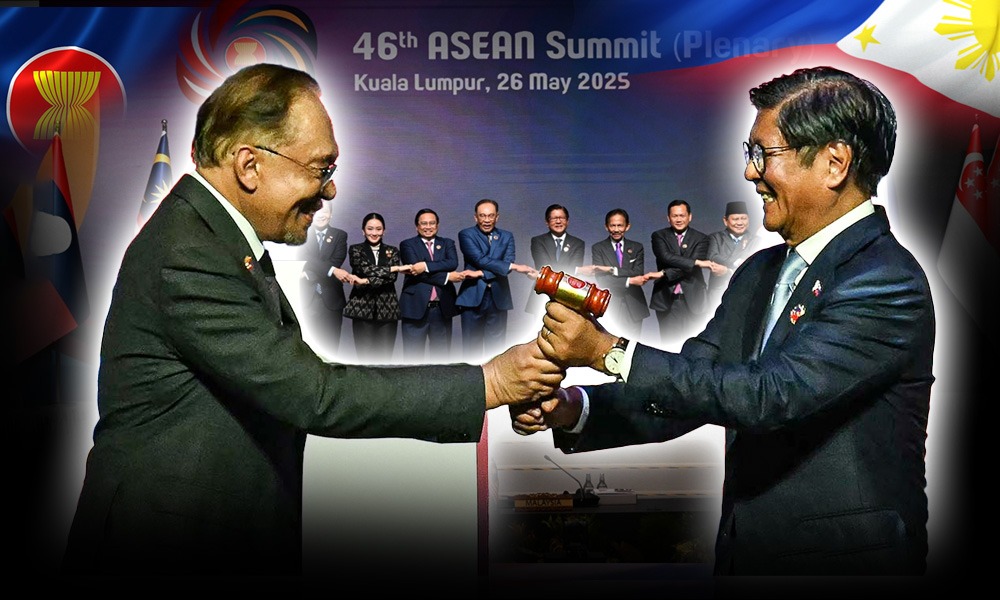
The recent ASEAN Summit in Malaysia marked a crucial turning point for Southeast Asia, setting the tone for the region’s diplomatic direction ahead of the Philippines’ chairmanship in 2026. The summit’s discussions revolved around three major themes, maritime security, economic resilience, and great-power rivalry, all of which have become defining challenges in the Indo-Pacific. While ASEAN leaders reaffirmed their commitment to maintaining peace, unity, and stability, the meeting also exposed the delicate balance between China’s growing assertiveness and the United States’ renewed engagement in the region.
One of the key outcomes of the summit was a collective decision to accelerate negotiations for a binding Code of Conduct (COC) in the South China Sea, a long-standing goal that has faced years of delays and diplomatic stalemates. The move came amid growing concern over China’s maritime activities, including the harassment of Southeast Asian vessels within their own Exclusive Economic Zones (EEZs). By pushing for faster progress on the COC, ASEAN leaders sought to reaffirm the bloc’s commitment to the rule of law and freedom of navigation, signaling that regional security cannot be dictated by unilateral actions.
Beyond security, the summit also highlighted ASEAN’s focus on economic stability and independence. Leaders emphasized the importance of strengthening regional trade, diversifying supply chains, and investing in green technology to shield the region from economic disruptions and overreliance on any single global power. A joint statement underscored the need for a “free, open, and inclusive Indo-Pacific,” a phrase widely seen as a diplomatic nod toward balancing relations between Beijing and Washington.
China’s role at the summit was both prominent and complicated. While Beijing sent a high-level delegation that called for “cooperation, not confrontation,” its actions in the South China Sea continued to undermine trust. Chinese officials reiterated their promise to “fast-track” the COC talks, yet ASEAN members remained wary of Beijing’s preference for vague, non-binding agreements. To counter growing unease, China offered new economic incentives and infrastructure investments under its Belt and Road Initiative (BRI), hoping to maintain influence through economic leverage even as political tensions rise.
The United States, for its part, reaffirmed its commitment to ASEAN’s centrality and to a “free and open Indo-Pacific.” U.S. officials pledged deeper cooperation in maritime defense, cybersecurity, and climate initiatives. Washington also highlighted its network of alliances including with the Philippines, Japan, and Australia, as the foundation for regional stability. This message was reinforced by assurances that America’s treaty commitments, particularly the 1951 Mutual Defense Treaty with the Philippines, remain “ironclad.”
For the Philippines, these developments create both challenges and opportunities as it prepares to lead ASEAN in 2026. On one hand, the country will inherit a region caught between two global powers; on the other, it has the chance to guide ASEAN toward unity and assertiveness. The groundwork laid in Malaysia, especially the renewed momentum on the Code of Conduct, gives Manila a solid platform to champion international law, strengthen regional cooperation, and balance diplomacy with deterrence. In short, the Malaysia summit reinforced that ASEAN’s future and the stability of the South China Sea, will depend on the collective leadership of nations like the Philippines, which now stands ready to steer the bloc through one of its most critical chapters.
Ukraine’s Combat UAV Steals the Show at Philippines Defense Exhibition
Philippines’ Role
As tensions rise in the Indo-Pacific and great-power rivalry intensifies, the Philippines is emerging as a central diplomatic and strategic player within ASEAN and the broader regional order. With its upcoming chairmanship of ASEAN in 2026, Manila is positioning itself not just as a participant, but as a bridge-builder and agenda-setter, a nation determined to guide the bloc toward unity, resilience, and a rules-based maritime environment.
In recent years, the Philippines has taken a more assertive and proactive foreign policy stance, particularly under President Ferdinand Marcos Jr. His administration has moved decisively to strengthen alliances, diversify partnerships, and modernize national defense, marking a shift from the previous era of cautious engagement. The Philippines is now seen as a leading advocate for international law, particularly in defending the 2016 Hague tribunal ruling, which invalidated China’s sweeping nine-dash-line claims over the South China Sea. This ruling remains the cornerstone of Manila’s diplomatic messaging, a symbol of lawful resistance and a rallying point for ASEAN unity.
At the same time, the Philippines is pursuing strategic initiatives to balance security and diplomacy. Through the Enhanced Defense Cooperation Agreement (EDCA) with the United States, Manila has expanded access for U.S. forces to strategic locations across Luzon and Palawan, areas that directly face the South China Sea and Taiwan Strait. These moves are designed to enhance deterrence and improve the country’s ability to respond to maritime threats, but also to demonstrate shared responsibility within alliances, rather than dependency. The Philippines has also strengthened defense cooperation with Japan, Australia, and France, forming a growing web of partnerships that support joint exercises, intelligence sharing, and maritime surveillance.
On the diplomatic front, Manila is reframing ASEAN discussions around accountability and collective security. As incoming chair, it aims to revive the stalled Code of Conduct negotiations by emphasizing transparency, crisis management, and dispute prevention mechanisms. The Philippines has also advocated for the establishment of joint patrols, communication hotlines, and maritime domain awareness initiatives, ensuring that smaller ASEAN members can collectively deter coercion without direct confrontation. In parallel, Manila continues to champion economic cooperation, trade connectivity, and sustainable development, signaling that security and prosperity must go hand-in-hand.
Importantly, the Philippines has adopted what analysts call a strategy of “assertive transparency”, publicly exposing and documenting Chinese incursions in its waters to mobilize international support. This approach has proven effective, strengthening global awareness and rallying both diplomatic and public backing for its maritime rights. It shows a confident, values-based diplomacy rooted in openness and adherence to international norms.
In short, the Philippines is carving out a dual identity in the Indo-Pacific: as a frontline state defending sovereignty and as a diplomatic leader fostering cooperation. By combining stronger defense ties, principled diplomacy, and regional leadership, Manila is not only protecting its national interests but also shaping ASEAN’s collective response to the shifting balance of power in Asia. Its upcoming chairmanship will be a defining moment, a chance to prove that small and medium-sized nations, when united and strategic, can play a decisive role in safeguarding peace and stability in one of the world’s most contested regions.
Hegseth’s Daring Strategy to COUNTER China in Southeast Asia
Escalation in the South China Sea
The South China Sea has once again become the center of rising tensions, with the Philippines and its Southeast Asian neighbors facing increasingly aggressive actions from China. Over the past months, the situation has escalated through a series of confrontations that highlight how fragile peace in these waters has become. Chinese coast guard and maritime militia vessels have continued to block, ram, and water-cannon Philippine boats attempting to deliver supplies to troops stationed at Second Thomas Shoal (Ayungin Shoal). In several cases, Chinese ships were reported to have used sharp-edged poles and blades to damage smaller Philippine vessels, a shocking and deliberate escalation short of direct warfare.
At the same time, satellite imagery has revealed an expanding Chinese presence around Scarborough Shoal and other areas well within the Philippines’ Exclusive Economic Zone (EEZ). These deployments have created what analysts call a “maritime blockade by presence,” where hundreds of Chinese fishing and militia ships operate in coordinated formations to deny Filipino fishermen access to traditional waters. Each of these incidents has drawn international criticism, with countries like the United States, Japan, Australia, and Canada reiterating support for the 2016 Hague ruling, which invalidated China’s sweeping “nine-dash line” claims.
The diplomatic impact of these confrontations has been significant. Within ASEAN, member states are increasingly divided on how to address China’s maritime behavior. The Philippines and Vietnam have called for a firmer regional stance and a legally binding Code of Conduct (COC), while others, economically tied to Beijing, prefer quiet diplomacy. This division weakens ASEAN’s collective leverage and highlights the difficulty of maintaining unity in the face of great-power pressure. Still, the momentum toward finalizing the COC has grown, with the Philippines expected to make it a top priority during its upcoming ASEAN chairmanship in 2026.
For Manila, the escalation has triggered both defensive and diplomatic responses. The Philippines has intensified joint patrols with the U.S. and Japan, expanded its military modernization efforts, and adopted a strategy of “assertive transparency” documenting and publicizing every Chinese incursion to expose violations of international law. This approach has strengthened international support and kept global attention focused on the West Philippine Sea, but it also increases the risk of accidental clashes or miscalculations at sea.
The implications for regional stability are profound. The South China Sea is now crowded with military and coast guard vessels from multiple nations, creating a high-risk environment where even a minor collision could escalate into a broader crisis. China’s gray-zone tactics using non-military force for military objectives, are designed to pressure smaller countries without triggering open war. Yet as the U.S. strengthens its defense commitments and allies increase patrols, the risk of direct confrontation continues to grow.
Ultimately, the Philippines stands at the crossroads of deterrence and diplomacy. It must assert its sovereignty and defend its maritime rights while preventing the region from sliding into open conflict. As ASEAN’s future chair, Manila will play a crucial role in steering Southeast Asia toward collective stability, rule-based order, and regional unity. The challenge is immense, but so is the opportunity, to turn a sea of tension into a stage for cooperation, and to show that even small nations can help anchor peace in one of the world’s most contested waters.
Economic Considerations
The Philippines’ upcoming leadership of ASEAN carries not only diplomatic weight but also significant economic potential. By taking the chairmanship, Manila gains a powerful platform to shape the region’s economic direction, promoting trade, investment, and sustainable growth initiatives that align with its national interests. A stable and proactive ASEAN under Philippine leadership could help lower regional tensions and create a more predictable business environment, encouraging investors to view Southeast Asia as a safe and dynamic hub for manufacturing, logistics, and digital innovation. For the Philippines, this means new opportunities to attract investments into sectors like shipbuilding, renewable energy, information technology, and infrastructure, all of which are central to its long-term growth goals.
Beyond attracting foreign capital, the Philippines can also use its chairmanship to drive regional economic cooperation. It can push for greater ASEAN integration by advocating for smoother trade regulations, harmonized customs procedures, and joint infrastructure projects that connect economies across borders. Strengthening partnerships with major economic powers such as Japan, South Korea, the United States, and the European Union could also bring in development financing and technology transfer. Additionally, focusing on emerging industries like the digital economy and green energy can position the Philippines and ASEAN more broadly, as a leader in sustainable development.
The country’s leadership of ASEAN represents both a test and an opportunity. Economically, it allows the Philippines to convert its growing strategic importance into tangible gains, more trade, more investment, and more jobs. If Manila successfully balances diplomacy with economic foresight, it can transform its ASEAN chairmanship into a milestone for inclusive growth and regional resilience.
Balabac Base as Philippines Stronghold Against China in the South China Sea
Conclusion
As the Philippines prepares to assume the ASEAN chairmanship, it stands at a pivotal point where diplomacy, security, and economics converge. The country’s leadership offers an opportunity to showcase ASEAN’s unity amid rising tensions in the South China Sea and to prove that the region can pursue peace and prosperity side by side. For Manila, this moment is more than symbolic, it is a chance to reinforce its role as a bridge between Southeast Asia and its global partners, advocating for a rules-based order while promoting sustainable growth and cooperation.
Looking ahead, the Philippines’ challenge will be to balance assertiveness with inclusivity. It must continue championing a binding Code of Conduct in the South China Sea while ensuring that economic cooperation remains the core of ASEAN’s agenda. Success will depend on building consensus among diverse member states, deepening trade and digital integration, and maintaining open channels with both China and Western partners.
Ultimately, the Philippines’ year as ASEAN chair could redefine its place in the region. If it leads with vision, strengthening maritime security, advancing economic innovation, and promoting unity, it will not only elevate its own standing but also shape ASEAN’s path in an era of shifting global power. The future of Southeast Asia may well depend on how effectively Manila turns this leadership opportunity into lasting regional progress.