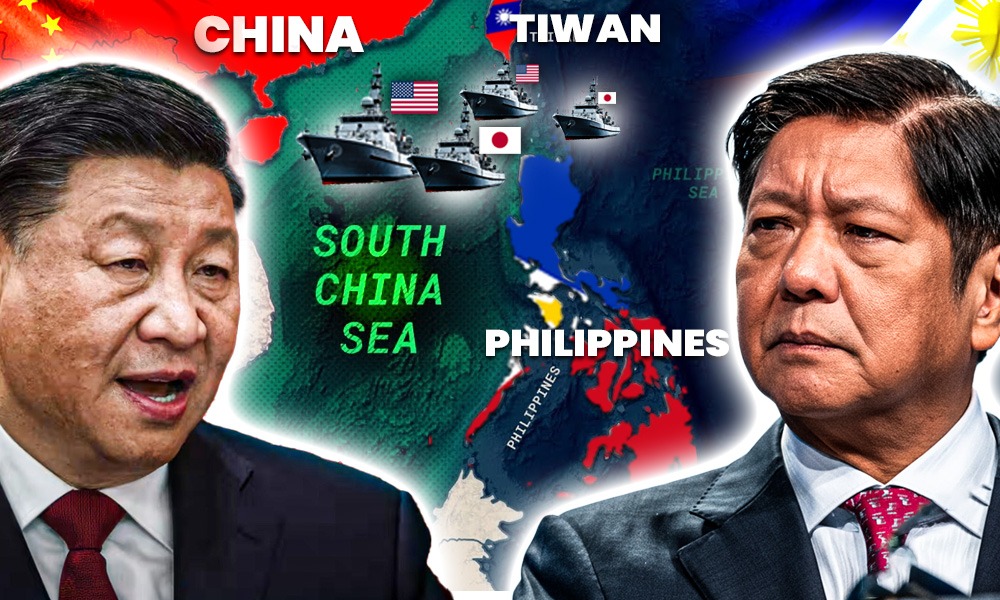
The South China Sea has entered a dangerous new phase as great-power rivalry collides with long-running territorial disputes. In mid-September 2025 the United States, Japan, and the Philippines carried out joint maritime exercises inside Manila’s Exclusive Economic Zone to demonstrate unity and a commitment to a free and open Indo-Pacific. Within hours, China’s Southern Theater Command issued a sharp warning for the Philippines to “immediately stop provoking incidents and escalating tensions,” while dispatching routine naval patrols and advancing plans for a “nature reserve” at Scarborough Shoal. Manila and its allies stood firm: U.S. Secretary of State Marco Rubio condemned Beijing’s “destabilizing plans,” and Philippine officials defended the drills as a sovereign right and a necessary deterrent.
Behind these moves lie hard numbers and legal realities. Chinese “gray-zone” tactics, from water-cannon attacks to maritime-militia blockades, have nearly doubled between 2024 and 2025, even as more than $3.4 trillion in trade and vast energy reserves transit the sea each year. The 2016 Permanent Court of Arbitration ruling already invalidated China’s nine-dash line, a decision President Ferdinand Marcos Jr. calls “beyond compromise,” yet Beijing still rejects it as “null and void.”
The immediate effect is a volatile mix: multiple navies operating in close quarters raise the risk of miscalculation; the U.S.–Japan–Philippines partnership hardens into a collective deterrent; and the prospect of shipping disruptions threatens global supply chains. Looking ahead, analysts warn that China is likely to continue its “salami slicing” strategy of incremental control, while the outcome of these tests will shape whether international law can restrain unilateral claims and how severe the economic shock would be if conflict erupted.
China’s warning to the Philippines therefore crystallizes a turning point. What began as a contest over reefs and fishing rights is now a front line in great-power competition, where each decision by Beijing, Manila, Washington, and Tokyo will influence the balance of power, the freedom of the seas, and the strength of the rules-based order for decades to come.
The Immediate Crisis: September 2025 Events
The latest surge in South China Sea tensions unfolded in mid-September 2025, when the United States, Japan, and the Philippines carried out a high-profile Joint Maritime Cooperative Activity inside Philippine waters. Conducted squarely within Manila’s exclusive economic zone (EEZ), the drills included coordinated maneuvers and information-sharing exercises aimed at strengthening interoperability and maritime domain awareness. A statement from the U.S. Indo-Pacific Command framed the exercise as part of the shared effort to “strengthen regional cooperation and support a free and open Indo-Pacific,” highlighting its defensive and rules-based intent. For the Philippines, the activity was both a practical readiness test and a visible assertion of sovereign rights overseas increasingly shadowed by Chinese coast guard and militia ships.
Beijing’s reaction was immediate and uncompromising. China’s Southern Theater Command accused Manila of “provoking incidents and escalating tensions,” issuing a formal communiqué that “sternly warns the Philippine side to immediately stop provoking incidents and escalating tensions… as well as bringing in external forces for backing such efforts that are destined to be futile.” To give muscle to its words, China announced new “routine patrols” near the exercise zone, widely read as a counter-show of force and signaled the start of what it called an environmental “nature reserve” plan at Scarborough Shoal. This latter move, which Manila rejected as a cover for territorial expansion, added another layer of friction by suggesting that China was ready to consolidate its presence on multiple fronts at once.
The Philippines and its partners answered with equal clarity. Philippine defense officials stressed that the exercises were defensive, lawful, and conducted inside national waters, calling them an essential part of protecting maritime rights. In Washington, U.S. Secretary of State Marco Rubio condemned what he described as China’s “destabilizing plans” and reaffirmed that the 1951 Mutual Defense Treaty obliges the United States to help defend the Philippines if its forces come under armed attack, including in the South China Sea. Japanese officials likewise reiterated support for a rules-based maritime order and freedom of navigation. By the week’s end, what began as a training event had become a full-blown diplomatic and military standoff, one that vividly illustrates how quickly a localized exercise can cascade into a regional crisis when competing great powers are involved.
Latest Stats, Quotes, Facts, and Figures
The September 2025 confrontation between China and the Philippines cannot be understood without examining the steady intensification of Chinese military and “gray zone” activity in the South China Sea. “Gray zone” tactics are operations deliberately calibrated to fall below the threshold of outright armed conflict while still exerting pressure. A dramatic example occurred in August 2025, when Chinese Coast Guard vessels used high-pressure water cannons against Philippine supply boats headed for the grounded BRP Sierra Madre at Second Thomas Shoal, sparking dangerous collisions and injuries. Independent maritime monitoring groups report that China’s so-called “routine patrols” nearly doubled from 2024 to 2025, a quantitative leap that gives Beijing constant on-scene presence and allows it to harass Philippine and other Southeast Asian vessels without firing a shot. These facts underscore how Beijing is refining a long-running pattern of coercion, ranging from laser-pointing incidents to dangerous ship maneuvers, that keeps pressure on Manila while skirting the rules of open warfare.
The stakes of this contest go far beyond daily skirmishes. The South China Sea is a global economic artery, carrying an estimated $3.4 trillion in trade annually, roughly one-third of all maritime commerce. It is also a treasure trove of natural resources, with U.S. Geological Survey estimates of 11 billion barrels of oil and 190 trillion cubic feet of natural gas lying beneath its seabed. For the Philippines, whose economy depends heavily on energy imports and seafood resources, secure access to these waters is not just a matter of sovereignty but of long-term economic survival. For China, control over these shipping lanes and resources offers both strategic depth and energy security, further explaining why it is willing to court confrontation.
Against this backdrop, international law provides Manila with a powerful, if contested, legal weapon. In 2016, the Permanent Court of Arbitration (PCA) in The Hague ruled unequivocally that China’s “nine-dash line” claim had no legal basis, affirming that features like Scarborough Shoal lie within the Philippines’ exclusive economic zone and condemning Chinese interference with Filipino fishing rights. Philippine President Ferdinand Marcos Jr. has repeatedly invoked this decision, declaring that “the award is now part of international law, beyond compromise and beyond the reach of passing governments to dilute, diminish, or abandon.” Yet China continues to dismiss the ruling as “null and void” and has refused to abide by it, creating a dangerous disconnect between legal norms and power politics.
Together, these facts, figures, and authoritative statements reveal the structural pressures behind each new flare-up. China’s escalating gray zone operations and its defiance of international law intersect with immense economic stakes, ensuring that even seemingly routine naval drills or patrols have the potential to ignite a much broader regional crisis.
How It Can Affect Now and in the Future?
The immediate impact of China’s latest warning to the Philippines, triggered by joint U.S.-Japan-Philippine naval drills, lies in the heightened risk of miscalculation at sea. With multiple warships and coast guard vessels operating in contested waters, even a minor navigational error or misinterpreted maneuver could spark a sudden confrontation. Analysts point to past near-collisions, such as the August 2025 water-cannon and ramming incidents near Second Thomas Shoal, as proof of how easily a single spark could escalate into a regional crisis involving great powers.
At the same time, these encounters are hardening security alliances. The mid-September 2025 joint maritime cooperative activity demonstrated that Washington, Tokyo, and Manila are moving beyond rhetoric toward practical “minilateral” defense cooperation. U.S. and Japanese naval participation in exercises inside the Philippine exclusive economic zone signals a willingness to deter Chinese pressure collectively. For Manila, this provides an essential psychological and operational backstop; for Beijing, it underscores that any future confrontation will not be purely bilateral.
The tensions also carry a direct economic risk. The South China Sea handles over $3.4 trillion in annual trade, around a third of global maritime commerce, so even short-lived disruptions could ripple through supply chains. Observers recall how a single ship blocking the Suez Canal in 2021 caused weeks of delays and billions in losses. A clash in the South China Sea could replicate or exceed that shock, driving up shipping insurance rates and commodity prices worldwide.
Looking further ahead, analysts warn of a protracted “salami slicing” strategy, where China consolidates control through many small, legally ambiguous actions that individually fall short of war but cumulatively transform the status quo. Think tanks project this pattern will continue, gradually normalizing Chinese dominance if unchallenged.
The standoff also tests the resilience of international law. Whether the 2016 Permanent Court of Arbitration ruling remains a meaningful constraint on great-power behavior will influence not only the South China Sea but also future maritime disputes from the Arctic to the East China Sea. The outcome will help determine whether a rules-based order can withstand sustained challenge.
Finally, the economic toll of an outright conflict could be catastrophic. A National Bureau of Economic Research study estimates that a major South China Sea war closing key shipping lanes could shrink Taiwan’s economy by 33 percent and cut 10–15 percent from Philippine and Vietnamese GDP. Such projections highlight what is at stake if current flashpoints ignite, a potential global economic shock and long-term regional instability.
Northern Luzon Marines Ready to DEFEND Philippines Watch Their Power
Conclusion: A Turning Point
China’s stark warning to the Philippines in the wake of joint U.S.–Japan–Philippine naval drills highlights how a long-running maritime dispute has evolved into a core arena of great-power competition. By linking its threat directly to Manila’s growing security cooperation with Washington and Tokyo, Beijing has turned a regional sovereignty issue into a strategic flashpoint with global implications.
What happens next will reverberate far beyond the South China Sea. The actions and choices of Beijing, Manila, Washington, and Tokyo over the coming months will help determine whether the Indo-Pacific remains stable and rules-based or slides into confrontation and coercion. The contest now unfolding is not only about contested reefs and fishing rights, it is about the future global balance of power and the credibility of international law for decades to come.