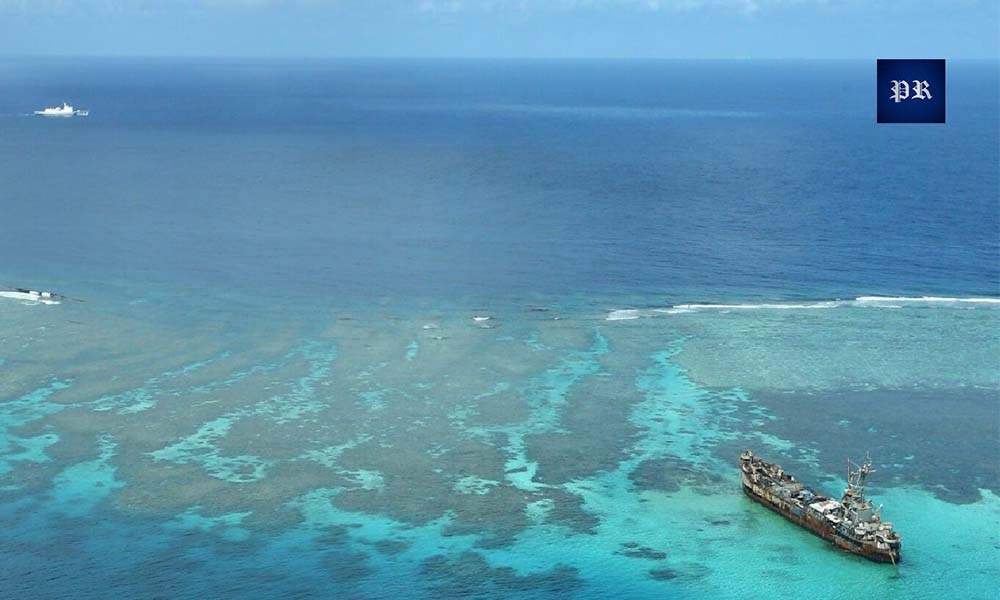
In the pre-dawn hours of 1999, retired Philippine Navy Vice Admiral Eduardo Santos orchestrated one of the most quietly audacious maneuvers in modern maritime history. Without fanfare, he piloted the aging landing ship BRP Sierra Madre across the restless waters of the South China Sea and deliberately ran it aground on the reef known internationally as Second Thomas Shoal (Ayungin Shoal in the Philippines). The move, barely noticed at the time, was calculated: in one stroke, Manila secured a physical hold within its Exclusive Economic Zone (EEZ), turning a derelict warship into a durable marker of sovereignty—an outpost resolute, visible, and strategically immovable. As Santos later reflected, “I did it as quietly as I could,” and yet its significance has resonated louder each year since.
Over two decades later, the Sierra Madre remains a rusting time capsule and sentinel, inhabited by Filipino marines living aboard the decaying vessel. It stands not just as a relic of World War II engineering, but as a potent emblem—perhaps the most powerful material assertion by the Philippines of its maritime rights in the face of China’s sweeping claims.
In this video, we’ll look at whether China could physically tow away the BRP Sierra Madre—and what that would mean for international law, national sovereignty, and regional stability. While technically feasible under extreme circumstances, China’s towing of the BRP Sierra Madre would entail profound legal, political, and military costs—making it a highly risky and strategically improbable maneuver in the near term. Nonetheless, escalating gray-zone tactics, as well as shifts in geopolitics, render the question more pressing than ever.
The Current Situation: The “Why” and “How” of the Standoff
A. Latest Facts and Figures
The Armed Forces of the Philippines (AFP) reported in August 2025 that as many as twenty-five Chinese vessels were observed maneuvering near Second Thomas Shoal. The presence included several China Coast Guard cutters, fast boats, rigid-hulled inflatables, a helicopter, and even an unmanned aerial vehicle. Philippine officials noted that these deployments occurred entirely within the country’s EEZ, and the Department of Foreign Affairs stressed that resupply missions to the grounded vessel remain humanitarian operations protected under international law. Rear Admiral Roy Vincent Trinidad described the sudden increase in activity as “unusual” and emphasized the need for vigilance, while Defense Secretary Gilberto Teodoro underscored that adjusting Manila’s stance would amount to surrendering its national interest.
Chinese pressure has relied heavily on gray-zone tactics that skirt the threshold of outright military conflict. Over recent years, Philippine resupply missions have been met with high-pressure water cannons powerful enough to disable small craft. In February 2023, a China Coast Guard vessel directed a military-grade laser at the Philippine coast guard ship BRP Malapascua, temporarily blinding some of the crew. Other incidents have been even more confrontational: fishing nets were deployed across navigation channels to entangle propellers; Chinese fast craft swarmed and rammed smaller Philippine vessels; and in June 2024, Chinese personnel armed with bladed weapons boarded Philippine resupply boats, seizing firearms and equipment and injuring eight Filipino personnel, including one who lost a thumb. In most recent missions, Chinese encirclement has become overwhelming, with as many as forty-six vessels shadowing a handful of Philippine ships, a tactic designed to intimidate without triggering a direct military clash.
Despite these pressures, the BRP Sierra Madre remains in place. Structurally, the ship is badly compromised, its hull eaten away by saltwater corrosion and waves. Yet it continues to function as a living garrison. Marines rotate regularly and morale, according to Philippine defense officials, remains remarkably high. Secretary Teodoro has described the vessel as both “a military outpost” and “a symbol of sovereignty.” In short, the Sierra Madre is militarily fragile but politically immovable.
Geopolitical Impacts of a Towing Operation
A. Violation of International Law and Sovereign Immunity
Any forcible removal of the Sierra Madre would represent a flagrant violation of international law. The 2016 Permanent Court of Arbitration ruling in the Philippines v. China case declared that Beijing’s expansive “nine-dash line” has no legal basis under the UN Convention on the Law of the Sea (UNCLOS). Second Thomas Shoal was affirmed as part of the Philippines’ EEZ, and therefore a lawful site for Manila’s outpost. A towing operation would directly contravene this judgment and undermine the very authority of UNCLOS. Furthermore, because the Sierra Madre is a commissioned warship, it enjoys sovereign immunity. International law prohibits the seizure or forcible removal of such vessels by foreign powers. Attempting to tow it away would not be a maritime maneuver—it would be an act of aggression against a sovereign state.
B. The U.S.–Philippines Mutual Defense Treaty (MDT)
Beyond legal issues, a towing operation would almost certainly activate the 1951 Mutual Defense Treaty between the Philippines and the United States. The treaty explicitly covers “armed attacks on the armed forces, public vessels, or aircraft in the Pacific.” The Sierra Madre is a Philippine naval vessel, and its forcible removal would constitute an attack by any reasonable interpretation. U.S. officials have repeatedly described their commitment to the treaty as “ironclad,” warning that aggression against the Philippines in the South China Sea would trigger American involvement. For Beijing, this is not a distant threat but a near-certainty, particularly given the heightened U.S. presence in the Indo-Pacific since 2022.
Diokno Pushes Philippines to Rejoin ICC Amid Escalating South China Sea Aggression by China
C. Regional and Global Ramifications
The ramifications of a successful towing would extend well beyond Manila. First, it would erode the rules-based order. International law, and particularly UNCLOS, would be hollowed of authority, setting a precedent that force, rather than legal judgment, determines maritime sovereignty. Second, it would accelerate the consolidation of alliances. States such as Japan, Australia, India, and members of the European Union would likely move closer to Washington and Manila, deepening cooperation through frameworks like AUKUS and the Quad. Finally, it would imperil the global economy. The South China Sea carries one-third of world shipping. An open clash triggered by towing the Sierra Madre would raise insurance rates, disrupt trade flows, and inject volatility into already fragile supply chains.
Legal and Political Barriers to a Towing Operation
A. International Legal Constraints
International law poses near-insurmountable obstacles to a forcible removal. The 2016 arbitral tribunal rejected China’s “nine-dash line” and confirmed that Second Thomas Shoal lies within the Philippines’ EEZ. The judgment was binding under UNCLOS, even though China rejected it. Removing the Sierra Madre would be a direct defiance not just of Manila but of the international legal system. On top of this, the principle of sovereign immunity protects military vessels from seizure. Warships are regarded as extensions of the state itself, and any attempt to tow away the Sierra Madre would be equivalent to attacking Philippine sovereign territory.
B. Geopolitical and Diplomatic Costs
The political and diplomatic consequences would be immediate and severe. An attempted tow would almost certainly trigger provisions of the MDT and invite U.S. military intervention. It would also generate sweeping condemnation from a broad coalition of states. Australia has repeatedly emphasized its support for the rules-based order, Japan has condemned Chinese coercive tactics, and the European Union has issued statements backing Philippine rights in the South China Sea. Domestically, the Philippine government has set firm red lines. Rear Admiral Trinidad and other defense officials have declared that any attempt to dislodge the Sierra Madre would be considered hostile aggression. Members of the Philippine Congress have echoed this sentiment, praising the AFP for its efforts to block Chinese incursions and vowing not to yield sovereignty. The unified domestic stance makes it politically impossible for any Philippine administration to accept the removal of the ship.
Philippines Should Accelerate Island Building in the South China Sea Like Vietnam
The “How” of a Hypothetical Towing Operation
A. Technical Feasibility
From a purely engineering standpoint, towing the Sierra Madre would be a formidable task. The ship has been grounded for more than two decades. Its hull is weakened by corrosion, making it prone to breaking apart under stress. Any attempt to move it risks disintegration, potentially spilling debris across the reef. The shoal’s shallow waters complicate maneuvering of large salvage tugs, and the operation would require heavy cranes, cutting equipment, and numerous support vessels. It would be a highly visible operation, impossible to disguise and fraught with environmental consequences. Far from being a swift maneuver, it would take weeks, if not months, to plan and execute.
B. Military and Escalation Risks
The technical obstacles pale beside the military risks. Philippine forces aboard the Sierra Madre have standing orders to resist boarding or removal attempts at all costs. Even limited defensive action could escalate rapidly, especially if Philippine naval or coast guard reinforcements intervened. An exchange of fire, however limited, could draw in the United States under the MDT. This prospect makes towing not just technically difficult but strategically reckless. For Beijing, it would be a gamble with unpredictable escalation dynamics, potentially sparking the most serious military confrontation in the South China Sea since the 1970s.
China Coast Guard Releases Video of Manila’s So-Called ‘Provocation’ at Ren’ai Jiao
Future Impact: Effects Now and in the Future
A. Immediate Effects
If China were to succeed in towing away the Sierra Madre, the most immediate impact would be the erosion of international law. The arbitral ruling of 2016 and the authority of UNCLOS would be rendered moot in practice, replaced by the principle that effective control equals sovereignty. Tensions in the South China Sea would spike dramatically, raising the risk of accidental or intentional conflict among naval and coast guard forces. Regional militaries would mobilize, and Washington would face immense pressure to demonstrate resolve.
B. Long-Term Effects
Over the long term, such an event would reshape the security architecture of the Indo-Pacific. Alliances would harden, with the United States, Japan, Australia, and others stepping up patrols, exercises, and possibly even permanent deployments in the South China Sea. Trade would suffer as shipping companies rerouted vessels or increased premiums to account for risk, which could have cascading effects on global markets. Perhaps most dangerously, a successful tow would set a precedent. If China can remove a sovereign Philippine warship with impunity, other states with maritime disputes—from the East China Sea to the Arctic—may feel emboldened to pursue similar measures.
EU Stands with the Philippines Against China in the South China Sea
Future Outlook
Despite speculation, Beijing is unlikely to attempt towing the BRP Sierra Madre in the immediate future. The risks—legal, military, diplomatic, and economic—far outweigh the potential benefits. Instead, China is likely to persist with its gray-zone tactics. These include harassment with water cannons, the use of lasers and electronic interference, the deployment of swarming small craft, and the construction of logistical blockades. Such tactics carry lower risk of escalation while slowly undermining Philippine morale and capability. They also take advantage of the Sierra Madre’s natural deterioration. Beijing’s strategic bet may be that the ship will eventually collapse under its own decay, eliminating the need for direct action.
The larger struggle, however, is not just about one rusting warship. It is about the future of the South China Sea and, by extension, the viability of international law in the Indo-Pacific. The Sierra Madre embodies the collision between legal principle and coercive power. As long as it remains grounded on Ayungin Shoal, the Philippines asserts its rights, Washington’s credibility is tested, and China’s ambitions are checked by the costs of escalation. The standoff therefore remains a defining microcosm of twenty-first century maritime competition. The outlook is one of continuing tension, persistent gray-zone conflict, and uncertain resolution.