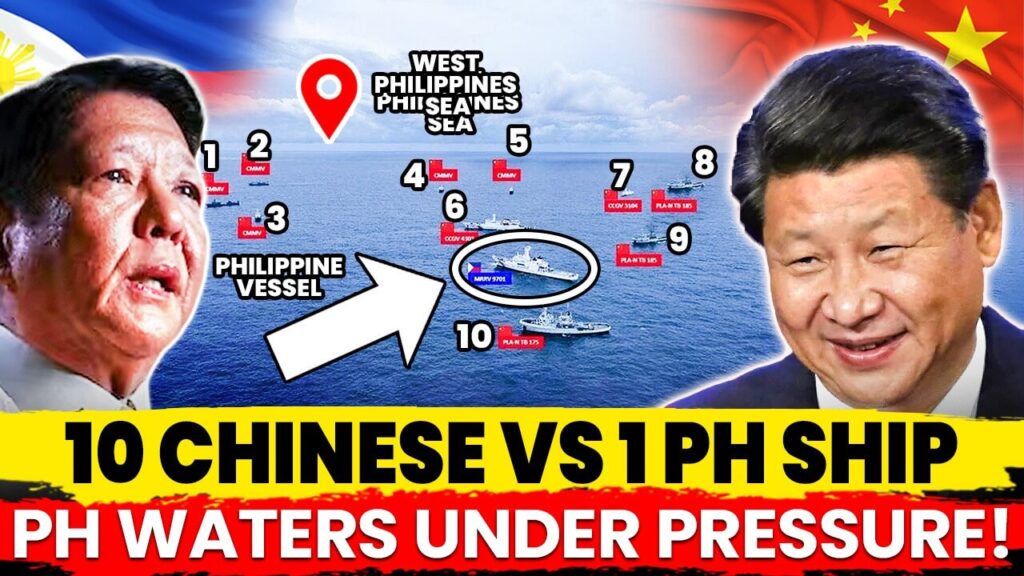
10 Chinese Ships vs 1 Philippine Vessel
How Beijing Turns Aggression Into “Routine Patrols”
10 Chinese Ships vs 1 Philippine Vessel. On paper, Beijing calls it a “routine patrol.” On the water, it looks very different. The overwhelming numerical imbalance is not accidental; it is designed. By surrounding a lone Philippine ship with coast guard and maritime militia vessels, China projects dominance without firing a single shot, transforming coercion into something it insists is normal, legal, and administrative.
This is how modern gray-zone pressure works in the West Philippine Sea. Instead of overt military confrontation, Beijing floods contested waters with “law-enforcement” ships, reframing intimidation as everyday governance. Each maneuver is calibrated: close enough to signal control, restrained enough to avoid escalation. The goal is not battle, it is endurance, forcing Manila to operate under constant pressure while China reshapes perceptions of who truly controls the sea.
Over time, repetition becomes a strategy. When ten ships shadow one vessel again and again, the abnormal starts to look routine to outside observers. That normalization is the real objective. In the South China Sea, aggression is no longer announced with weapons, it is quietly embedded in patrol patterns, radio calls, and sheer presence, until coercion itself begins to feel ordinary.
1) Cold Open — The Shot That Explains the Strategy
A lone Philippine public vessel cuts through open water. For a moment, the sea looks empty, calm, unremarkable. Then the frame begins to fill. One Chinese hull appears. Then another. Then several more, spreading across the horizon until the imbalance becomes impossible to ignore. No weapons are fired. No collision occurs. And yet the visual alone explains everything. This is not an encounter. It is a message.
“Ten ships. One target. No gunfire. No collision.” The restraint is deliberate, but the intent is unmistakable. The Philippine vessel is free to move only within limits set by others. Every maneuver is watched. Every course correction is shadowed. Control is asserted not through violence, but through presence, dense, persistent, and overwhelming.
This is the core of China’s coercive strategy at sea. Beijing applies pressure while carefully staying below the threshold of open conflict, branding its actions as “law enforcement” rather than aggression. Coast guard ships lead the formation, maritime militia fill the gaps, and naval forces remain just over the horizon. Together, they create a wall of hulls that constrains them without openly attacking.
The thesis is simple, and it has been repeated countless times in the West Philippine Sea: presence becomes pressure. By overwhelming smaller states with numbers, shaping the narrative around legality and routine patrols, and repeating these encounters until they feel ordinary, Beijing turns coercion into background noise. What looks calm on the surface is, in fact, control, quiet, calculated, and increasingly normalized.
2) What Happened — Encirclement as a Tactic, Not a Moment
What unfolded was not a sudden confrontation, but a textbook execution of a familiar tactic. Encirclement at sea is not about a single dramatic moment, it is a process. Chinese vessels position themselves deliberately ahead, abeam, and astern of a target ship, compressing its maneuvering space until every safe option narrows. Close shadowing becomes constant. Bows are crossed just far enough to force course changes, while speed and spacing are adjusted to keep the smaller vessel boxed in without physical contact.
Alongside these maneuvers comes the verbal layer of pressure. Radio challenges are issued calmly, framed as “warnings” or “reminders” of supposed jurisdiction. These transmissions are not just for the crew being addressed; they are recorded, logged, and later cited as evidence of “law enforcement activity.” In Beijing’s narrative, the encounter is no longer an act of intimidation, it becomes an administrative exchange backed by a paper trail.
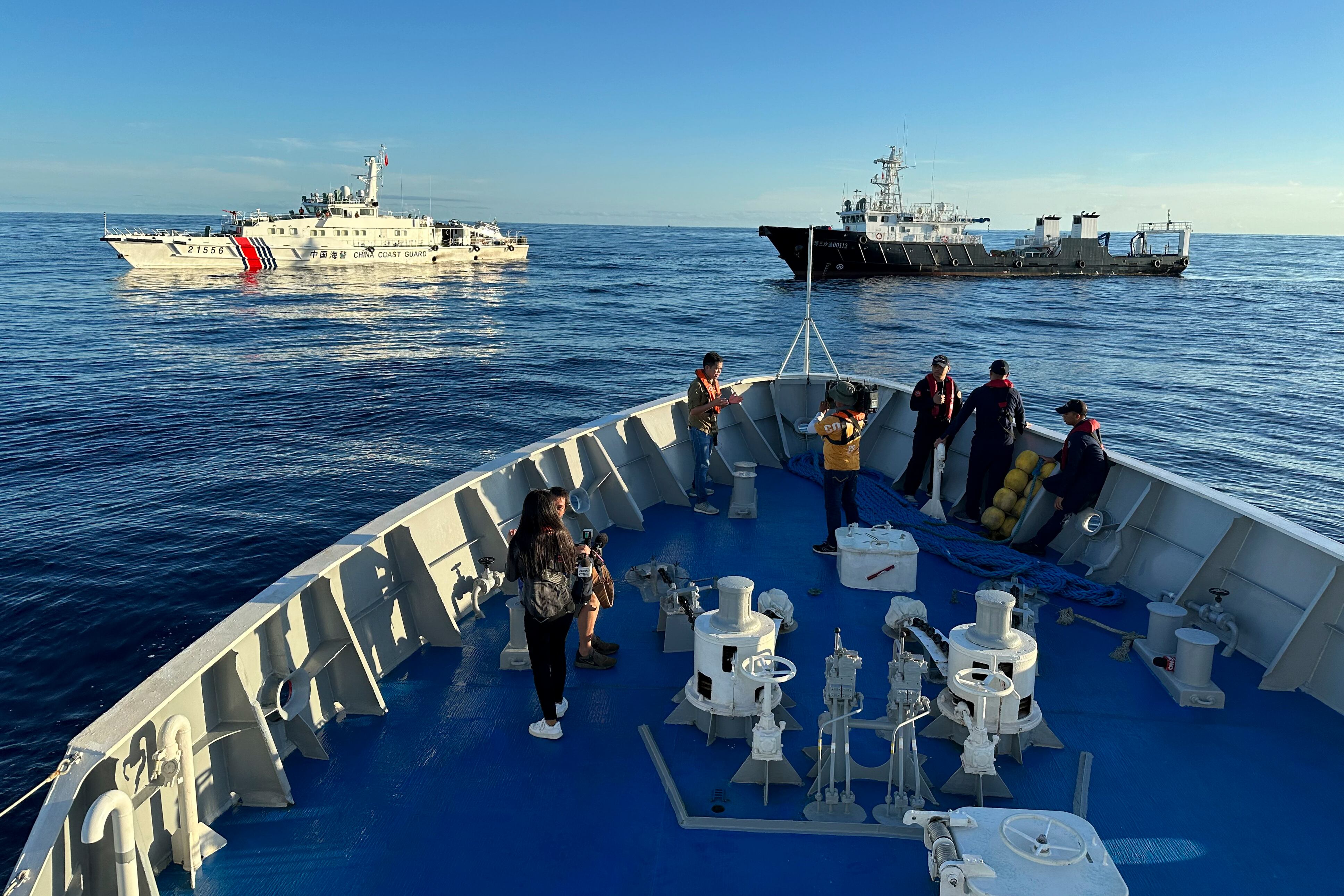
The absence of violence does not make the tactic benign. Even without ramming, water cannons, or gunfire, the targeted vessel’s freedom of navigation is effectively reduced. It may still be moving, but only within boundaries imposed by others. This is control without combat, denial without a trigger event that would justify retaliation or invoke treaty responses.
That distinction is precisely why the tactic matters. As Reuters reported in a 2024 incident, the Philippine Coast Guard stated that one of its vessels was “impeded” and “encircled” by a Chinese coast guard ship alongside maritime militia units. No shots were fired, yet the outcome was clear: the Philippine vessel’s mission was constrained, and China achieved operational control while maintaining the appearance of restraint.
3) The Force Mix — Why It’s So Hard to Respond Cleanly
China’s advantage isn’t just in what it does, but in how it layers its forces. Instead of relying on a single type of ship, Beijing deploys a three-layer stack designed to blur accountability and control escalation. First come the maritime militia, civilian-looking fishing vessels that crowd, shadow, and obstruct. Though non-military in appearance, they move in coordination, creating ambiguity and raising the political risk of any response against “civilians.”
Next is the China Coast Guard. The white hulls are intentional. They frame the encounter as “law enforcement,” not aggression, with radio warnings and jurisdictional claims providing a ready-made narrative shield, even when the result is effective control of another state’s vessel. Behind them sits the PLA Navy. Gray hulls rarely intervene, but their nearby presence establishes escalation dominance. Everyone understands the message: if things turn kinetic, China holds the heavier cards.
This structure is reinforced by scale. CSIS estimates China fields over 142 oceangoing and offshore patrol vessels and more than 400 smaller ships, enabling sustained saturation. Ten ships around one target is not an exception, it’s repeatable. The effect is decisive. Coercion looks non-military, escalation stays ambiguous, and red lines remain blurred. That calibration, pressure without a clear trigger, is precisely why responding cleanly is so difficult.
4) Beijing’s Core Trick — Flood, Frame, Normalize
At the heart of Beijing’s maritime playbook is a simple but powerful sequence: flood the space, frame the encounter, and repeat it until coercion no longer looks like coercion at all.
First comes the flood. China overwhelms a contested area with sheer numbers. More hulls mean more angles for obstruction, more shadows crossing a bow, more pressure without physical contact. Each additional ship multiplies intimidation while preserving deniability. No single vessel has to act aggressively; presence itself does the work. From Beijing’s perspective, nothing “happens” they are simply there, in force.
Then comes the frame. The objective is not only to restrict a ship’s movement, but to control the story that follows. Radio challenges are recorded. Warnings are issued. Official statements emphasize legality, restraint, and responsibility. “We warned them.” “They were operating illegally.” “We acted professionally.” By the time footage or reports reach the public, China has already constructed a narrative in which coercion is recast as enforcement.
Finally comes normalization. This is the long game. The same tactics are repeated again and again, at Scarborough, at Ayungin, across the West Philippine Sea, until each incident blends into the last. When something happens constantly, outsiders stop reacting with urgency. Diplomatic protests lose edge. Headlines shrink. “Routine patrol” becomes the default description, even when the behavior would once have been labeled a serious provocation.
Together, flood, frame, and normalize form Beijing’s core trick. Control the water, control the narrative, and then wait. Over time, the extraordinary is absorbed into the background and coercion, once shocking, becomes just another day at sea.
5) Lawfare at Sea — The Legal Wrapper Around Coercion
What makes this pressure campaign especially effective is the legal wrapper wrapped tightly around it. The ships applying the pressure are not gray-hulled warships, but white-hulled coast guard vessels and that distinction is not cosmetic. At sea, color carries meaning. A white hull signals policing. A gray hull signals war. By leading with coast guard ships, Beijing keeps its actions framed as civilian law enforcement rather than military coercion, allowing it to push hard while staying “below war” and steadily changing facts on the water.
This visual framing is a strategic weapon. A coast guard vessel issuing warnings, blocking movement, or shadowing another ship can be described as doing its job, even when the behavior would be considered hostile if carried out by a navy. The result is pressure without a clean trigger for escalation. China advances control while complicating any response that would look proportionate, lawful, and restrained to outside observers.
Behind those white hulls sits a legal architecture designed to support assertive behavior. Analysts at CSIS, through the Asia Maritime Transparency Initiative, have noted that China’s Coast Guard Law contains explicit language authorizing the use of force in defense of what Beijing defines as its sovereignty and maritime rights. The concern is not abstract: when sovereignty claims are expansive and disputed, “law enforcement” authority becomes a tool for aggressive action in contested waters, while still wearing a legal badge.
Manila’s counter rests on a very different legal foundation. The Philippines consistently invokes the 2016 arbitral ruling under UNCLOS, which rejected China’s expansive claims and clarified maritime entitlements in the West Philippine Sea. The Permanent Court of Arbitration’s case record details both the scope of the dispute and China’s refusal to participate, an absence that has not diminished the ruling’s legal standing in the eyes of international law.
The contrast is stark and visual. On one side: tribunal decisions, legal texts, and rules-based order. On the other: ships at sea, physical presence, and pressure applied in real time. This is lawfare at sea, not law replacing power, but law being used to cloak it. And in the gap between legal judgment and maritime reality, Beijing continues to press its advantage.
6) The Philippine Dilemma — Restraint Isn’t Optional
For the Philippines, restraint is not a choice, it is a condition imposed by the environment. Manila cannot “just push back” without walking directly into Beijing’s narrative trap. Any collision, warning shot, or aggressive maneuver at sea can be instantly reframed: the Philippines becomes the provocateur, China the restrained enforcer. In that inversion, Beijing gains twice, operational control on the water and moral leverage in the information space.
This asymmetry shapes every decision made by Philippine commanders on scene. Even when encircled or impeded, responding forcefully risks handing China exactly what it wants: a visual or audio clip that can be edited, replayed, and cited as proof that Manila escalated first. Once that frame takes hold, the focus shifts away from the original coercion and toward “stability,” “restraint,” and calls for de-escalation, language that freezes China’s gains in place. China’s Mega Projects: Boom or Debt Trap?
The strategic costs accumulate quietly. Constant operations under pressure exhaust crews and platforms. Each close-in maneuver increases the risk of miscalculation, collision, or accident, events that no one may intend, but which could spiral rapidly. The pressure is psychological as much as physical. Public-vessel crews are tested not on firepower, but on discipline, patience, and willpower, day after day, patrol after patrol.
President Ferdinand Marcos Jr. has described Chinese actions as “illegal, coercive, aggressive and dangerous,” while vowing that the Philippines will respond with proportionate countermeasures. That balance, naming the behavior clearly while avoiding the escalation China seeks, defines Manila’s dilemma. In the West Philippine Sea, restraint is not a weakness. It is a strategic necessity imposed by an adversary that thrives on forcing others to make the first visible mistake.
Case Studies — How Gray-Zone Pressure Actually Works
One of the clearest examples of China’s gray-zone strategy came during repeated Philippine resupply missions to Second Thomas Shoal in 2024. Chinese vessels used water cannons and deliberate obstruction to disrupt logistics without triggering open conflict. The goal was not destruction, but denial, making routine resupply dangerous, costly, and politically exhausting. As Reuters reported, the logic was simple: control logistics, and you control the outpost, without firing a missile.
A second pattern emerged in Reuters-documented “encircle and impede” incidents the same year. Philippine Coast Guard vessels were surrounded by China Coast Guard ships and maritime militia, their movement constrained without a single dramatic clash. No ramming. No explosions. Just procedural domination, turning open water into a managed space where movement required tacit permission.

In 2025, pressure became more visible near Subi Reef. The Associated Press reported a Philippine patrol aircraft targeted with signal flares while observing at least 29 suspected Chinese maritime militia vessels in the area. The episode showed how quickly Beijing can scale coercion. Massed militia activity creates “normal-looking” facts on the water that fundamentally alter the operational balance.
Another 2025 incident pushed the envelope further. AP News reported a water cannon attack that damaged a Philippine vessel and endangered a civilian research crew near the Sandy Cay–Thitu area. The message was clear: coercion is not limited to military targets. Civilian-linked and scientific missions are equally vulnerable, widening the pressure field. Together, these cases reveal the pattern. China’s strategy is not built on dramatic clashes, but on repetition, control, and scalability, applying pressure, avoiding war, and normalizing dominance until resistance itself becomes the exception.
The Alliance Factor — Why “Public Vessels” Changed the Math
A key deterrence detail often missed: U.S. officials have repeatedly stated that the Mutual Defense Treaty covers Philippine public vessels, including coast guard ships, in the South China Sea. That single clarification quietly raises the stakes around white-hulled encounters. China has adapted by staying in the harassment zone, water cannons, lasers, jamming, flares, ramming pressure, tactics calibrated to avoid clear treaty triggers. This is not restraint; it is precision. The gray zone exists precisely to blur thresholds while preserving control.
Why “10 vs 1” Works — Optics and Psychology
The imbalance is the operation. Ten ships around one vessel create an instant visual of dominance that spreads faster than legal arguments or diplomatic notes. In an algorithm-driven world, images beat explanations, and Beijing knows it. The coercion targets three audiences at once: Philippine crews and public (fatigue and fear), regional states (discouraging alignment), and global observers (manufacturing doubt). As a single line captures it: China doesn’t need a naval victory. It needs the world to accept the pattern.
What the Philippines Can Do — A Realistic Response
First: win the record. Continuous video documentation and rapid public release blunt narrative reversal and expose gray-zone tactics in real time. Second: deter without escalating. More frequent joint patrols, smarter PCG–Navy coordination, and operations anchored in international law raise costs without crossing red lines. Third: build endurance. This is a tempo contest measured in years. Fleet modernization and more hulls matter because capacity is a strategy.
Indian combat aircraft crashes during a live demonstration at the Dubai Air Show
Closing
“No shots fired” does not mean “no attack.” In the West Philippine Sea, coercion is engineered to be constant, deniable, and ordinary. In the South China Sea, numbers aren’t present. They’re power and power, repeated often enough, start to look like law.