Introduction
For centuries, control over maritime domains has been synonymous with power, as the vast oceans serve as strategic chessboards, with islands acting as critical pieces in the pursuit of regional and global hegemony. Around the globe, nations vie for control over islands near key maritime routes, driven by the allure of economic wealth and strategic advantage. Islands possess lucrative oil and gas reserves, vital non-renewable resources and abundant fishing grounds that can sustain millions.
Additionally, they offer control over shipping lanes, enabling the regulation of huge trade, and serve as strategic military outposts. In this game for supremacy, the Natuna Islands—a minor cluster in the South China Sea—emerge as a highly significant asset, promising economic prosperity, food security, and geopolitical influence to those who control them.
Located in Indonesia’s Exclusive Economic Zone, the Natuna Islands are a geostrategic gem despite their remote and underdeveloped status, housing a population of 80,000. These islands have some of the world’s richest fishing grounds, with over 300 prime fishing points, and hold staggering reserves of natural gas, 222 trillion cubic feet, of which 46 trillion cubic feet is extractable, along with significant oil deposits of approximately 11 billion barrels. Strategically situated near the Strait of Malacca, the islands connect the Indian and Pacific Oceans, making them indispensable to any nation aspiring for global power.
This combination of abundant resources has drawn the attention of major regional and global players, including China, highlighting the Natuna Islands as a battleground for geopolitical and economic dominance in the 21st century. Given the island’s substantiality, it is time to address the elephant in the room: Will China attempt to take over the Natuna Islands, mirroring its actions in the Spratly and Paracel Islands?
China’s Takeover of the Spratly Islands
No single country has a direct claim to the entire sea or to its resources, therefore, to prevent the disputes United Nations through the, “Convention on the Law of the Sea” bifurcated the seas into different Exclusive Economic Zones for each country. However, these laws have failed to prevent stronger regional powers from usurping the rights of relatively weaker countries.
Consider the Spratly Islands—composed of islands, reefs, and atolls scattered across the South China Sea.
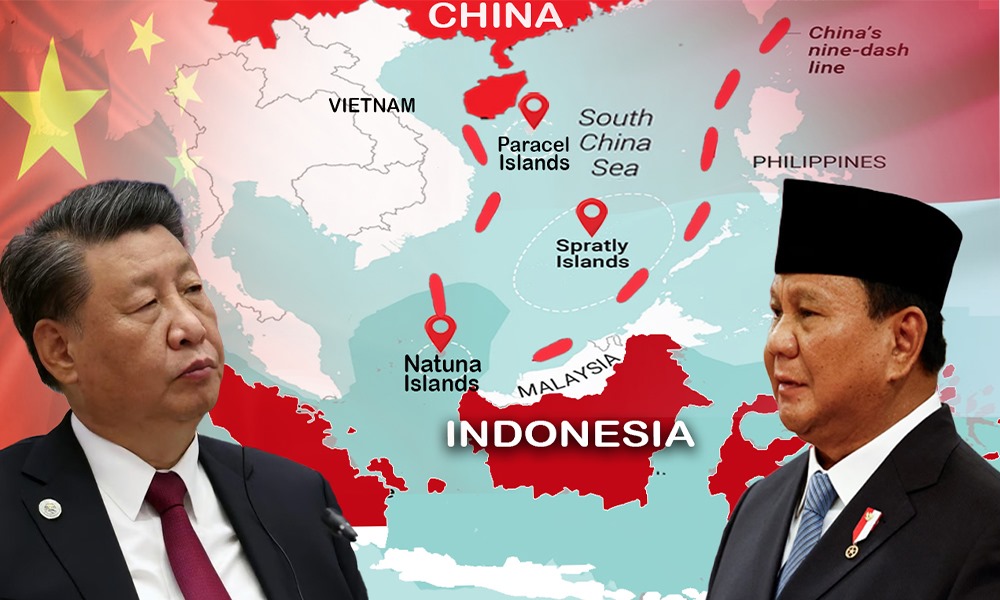
China justifies its claim on the Spratly Islands on the basis of the “Nine-Dash Line” which is basically an ancient map—at least seventy-five years old—demarking the South China Sea. Wherein, 80-90% of South China Sea’s territory belongs to China inclusive of the areas under the control of Vietnam, Philippines, Malaysia, Brunei, and Indonesia.
Of course these countries contest the Chinese claims but it has not been enough to prevent China from aggressively taking over these islands. Over the past two decades, particularly since the year 2000, China has extensively built artificial islands in this area equipped with military installations, runways, and radar systems. It has dramatically altered the regional geography, establish China’s military might in the region and ward of the claims by Vietnam, Philippines, Malaysia, Brunei, and Indonesia.
China’s aggressive actions have drawn negative attention, the case between China and Philippines in the Permanent Court of Arbitration is a testament of this fact. Philippines challenged the Chinese claim and the Court ruled in Philippines’ favour stating Chinese claims have no legal basis. The ruling was still not enough to stop China from militarising the regions and asserting control over the Spratly Islands.
Alfred Thayer Mahan, a renowned naval strategist once stated, “Whoever controls the sea commands the trade; whoever commands the trade of the world commands the world.” The relevance of this quote is reflected through China’s dealing with Spratly Islands. Control over Spratly Islands allow China to control the busiest shipping lanes with trillions of dollars’ worth of trade—paving the way towards economic superiority and ultimately, global hegemony.
Robert Kaplan, a prominent geopolitical analyst, in his book, “The Revenge of Geography” asserted the importance of geography in shaping global power dynamics. He states, “Geography remains a powerful force in world affairs.” Correspondingly, China’s actions relating to Spratly Islands is a manifestation of this principle, a vital step towards the achievement of geopolitical dominance.
The islands proximity to important maritime routes and potential oil and gas resources have compelled China to control these islands. Moreover, by the construction of artificial islands, altering the geography and establishing a military presence, China has the leverage of preventing enemy nations’ from conducting any trade through these maritime routes, which is indirectly important for undermining its enemies and damaging them economically.
China’s Takeover of the Paracel Islands
The Paracel Islands, are composed of small coral islands and reef, located in the South China Sea, 400 kilometres in the east of central Vietnam and 350 kilometres in southeast of China’s Hainan Island. While discussing China’s policy for the Paracel Islands it is needless to mention that it has been similar to that of Spratly Islands.
Various countries such as China, Vietnam and Taiwan claim authority over these Islands; nevertheless, China has been the one controlling them since 1974, after seizing them from Vietnamese control through a military clash with South Vietnam. China’s interest in Paracel Islands was sparked by the discovery of oil deposits underneath the soil bed; thereafter, China aggressively assumed control of the entire archipelago.
Although Paracel Islands has been a source of contention between Vietnam and China, it has not garnered enough international attention as compared to Spratly Islands.
Robert Kaplan, in the work concerning “Indo-Pacific” stated, “The Indo-Pacific is an increasingly contested space.” Allowing to consolidate its power within the South China Sea, militarise the entire maritime region and control the trade that flows through it. This way no regional power in the Pacific and Southeast Asia would be able to challenge Chinese might.
Evolving Situation on the Natuna Islands
We have so far discussed China’s role in context of the Spratly and Paracel Island, and it has given us a clear idea of its aggressive-militarised policies to achieve control either by hook or by crook.
Now let’s direct our focus once again towards the Natuna Islands and the rapidly evolving situation there. Indonesia has asserted sovereignty over these islands but now it is threatened by China—and its aggressive-militarised strategies and an assertive regional presence.
Increased Chinese Assertiveness
Over the past years Chinese vessels, coast guard ships, and fishing boats have been frequently intruding into the Indonesian Exclusive Economic Zone. China claims the Natuna Islands belong to them alongwith the fishing grounds within its premises because of the Nine-Dash Line.
These disputes having been intensifying for a while now, Indonesia contests Chinese claims because these fishing grounds particularly and the Natuna Islands collectively is crucial for Indonesia’s economic and regional stability and they fall within its Exclusive Economic Zone.
Military Responses
In the year 2021, Chinese survey ships and coast guard vessels entered the Tuna Block an offshore natural gas exploitation area, under Indonesian control. Indonesia therefore, swiftly deployed air and naval patrols from the bases on the Natuna Island. The standoff continued for months with both sides shadowing each other.
Similarly, in 2023, Indonesian government approved the drilling for natural gas and oil reserves on Natuna Islands. Consequently, the Chinese Coast Guard sent its largest vessel in to the area to halt their activities. In response, Indonesian warship, a maritime patrol aircraft, and a CH-4 UAV was dispatched from the Natuna base to monitor Chinese movements and deter possible efforts of halting the drilling.
Diplomatic Responses
The Chinese Government explicitly asked the Indonesian Government to stop the drilling for oil and natural gas on the Natuna Islands claiming the region was Chinese territory and Indonesia had no right of doing so. The Chinese claims were categorically denied by the Indonesian government and the drilling was continued despite the protests by China.
Evidently, the tensions concerning Natuna Islands are rising. The threats posed by Chinese naval might and maritime capabilities is a concerning for Indonesia. So far Indonesia has been able to keep China at bay but only time will tell if the status quo is maintained.
Local Perspectives
To gain a deeper understanding of the Natuna Islands dispute, it is essential to consider the local perspectives, particularly those of Indonesians. An Indonesian Parliamentarian and member of National Security Committee, Muhammad Farhan, claimed that Chinese diplomats sent letters protesting the drilling for natural gas and oil at Natuna Island, ordering it to be stopped. However, the Indonesian Foreign Ministry, although tight-lipped, issued a firm reply, stating, “that we are not going to stop the drilling because it is our sovereign right.”
The fishermen rely on surrounding waters to earn their livelihoods, Chinese intrusion in these waters through vessels and coast guard ships will take this opportunity away from the local fishermen.
To counter these Chinese efforts, and prevent exploitation of Indonesian Exclusive Economic Zones the Indonesian government has started sending hundreds of fishermen from the Northern coast of Java to Natuna. The Indonesian Fishermen, have demonstrated resoluteness in this matter and a firm desire to hold ground, they stated:
“We can and are willing to sail all the way to the EEZ, but the thing is our fleet is inadequate and we don’t have the technology. But if we are trained, we can contribute to play our role in being on the front line for the nation.”
The Indonesia political analysts have voiced their concerns regarding the long-term implications of China’s actions for Indonesia’s national security.
Analysis and Predictions: Similarities and Differences vis a vis Spratlay and Paracel Islands
Now let’s compare the similarities and differences between the Chinese approach in Spratly, Paracel, and Natuna Islands. One thing is obvious, China has exhibited a strong desire to establish hegemony throughout the South China Sea, and exert control over the vital maritime routes.
In the Spratly Islands, China has built artificial islands and established military bases on them, to create a military presence in the region, and ward of any intrusion through use of arms if the need be.
On the other hand, in the Paracel Islands, China assumed control by a military clash and drove out the South Vietnamese forces. China consolidated control through military presence and faced limited opposition.
Whereas, in the Natuna Islands, Chinese actions have been subtle yet passive-aggressive, no military confrontations have been reported, nevertheless, dominance has been asserted through the disputes with the fishermen and intrusions of Chinese vessels into Indonesia EEZ. China has also used the diplomatic front to express discontentment over the situation with the Natuna Islands and to claim its authority.
Unique challenges posed by the Natuna
The situation in the Natunas is complex even for China, because Indonesia possess a relatively stronger military presence as compared to other Southeast Asian countries who forfeited control in front of China. Indonesia has prominent naval presence around the Natunas and constantly reinforces its sovereignty over the Islands. It has actively responded to Chinese incursions with military deployments and diplomatic protests, demonstrating its capacity to resist external pressure.
The Natuna Islands fall within the Indonesia’s Exclusive Economic Zone (EEZ). Indonesia’s claim to sovereignty over these islands is legitimate and backed by United Nations Convention on the Law of the Sea. Thus, making Chinese intrusion unjustifiable.
Natunas are also closer to Indonesia’s central regions, its political and economic hubs, due to which the Chinese efforts to gain control over these islands becomes more complicated as compared to the situation with Spratlys or Paracels. Chinese efforts would possibly escalate tensions regionally and internationally.
China has so far faced weakened resistance when assuming control over Spratlys or Paracels because those nations were militarily insignificant, however, with Natunas China is likely to encounter unified regional and international opposition.
Possible Scenarios
There are several scenarios that could play out in the coming years.
- China could continue with subtle, and low-level confrontations in the region, maintaining a persistent but limited presence without escalating tensions or engaging in direct military conflict with Indonesia over the Natuna Islands.
- China could escalate tensions wage a military conflict backed by its Navy and Air force to dismantle Indonesian sovereignty over the island. This possibility cannot be ruled out if Chinese vessels continue invading Indonesia EEZ and be driven out by them.
- There could be a diplomatic resolution, both China and Indonesia can settle the dispute through a dialogue, as demonstrated in other regional maritime disputes.
Conclusion
The Natunas are rich in terms of natural resources and due to their geographical position. For this very reasons they have become the bone of contention between Indonesia and China. Chinese claims are backed by historical evidence, predating China’s inception, i.e., the “nine-dash line” whereas, Indonesia has been able to maintain its sovereignty over the islands with the help of international legal frameworks such as UNCLOS, and maritime deterrence.
Although, China’s increasing influence and assertive foreign policy poses threats to Indonesia sovereignty nevertheless a peaceful resolution is achievable only through a balanced approach involving dialogue, regional partnerships, and adherence to legal norms.
The possibility of China taking over Natuna Islands is significantly lower as compared to the situation with Spratly and Paracel Islands given Indonesia’s firm stance and ties with global and regional allies. However, the matter is made much more complex with China’s growing ambitions and the evolving geopolitical landscape.