Why China Now Sees Japan and the Philippines as America’s Frontline
China’s security strategy is undergoing a profound transformation. Rather than viewing Japan and the Philippines as separate U.S. allies, Beijing increasingly sees them as interconnected pillars of a broader Indo-Pacific security network. This article examines how military cooperation, geography, and regional alliances are reshaping the strategic balance across the First Island Chain.
THE STRATEGIC SHIFT BEIJING CAN NO LONGER IGNORE
China is changing the way it sees Japan and the Philippines.
Just this week, Taiwan said it was tracking more than 110 Chinese military and coast guard ships operating across the First Island Chain. Around the same time, Beijing launched new coast guard patrols east of Taiwan, expanding its presence into waters where it had rarely operated before.
These are not isolated military activities. They are part of a much bigger shift.
For years, China focused on American aircraft carriers, military bases, and troop numbers in Asia. But today, Beijing is increasingly looking at something else—America’s allies. Imagine looking at the region through the eyes of a Chinese military planner.
Japan is expanding its military role. The Philippines is opening strategically important locations for allied forces. The United States is conducting larger military exercises. Intelligence is being shared faster. Allies that once trained separately are now planning and operating together.
From Beijing’s perspective, these countries are no longer acting like separate partners.
They are beginning to operate like one military network.
That helps explain China’s recent actions. Taiwan says Chinese naval deployments are showing an “upward trend,” with four Chinese naval formations now operating across the Western Pacific during this year’s peak exercise season. Beijing is not simply increasing military activity. It is watching how this growing alliance network is evolving—and preparing its own response. This is the real story.
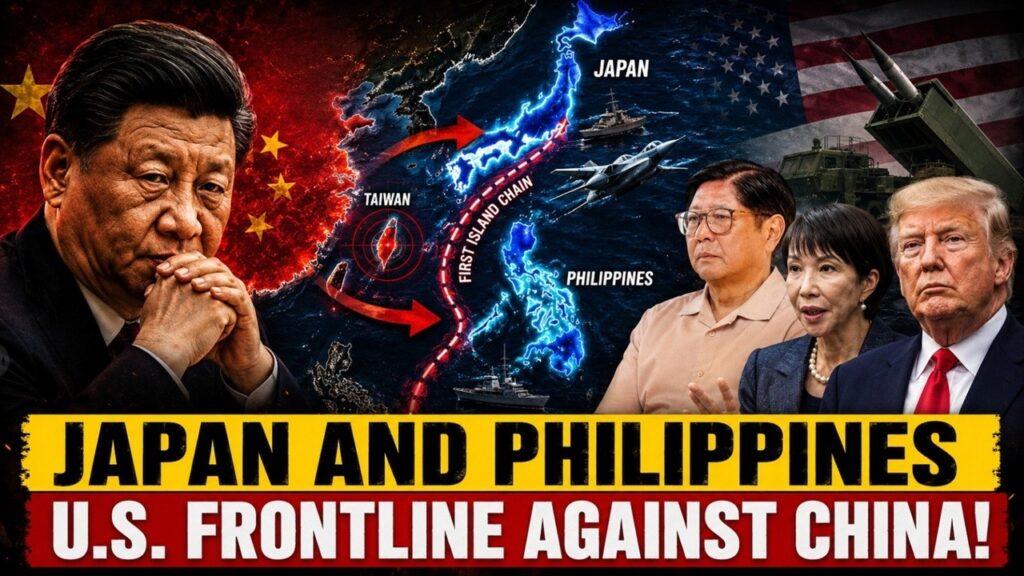
China no longer sees Japan and the Philippines as two separate American allies. It increasingly sees them as the northern and southern anchors of a connected frontline stretching across the First Island Chain.
And if Beijing now sees one frontline instead of two separate allies, then one question becomes impossible to ignore.
What changed? How did Japan and the Philippines become one strategic problem in China’s military planning?
FROM TWO ALLIES TO ONE MILITARY NETWORK
For years, China looked at the region through a simple lens.
There was the U.S.-Japan alliance in the north. And there was the U.S. Philippines alliance in the south. Both mattered, but they largely operated separately. Today, Beijing sees something very different. Those two alliances are becoming one connected military network.
The best example is Balikatan 2026. More than 17,000 troops took part, but that wasn’t the biggest story. The real story was who showed up.
For the first time, Japan, Canada, France, and New Zealand joined as active participants alongside the United States, the Philippines, and Australia. What began as a bilateral exercise has become a multinational demonstration of allied cooperation. The training also reflected that shift.
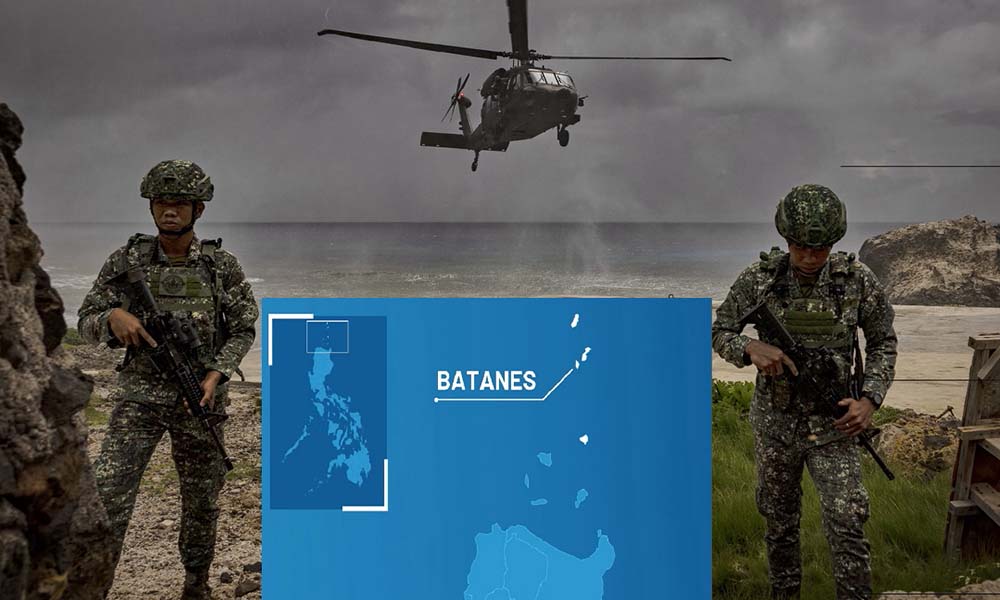
Forces practiced air and missile defense, maritime strike operations, and live-fire drills. On Itbayat Island, just 155 kilometers from Taiwan, U.S. and Philippine forces trained together while the Philippines’ BrahMos anti-ship missiles and Japan’s Type 88 missile system demonstrated how different allies can combine their capabilities in a single operation.
Now imagine looking at this from Beijing. China no longer sees Japan training in one place and the Philippines in another. It sees a network learning how to fight together. That changes everything.
A Philippine airfield can support American aircraft. Japanese missile systems can strengthen regional defenses. Intelligence collected by one ally can be shared across the entire network. Every new connection makes the alliance stronger without requiring thousands of additional American troops. Military planners call this force multiplication. The alliance itself becomes a strategic advantage.
That is why Beijing is paying such close attention. China is no longer measuring American power by troop numbers alone. It is measuring how quickly America’s allies are becoming a single operational network across the First Island Chain.
And among all of those allies, one country has changed more than any other.
Japan to Give 6 Warships to the Philippines to DETER China in the WPS!
WHY JAPAN HAS BECOME A DIFFERENT KIND OF ALLY
If China’s view of the Philippines has changed, its view of Japan has changed even more.
For decades, Japan was America’s closest ally in Asia, but it also had clear limits. After World War II, its military focused mainly on defending its own territory, while the United States carried most of the responsibility for regional security.
That Japan is disappearing.
Over the past few years, Tokyo has increased defense spending, relaxed its arms export rules, developed long-range counterstrike capabilities, and expanded military cooperation with countries like the Philippines and Australia. These are not isolated decisions. They are part of a much bigger shift in Japan’s security strategy. That shift became impossible to ignore during Balikatan 2026.
For the first time, Japan played a major operational role in the exercise, even firing its Type 88 anti-ship missile during a live-fire sinking drill. Reuters described it as the first time Japan’s post-war military fired missiles outside its own territory—a powerful sign of how much Tokyo’s role has changed.
But perhaps the bigger change is this. Japan is no longer preparing to defend only itself. It is helping strengthen the region’s wider security network. Tokyo has agreed to transfer Abukuma-class destroyers to the Philippines, is expanding military cooperation with Australia, and is working more closely with the United States to integrate allied forces across the First Island Chain.
From Beijing’s perspective, this is the real concern.A stronger Japan doesn’t just make Japan stronger. It makes the entire alliance stronger.
That is why China now speaks less about individual countries and more about military blocs and regional alliances. Beijing increasingly sees Japan not as a country acting alone, but as a key pillar of a growing coalition that could complicate China’s military plans in both the East China Sea and around Taiwan.
But Japan is only one half of the equation. The other half lies farther south, where geography has turned the Philippines into one of the most strategically important countries in the Indo-Pacific.
WHY THE PHILIPPINES HAS BECOME THE SOUTHERN ANCHOR
If Japan anchors the northern end of the First Island Chain, the Philippines anchors the southern end.
And the reason isn’t politics. It’s geography. Open a map of the Indo-Pacific. Just south of Taiwan are Batanes and Northern Luzon. Between them lies the Luzon Strait—one of the world’s most important sea routes. Any navy moving between the South China Sea and the wider Pacific has to think about this narrow passage. You can’t move the Luzon Strait. You can’t build another one. That’s why the Philippines matters.
Long before a missile is fired or a base is built, geography has already given the Philippines enormous strategic value.
That is exactly why allied military activity is shifting north.
During Balikatan 2026, American and Philippine forces held maritime strike drills on Itbayat Island, just 155 kilometers from Taiwan. At the same time, Japan, Australia, Canada, France, and New Zealand joined the largest Balikatan exercise ever held. Together, they practiced operating across the Philippine archipelago under realistic combat conditions.
The weapons on display reinforced the same message. The Philippines deployed its BrahMos anti-ship missiles, while Japan brought its Type 88 missile system. Different countries. Different capabilities. One increasingly connected strategy.
Beijing noticed.
While Balikatan was underway, the People’s Liberation Army carried out live-fire drills east of Luzon, calling them a necessary response to the regional security situation. The timing was difficult to ignore. China wasn’t simply conducting another exercise—it was signaling that it was watching the alliance grow more closely coordinated.
The same logic explains why EDCA sites matter. Their importance isn’t measured by how many American troops are stationed there. It comes from where they are located. Positioned near the Luzon Strait and close to the South China Sea, they allow allied forces to respond more quickly to a crisis.
From Beijing’s perspective, the Philippines is no longer just another U.S. ally. It has become the southern anchor of a growing alliance network stretching from Japan to the South China Sea.
And once you see the map this way, something becomes clear. China is no longer looking at individual countries. It is looking at an entire chain of allies working together across one strategic frontier.
THE FIRST ISLAND CHAIN IS BECOMING AN ALLIANCE CHAIN
Now, zoom out and look at the map.
Start with Japan. Move south to Taiwan. Then continue to the northern Philippines.
At first, these look like separate countries with separate militaries.
But that is no longer how Beijing sees them.
Military planners call this the First Island Chain. For decades, China viewed it as a natural barrier separating its navy from the wider Pacific Ocean. The islands were the challenge.
Today, the challenge is something very different.It is the growing coordination across those islands.
Japan is expanding its military role. The Philippines is opening strategically located facilities. The United States is holding larger joint exercises, while allies are sharing intelligence, improving logistics, and training to respond together.
Each of these changes may seem small on its own. Together, they create a completely different military picture.
Imagine an invisible network connecting Japan to the Philippines. Airfields, ports, radar stations, missile batteries, and naval forces are no longer operating independently. They are becoming part of a larger system. Information can be shared within moments. Reinforcements can arrive from multiple directions. And in a crisis, one ally no longer has to respond alone.
Geography hasn’t changed. What has changed is who is coordinating across it.
That is why China is increasing its military activity across the same region. Taiwan says it is now tracking more than 110 Chinese military and coast guard vessels operating along the First Island Chain, while Chinese and Russian naval forces continue conducting joint operations nearby. Beijing is not simply showing strength. It is closely watching how this alliance network is evolving—and searching for ways to counter it.
From China’s perspective, this is no longer just a chain of islands.
It is becoming an alliance chain. And once a group of allies begins operating as one network, China’s challenge is no longer dealing with one country at a time. It is dealing with an entire coalition across a single strategic frontier.
WHY CHINA IS RESPONDING WITH GREY-ZONE PRESSURE
If China now sees Japan and the Philippines as America’s frontline, then one obvious question follows.
Why hasn’t war started? Because Beijing has another option. One that is cheaper, less risky, and often more effective. It is called grey zone pressure.
Instead of launching an invasion, China applies constant pressure without crossing the line into open conflict. Coast guard ships replace warships. Maritime militia shadow foreign vessels. Military aircraft test air defense zones. Cyber attacks target critical networks. Economic pressure and information campaigns raise the political cost for China’s rivals. Each move seems small. But together, they create relentless pressure.
Recent events east of Taiwan show exactly how this strategy works.
China has launched new coast guard patrols in waters where Taiwan says Beijing has no legal authority. Chinese officials describe them as routine law enforcement. Taiwan calls them an illegal attempt to expand China’s control without firing a single shot.
The timing was no coincidence.
The patrols came shortly after Japan and the Philippines announced plans to begin formal maritime boundary talks—something Beijing strongly opposed. China even warned other countries not to support those discussions.
That reveals the real purpose of grey-zone operations. China isn’t just challenging Taiwan. It is testing the alliance.
How quickly will Japan, the Philippines, and the United States respond? Will they stay coordinated under constant pressure? Or will political differences begin to appear?
Because alliances rarely break in one dramatic battle.They usually weaken slowly—through pressure, uncertainty, and fatigue.
That is Beijing’s calculation. The goal is not to start a war. The goal is to make the alliance weaker before a war ever becomes necessary. But here is the irony. Every time China increases that pressure, it gives its neighbors another reason to work more closely together.
And that may be producing exactly the opposite result that Beijing intended.
CHINA’S STRATEGIC PARADOX
Here is the irony.
For more than two decades, China has invested heavily in modernizing its military. It built the world’s largest navy by hull numbers, expanded its missile forces, strengthened its coast guard, and increased pressure around Taiwan and the South China Sea.
The goal was straightforward. Make it harder for the United States to operate in China’s neighborhood. In many ways, China has succeeded. But it also produced a consequence that Beijing probably didn’t want.
Instead of pushing America’s allies apart, China’s growing military power has brought them closer together.
Japan is taking on a larger defense role. The Philippines is opening more locations for allied cooperation. Australia is deepening military ties with Washington and Tokyo. South Korea is strengthening security coordination with the United States and Japan. Even countries like France, Canada, and New Zealand are now taking part in exercises such as Balikatan 2026—something that would have seemed unlikely just a few years ago.
This is China’s strategic paradox. The rise of China’s military has not only strengthened the People’s Liberation Army. It has also strengthened the coalition forming around it. That changes the balance of power. The United States is no longer carrying the burden alone. Its allies are becoming more capable, more connected, and more willing to operate together. The result is not simply more American military power—it is a much stronger alliance network spread across the Indo-Pacific.
From Beijing’s perspective, that may become the harder challenge.
Because competing with one country is difficult.
Competing with an entire coalition is even harder.
And that brings us to the final question.
In the end, what will matter more—military strength or the ability of that coalition to stay united?
THE CONTEST IS NOW ABOUT ENDURANCE
That brings us back to where we started.
China no longer appears to see Japan and the Philippines as two separate American allies. It increasingly sees them as the northern and southern anchors of a connected frontline stretching across the First Island Chain.
And that changes everything.
It explains why China is increasing military activity around Taiwan. It explains the growing use of coast guard patrols, grey-zone pressure, and diplomatic protests. Beijing is no longer responding to one country at a time. It is responding to an alliance that is becoming more connected every year.
That is why the balance of power in the Indo-Pacific can no longer be measured simply by counting aircraft carriers, fighter jets, or troop numbers.
The more important question is much harder to answer.
Can this alliance remain united when it comes under real pressure?
Military exercises are important.
But alliances are not truly tested during exercises.
They are tested when political disagreements emerge, when economies come under pressure, and when every decision carries the risk of escalation.
That is the competition now unfolding across the Indo-Pacific.
China will continue looking for ways to test the unity of this coalition without
a full-scale war. The United States and its allies will continue expanding joint exercises, sharing intelligence, and strengthening their ability to operate together.

So the real contest is no longer about who has the biggest military. It is about which side can maintain its strategy, preserve its partnerships, and outlast the other. Because in the end, ships can be built. Missiles can be replaced. Military budgets can rise. But a strong alliance takes years to build—and only moments to break. That may become the most important lesson of the Indo-Pacific’s next chapter.
Conclusion
The Indo-Pacific is entering an era where alliances, interoperability, and strategic endurance matter as much as military hardware. Understanding these developments helps readers appreciate why regional security is evolving so rapidly.
About Indo-Pacific Report
For more geopolitical analysis, strategy coverage, and Indo-Pacific security reporting, visit Indo-Pacific Report:
Website
Facebook
YouTube
Why China Now Sees Japan and the Philippines as America’s Frontline