U.S Moved Military Aircraft to the Philippines Ahead of Trump’s Visit
The immediate explanation is the extensive security and logistical preparation required for a US president travelling overseas. A presidential visit is not simply an aircraft landing at an international airport, followed by meetings with government officials. It requires advance planning involving protective personnel, transportation, communications equipment, medical arrangements, aviation support and coordination with the host country’s security agencies. Much of this preparation takes place several days before the president arrives, which explains why military transport aircraft and other American assets may appear at regional airports during the preparation period. However, the wider strategic context makes these movements particularly important. The Philippines occupies a significant geographical position between the South China Sea and the western Pacific, with northern Luzon located relatively close to Taiwan and the Luzon Strait. It is also a long-standing US treaty ally whose defense cooperation with Washington has expanded in recent years. As a result, military movements connected with a presidential visit can attract attention beyond their immediate logistical purpose.
It is important, however, to distinguish between confirmed military movements and reports that still require independent verification. A warship’s port call, an aircraft’s flight-tracking record and an unconfirmed report about an Osprey deployment do not provide the same level of evidence. They also do not automatically demonstrate that every platform was assigned to one coordinated presidential security mission. Understanding these differences is essential to explaining what happened in Manila without exaggerating the military significance of the deployment.
USS Michael Murphy: The US Navy Destroyer That Called at Manila
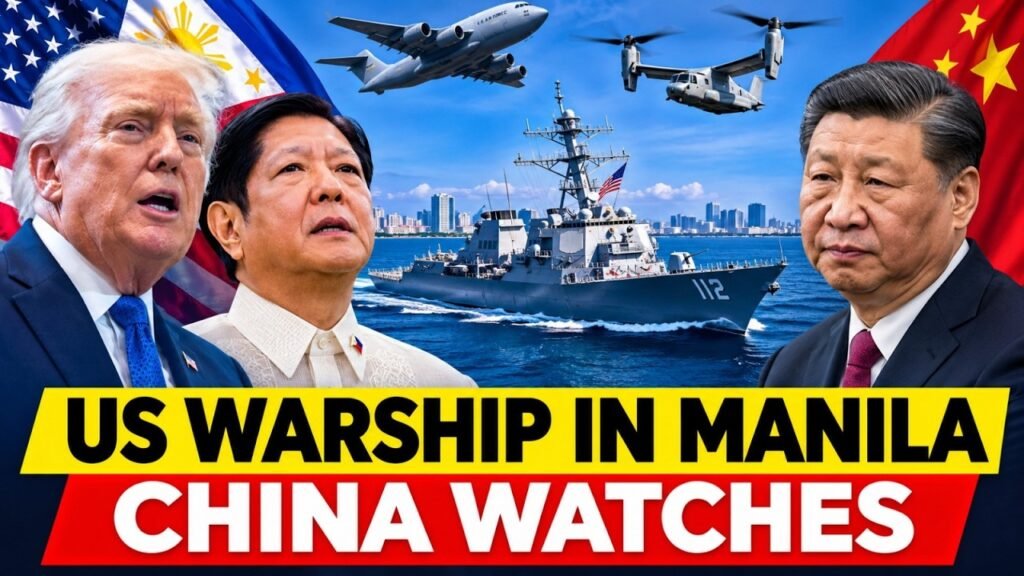
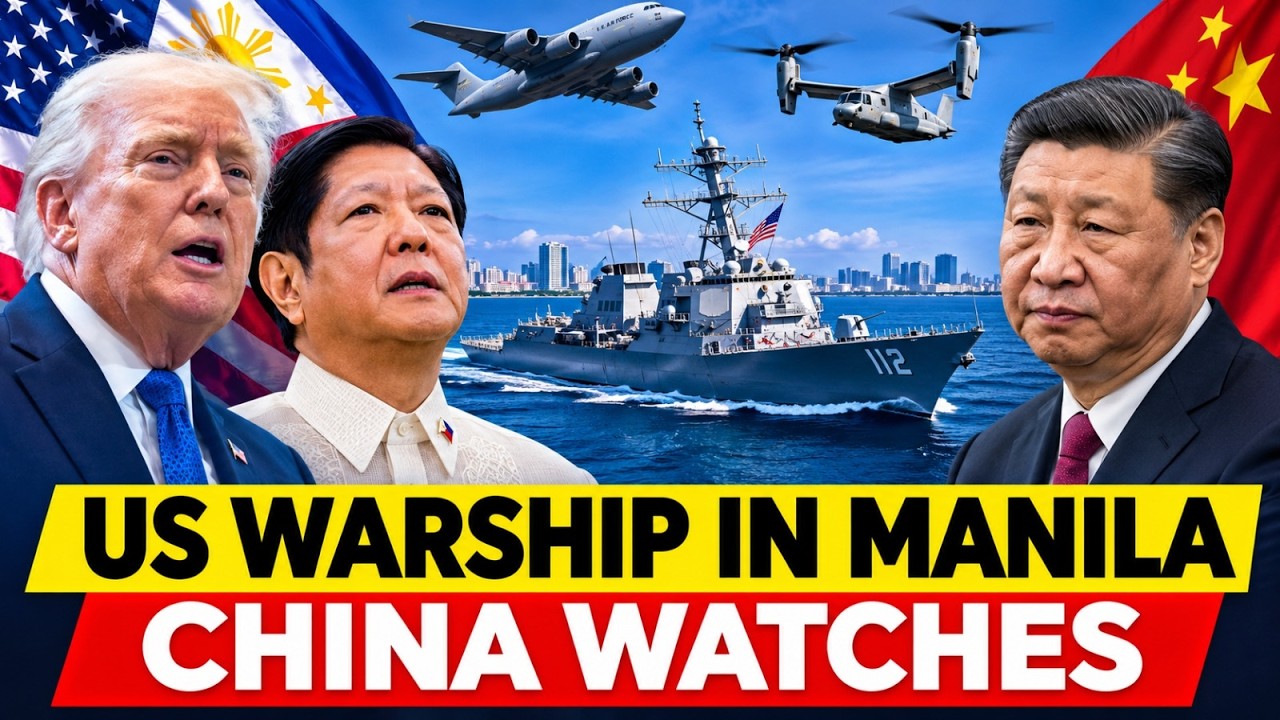
One of the most significant naval developments surrounding the preparations was the Manila port call by the USS Michael Murphy (DDG-112). The vessel is an Arleigh Burke-class guided-missile destroyer operated by the US Navy. These warships are designed to perform several missions, including air and missile defense, surface warfare, anti-submarine operations and maritime security. They form an important part of the American Navy’s ability to maintain a presence across major international waterways. The USS Michael Murphy is equipped with the Aegis combat system, which combines advanced radar, tracking, command-and-control capabilities and weapons systems. Its vertical launch system can accommodate different types of missiles according to operational requirements and configuration. These capabilities allow the destroyer to operate alongside aircraft carriers and other naval vessels while responding to a range of potential threats at sea.
According to US Navy imagery published through the Defense Visual Information Distribution Service, the USS Michael Murphy was preparing to moor in Manila on October 26, 2026. The ship was assigned to Destroyer Squadron 15, which operates as part of the US Seventh Fleet’s principal surface force. However, the destroyer’s presence should not be confused with a specific assignment to protect President Trump. The USS Michael Murphy returned to Pearl Harbor on November 12 after an 11-month deployment, according to the US military’s official reporting. Its return took place before Trump’s November 17 arrival in Manila. Therefore, describing the ship as a destroyer that remained in the Philippines to escort or protect the American president would be inaccurate. The more relevant explanation is that the USS Michael Murphy’s Manila visit demonstrated the continuing operational presence of the US Navy in the region. American naval vessels regularly operate across the Philippine Sea, South China Sea and wider Pacific, conducting deployments, maritime operations and engagement with regional partners. A port call can also support diplomatic engagement, military familiarity and cooperation between naval forces. Nevertheless, a port visit alone does not establish that a ship was assigned to a particular presidential security mission.
How the US Moves Presidential Security Equipment Across the Pacific
The C-17 Globemaster III provides a different but equally important part of the military picture. Unlike a guided-missile destroyer, the C-17 is a large strategic transport aircraft operated by the US Air Force. It is designed to carry military personnel, vehicles, equipment and heavy cargo across long distances. Its ability to transport substantial loads between distant locations makes it particularly useful when American forces need to establish temporary logistical operations outside the United States. Preparing for a presidential visit thousands of miles from Washington requires considerable transportation capacity. Security vehicles, communications equipment, support personnel and other essential supplies may need to reach the host country before the presidential aircraft arrives. The C-17 offers the ability to move such equipment quickly and connect major military transportation hubs with airports in different regions.Flight-tracking records cited in reports about the Manila preparations identified C-17 movements into the Philippines between November 10 and November 13. One identified aircraft, registration 09-9207, reportedly travelled from Tokyo to Manila on November 11 before returning to Tokyo on November 12. Other reported movements involved Ninoy Aquino International Airport and Clark International Airport. These records indicate that American strategic airlift activity was taking place in the Philippines during the preparation period. However, flight-tracking information has limitations. It can help establish an aircraft’s location, route and approximate movement time, but it cannot independently confirm the cargo inside.
Without an official cargo manifest or confirmation from the relevant military authorities, it would be inappropriate to claim that every C-17 carried presidential security vehicles, Secret Service equipment or communications systems. The aircraft may also have supported different logistical requirements unrelated to the presidential visit. Even with these limitations, the C-17’s importance is clear. Modern presidential security operations depend on moving equipment and personnel before the main delegation arrives. Airports, landing facilities and ground transportation networks must be prepared in advance, while security teams need access to the equipment required for their responsibilities. Strategic airlift makes it possible to establish this temporary infrastructure across international distances without waiting for commercial transportation arrangements. For the Philippines, these aircraft movements also demonstrate the logistical value of its airports and regional infrastructure to American operations in the Indo-Pacific. Clark International Airport, in particular, is geographically important because of its location in Luzon and its potential role in regional transportation and military logistics. The presence of transport aircraft does not automatically indicate a combat deployment, but it illustrates how quickly the United States can move personnel and equipment when operational requirements demand it.
MV-22B Osprey: Why Vertical Mobility Matters in the Philippines
The reported presence of four US Marine Corps MV-22B Osprey aircraft added another important dimension to the military activity surrounding Trump’s Manila visit. The Osprey is a tiltrotor aircraft that combines features of a helicopter with those of a conventional turboprop aircraft. Its rotors can rotate between vertical and forward-facing positions, allowing it to take off and land vertically while travelling at higher speeds than many traditional helicopters. This combination makes the MV-22B particularly useful for military operations in areas where conventional runways are limited or where personnel need to move between different locations quickly. It can transport Marines, equipment and supplies, making it valuable for logistics, personnel movement and selected operational support missions. Its ability to use suitable landing areas without requiring a conventional airport gives military planners additional flexibility.
The Philippines is an archipelago made up of thousands of islands, which creates particular transportation and logistical challenges. Moving personnel between islands can require considerable planning, especially when facilities are limited or weather conditions affect normal aviation operations. An aircraft with vertical take-off and landing capabilities can provide additional transportation options in such an environment. This is one reason why the Osprey has attracted attention in discussions about American military cooperation in the region. In a presidential security operation, aircraft with vertical mobility could potentially support personnel transportation between prepared landing locations, depending on the security arrangements and mission assignment. However, it is important not to assume that this was the actual purpose of the reported Osprey deployment. The available information identifies four aircraft as a reported movement, but their specific arrival records, unit identities and operational assignments require independent confirmation.
The distinction between an aircraft’s capabilities and its actual mission is particularly important in military reporting. The fact that the MV-22B can transport personnel and operate from suitable landing areas does not establish that four aircraft were officially assigned to Trump’s protection. Until reliable photographs, dated military records or credible official reporting establish their participation, the Osprey presence should remain a reported development rather than a confirmed element of the Manila operation. Nevertheless, the aircraft’s wider significance is worth understanding. Its combination of speed, range and vertical access gives the US Marine Corps a useful transportation capability in an island environment. If deployed as part of a larger support arrangement, it could complement conventional transport aircraft and helicopters while providing greater flexibility for movement between locations.
KC-130J Hercules: The Aviation Support Behind Marine Operations
The movement of military aircraft requires more than pilots and suitable landing facilities. Aviation operations also depend on fuel supplies, maintenance crews, spare parts, communications systems and ground support. The KC-130J Hercules is an important platform in this wider support network because it can transport personnel and cargo while also providing aerial refuelling capabilities. The US Marine Corps operates the KC-130J as a tactical transport and tanker aircraft. Its aerial-refuelling capability can support compatible aircraft, including the MV-22B Osprey, under suitable operational conditions. By transferring fuel during flight, a tanker aircraft can help extend the operating range and endurance of supported aviation platforms. This capability can be particularly useful when aircraft operate across large geographical areas or need additional flexibility in their flight planning.
In the Philippines, where military transportation can involve long distances between islands, aviation support becomes an important part of operational planning. Aircraft movements must account for fuel availability, weather conditions, maintenance requirements, alternate landing locations and the ability to respond to unexpected changes. A transport aircraft may be able to complete a particular journey, but sustaining repeated operations requires a much larger support system. The KC-130J therefore helps explain how different Marine aviation platforms can work together. A transport aircraft can move personnel and equipment, an Osprey can provide vertical transportation, and a tanker aircraft can support compatible aviation operations. These platforms have different functions, but their capabilities can complement one another when they are assigned to a coordinated mission. However, the same evidence standard applies here. The KC-130J’s established operational capabilities do not prove that it participated in the specific preparations for Trump’s Manila visit. Without dated photographs, flight records or official confirmation, its involvement should not be presented as established fact. It is more accurate to explain the aircraft’s possible supporting role while keeping the reported movements separate from verified operational activity.
How the US Secret Service and Military Prepare for a Presidential Visit
A visit by the American president requires a security operation involving several government institutions. The US Secret Service leads the president’s protective mission, but it does not operate in isolation. Other American agencies, military support personnel and the host country’s security institutions may contribute transportation, communications, medical assistance, airport coordination and other logistical arrangements.
The advance preparation normally begins before the president arrives. Security teams assess locations, transportation routes, access arrangements and emergency procedures. Vehicles and communications equipment may need to be transported in advance, while officials coordinate with local authorities to ensure that airports, hotels and meeting venues are prepared. Medical support and alternative transportation arrangements are also important because presidential schedules can change unexpectedly.Military aircraft can support these preparations by transporting equipment, personnel and supplies. Their role is primarily logistical or operational support where assigned, rather than replacing the protective responsibilities of the Secret Service. In Manila, Philippine security agencies and local authorities also had responsibilities for security arrangements within the country’s jurisdiction. The result is a coordinated system involving both governments rather than a purely American military operation.
How the United States Helps Protect Philippine Energy Reserves from China
The reported movement of helicopters associated with Marine Helicopter Squadron One, commonly known as HMX-1, also deserves careful attention. HMX-1 operates aircraft used in support of presidential transportation and other official missions. However, identifying a helicopter type or observing an aircraft being transported does not automatically establish that it was assigned to carry President Trump during the Manila visit.
Aircraft identification requires more than a visual resemblance. The specific helicopter type, unit affiliation, registration, arrival date and operational assignment all need to be considered. A VH-3D Sea King, for example, should not be confused with other helicopter types used in presidential aviation. Without reliable documentation, claims about a particular helicopter’s involvement should remain qualified. The larger lesson is that presidential security is a network of people, equipment, agencies and transportation arrangements. A C-17 may move cargo, a helicopter may support transportation, and military personnel may provide technical assistance, but the protective mission remains dependent on coordination between American and Philippine authorities. Understanding this division of responsibilities helps explain why a presidential visit can involve military assets without becoming a military operation in the conventional sense.
Trump’s Philippines Visit and the Diplomatic Importance of Manila
The timing of the visit was important because the Philippines plays a significant role in Southeast Asian diplomacy. As a member of ASEAN, Manila has an interest in regional stability, economic cooperation and maintaining working relationships with major powers. At the same time, its defense partnership with the United States remains a central part of its national security planning, particularly as maritime tensions in the South China Sea continue. For Washington, engagement with the Philippines is important for several reasons. The two countries share a formal defense treaty, maintain military cooperation and participate in joint exercises. Their relationship also extends to maritime security, defense modernization, technology, trade and investment. These areas demonstrate that the alliance is not limited to military deployments or presidential meetings.
The November visit also took place during a period of expanding regional defense coordination involving Australia, Japan, the Philippines and the United States. These four countries have increasingly discussed practical cooperation, including maritime security, military interoperability and defense planning. Such cooperation is significant because regional security challenges are not limited to one country or one maritime area.
On November 10, 2026, an official joint statement announced an initiative to establish a Combined Coordination Center in the Philippines. The announcement followed discussions among the four countries’ defense leaders and included commitments to improve coordination, synchronize defense investments and expand combined exercises. The proposed center is significant because it reflects a growing interest in practical coordination among regional partners. It should not, however, be described as a newly established American military base or a permanent foreign command structure. The announcement concerns a coordination initiative, and its specific functions and implementation should be assessed through further official information. Its importance lies in the direction of regional cooperation rather than an assumption that a new military facility has already been established.
Why Washington Considers the Philippines Strategically Important
The geographical position of the Philippines is one of the main reasons it remains important to American Indo-Pacific planning. The country stretches across the western Pacific, with the South China Sea to its west and the Philippine Sea to its east. Its northern islands are relatively close to Taiwan, while the Luzon Strait and Bashi Channel connect important maritime and aviation approaches around Taiwan with the wider Pacific.
These waterways matter for international trade, commercial shipping and military movement. The South China Sea is one of the world’s important maritime corridors, connecting major Asian economies with international markets. Any disruption to regional shipping routes could have consequences beyond Southeast Asia, affecting supply chains, energy transportation and international commerce. The Philippines also offers opportunities for cooperation in logistics, military training and maritime awareness. Access to agreed facilities, combined exercises and improved communications can help American and Philippine forces work together more effectively. This does not mean that every American military movement through the country is connected to a potential conflict. Rather, it shows why the relationship has become an important part of wider regional security planning.
The northern part of Luzon is particularly relevant because of its proximity to Taiwan and the Luzon Strait. In a regional emergency, the ability to move personnel, monitor maritime activity and coordinate with partners can become important. However, geographical proximity should not be interpreted as evidence that the Philippines has automatically agreed to participate in every possible military contingency involving Taiwan. Decisions about national defense and military cooperation remain subject to Philippine policy, sovereignty and the terms of existing agreements.
The United States also benefits from having reliable partners across the Indo-Pacific rather than depending entirely on military facilities located far from the region. Cooperation with the Philippines can support training, humanitarian assistance, disaster response and maritime security. These activities strengthen the practical relationship between the two countries while providing a framework for responding to a range of regional challenges.
US-Philippines Mutual Defense Treaty and EDCA Explained
The defense relationship between Washington and Manila is based on the 1951 Mutual Defense Treaty. The agreement provides the formal foundation of the alliance and establishes commitments concerning armed attacks against either country in the Pacific area. Over the decades, the treaty has remained an important element of Philippine and American security cooperation, although its implementation continues to depend on the circumstances and the obligations defined by the agreement. The alliance has developed through additional agreements, including the 1998 Visiting Forces Agreement and the 2014 Enhanced Defense Cooperation Agreement, commonly known as EDCA. These arrangements provide a framework for American military personnel to participate in agreed activities, exercises and security cooperation in the Philippines. They also support practical coordination between the two countries’ armed forces.
EDCA has become particularly important because it allows rotational American access to agreed Philippine military locations and supports infrastructure development. The number of agreed locations increased from five to nine in 2023. These facilities provide opportunities for training, logistics, humanitarian assistance and disaster response, while also improving the ability of the two militaries to operate together.It is important to understand that EDCA does not mean the United States has acquired permanent sovereign military bases in the Philippines. The locations remain Philippine facilities, and the agreement provides for agreed access and activities under the established framework. Philippine sovereignty and domestic political considerations remain important parts of the debate over the country’s defense relationship with Washington. For the United States, the agreement provides a practical way to improve regional access and cooperation. For the Philippines, it offers opportunities for infrastructure development, training and defense capacity-building. Joint exercises such as Balikatan provide another important element of the relationship. These exercises allow the two militaries to practise communications, transportation, maritime coordination and combined operational procedures. They also help personnel become familiar with one another’s equipment and working methods. Such activities are particularly relevant in an archipelago where transportation, maritime awareness and disaster response require coordination across different locations.
China, the South China Sea and Wider Indo-Pacific Security Environment
The Philippines’ expanding defense relationship with the United States has attracted attention from China, particularly because of continuing tensions in the South China Sea. The two countries have overlapping maritime claims and have experienced repeated confrontations involving coast guard vessels, fishing activities and access to disputed waters. Manila refers to the maritime areas on its western side as the West Philippine Sea, while Beijing maintains extensive claims across the wider South China Sea. For the Philippines, cooperation with Washington can strengthen maritime awareness, improve defense capabilities and support deterrence. Joint exercises and access to military facilities can help Philippine forces develop their ability to monitor and respond to maritime activity. The alliance also gives Manila a formal security relationship with a major military power, although its practical value depends on the circumstances and the decisions made by both governments. For Washington, the Philippines is an important partner within the wider First Island Chain. This geographical concept refers to a series of island territories and maritime areas stretching along the western Pacific, including Japan, Taiwan and the Philippines. The region is strategically important because it influences access between the East Asian mainland and the wider Pacific Ocean. China’s military modernization and expanding maritime activity have encouraged the United States and its regional partners to strengthen defense coordination. From Beijing’s perspective, closer cooperation among the United States, Japan, Australia and the Philippines may raise concerns about increased American military access and the development of a more connected regional security network. These concerns form part of the wider strategic competition between Washington and Beijing.
However, the military activity surrounding Trump’s Manila visit should not be presented as a direct deployment against China. The documented port call by the USS Michael Murphy, the reported C-17 movements and the unconfirmed Osprey reports do not establish that these assets were sent specifically to confront Beijing. The immediate explanation for the preparations is the presidential visit and the logistical requirements associated with it. The wider strategic significance comes from the existing alliance and the geographical importance of the Philippines. Military cooperation can influence regional planning even when a particular movement is not a combat operation. Improved logistics, training and communication can make it easier for partners to coordinate during emergencies or security crises. That is a broader strategic development, but it should not be confused with evidence of an immediate military confrontation. The Philippines also has its own national interests and foreign policy priorities. Manila must consider its territorial sovereignty, economic relationships, domestic political opinion and the risks associated with rising regional tensions. Its cooperation with Washington does not mean that the country has no independent position on China or regional security.
What the Military Movements Reveal About the Future
The different American platforms connected with the Manila preparations illustrate how modern military operations depend on several capabilities working together. A guided-missile destroyer provides naval presence and maritime capabilities. A C-17 Globemaster III can move personnel, vehicles and heavy equipment across long distances. An MV-22B Osprey, if its reported participation is confirmed, offers vertical transportation and access to suitable landing areas. A KC-130J can provide transport and aerial-refuelling support to compatible aircraft. None of these platforms can explain the entire operation on its own. Military aircraft need trained crews, maintenance, fuel and ground support. Warships require port access, communications and operational planning. Presidential security teams need reliable transportation, medical arrangements and cooperation with local authorities. The effectiveness of an overseas operation depends on how these different elements are coordinated. This logistical dimension is particularly important in the Indo-Pacific because of the region’s size and geography. American forces must operate across vast distances while maintaining relationships with countries that have different security requirements and political priorities. The Philippines provides an important location for cooperation, but the wider network also includes Japan, Australia and other regional partners.
The proposed Combined Coordination Center involving the Philippines, the United States, Japan and Australia reflects this growing emphasis on coordination. Its stated objectives include improving communication, strengthening interoperability and supporting cooperation among the four countries. The practical value of the initiative will depend on how it develops, what responsibilities are assigned and how effectively it supports regional security. For the Philippines, stronger defense cooperation can bring benefits in training, infrastructure, maritime awareness and disaster response. At the same time, it creates policy questions about sovereignty, the country’s relationship with China and the possibility of becoming more directly involved in wider regional tensions. These issues require careful consideration by Philippine leaders and institutions. For Washington, the relationship offers an opportunity to strengthen its regional partnerships without relying exclusively on its own military infrastructure. The alliance also provides a framework for cooperation during humanitarian emergencies, natural disasters and maritime security challenges. These practical benefits are important because regional stability depends on more than military capabilities alone. The future of the partnership will therefore depend on decisions made by both countries. Access arrangements, infrastructure investments, joint exercises and regional coordination will determine how the relationship develops. A presidential visit can highlight the importance of the alliance, but long-term cooperation is shaped by agreements, policies and sustained institutional engagement.
Conclusion
The American military activity surrounding Trump’s November 17 visit to Manila highlighted the scale of planning required for a presidential trip across the Pacific. The USS Michael Murphy’s October 26 port call was documented by US Navy imagery, while the destroyer’s return to Pearl Harbor on November 12 established that it did not remain in Manila to escort the president. Reported C-17 flights indicated strategic airlift activity in the Philippines, although aircraft-tracking records alone cannot establish the cargo carried. The reported presence of four MV-22B Ospreys and any KC-130J involvement require additional independent confirmation before they can be treated as established facts. These distinctions do not reduce the importance of the story. Instead, they provide a clearer understanding of how American military capabilities, presidential logistics and regional security cooperation intersect in the Philippines. The preparations involved a combination of transportation, planning, equipment and coordination, while the wider strategic environment explains why these developments attracted attention across the Indo-Pacific.
The Philippines is increasingly important to Washington because of its geographical position, treaty relationship, defense cooperation arrangements and role in regional security discussions. Its location connects the South China Sea with the western Pacific and the approaches to Taiwan. Its cooperation with the United States, Japan and Australia also reflects a broader effort to strengthen communication and interoperability among regional partners. However, one presidential visit does not create a new American military commitment, establish permanent US bases or independently change the balance of power in the South China Sea. Those developments depend on longer-term political decisions, defense agreements, infrastructure investments and the choices of the countries involved. The central question for the coming years is how the Philippines and the United States will manage their expanding defense partnership while protecting Philippine sovereignty and avoiding unnecessary regional escalation. The answer will shape not only the future of their bilateral alliance but also the wider security environment across the South China Sea, the Taiwan Strait and the Indo-Pacific.
About Indo-Pacific Report
For more geopolitical analysis, strategy coverage, and Indo-Pacific security reporting, visit Indo-Pacific Report:
Website
Facebook
YouTube
U.S Moved Military Aircraft to the Philippines Ahead of Trump’s Visit