The Philippines at the Edge: Can Marcos Deliver the Middle-Income Dream Before the World Closes In?
A strategic analysis of Manila’s economic ambition in an age of global turbulence — slowing growth, energy shocks, fragile remittances, and the race against regional competitors.
Indo-Pacific Report | Strategic Analysis Desk | April 2026
Introduction: A Nation on the Threshold
For the first time in a generation, the Philippines stands on the threshold of an economic milestone it has chased for decades — graduation into the ranks of upper middle-income nations. Under President Ferdinand Marcos Jr., this ambition has moved from the margins of policy papers to the center of national strategy. Manila’s economic planners, finance officials, and diplomatic establishment have aligned around a single conviction: the country can cross the World Bank’s upper middle-income threshold before Marcos’ term ends in 2028.
And yet, the road to that milestone is narrowing.
The global environment into which the Philippines now projects its ambitions looks nothing like the one in which that ambition was drafted. Wars are reshaping energy markets. Supply chains are tightening. Forecasts across multilateral institutions are being quietly revised downward. The Indo-Pacific, far from being insulated from these pressures, sits at their center — and the Philippines, more than most of its neighbours, is exposed to nearly all of them at once.
This analysis examines the structural, strategic, and geopolitical forces now shaping the Philippines’ economic trajectory — and assesses whether the Marcos administration’s bid for middle-income status will survive the turbulence closing in around it.
The Quiet Downgrade: Why Growth Forecasts Are Slipping
Only a few quarters ago, the Philippines looked like one of Southeast Asia’s strongest economic performers. Growth was solid. Consumer demand was expanding. And there was quiet confidence across Manila’s policy circles that the trajectory would hold.
That confidence is now being tested.
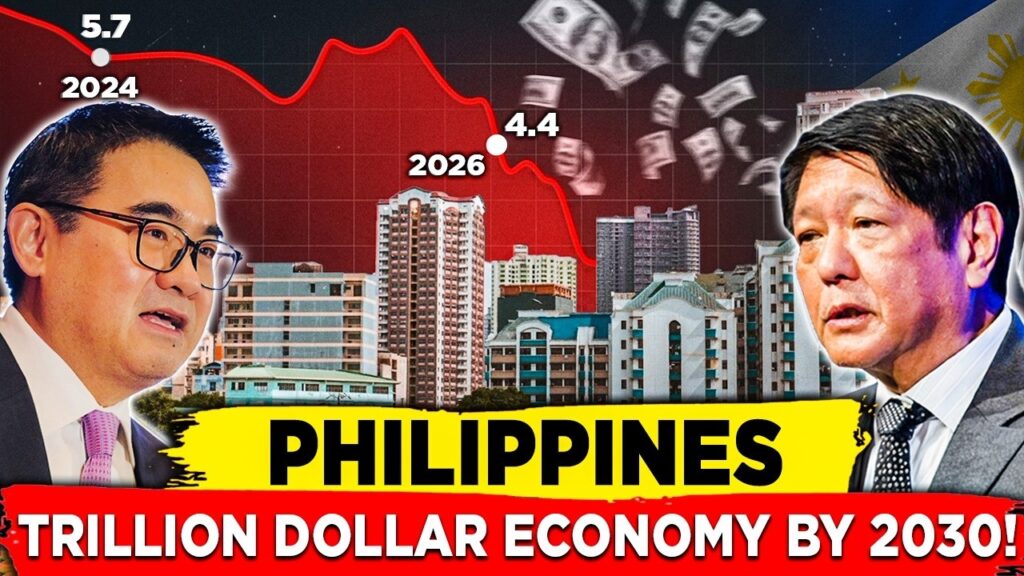
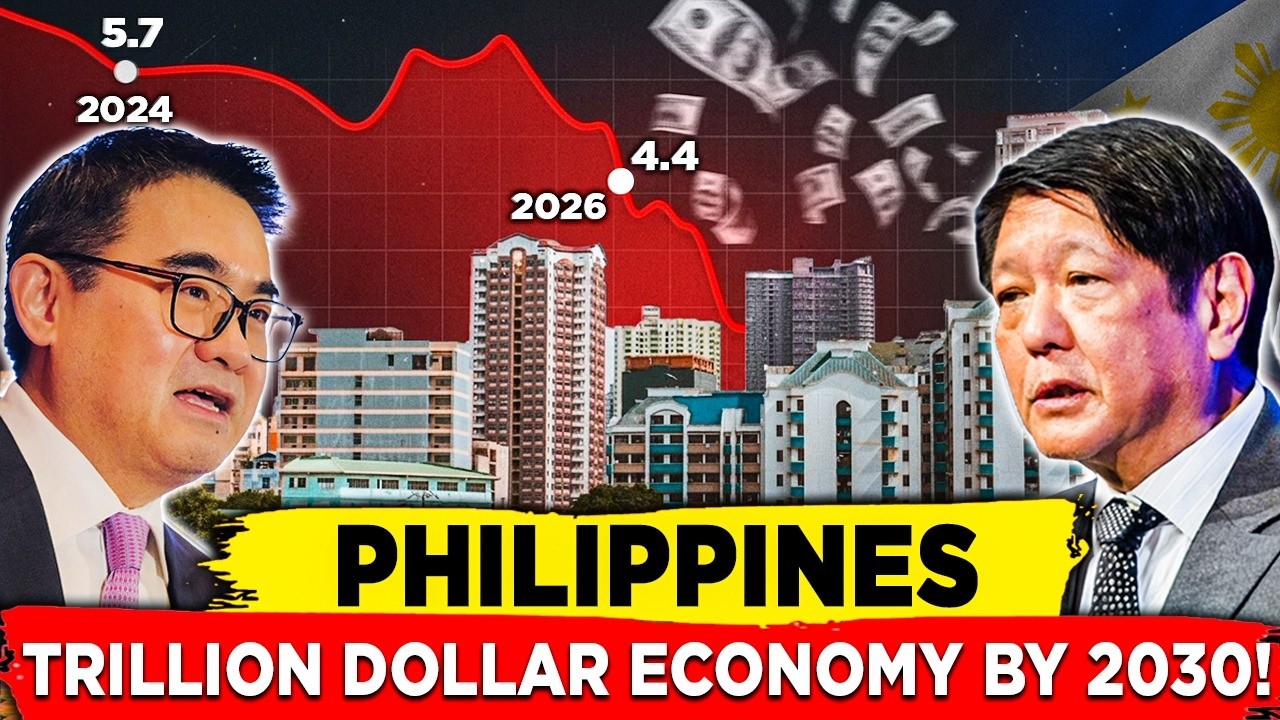
The Asian Development Bank has revised its 2026 growth projection for the Philippines down to 4.4 percent, a notable step back from its earlier forecast of 5.3 percent. The International Monetary Fund
has gone further, projecting growth closer to 4.1 percent. In headline terms, these revisions look modest. In structural terms, they are not.
A single percentage point of lost GDP growth, sustained over several years, translates into tens of thousands of jobs that are never created, wages that rise more slowly than the cost of living, and fewer pathways out of poverty for households still clinging to the lower rungs of the Philippine middle class. It also narrows the fiscal space Manila needs to finance its infrastructure and social spending commitments — the very commitments that underpin the upper middle-income strategy.
Compounding this slowdown is an inflation outlook of around 4 percent, driven in large part by rising global energy and commodity prices. For a country where a significant share of household spending goes to food, fuel, and transport, that is not a statistic. It is a daily compression of purchasing power.
The Philippines is still growing. But the quality and velocity of that growth are no longer compounding the way they need to.
War, Oil, and the Imported Cost of Instability
The most dangerous threats to the Philippine economy in 2026 are not domestic. They are geopolitical
— and they originate thousands of kilometres from Manila.
Escalating conflict across the Middle East has unsettled global energy markets, pushing oil prices upward and reintroducing volatility into a system that had only partially stabilised. For a country as fuel-dependent as the Philippines, this matters enormously. The archipelago imports the overwhelming majority of the petroleum products that power its transport networks, industrial base, and electricity generation.
When global oil prices move, the Philippine economy moves with them — in the cost of jeepney fares, in the price of rice at the palengke, in the operating margins of manufacturers, and in the investment decisions of foreign firms weighing their regional options.
Recognising the pressure, the Marcos administration has acted decisively. It has declared a national energy emergency, rolled out fuel subsidies, suspended select taxes on petroleum products, and scaled up targeted assistance for vulnerable households. These are meaningful interventions. But even the best-designed domestic measures have structural limits when the shock originates abroad.
The broader Asian picture reflects this vulnerability. Regional growth forecasts across developing Asia have been eased to around 5.1 percent, a quiet but telling sign that the continent’s economic momentum is being dragged down by the same global headwinds. For the Philippines, which sits at the intersection of fuel dependency, import vulnerability, and an overseas workforce concentrated in unstable regions, the exposure is compounded rather than diluted.
In an interconnected global system, distance offers no protection. Every crisis that raises the global price of a barrel of oil arrives, eventually, at a Filipino family’s doorstep.
The Remittance Lifeline and Its Geopolitical Fragility
No other line item on the Philippine balance sheet captures the human dimension of the country’s economy quite like remittances.
In 2025, Overseas Filipino Workers sent home more than 35 billion dollars — a figure equivalent to roughly 7 percent of the entire national economy. Few economies in the world depend so heavily on the earnings of citizens abroad. Remittances do not merely pad GDP. They pay tuition fees, keep small businesses afloat, fund medical care, and cushion families against the worst effects of inflation.
But this lifeline has a geopolitical geography — and right now, that geography is unfavourable.
More than 17 percent of all remittances flowing into the Philippines originate from workers based in the Middle East. That is a region now sliding deeper into conflict, political instability, and economic contraction. If hostilities widen, if contracts are terminated, if businesses shutter, or if host governments begin large-scale workforce rationalisations, the effects will not stay local. They will arrive in Philippine households within weeks.
This is the quiet strategic reality embedded in the Philippine economy: a significant portion of its domestic consumption is underwritten by the stability of foreign regions over which Manila has no policy influence. For decades, that dependency was manageable because the Middle East’s turbulence was contained. That assumption no longer holds.
Remittances have long been portrayed as a symbol of Filipino resilience. They are. But resilience, as a national strategy, is not the same as security.
The Regional Race: Vietnam, Indonesia, Malaysia
The Philippines is not running this race alone — and it is not running it fastest.
Across Southeast Asia, several economies are pursuing the same trajectory of industrial upgrading, infrastructure modernisation, and middle-income graduation. In this quiet competition, three neighbours stand out.
Vietnam has, over the past decade, reinvented itself as one of the region’s most formidable manufacturing hubs. Global corporations — including many that once concentrated production in China
— have redirected billions of dollars into Vietnamese factories. Its export growth has been remarkable, its industrial policy disciplined, and its cost structure aggressively competitive. For a growing share of international investors, Vietnam is no longer an alternative to the traditional manufacturing giants. It is the destination.
Indonesia, by contrast, wins on scale. With the largest population in Southeast Asia and an enormous base of natural resources, Jakarta has methodically expanded its infrastructure, fortified its domestic industries, and built out the ports, highways, and industrial zones required for sustained growth. Crucially, Indonesia enjoys the kind of vast internal market that makes it less exposed to global demand
https://youtu.be/RJxJW19f9pk?si=jA4J3ZlsdEpVitrN
shocks — an advantage the Philippines, despite its large population, has historically underutilised.
Malaysia occupies the position the Philippines aspires to reach. Already classified as an upper middle-income economy, Kuala Lumpur has spent decades layering industrial depth, advanced manufacturing, and modern infrastructure on top of a relatively open economy.
For Manila, these comparisons are not academic. In regional economic competition, investment flows are zero-sum over short time horizons. Capital that goes to Hanoi does not go to Manila. Supply chains that anchor in Jakarta do not anchor in Cebu. Middle-income graduation is not simply about running fast
— it is about running faster than the neighbours running alongside you.
The Philippines is still in the race. But the gap between ambition and relative performance is becoming more difficult to ignore.
Marcos’ Strategy: Vision, Execution, and the Limits of Leadership
Facing pressure from every direction, the Marcos administration has placed economic transformation at the centre of its governing agenda. The strategy rests on three pillars.
First, infrastructure. The administration is driving an aggressive build-out of highways, deep-water ports, rail networks, airports, and agricultural supply corridors. The logic is clear: the Philippine archipelago’s logistical fragmentation has long been a structural tax on productivity. Connecting islands, lowering trade costs, and modernising supply chains are essential preconditions for industrial scale.
Second, investment liberalisation. Key sectors — including telecommunications, shipping, railways, and renewable energy — have been reopened to greater foreign participation. This represents a meaningful break from the more protectionist posture of earlier administrations and is designed to signal Manila’s readiness to compete for capital in a contested regional marketplace.
Third, social protection. Recognising that growth alone does not deliver political legitimacy, the Marcos administration has widened fuel subsidies, direct financial assistance, and targeted programs designed to cushion households from the cost-of-living squeeze.
Senior officials remain publicly confident that upper middle-income status can still be reached within this administration’s term. That confidence is not unjustified — on paper, the building blocks are being laid.
But history offers a cautionary note that every serious student of development economics eventually learns: ambitious plans rarely fail on vision. They fail on execution. And in an era defined by overlapping global shocks — war, energy volatility, supply chain disruption, geopolitical fragmentation
— the margin for execution error shrinks dramatically.The Philippines does not merely need good policy. It needs good policy implemented under conditions far more hostile than those in which its peer economies made their ascent.
The Hidden Weakness: Human Capital and the Middle-Income Trap
There is a challenge no highway can solve, no port can absorb, and no investment reform can paper over: the Philippines’ human capital gap.
Educational attainment remains uneven. Learning outcomes across public schooling continue to lag regional benchmarks. Employers across industries cite a persistent shortage of skilled workers as a constraint on expansion. Youth unemployment remains stubbornly elevated, leaving a cohort of young Filipinos entering adulthood without clear pathways into the productive economy.
This is not an incidental problem. It is the single most likely cause of a scenario every development economist dreads — the middle-income trap.
The middle-income trap describes an economy that rises successfully from low-income status, begins the journey toward middle-income status, and then stalls. It stalls not because investment dries up, but because its workforce is not equipped to move into higher-value industries. Infrastructure alone cannot carry a country across this threshold. What carries it across is the capacity of its people to absorb, operate, and innovate on top of that infrastructure.
For the Philippines, this is the most strategically consequential risk on the horizon. An economy can build ports faster than it builds engineers. It can attract capital faster than it trains the workforce required to deploy it productively. When that imbalance persists, productivity plateaus. Wages stagnate. And the middle-income threshold, even once crossed, becomes a ceiling rather than a stepping stone.
The true test of Marcos’ economic legacy will not be whether Manila crosses the statistical threshold in a given year. It will be whether the Philippines enters that bracket with the human capital foundations required to climb higher still.
https://indopacificreport.com/is-marcos-selling-the-west-philippine-sea-to-china-for-oil/
Strategic Outlook: The Narrow Path Forward
The Philippines stands at one of the most consequential inflection points in its modern economic history. For decades, the upper middle-income threshold has loomed as an aspirational horizon. Under Marcos, it has drifted closer than at any previous point.
But the approach is no longer unobstructed.
Growth forecasts are softening. Distant conflicts are transmitting inflation into Philippine kitchens. Remittance flows are exposed to the unstable geography of the Middle East. Regional competitors — Vietnam in particular — are accelerating. And the country’s own structural weaknesses, especially in education and skills, remain unresolved.
No single one of these pressures is, by itself, sufficient to halt Philippine progress. But they are not arriving one at a time. They are converging — precisely at the moment when momentum matters most.
Marcos: A “Future-Ready” PH–US Alliance Evolving Beyond Defense
Three strategic conclusions follow.
First, the Philippines’ economic trajectory is now inseparable from Indo-Pacific geopolitics. The health of Middle Eastern labour markets, the stability of global energy corridors, the trajectory of U.S.–China competition, and the resilience of regional supply chains will shape Philippine growth as directly as any domestic policy decision. Manila cannot pursue economic policy in isolation from its strategic posture.
Second, middle-income status, if reached, will be the beginning of the harder journey, not the end. Graduation is the easy part. Sustaining growth beyond it — avoiding the middle-income trap that has caught dozens of countries before — will demand a generational investment in human capital that no Philippine administration has yet fully undertaken.
Third, execution is now the binding constraint. The Marcos administration has the vision and the plan. What remains uncertain is whether Philippine institutions can deliver infrastructure on time, absorb foreign investment productively, and reform education at the pace the global environment now demands.
The Philippines is not falling behind. But it is no longer sailing through calm waters. The question that will define the rest of this decade is not whether Manila reaches the middle-income threshold under Marcos. The question is what kind of economy — and what kind of country — meets that moment when it arrives.
The answer will shape far more than the legacy of a single presidency. It will shape the strategic weight of the Philippines in the Indo-Pacific for a generation to come.
Indo-Pacific Report provides strategic analysis on Indo-Pacific geopolitics, great-power competition, and the economic forces shaping the region’s future.
Visit us at www.indopacificreport.com.
https://youtu.be/RJxJW19f9pk?si=jA4J3ZlsdEpVitrN