Russia Jammed A British Military Aircraft Near NATO Territory
Published by Indo-Pacific Report | Russia NATO Tensions | GPS Jamming | Electronic Warfare | European Security
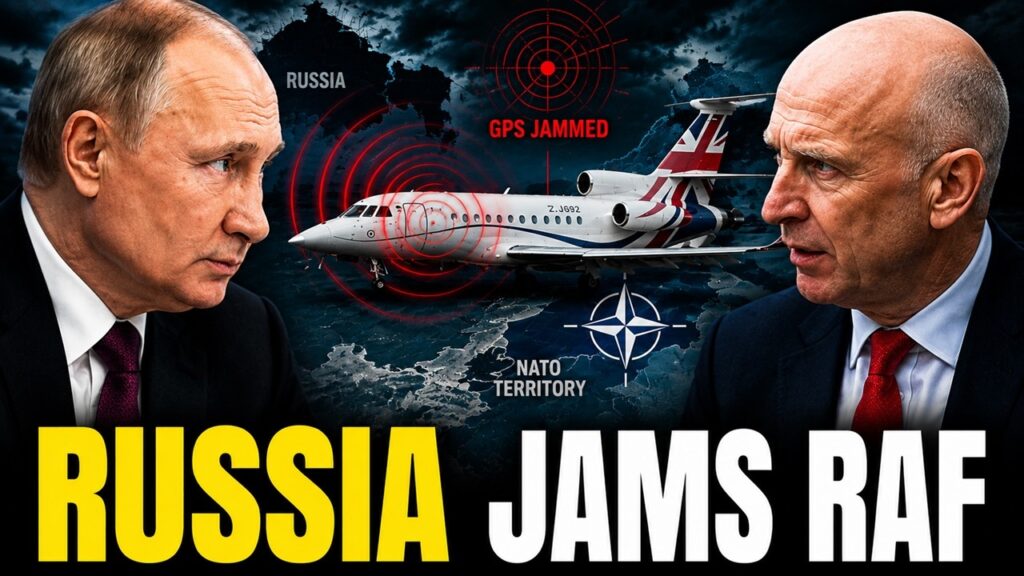
A British Royal Air Force aircraft carrying UK Defence Secretary John Healey lost GPS navigation for several hours during a flight near NATO’s eastern frontier with Russia. Satellite navigation went dark. Phones and laptops on board stopped functioning normally. Pilots switched to backup inertial navigation systems to maintain course. British officials believe the disruption was caused by deliberate Russian GPS jamming.
The aircraft made it home safely. But the incident was not a minor technical glitch. It was a message.
Russia targeted — or at minimum accepted as collateral — an aircraft carrying one of Britain’s most senior government officials near NATO territory. The fact that this happened on a military flight returning from a visit to British troops stationed in Estonia, as part of NATO’s forward presence on Russia’s border, makes the timing and location impossible to read as accidental.
To understand why this incident is more significant than a navigation disruption, you need to understand what GPS jamming actually is, why Russia has been using it with increasing aggression across Europe, and what it signals about the direction of the Russia-NATO confrontation.
What Happened: The Full Picture of the Incident
John Healey had just completed a visit to British troops stationed in Estonia as part of NATO’s Enhanced Forward Presence — the alliance’s forward defensive deployment along its eastern flank that was significantly expanded following Russia’s full-scale invasion of Ukraine in February 2022.
After finishing the visit, Healey boarded an RAF aircraft for the return flight to the United Kingdom. During that flight, passing near the border region between NATO and Russian territory, the aircraft’s GPS systems were jammed for several hours. The disruption affected:
GPS satellite navigation systems, which went offline entirely
Communication devices including phones and laptops carried by passengers and crew
Standard navigation equipment that relies on GPS positioning data
RAF pilots responded by switching to inertial navigation systems — backup technology that does not rely on external satellite signals, using instead accelerometers and gyroscopes to track the aircraft’s position and movement. These systems are less precise over long distances than GPS but are deliberately maintained for exactly this kind of scenario.
https://indopacificreport.com/a-russian-drone-hit-a-chinese-ship-near-ukraine-the-timing-could-not-have-been-worse-for-moscow/
One RAF pilot involved in the flight reportedly said they had not experienced electronic interference of this intensity for a very long time. That statement from an experienced military aviator is worth taking seriously. RAF pilots flying near Russian territory have become accustomed to a background level of electronic interference. When one of them describes an incident as exceptional, it is.
British defence officials attributed the jamming to Russia. Moscow has not acknowledged responsibility, which is consistent with its standard posture on electronic warfare operations it prefers not to formally claim.
This was not a navigation glitch. It was a deliberate act of electronic aggression against a military aircraft carrying one of Britain’s most senior cabinet officials, in airspace near a NATO ally. Russia knew exactly what it was targeting.
For comprehensive coverage of Russia-NATO tensions and European security developments, visit Indo-Pacific Report.
What GPS Jamming Actually Is — And Why It Is Such an Effective Weapon
GPS jamming is one of those terms that gets used frequently in defence reporting without always being properly explained. Understanding what it actually does — and why modern militaries are so vulnerable to it — is essential context for understanding why this incident matters.
How GPS Works
The Global Positioning System operates by having receivers on the ground, in aircraft, or on ships calculate their position by receiving signals from a constellation of satellites orbiting the earth. The calculation is based on precisely measuring how long signals take to travel from multiple satellites to the receiver. When those calculations line up correctly, the system can pinpoint a location to within a few metres.
The critical vulnerability is that GPS signals are extraordinarily weak by the time they reach receivers on earth — the satellites are thousands of kilometres away, and the signals have travelled an enormous distance. This means that relatively low-powered electronic noise broadcast at the right frequencies can effectively drown out the satellite signals and render GPS receivers unable to function. That is what jamming does.
What Jamming Disrupts
The dependency of modern military and civilian systems on GPS is so pervasive that most people do not fully appreciate it until it disappears. GPS jamming can simultaneously disrupt:
Aircraft navigation systems — including commercial airliners, which is why GPS jamming in conflict zones creates civilian aviation safety hazards
Military drone guidance systems, which rely heavily on GPS for precision navigation and target acquisition
Precision-guided munitions, many of which use GPS to navigate to their target Military communications networks that use GPS timing signals for synchronisation Ground vehicle navigation used by military convoys and armoured units
Naval positioning systems used by warships operating in contested waters
Civilian infrastructure including air traffic control, mobile phone networks, and financial transaction systems that use GPS timing

GPS Spoofing: The More Sophisticated Cousin
Beyond jamming, Russia also employs GPS spoofing — a more sophisticated technique that does not simply block GPS signals but broadcasts false signals that cause receivers to display incorrect position information. A spoofed aircraft might believe it is somewhere it is not. A spoofed drone might navigate to the wrong target. A spoofed ship might think it is in safe waters when it is actually heading toward danger. Spoofing is harder to detect than jamming because the receiver is not simply failing to get a signal — it is getting a convincing but false signal.
Both techniques have been extensively documented in use by Russia across the Baltic region, the Black Sea, Finland and the surrounding airspace, and throughout the conflict zone in Ukraine. The RAF incident near Estonia fits into this documented pattern of systematic Russian electronic warfare operations across NATO’s eastern flank.
Russia’s Electronic Warfare Campaign: This Is Not a New Pattern
The RAF incident drew significant media attention partly because the target was a senior cabinet minister’s aircraft. But GPS disruptions affecting military and civilian aircraft near Russia’s borders have been occurring with increasing frequency for years. This particular incident is part of a systematic, deliberate, and well-documented Russian electronic warfare campaign across
NATO’s eastern frontier.
The Baltic Region as an Electronic Warfare Zone
The Baltic Sea and the surrounding airspace have become one of the most electronically contested environments in the world. European aviation authorities and the European Union Aviation Safety Agency have documented thousands of GPS disruption incidents affecting commercial aircraft flying over Finland, Estonia, Latvia, Lithuania, Poland, and the surrounding waters. Airlines have reported GPS outages lasting hours. Pilots have been forced to use backup navigation. Some flights have been diverted.
The disruptions are concentrated in areas near Russian military installations, particularly the Kaliningrad exclave — a Russian territory sandwiched between Poland and Lithuania that hosts significant Russian military assets including advanced electronic warfare systems — and the border regions near St. Petersburg and Finland.
Ukraine and the Laboratory of Electronic Warfare
The war in Ukraine has dramatically accelerated Russian electronic warfare development and deployment. Ukraine has become, in effect, a real-world testing ground for the full spectrum of Russian electronic warfare capabilities. Russia has used jamming and spoofing extensively to target Ukrainian drones, disrupt Ukrainian GPS-guided artillery, interfere with command communications, and degrade the effectiveness of Western-supplied precision weapons that depend on GPS guidance.
Ukraine, in turn, has had to develop counter-measures, alternative navigation approaches, and systems resilient to GPS denial. The lesson from Ukraine that Western militaries are absorbing — and that the RAF pilots on Healey’s aircraft directly experienced — is that any future conflict with Russia will involve significant GPS degradation from the opening moments, and militaries that have not trained and equipped for GPS-denied operations will be at a severe disadvantage.
Why Russia Targets High-Profile Flights
Targeting a military aircraft carrying a senior government official sends a specific message beyond the tactical disruption it causes. It demonstrates capability. It signals intent. It tests responses. And it probes how the affected government will react — whether it will issue a formal protest, raise the incident at NATO, quietly absorb it, or escalate in some other way. Russia learns from each of these reactions, calibrating its understanding of Western red lines and tolerance thresholds.
Russia’s GPS jamming campaign is not opportunistic harassment. It is a systematic program of probing, messaging, and capability demonstration designed to understand NATO’s electronic vulnerabilities and test its political willingness to respond.
Watch our analysis of Russia’s electronic warfare strategy and NATO’s response on the Indo-Pacific Report YouTube channel.

Estonia and NATO’s Eastern Flank: Why This Location Is Significant
The fact that this incident occurred during a flight from Estonia is not incidental. Estonia sits at the sharp end of NATO’s confrontation with Russia and represents one of the alliance’s most exposed frontlines.
Estonia shares a direct land border with Russia. Its capital Tallinn is closer to St. Petersburg than it is to many Western European capitals. The country has a significant Russian-speaking minority whose political allegiances Russia has historically sought to exploit. And Estonia, along with Latvia and Lithuania, is one of the three Baltic states that joined NATO in 2004 — a development Russia has never accepted as legitimate.
Britain is one of the primary contributors to NATO’s Enhanced Forward Presence in Estonia. UK troops are stationed there as part of a multinational battlegroup whose purpose is explicit: to serve as a tripwire force whose presence makes clear that any Russian military action against Estonia would immediately involve NATO allies. John Healey’s visit was not a ceremonial goodwill trip. It was a direct engagement with one of Britain’s most operationally significant forward deployments.
The Russian jamming of the return flight therefore targeted not just an aircraft, but the political symbolism of the visit itself. Britain sends its Defence Secretary to visit troops on Russia’s doorstep. Russia responds by jamming his flight home. The exchange is not subtle.
Estonia shares a direct land border with Russia and hosts British-led NATO battlegroups
Britain is one of NATO’s leading contributors to the Enhanced Forward Presence mission in the Baltic states
The Baltic region has seen a sustained increase in Russian military, naval, and electronic activity since 2022
Kaliningrad, Russia’s militarised exclave between Poland and Lithuania, hosts advanced GPS jamming systems that affect the entire surrounding region
GPS disruptions affecting commercial aviation in Finnish, Estonian, and Baltic airspace have been documented in the thousands of incidents
What This Means for NATO’s Defence Planning
The RAF incident is generating serious discussion inside NATO defence establishments not because a British aircraft nearly crashed — it did not, the crew handled the disruption professionally — but because of what it reveals about the vulnerability of modern military aviation and the direction of Russian strategy.
The GPS Dependency Problem
NATO militaries, like virtually all modern armed forces, have built decades of doctrine, equipment, and training around the assumption that GPS will be available. Precision-guided weapons, drone operations, logistics coordination, joint force communication — all of it assumes reliable GPS. The systematic Russian jamming campaign is a direct challenge to that assumption.
The response within NATO has been a growing emphasis on what military planners call “GPS-denied operations” — the ability to function effectively when satellite navigation is unavailable or unreliable. This includes:
Training pilots and navigators in traditional inertial navigation and celestial navigation techniques that do not rely on satellites
Developing and fielding weapons guidance systems that use multiple navigation inputs rather than GPS alone, including terrain-matching and visual recognition systems
Hardening communications and timing systems against electronic interference
Investing in anti-jamming technology for aircraft, drones, and precision munitions
Developing counter-electronic-warfare capabilities to locate and suppress jamming sources
The Escalation Risk
There is a deeper concern that goes beyond the technical challenge of GPS dependency. Russia’s willingness to jam military aircraft carrying senior officials near NATO territory represents a form of escalation that sits in a grey zone — aggressive enough to send a clear message, but calibrated to stay below the threshold that would require a formal military response.
This is the same logic Russia applies across its broader hybrid warfare toolkit: cyber attacks, disinformation campaigns, energy pressure, proxy conflicts. Each individual action is designed to impose costs and demonstrate capability without crossing the line that triggers Article 5 — NATO’s collective defence clause. The cumulative effect of these actions, however, is a steady erosion of the security environment and a continuous testing of NATO’s tolerance thresholds.
A Russian Drone Hit a Chinese Ship Near Ukraine. The Timing Could Not Have Been Worse for Moscow
The risk is that this calibration eventually fails. A jamming operation that causes an aircraft accident rather than merely a navigation disruption would create a crisis of a completely different magnitude. Russia appears to believe it can manage that risk. NATO is not so confident.
Every time Russia jams a NATO aircraft and nothing significant happens in response, Russia learns that the cost of doing so is acceptable. That is a very dangerous lesson to teach an adversary that is already probing borders and testing limits.
The Broader Shift: Electronic Warfare as the New Front Line
The RAF incident near Estonia is one data point in a much larger transformation in how great power competition and potential conflict are actually playing out. The battlefield has expanded well beyond the physical domain of land, sea, and air. The electronic spectrum — the invisible environment of radio waves, satellite signals, radar emissions, and digital communications — has become a contested domain in its own right.
Russia has invested heavily in electronic warfare capabilities over the past two decades, drawing lessons from its operations in Georgia in 2008, eastern Ukraine since 2014, and the full-scale invasion since 2022. Russian electronic warfare units are now embedded throughout its military structure, and their capabilities range from tactical-level jamming of battlefield drones to strategic-level disruption of GPS and communications over large areas.
China has been watching this closely and developing parallel capabilities. The People’s Liberation Army has made electronic warfare a central pillar of its military modernisation, with specific focus on the ability to degrade US and allied GPS dependency in any future conflict over Taiwan or in the broader Indo-Pacific.
For NATO and its partners across the Indo-Pacific, the lesson of the RAF incident near Estonia is the same one being absorbed from the battlefields of Ukraine: the electronic spectrum is no longer a support function for military operations. It is itself a domain of competition, and losing it — even temporarily — can have consequences that range from navigation disruption to mission failure to strategic disadvantage.
Follow our daily coverage of electronic warfare, NATO security, and Indo-Pacific military developments on our Facebook page.
What Happens Next: The Responses Worth Watching
The RAF incident will produce responses across several dimensions, and tracking them will reveal a great deal about where the Russia-NATO confrontation is heading.
The Diplomatic Response
Britain is likely to raise the incident through formal NATO channels and potentially in direct diplomatic communication with Moscow, though Russian acknowledgement is extremely unlikely. The more significant question is whether the incident produces any change in the rules of engagement governing how NATO responds to electronic warfare attacks on member state aircraft. The current framework largely treats these incidents as provocations to be documented rather than attacks to be actively countered. That framework is under pressure.
The Military Response
NATO is likely to accelerate its already-ongoing investment in GPS-resilient navigation systems and electronic warfare counter-measures for military aircraft. The RAF incident provides political impetus for procurement decisions that were already technically justified. Expect to see increased training exercises focused on GPS-denied operations and expanded deployment of counter-electronic-warfare assets to NATO’s eastern flank.
The Political Signal
Perhaps most importantly, the incident signals to European publics and parliaments that the Russia-NATO confrontation is not a distant abstract competition. It is a live, active contest that is reaching into the airspace above NATO territory, affecting aircraft carrying the most senior officials of member state governments, and operating in ways that most people did not previously associate with the conflict. That shift in public awareness matters for the political sustainability of NATO’s defence commitments and spending levels.
The Invisible War Above Europe Is Escalating
Russia’s jamming of a British RAF aircraft carrying the UK Defence Secretary is not a story about a navigation system going offline. It is a story about the direction of a conflict that is expanding beyond the conventional military domain into the electronic and digital spaces where modern societies are most vulnerable.
GPS jamming does not produce the dramatic visuals of a missile strike or the clear moral clarity of a territorial invasion. But it disrupts aviation safety, degrades military effectiveness, erodes trust in critical infrastructure, and sends unmistakable political messages to adversaries who understand exactly what is being said.
Russia is saying several things simultaneously with this campaign. It is demonstrating that it can reach into NATO airspace. It is showing that its electronic warfare capabilities are active and aggressive. It is testing how far it can push before NATO pushes back. And it is preparing the electronic battlespace for a potential future conflict in which GPS denial would be one of its opening moves.
NATO is taking these signals seriously. Whether the alliance’s response — diplomatically, militarily, and technologically — will be sufficient to change Russia’s calculation is the question that European security for the next decade may depend on answering correctly.
Stay Informed on European Security and Global Military Developments
For sharp, reliable analysis of Russia-NATO tensions, electronic warfare, and global security developments, visit Indo-Pacific Report — strategic intelligence from the world’s most critical regions.
► Subscribe on YouTube
► Follow us on Facebook