The Philippines is preparing to take China to court over its alleged destruction of the marine environment in the South China Sea, a move that could spark a fresh wave of legal challenges between the two countries. The government is currently evaluating international legal platforms to pursue its case, which is set to focus on China’s environmental actions in the Philippines’ Exclusive Economic Zone (EEZ).
Justice Secretary Crispin Remulla confirmed that the government was in discussions about where to file the case, noting that the decision would be made soon. “The sins are really so obvious,” Remulla remarked, underscoring the severity of the environmental damage caused by Chinese activities in the contested waters.
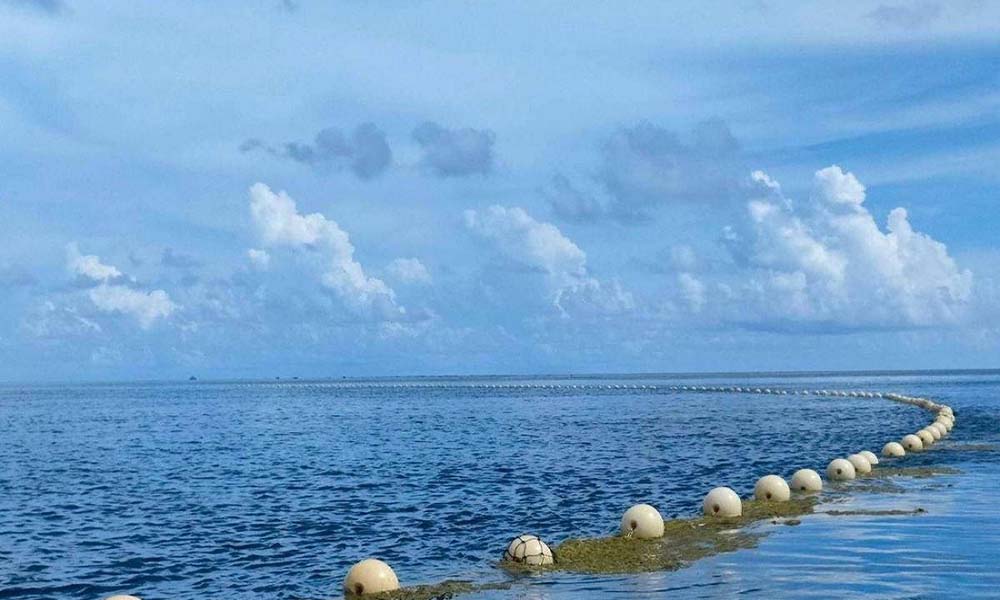
This move follows a long-standing dispute between the Philippines and China over territorial claims in the South China Sea. Manila seeks accountability for the destruction of coral reefs, the harvesting of giant clams, and other environmental damage allegedly caused by China’s activities, particularly in the vicinity of the Scarborough Shoal. This area has been a flashpoint for tensions between the two nations since 2012, when China effectively took control of the shoal after a maritime standoff with the Philippines.
The Philippines’ previous legal victory in 2016 at the Permanent Court of Arbitration (PCA) marked a significant turning point in the South China Sea dispute. The PCA ruled in favor of the Philippines, stating that China’s expansive claims over the region, including the “Nine-Dash Line,” had no legal basis under international law. Despite this ruling, China has rejected it and continued its activities in the region, including constructing artificial islands and deploying coast guard vessels.
This new legal case will focus specifically on environmental harm. According to the Philippines, China has caused significant damage to coral reefs in areas such as the Iroquois Reef, located near Reed Bank, a region rich in untapped gas reserves. Philippine authorities have accused China’s coast guard and fishing militia of harvesting coral and engaging in harmful dredging activities, which Manila argues violate international environmental protection standards.
“The damage to our marine environment is beyond dispute,” Remulla emphasized. The Philippines claims that Chinese vessels, particularly fishing trawlers described as “maritime militia,” have caused widespread destruction to coral reefs. These reefs are vital to marine biodiversity and local fishing communities. Coral reefs in the South China Sea, including the Iroquois Reef, have been used for a range of purposes, from traditional medicines to construction materials.
China, however, has denied these allegations. Beijing has consistently maintained that it has a historical right to the South China Sea, asserting its sovereignty over the waters and the islands within it. In response to the Philippines’ claims, Chinese officials have accused Manila of fabricating “political drama” to stir tensions. “We urge the relevant party of the Philippines to stop creating a political drama from fiction,” Chinese foreign ministry spokesperson Mao Ning said.
Despite China’s rejection, the Philippines remains firm in its stance. A 2023 report by the Center for Strategic and International Studies (CSIS) revealed that Chinese construction activities in the South China Sea have buried over 4,600 acres of coral reefs. The Philippines’ coast guard and military have provided evidence of the damage caused by Chinese dredging and reef destruction, a situation that has prompted Manila to seek international legal recourse.
The Philippines’ legal case is expected to draw on this evidence. “We have a lot of evidence,” Remulla said, referring to the testimonies and reports from the Philippine coast guard and military, who are on the frontlines of the South China Sea dispute. Manila is currently assessing the full extent of the damage to the marine environment before proceeding with the case.
China has also faced criticism for its broader activities in the region, which include the construction of artificial islands on submerged reefs, some equipped with military infrastructure such as runways, radar, and missile systems. This militarization of the South China Sea has raised alarm among other nations in the region, including Vietnam, Malaysia, and the Philippines, all of which have competing territorial claims in the Spratly Islands.
In the Philippines, there is growing concern that China’s actions are not only damaging the environment but also undermining the country’s sovereign rights to its maritime resources. The South China Sea is an important fishing ground for the Philippines, and the potential for oil and gas reserves adds another layer of economic importance to the region.
A timeline of recent events illustrates the ongoing tensions between the two countries. In 2023, the Philippines accused China’s coast guard of harassing its vessels in the South China Sea, including incidents near the Scarborough Shoal and the Second Thomas Shoal. On several occasions, Philippine vessels have been forced to contend with Chinese water cannon attacks, and military confrontations have escalated.
In one such incident in April 2023, the Philippines accused China’s coast guard of ramming its ships while attempting a resupply mission to troops stationed on the Second Thomas Shoal. These confrontations underscore the growing risks of military escalation in the region, particularly as China increases its presence in the area.
The Philippines’ legal strategy may also face complications due to China’s refusal to recognize the 2016 PCA ruling. Beijing has consistently dismissed international arbitration decisions, emphasizing its belief in the legitimacy of its territorial claims based on historical grounds. Despite this, Manila remains committed to challenging China through international legal channels.
The Philippines has identified several potential venues for filing the environmental case, including the PCA and the International Court of Justice. Given the precedent set by the 2016 ruling, the Permanent Court of Arbitration is considered the most likely forum for this case. However, legal experts caution that the lack of enforcement mechanisms for international rulings could make it difficult for the Philippines to secure any meaningful action against China.
The Philippines’ diplomatic efforts in the South China Sea have been supported by its longstanding security alliance with the United States. In recent years, the two countries have conducted joint military exercises and maritime patrols in the region to counter China’s growing influence. These activities have further strained China-Philippines relations, as Beijing views them as a direct challenge to its claims in the South China Sea.
The Philippines’ pivot back towards the U.S. under President Ferdinand Marcos Jr. has added another layer of complexity to the dispute. Manila has been strengthening its ties with Washington, which has pledged to support the Philippines in its maritime disputes with China. The two countries have agreed to hold joint patrols in the South China Sea and have conducted military drills to enhance their security cooperation.
As the Philippines prepares to file its legal case against China, experts argue that the growing environmental and geopolitical stakes in the South China Sea make the region an increasingly volatile flashpoint. The international community’s response to the Philippines’ legal action could have far-reaching implications for the future of the South China Sea dispute.
In the meantime, the environmental damage caused by China’s activities continues to degrade marine ecosystems that are crucial to the livelihoods of millions of people in the region. For the Philippines, this legal case is seen as an opportunity to hold China accountable for its actions and to assert the country’s sovereign rights over its maritime territories.
While the legal proceedings may take years to resolve, the case represents a significant moment in the ongoing struggle for control over the South China Sea. The outcome could have lasting implications not only for the Philippines and China but also for the broader international community, which has a vested interest in maintaining stability and preserving the marine environment of this critical region.
As the Philippines looks to its next steps, the global community watches closely. The future of the South China Sea—and the rule of law in international maritime disputes—hangs in the balance.