They say the most dangerous battles aren’t always fought on massive battlefields but on forgotten pieces of land surrounded by water. Now imagine this: a tiny island, no bigger than a small village, floating in turquoise seas. It has no skyscrapers, no crowds, not even traffic. Just palm trees, coral reefs and a military garrison bracing for war. This is Zhongye Island or as the locals call it, Pag-asa. But don’t be fooled by its calm surface. Beneath the waves, warships patrol. In the skies above, drones hum. And all around it, the world’s superpowers are circling, waiting, watching, claiming.
Zhongye Island isn’t just another tropical island. It’s a strategic goldmine, smack in the middle of the South China Sea, one of the busiest and most contested waters on Earth. Every year, over $3.5 trillion in global trade passes just miles from its shores. The seabed beneath? Possibly hiding vast reserves of oil and natural gas. The surrounding waters? Packed with fish that feed millions. But it’s not just about resources, it’s about control. Whoever commands this island gains eyes on the sea lanes, dominance over airspace, and a foothold in one of the world’s most volatile regions.
Right now, the Philippines holds the island. There’s even a small community, families, fishermen, schoolchildren living under the shadow of a looming threat. China, however, calls it theirs. “Indisputable sovereignty,” they claim. Their coast guard ships hover nearby. Their artificial islands armed to the teeth are just over the horizon. And that’s not all, Vietnam and Taiwan are quietly staking their claims too. What unfolds on this island is a slow-burning standoff, a cold war on coral.
So what’s really happening on Zhongye Island? Why is the world watching a patch of land most people have never heard of? And what could ignite a full-blown conflict in this so-called “paradise”? Let’s break it down.
Historical Roots of Contention: How This Tiny Island Got So Complicated
Before warships circled and drones flew over Zhongye Island, this place was just another lonely speck in the sea, visited only by fishermen, battered by storms, and largely forgotten by the world. But scratch the surface, and you’ll find that this island’s story goes back centuries, tangled in colonial maps, fading empires, and rising superpowers.
Long before modern borders were drawn, fishermen from Champa, what we now know as Vietnam and coastal China would dock at these islands for shelter and supplies. Their presence left behind oral histories and navigation routes but not clear claims. Fast forward to 1734, and here comes one of the oldest smoking guns: the Velarde Map, drawn by the Spanish colonial government in Manila. It showed the Spratly Islands, labeled Los Bajos de Paragua, within Philippine territory. Centuries later, that map would be waved in courtrooms as evidence of historical sovereignty by Philippine jurists like Justice Antonio Carpio.
But it didn’t end there. In 1883, Germany started surveying the Spratlys and Paracels, testing the waters for colonial expansion. China protested. Not with weapons, but with paperwork, a subtle signal that it already saw this region as part of its maritime sphere. This marked the beginning of formalized interest and a precursor to a dispute that would spiral through the 20th century.
Then came World War II, and everything changed. After Japan’s defeat, the South China Sea became a diplomatic free-for-all. In 1947, the Republic of China (yes, the government now in Taiwan) released a map with a sweeping “11-dash line”, a bold claim to almost the entire sea. Later, the People’s Republic of China adopted it, trimming it to 9 dashes, but keeping the ambition. Meanwhile, Taiwan never let go either and has occupied Itu Aba, the largest natural island in the Spratlys, since 1956.
By 1951, with Japan officially renouncing claims to the islands, a geopolitical scramble began. Taiwan, mainland China, and Vietnam all stepped in to declare ownership. The Philippines? They joined in by 1955, asserting that the islands were within their exclusive economic zone, based on geography and proximity.
But the turning point came in the 1970s. In 1971, after a storm forced Taiwanese troops to temporarily abandon Zhongye Island, the Philippines moved in and occupied it. By 1974, they had formally declared it part of the Kalayaan municipality. And two years later, in 1976, they built an airstrip on Pag-asa Island, a clear message: We’re not just claiming this, we’re staying for good.
And so, what began as a quiet fishing stop centuries ago evolved into a strategic military and legal hotspot, claimed by four governments, watched by the world, and guarded 24/7. Every dash on a map, every ship that docks here, adds another layer to a conflict that’s no longer just about history, it’s about the future.
The Philippines’ Stance: Building Sovereignty on Sand and Sea
To the Philippines, Pag-asa Island is more than just a coral outpost, it’s a living, breathing symbol of sovereignty, planted in one of the world’s most disputed waters. And they’re not just claiming it on paper, they’re living on it, guarding it, and building on it, brick by brick.
Let’s start with their legal case. The Philippines argues that the Kalayaan Island Group, which includes Pag-asa, is not a random land grab, but part of the archipelago’s natural extension. It’s geographically close, historically connected, and legally backed. Their position hinges on the 1982 UNCLOS treaty, which grants countries special rights within 200 nautical miles of their coastline, known as an Exclusive Economic Zone (EEZ). Then, in 2016, the Permanent Court of Arbitration in The Hague dropped a bombshell: it ruled in favor of the Philippines, stating that China’s sweeping claims have no legal basis. That gave Manila even more firepower, not with missiles, but with maps and maritime law.
But legal victories mean little without boots, and families, on the ground. That’s why Pag-asa Island today is unique in the Spratlys. It’s not just a military base, it’s home. Around 200 Filipino civilians live here, complete with a mayor, a school, and a tiny health clinic. The island serves as the Poblacion or the town center of Kalayaan Municipality, the westernmost settlement of the Philippines. There are no malls, no cinemas, but there’s Wi-Fi, solar power, and a growing sense of national pride.
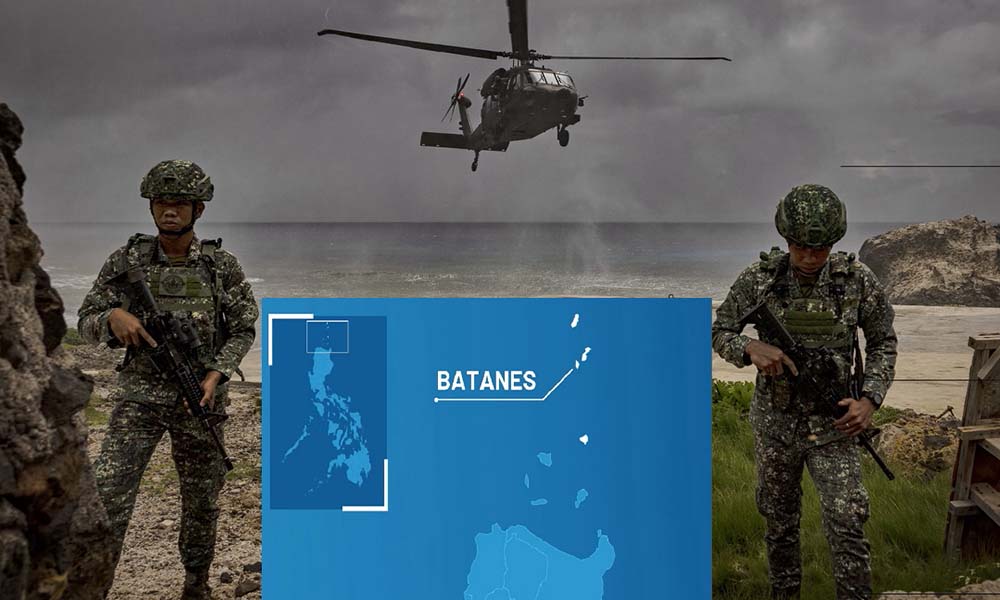
Still, it’s not all civilian life. Overlooking the village is Rancudo Airfield, a military-grade runway. Nearby, an army detachment stands watch 24/7. This island may be peaceful, but it’s never unguarded. And with growing pressure from Chinese patrols and gray-zone tactics, the Philippines is shifting gears, from defense to deterrence.
Philippines Weighs Acquisition of U.S.-Made Typhon Missile System
Since 2014, Manila has ramped up development. New barracks, communication towers, solar grids, and even a wharf for supply ships have transformed the once-sleepy island into a forward operating base. In 2023, they launched a Coast Guard Monitoring Base, designed to track Chinese movements in real time. These aren’t just upgrades, they’re statements.
And behind all of this is a bold military vision: the Comprehensive Archipelagic Defence Concept (CADC). Under this doctrine, the Philippines isn’t just defending territory, it’s strategically hardening key outposts like Pag-asa, preparing for all scenarios. Think multi-layered surveillance, better resupply chains, and interoperable defense systems with allies like the U.S. and Japan.
In a region where power is often shown through parades of warships, the Philippines is fighting with a different kind of strength: people, permanence, and principle. And for now, on Pag-asa Island, the flag still flies high, sun-bleached, wind-tattered, but unshaken.
China’s Assertions: Lines on a Map, Warships in the Water
If the South China Sea is a chessboard, then China is playing both sides, diplomat and enforcer. Its boldest move? A set of nine dashes that stretch across nearly the entire sea, slicing through the exclusive zones of Vietnam, Malaysia, Brunei, and, yes, the Philippines. To Beijing, these dashes aren’t just ink on paper, they’re a historic claim to “indisputable sovereignty.”
This “Nine-Dash Line” traces its roots back to maps used by the Republic of China in 1947, later adopted and fiercely defended by the People’s Republic of China. And it doesn’t matter how many international rulings push back, Beijing is unmoved. Just this year, on May 21, 2024, Chinese Foreign Ministry spokesperson Wang Wenbin doubled down, stating: “The Philippines illegally occupied China’s Zhongye Dao, If any environmental degradation appears in those waters, it is the Philippines who needs to reflect on its behavior, instead of wrongly accusing China.”
But that’s only part of the picture. Because in 2016, a landmark international ruling by the Permanent Court of Arbitration rejected China’s sweeping maritime claims. The court ruled that China’s so-called “historical rights” had no legal basis, and that its massive island-building campaign had violated the UN Convention on the Law of the Sea (UNCLOS).
Did China back down? Not at all. It simply dismissed the ruling as “null and void.” Fast forward to July 11, 2025, and Philippine DFA Secretary Tess Lazaro had this to say: “China continues a revisionist, self-serving interpretation of international law. The legitimacy of the 2016 ruling is being tested, challenged, and deliberately subverted.”
Is Malaysia’s Military Strong Enough to Claim its Exclusive Economic Zone(EEZ) from China?
And that’s not just diplomatic talk, it’s happening on the water, every single day.
Welcome to China’s “gray zone operations”, a kind of warfare where there are no bullets, but plenty of aggression. Harassment without headlines. Coercion without open conflict. In June 2025, a Philippine Navy surveillance report revealed a record-breaking 49 Chinese vessels patrolling the West Philippine Sea, nine coast guard ships and three PLA-Navy warships spotted near Pag-asa Island alone. These ships don’t just patrol, they ram, water-cannon, block, blind with lasers, and tail Philippine boats with drone-level precision.
One of the most shocking incidents came in May 2025, when two unarmed Philippine research ships, BRP Datu Sanday and BRP Datu Pagbuaya were water-cannoned and rammed by Chinese coast guard vessels just 4 nautical miles from Pag-asa Island, near Sandy Cay. The damage was real, cracked hulls, shattered antennas, and China dismissed it as “film production, not genuine research.”
Then came April 2025. Chinese state media proudly aired footage of their coast guard personnel landing on Sandy Cay, planting their red flag on the reef. Their message was chillingly clear: “We have effectively seized this feature.”
So while the world debates legality, China is reshaping facts on the ground and in the water. The Nine-Dash Line may not hold in court, but it’s being drawn in real-time with steel hulls and satellite eyes. And the big question remains: How far will China go to enforce a claim that the world no longer recognizes?
The Global Chessboard: Law, Diplomacy, and the Battle for Legitimacy
In July 2016, a ruling dropped like a hammer. From The Hague, the Permanent Court of Arbitration delivered a stunning decision: China’s Nine-Dash Line? Legally baseless. Its island-building, coast guard harassment, and resource extraction inside the Philippines’ EEZ? Flat-out illegal under international law.
It was a win, not just for Manila but for every coastal nation staring down a maritime giant. And now, nine years later, on July 12, 2025, Philippine Defense Secretary Gilberto Teodoro Jr. reminded the world why that ruling still matters: “We continue to uphold the Award because it reflects what is right and just, not just for us, but for all coastal states whose rights must be respected under international law.” But here’s the problem: The ruling is enforceable in theory, not in practice. China simply ignored it. No penalties. No consequences. Just louder patrols and more concrete poured onto contested reefs.
That’s where diplomacy steps in, and this time, with reinforcements.
In recent years, the Philippines has launched a diplomatic offensive, shining a global spotlight on China’s “gray zone” bullying. From ramming boats to blocking resupply missions, Manila is documenting everything and making sure the world sees it. At the same time, it’s forging steel-strong alliances. From Tokyo to Canberra, Berlin to Wellington, countries are lining up behind the Philippines, backing both the 2016 ruling and a unified vision: a free, open, and rules-based Indo-Pacific.
One clear example? The Balikatan Exercises, now bigger, bolder, and deadlier. In 2025, U.S. and Philippine forces trained side-by-side in integrated air and missile defense, island seizure drills, and rapid amphibious responses. At the opening ceremony, U.S. Marine Corps Lt. Gen. James Glynn declared: “These drills demonstrate not just our will to uphold our mutual defense treaty but also our matchless capability to do so.” And it’s not just military hardware on display, it’s a message: The Philippines is not alone.
$35B War Machine: How the Philippines is Reshaping Its Military!
Meanwhile, freedom of navigation patrols have turned the South China Sea into a geopolitical highway. Warships from the U.S., Japan, Australia, and even the UK routinely sail through waters China claims as its own. To Beijing, these are provocations, outsiders meddling in a “regional issue.” But to much of the world, these patrols are a vital stand for international law and the right to free and open seas.
China’s response? Fierce condemnation. Beijing accuses Manila of “colluding with foreign powers” and turning the region into a “theater for great-power rivalry.” But for the Philippines, the game has changed. It’s no longer about maps and dashes, it’s about law, partnerships, and global solidarity. In the South China Sea, the fight isn’t just about territory. It’s about the very idea of a world where might doesn’t make right, and whether that idea can still hold water in the face of rising tides.
Fishermen, Reefs, and Riches: The Human and Environmental Cost of a Geopolitical Showdown
For generations, Filipino fishermen have braved the South China Sea’s temperamental waters, relying on rich fishing grounds near Pag-asa Island for their livelihoods. But today, their greatest threat isn’t the sea, it’s the foreign vessels that now dominate it. Reports of harassment, intimidation, and aggressive tactics by Chinese coast guard ships have become common. Fishermen from Palawan and Zambales say they are often blocked, chased away, or even sprayed with water cannons while trying to fish in areas they’ve relied on for decades. This isn’t just about losing income, it’s about survival. In June 2025, a Pulse Asia survey revealed that 73% of Filipinos support the Marcos administration’s decision to continue asserting the country’s rights in the West Philippine Sea, a clear reflection of national frustration and resolve.
Beyond human livelihood, there’s an unfolding ecological disaster beneath the waves. China’s extensive dredging and island-building projects have turned once-thriving reefs into barren sandscapes. An investigation by the Asia Maritime Transparency Initiative (AMTI) in December 2023 found that roughly 4,648 acres of reef have been destroyed due to land reclamation efforts. Experts say this may be the fastest large-scale coral reef degradation in recorded history. Marine ecosystems that took centuries to form are being flattened in weeks, all for strategic outposts. And while China denies responsibility, often deflecting blame onto the Philippines, environmentalists warn of irreversible consequences for biodiversity, fisheries, and regional climate stability.
At the core of this conflict lies another powerful motivator: resources. The South China Sea is believed to hold vast reserves of oil and natural gas, estimates vary, but all suggest enormous potential. Control over these energy sources could shift economic balances in the region. Meanwhile, the rich fisheries of the Spratlys are crucial not only to the Philippines but to millions across Southeast Asia. With rising global food insecurity and energy demand, these waters represent far more than symbolic sovereignty, they’re a vital economic and ecological lifeline. And that’s exactly why the battle for Zhongye Island and its surroundings is not just a matter of borders, it’s a fight for the future.
BREAKING: U.S. Marines Join Forces with the Philippines Troops to Defend Key Islands
Conclusion
The dispute over Zhongye Island, known locally as Pag-asa, stands as a symbol of a much deeper and more persistent struggle in the South China Sea. Nearly a decade after the landmark international ruling in favor of the Philippines, the reality on the ground remains unchanged. China continues to reject the verdict, advancing its presence through militarization, maritime patrols, and relentless gray zone tactics. This ongoing stalemate is not just a legal or territorial issue, it’s a geopolitical flashpoint that refuses to cool.
With each new confrontation at sea, the stakes grow higher. Tensions between China and the Philippines have now evolved into a regional security concern, drawing in global players and fueling fears of escalation. From American warships to Australian surveillance planes and Japanese coast guard cooperation, the South China Sea has become a stage for a modern-day chess match, where even the smallest miscalculation could trigger real-world consequences. The constant military build-up and joint defense exercises in these contested waters underscore just how strategic, and volatile, this maritime arena has become.
Looking ahead, the Philippines shows no signs of retreat. It is doubling down on diplomacy, transparency, and law. By documenting incidents, strengthening alliances, and anchoring its claims in international law, Manila hopes to rally global support and pressure Beijing to back off. But long-term resolution remains elusive. The question is no longer just who controls which island, it’s whether international law can still hold weight in the face of raw power. As the world watches, the South China Sea remains a test case for the future of rules-based order, regional peace, and the balance of power in Asia’s most contested waters.