China Blocks Scarborough Shoal to Monitor Balikatan 2026
Chinese vessels installed a 352-meter floating barrier at Scarborough Shoal on April 10–11, 2026 — the same week history’s largest US-Philippines military exercise began 120 nautical miles away. Philippine Coast Guard has confirmed Starlink signal drops within 24 nautical miles of the shoal. Analysts say it is not a glitch.

Indo-Pacific Report · April 22, 2026 · 12 min read · Grey Zone Warfare · Balikatan 2026 · EW / ISR
Chinese vessels installed a 352-meter floating barrier at Scarborough Shoal on April 10–11, 2026 — the same week history’s largest US-Philippines military exercise began 120 nautical miles away. Philippine Coast Guard has confirmed Starlink signal drops within 24 nautical miles of the shoal. Analysts say it is not a glitch.
Indo-Pacific Report · April 22, 2026 · 12 min read · Grey Zone Warfare · Balikatan 2026 · EW / ISR In the summer of 1982, the British task force sailing toward the Falkland Islands had a problem no admiral wanted to admit aloud. Argentine forces weren’t just firing missiles at their ships. They were watching them. Tracking them. Building a picture of exactly where the fleet was, how fast it was moving, and where it was heading.
That’s what surveillance is for — not to fight a battle today, but to understand the battlefield before the fight begins.
Fast forward to April 2026. Scarborough Shoal, South China Sea. A multinational military exercise involving 17,000 troops from seven countries has begun. And right next door, China is doing something quietly, persistently, and deliberately.
WHAT HAPPENED
The Barrier, the Vessels, and the Signal Drops
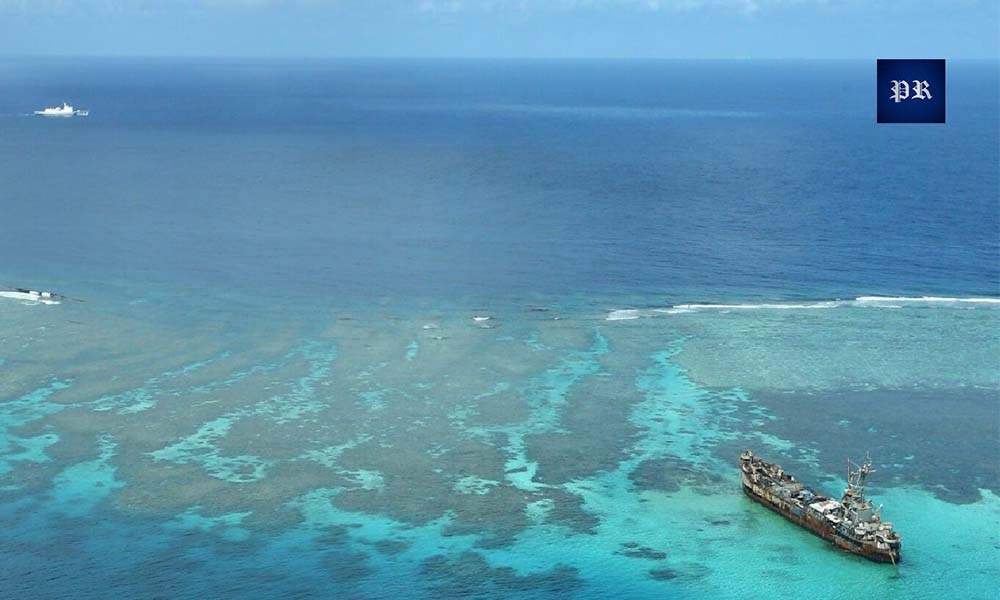
On April 10 and 11, 2026, Chinese vessels installed a 352-meter floating barrier at the entrance to Scarborough Shoal — confirmed by satellite imagery obtained by Reuters. Philippine Coast Guard spokesperson Commodore Jay Tarriela confirmed the deployment, reporting six Chinese maritime militia vessels inside the shoal and three more outside, holding a blocking posture at the entrance.
Between April 5 and April 12, Philippine Navy spokesperson Roy Trinidad confirmed approximately 10 China Coast Guard vessels operating in waters near the shoal simultaneously.
This wasn’t the first alarm. Back in February 2026, Tarriela had already flagged something more invisible — and more troubling. Starlink connections aboard Philippine Coast Guard and fisheries vessels were repeatedly dropping whenever ships entered within 24 nautical miles of Scarborough Shoal.
“We believe this may be due to signal jamming by the People’s Republic of China. This occurs consistently whenever our vessels approach or enter the 24-nautical-mile range.”
— Commodore Jay Tarriela, Philippine Coast Guard
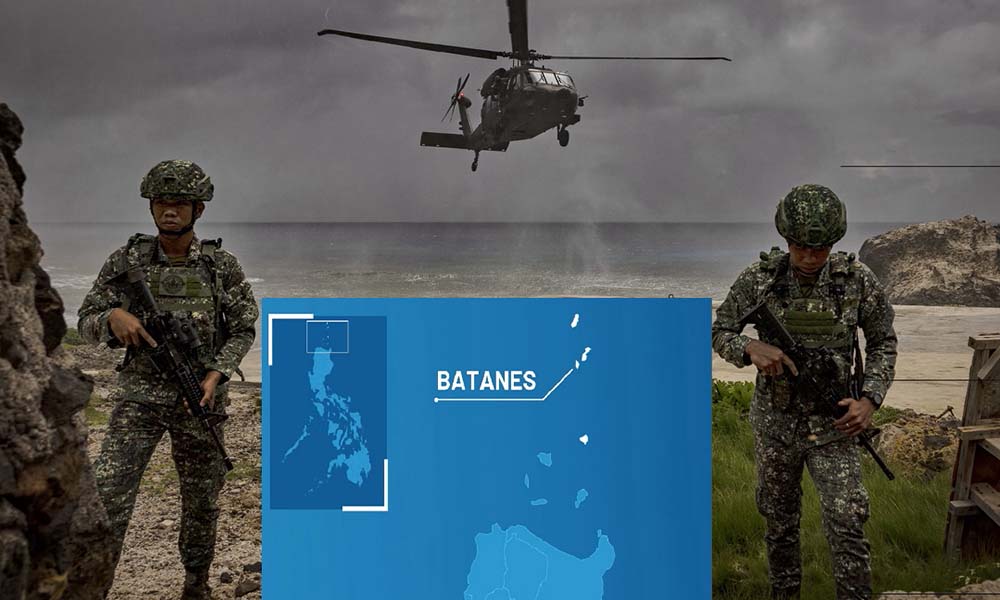
Now, Balikatan 2026 — the largest edition of the US-Philippines joint exercise ever held — has launched. 17,000 troops. Seven nations. April 20 to May 8. Exercise corridors in Zambales sit just 120 nautical miles from Scarborough Shoal.
The timing is not a coincidence.
TROOPS FROM 7 NATIONS — BALIKATAN 2026, THE LARGEST US-PHILIPPINES EXERCISE IN HISTORY
STRATEGIC MEANING
This Is Reconnaissance, Not a Technical Glitch
When Philippine Coast Guard vessels lose Starlink within 24 nautical miles of Scarborough Shoal — consistently, repeatedly — that’s not a technical glitch. That’s a pattern. China already has the infrastructure in place. Satellite imagery has confirmed electronic warfare systems on both Subi Reef and Mischief Reef — well within operational range of the Balikatan exercise corridor.
The Secure World Foundation’s 2026 Counterspace Report noted that China’s jamming capabilities in the South China Sea remain difficult to fully assess — but the geography tells its own story.
“I would say — this could already be a form of electronic warfare.”
— Commodore Vincent Trinidad, Philippine Navy West Philippine Sea Command
Elbridge Colby has argued that the first battlefield of any future Pacific conflict won’t be the ocean. It’ll be the electromagnetic spectrum. That battle may already be underway.
ESCALATION PATTERN
China Doesn’t Escalate Randomly — It Escalates Incrementally
Each move at Scarborough Shoal fits a decade-long pattern of calculated pressure designed to stay below the threshold of armed conflict — what strategists call grey-zone warfare.
2012 China seizes Scarborough Shoal after a standoff with the Philippine Navy. Manila never gets it back.
2024 Philippine vessels report AIS signal jamming near Second Thomas Shoal. Commodore Trinidad calls it “electronic warfare.”
Feb 2026 Starlink drops confirmed within 24 nautical miles of Scarborough. PCG flags suspected jamming publicly for the first time.
Apr 2026 352-meter floating barrier installed at shoal entrance. Balikatan 2026 launches 120 nautical miles away.
“These incremental steps, while individually limited, cumulatively shift the status quo in Beijing’s favor without triggering a kinetic response.”
— Foundation for Defense of Democracies, April 2026
The numbers underline the pace: 500+ joint US-Philippines military activities have been approved for 2026 alone — more than one per day. Graham Allison warned that rising powers don’t announce their intentions. They reveal them — through behavior, over time. China’s behavior at Scarborough Shoal has been remarkably consistent. The escalation isn’t accelerating. It’s accumulating.
https://indopacificreport.com/china-builds-a-military-base-on-scarborough/
MILITARY STAKES
Why Scarborough Is the Strategic Triangle of the South China Sea
Scarborough Shoal isn’t just a fishing ground. It’s a strategic choke point. Sitting 124 nautical miles west of Luzon, it sits directly astride the approach corridors from the South China Sea into the Philippine Sea. Any military planner working a Taiwan contingency draws a line straight through it.
“Whoever controls Scarborough controls the strategic triangle of the South China Sea.”
— Robert Kaplan, Geopolitical Analyst
If China were ever to militarize Scarborough — as it did with Subi Reef and Mischief Reef — US and Philippine forces operating out of northern Luzon would face a three-sided enclosure. China has already deployed jamming and surveillance systems across its artificial island chain — Subi Reef, Mischief Reef, Fiery Cross Reef. Each one a node in a larger sensor network.
Balikatan 2026 includes anti-submarine warfare, integrated air and missile defense, and joint maritime strike activities — precisely the capabilities China wants to map. Every transmission during those exercises is potential intelligence. The shoal is 352 meters wide at its entrance. The strategic consequences are considerably larger.

ALLIANCE IMPLICATIONS
Japan’s Structural Shift — and What China Is Probing
Japan’s presence at Balikatan 2026 is not symbolic. It’s structural. This is Tokyo’s first large-scale participation in the exercises — deploying personnel from the Ground, Maritime, and Air Self-Defense Forces, plus cyber and medical units. Japanese media described it as a significant shift in military policy.
“Japan considers this as related to Taiwan’s defense. Tokyo is focusing efforts in the Philippines precisely because of that connection.”
— Grant Newsham, Retired US Marine
Australia, Canada, France, and New Zealand are also present. Seven nations now training together, shoulder to shoulder, 120 nautical miles from a shoal China is actively jamming.
That coalition picture matters. Because China’s electronic warfare at Scarborough isn’t just targeting Philippine vessels — it’s probing the interoperability seams of an expanding alliance. Where do US and Japanese communications systems connect? Where are the gaps between Philippine and Australian maritime coordination? These are the questions China’s electronic intelligence apparatus is built to answer.
GLOBAL CONSEQUENCES
The Precedent Being Set Beyond the South China Sea
The timing of China’s escalation at Scarborough is not accidental. The US is simultaneously managing a naval blockade of Iran, an oil crisis, and a Philippines under a year-long state of national energy emergency. Diplomatic sources cited by Reuters noted fears that China may exploit perceptions that Washington is strategically distracted.
This is textbook Mearsheimer. Great powers don’t wait for ideal conditions. They exploit windows.
The 2026 Secure World Foundation Counterspace Report confirmed that the US, Russia, and China possess the most significant anti-satellite and jamming arsenals on the planet. China’s capabilities are expanding. Their willingness to deploy them — openly, repeatedly, against a US treaty ally — signals a new threshold of acceptable behavior.
That threshold matters everywhere. If jamming Philippine Coast Guard Starlink connections produces no meaningful response, the precedent is set. For Taiwan. For Japan. For any future contingency where electromagnetic dominance is contested before the first shot is fired.
“The structural competition between the US and China is entering its most dangerous phase — not because war is inevitable, but because both sides are now actively testing each other’s red lines.”
— Michael Beckley, Geopolitical Scholar
CONCLUSION
Here is the dilemma no alliance briefing has cleanly answered. China has spent years building a surveillance architecture across the South China Sea — artificial islands, EW systems, maritime militia, coast guard fleets — all operating below the level that triggers a military response. Commodore Tarriela confirmed the jamming. Satellite imagery confirmed the barrier. The Philippine Navy called it electronic warfare.
And the response has been statements.
The US-Philippines Mutual Defense Treaty is designed for armed attacks — not for Starlink signals going dark within 24 nautical miles of a shoal. That legal gap is precisely where China operates.
“Nations rarely lose through single catastrophic decisions. They lose through the gradual erosion of positions they forgot to defend.”
— Henry Kissinger
Scarborough Shoal was lost in 2012. The electromagnetic space around it is being lost now — quietly, incrementally, during the largest multinational military exercise the Philippines has ever hosted.
17,000 troops. Seven nations. Zero confirmed countermeasures to the jamming.
If China can surveil, jam, and probe a seven-nation coalition exercise from a shoal it was never supposed to control — what exactly does deterrence mean in the South China Sea anymore?
And if nobody has a clean answer to that — Beijing already does.