Hegseth’s Pacific Posture Shift: Reinforcing U.S. Deterrence Along the First Island Chain (2025–2030)
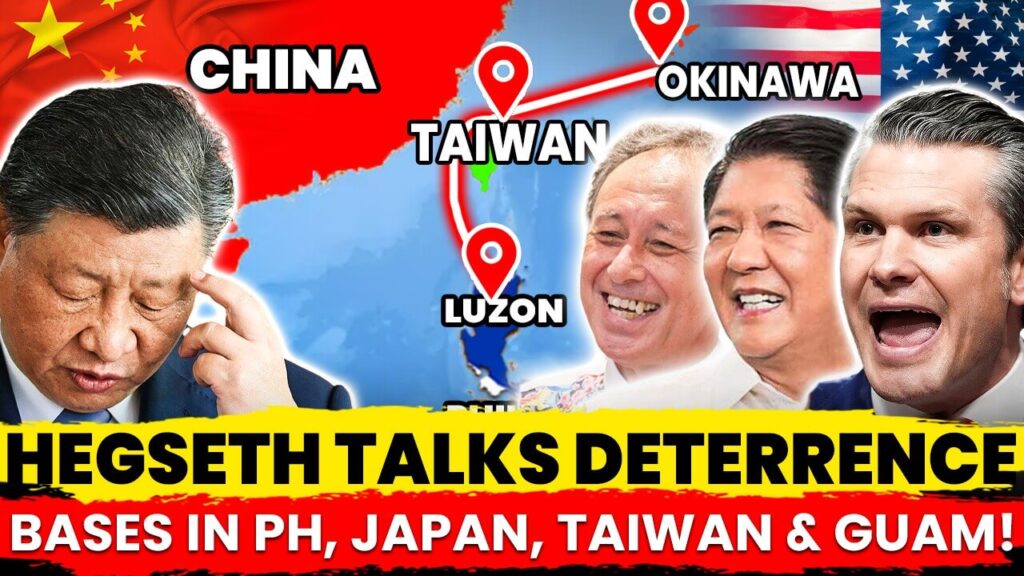
What if the front line of the next great-power conflict isn’t Washington or Beijing, but a narrow arc of islands stretching from Okinawa to Taiwan and all the way down to Luzon? That is the strategic question framing U.S. Defense Secretary Pete Hegseth’s landmark 2025 address, which signaled a historic transformation in America’s Indo-Pacific posture. Instead of relying on distant power projection, the U.S. is now shifting toward permanent, forward-leaning deterrence built along the First Island Chain, the very geography China must breach to threaten Taiwan.
The urgency is unmistakable. PLA air and naval operations around Taiwan have surged by more than 300% since 2020, prompting U.S. Indo-Pacific Command to call this “the most sustained coercive pressure in modern Chinese military history.”
Japan has reported its most dangerous air encounters in a decade, Chinese fighters radar-locking JASDF jets over the seas near Okinawa, while the Philippines recorded more than 200 hostile maritime incidents in 2024–25, including high-pressure water-cannon blasts, aggressive ramming attempts, and buoy placements inside its EEZ. The message embedded in Hegseth’s speech is clear: deterrence can no longer be symbolic; it must be real, visible, and unbreakable.
THE STRATEGIC IMPORTANCE OF THE FIRST ISLAND CHAIN
The First Island Chain is the Indo-Pacific’s most consequential geographic and military barrier, an arc of allied and partner territory stretching from Japan’s home islands, through Okinawa and Taiwan, and down to Luzon and the rest of the northern Philippines. This chain functions as the outer defensive wall of East Asia, a natural fortress that shapes how military power can move in and out of the region. For China, breaking through this barrier is essential to projecting naval and air forces into the open Pacific; for the United States and its allies, holding the line is the foundation of regional deterrence.
For decades, U.S. and allied wargames, including RAND, CSIS, and Pentagon simulations, have consistently shown that if China succeeds in punching a corridor through the First Island Chain, Taiwan’s defensive timeline collapses from weeks to mere days. In such scenarios, U.S. reinforcement becomes drastically harder, as PLA forces could sever sea lanes, dominate the airspace, and deploy long-range missiles deep into the Philippine Sea. Conversely, when the First Island Chain holds, Chinese forces are constrained, forced to operate within narrow maritime passages, and exposed to allied surveillance, missile fire, and submarine interdiction.
This strategic value is anchored in geography. The chain contains some of East Asia’s most vital chokepoints, the Bashi Channel, which serves as China’s primary submarine exit into the Pacific; the Miyako Strait, the narrow corridor where PLA bombers and fighters must pass to reach blue water; and the Luzon Strait, a critical pathway for U.S. naval forces maneuvering between the Philippine Sea and the South China Sea. Control over these chokepoints effectively determines who controls the air and maritime flows of the region, shaping everything from early-warning detection to logistics resupply in wartime.
The First Island Chain hosts a rising network of U.S., Japanese, and Philippine bases and access points, from Okinawa’s Kadena Air Base, Asia’s largest U.S. air hub, to Northern Luzon’s EDCA sites, now being upgraded for rapid deployment of missile batteries, long-range sensors, and maritime patrol aircraft. These positions enable distributed operations, complicate Chinese targeting, and give the U.S. the ability to project power rapidly while dispersing risk.
In essence, the First Island Chain is not simply terrain; it is the decisive arena where the future of deterrence will be won or lost. It determines whether China can expand outward into the Pacific or whether the U.S. and its allies can maintain a defensible, stable balance of power in East Asia.
HEGSETH’S DOCTRINE — DETER, NOT DOMINATE
Hegseth’s Pacific doctrine marks one of the clearest doctrinal shifts in the U.S. Indo-Pacific strategy since the Obama-era “Pivot to Asia.” His central message is simple yet strategically profound: the U.S. goal is not to remake China, but to prevent China from forcibly remaking Asia. As he stated, “We’re not trying to humiliate or dominate China. We are shaping an environment where aggression fails every single time.” This signals a departure from three decades of U.S. policy, from Clinton’s “engagement” to Bush’s hedging, to Obama’s rebalance, none of which seriously confronted Beijing’s accelerating military buildup.

Hegseth rejects regime-change fantasies and instead embraces a denial-based approach, the idea that the U.S. and its allies must make any Chinese attack on Taiwan so costly, so uncertain, and so slow that Beijing’s political objectives become unattainable. This approach draws on lessons from the 2022 Ukraine war, where rapid denial, mobile missile systems, dispersed logistics, and hardened infrastructure proved more decisive than attempts at territorial dominance. For the Indo-Pacific, denial means hardening bases, dispersing forces across the First Island Chain, expanding missile networks, elevating partner capability, and ensuring U.S. forces can survive the first 72 hours of a high-intensity conflict.
Crucially, Hegseth’s doctrine also introduces strategic clarity, ending decades of U.S. ambiguity about whether it would defend Taiwan. Through speeches, basing agreements, and joint statements with Japan and the Philippines, Washington has made it increasingly clear that it will contest any Chinese attempt, whether a blockade, a slow-burning gray-zone squeeze, or a rapid decapitation strike, to alter the status quo by force. This clarity is meant not to provoke China, but to remove the temptation for Beijing to gamble on miscalculation. As a senior U.S. official put it in late 2025, “Ambiguity didn’t deter China. Clarity might.”
Hegseth’s emphasis on resilience is equally transformative. U.S. forces are no longer positioned for dominance or overwhelming firepower alone; they are positioned for absorption, continuity, and rapid recovery. This includes pre-positioned fuel and munitions in the Philippines, hardened shelters in Japan, distributed airfields across Micronesia, and expanded maritime domain awareness networks linking Australia, Japan, and Southeast Asia. The idea is to deny China a quick victory by making the U.S. force posture impossible to neutralize in a single blow. In deterrence theory, resilience is sometimes more important than raw strength, because it convinces an adversary that there is no decisive knockout punch.
Hegseth’s doctrine acknowledges a geopolitical truth: the U.S. cannot and should not seek to dominate China, but it must prevent China from dominating Asia. Deterrence, not dominance; denial, not regime change. And through this, Washington hopes to preserve peace by ensuring that Beijing never sees war as a winnable option.
2025 NATIONAL SECURITY STRATEGY — A NEW BLUEPRINT FOR DETERRENCE
The 2025 National Security Strategy (NSS) delivers one of the most significant shifts in U.S. global posture since the post-9/11 era, placing the Indo-Pacific at the absolute center of American defense planning. For the first time in over twenty years, the NSS explicitly identifies the First Island Chain as essential terrain, a geographic line whose integrity directly affects U.S. national security. This marks a break from earlier strategies that spoke broadly about the Indo-Pacific without defining the physical battlespace that shapes deterrence. By framing the defense of Japan, Taiwan, and the Philippines as integral components of America’s own security architecture, the NSS signals that the First Island Chain is no longer peripheral; it is the primary theater where U.S.–China competition will be decided.
At the heart of the strategy is an ambitious effort to overhaul America’s forward presence through expanded basing access across Japan, Australia, and the Philippines. In Japan, U.S. forces gain deeper operational integration across the southwestern island chain, enabling combined air-defense, anti-ship, and counter-strike missions. In the Philippines, upgraded EDCA sites in Luzon and Palawan are being transformed into nodes for rotational forces, long-range surveillance, fuel storage, and maritime patrol platforms, creating, for the first time since the early 1990s, a robust U.S. presence facing the South China Sea and Taiwan Strait. In Australia, expanded U.S. air and naval rotations, supported by AUKUS initiatives, provide depth and redundancy in the event of sustained conflict. Together, these basing arrangements build a distributed and survivable posture designed to withstand China’s rapid-strike doctrine.
Equally central to the NSS is the creation of integrated missile networks and forward logistics systems positioned along the First Island Chain itself. The strategy calls for precision-strike capabilities, hardened fuel depots, pre-positioned munitions, and resilient resupply corridors designed to ensure U.S. and allied forces can fight, disperse, and reconstitute under sustained pressure. This logistical backbone, spanning from Okinawa to Northern Luzon, directly counters China’s reliance on long-range missile barrages aimed at crippling U.S. operational access in the first 72 hours of a conflict. The NSS reframes logistics not as a supporting function but as a central pillar of deterrence, ensuring that the U.S. isn’t just present in the Indo-Pacific but can remain operational even after a large-scale strike.
Finally, the NSS introduces the concept of “American conventional overmatch” as a core deterrence tool. Unlike nuclear deterrence, which focuses on existential threats, conventional overmatch signals the U.S. ability to defeat Chinese aggression in a conventional fight, whether through superior precision fires, airpower integration, undersea dominance, or allied interoperability. By highlighting overmatch as a strategic objective, the NSS aims to convince Beijing that any attempt to seize Taiwan or coerce regional neighbors will fail militarily, politically, and strategically.
The 2025 National Security Strategy is not merely a policy document; it is a blueprint for a new era of forward deterrence, one that uses geography, alliances, missile networks, and resilient basing to prevent China from shifting the balance of power in East Asia. For the first time in decades, U.S. strategy is built around the terrain where a conflict would occur, the partners who would fight alongside America, and the capabilities that can credibly deny China a quick or decisive victory.
WHY CHINA’S MILITARY TRAJECTORY DEMANDS A RESPONSE
China’s accelerating military trajectory has fundamentally altered the balance of power in East Asia, compelling the United States and its allies to rethink deterrence. The People’s Liberation Army Navy (PLAN) has expanded at a pace unprecedented in modern peacetime, now fielding over 370 operational hulls, making it the largest fleet in the world by sheer numbers. This naval growth, backed by advanced destroyers, amphibious assault ships, and a rapidly maturing carrier program, provides Beijing the maritime reach required for blockade operations, Taiwan encirclement, and power projection beyond the First Island Chain. Parallel to this, the PLA Rocket Force deploys thousands of DF-21D and DF-26 ballistic missiles, systems explicitly designed to hold U.S. and allied bases at risk from Okinawa to Guam. These weapons form the backbone of China’s “anti-access/area-denial” (A2/AD) strategy, intended to blind, delay, or push U.S. forces out of the conflict zone long before meaningful reinforcement can occur.
Taiwan is facing daily coercion, with a marked increase in PLA aircraft crossing the Taiwan Strait median line in 2025, challenging the island’s air defenses. Amphibious exercises have scaled up significantly, simulating invasion tactics. In the South China Sea, China’s maritime militia aggressively confronts Philippine patrol vessels and disrupts resupply efforts, employing gray-zone tactics to establish control without provoking open conflict.
These trends point to a sobering strategic conclusion: Beijing is rapidly building the capability to fight and win a short, sharp war. One that aims to seize Taiwan or assert control over the First Island Chain before the U.S. can mobilize sufficient forces. It is this trajectory, not hypothetical intentions, that drives Washington’s renewed focus on forward basing, integrated missile networks, and hardline First Island Chain deterrence. As Chinese capabilities expand, inaction becomes the riskiest strategy of all.
FLASHPOINTS: JAPAN & THE PHILIPPINES IN BEIJING’S CROSSHAIRS
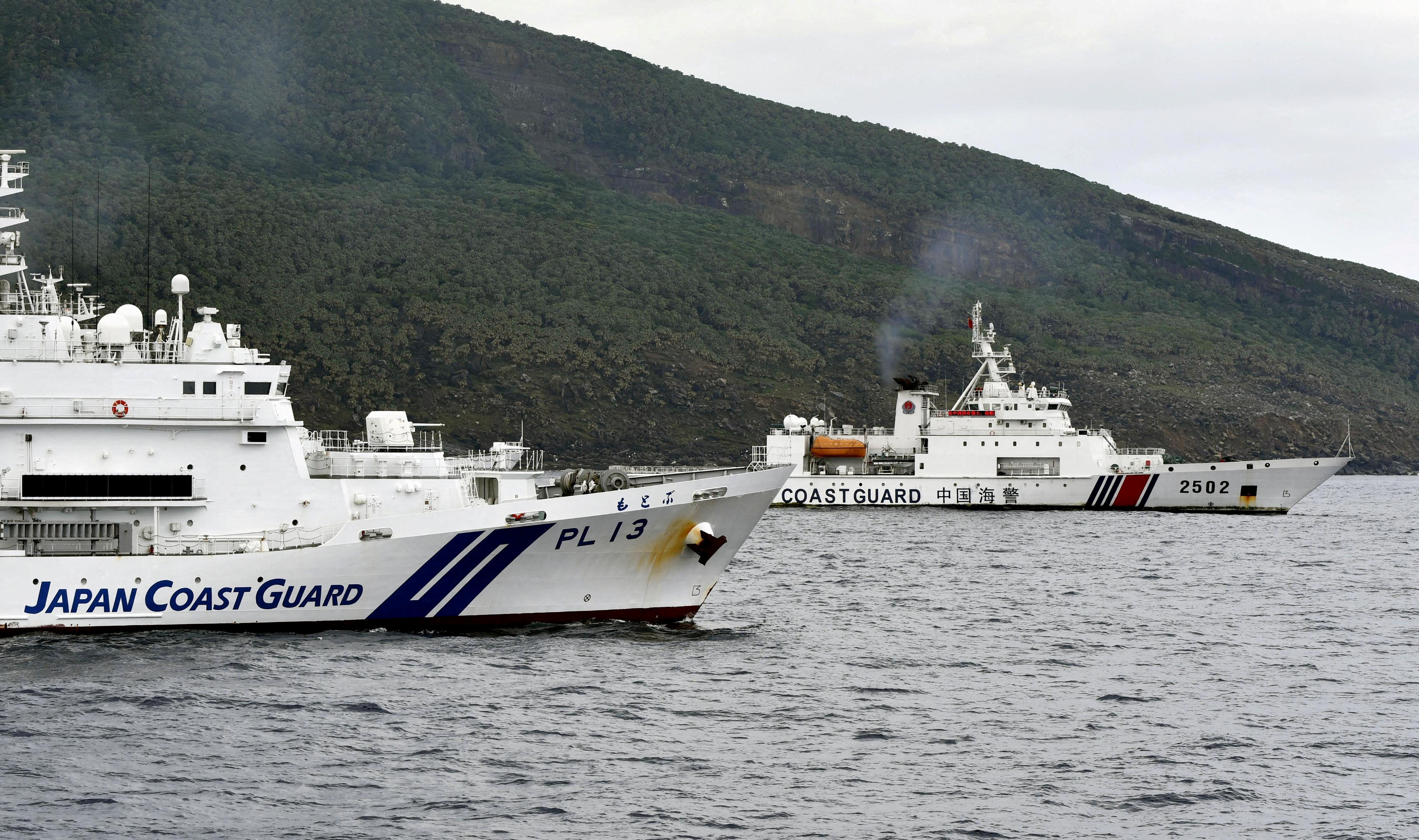
In the northern reaches of the First Island Chain, Japan now faces its most severe military pressure from China in over a decade. The latest escalation came when fighter jets from the PLA Navy’s Liaoning carrier group locked their targeting radar onto Japanese Air Self-Defense Force (JASDF) aircraft, an act Tokyo denounced as “extremely dangerous” and far beyond normal intercept behavior. Radar-locking is universally recognized as a hostile signal, one step below pulling the trigger and its use against Japanese aircraft represents a deliberate attempt by Beijing to test Tokyo’s red lines.
The Liaoning carrier strike group then maneuvered north toward Japan’s home islands, pressing into waters where Chinese carrier operations were once unthinkable. The incident pushed tensions to their highest point since the 2013 Senkaku crisis, reinforcing Japanese fears that Beijing is now prepared to use its expanding blue-water navy to coerce U.S. allies directly. For Japan, this is not a distant threat, it is unfolding less than 400 kilometers from its most populated regions, forcing Tokyo to integrate counter-strike planning and enhance coordination with U.S. forces stationed in Okinawa.
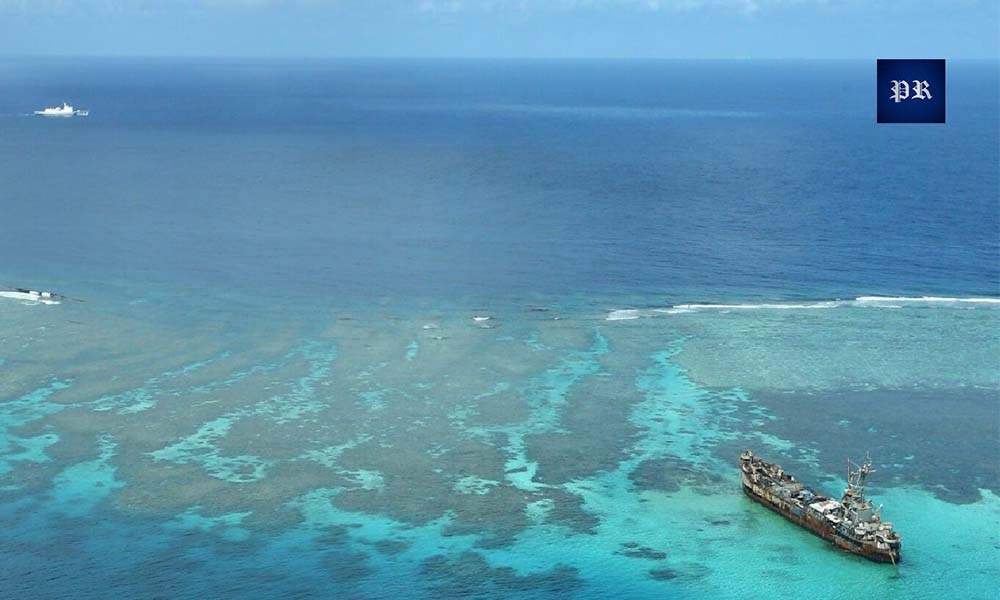
While Japan faces the brunt of Beijing’s northern pressure, the Philippines endures the gray-zone southern front, where China has intensified coercion with unprecedented scale and aggression. Philippine vessels now routinely face high-pressure water-cannon blasts powerful enough to shatter steel railings, deliberate ramming attempts, helicopter shadowing, and coordinated blocking maneuvers designed to cut off resupply missions at Ayungin Shoal and assert de facto control of Philippine waters.
These actions reflect a calibrated strategy: dominate the South China Sea without firing a shot, and erode Manila’s ability to operate in its own Exclusive Economic Zone. As a U.S. treaty ally, the Philippines is no longer just a peripheral player, it has become the southern anchor of the First Island Chain, a position that places Manila directly in the pathway of China’s maritime expansion. Can the Philippines Be the World’s Next Big Tech Hub?
This frontline role is reinforced by the transformation of Enhanced Defense Cooperation Agreement (EDCA) sites across northern Luzon. These bases place U.S. aircraft, sensors, and logistics hubs less than 300 kilometers from Taiwan’s southern tip, giving Washington and Manila prime vantage points over the Bashi Channel, the vital corridor through which Chinese submarines and aircraft attempt to break into the Pacific. For Beijing, the Philippines is no longer a weak link; it is a rising strategic obstacle supported by the U.S., Japan, and Australia. For Washington, these flashpoints form the geographic bookends of deterrence. Together, Japan and the Philippines have become the two hardest points in China’s path to military dominance along the First Island Chain.
THE U.S. BUILDUP (2019–2025) — LAYING THE FOUNDATION FOR DETERRENCE
Between 2019 and 2025, the United States quietly executed one of the most consequential realignments of its military posture in the Indo-Pacific since the end of the Cold War. This transformation centered on building what strategists now call a “Pacific Defense Network,” a dispersed lattice of forces stretching across Japan, the Philippines, Australia, and Micronesia. In Japan, the U.S. Marine Corps established Marine Littoral Regiments designed for stand-in operations inside contested zones, backed by long-range anti-ship missiles, drones, and distributed fueling points as far forward as Yonaguni—just 100 kilometers from Taiwan.
In the Philippines, Washington expanded to nine EDCA sites and began upgrading runways, fuel depots, ammunition storage, and logistics hubs, placing U.S. forces closer to Taiwan than at any time since the early 1990s. Meanwhile in Australia, the U.S. intensified bomber rotations, HIMARS deployments, and radar integration, creating strategic depth south of the First Island Chain. The key doctrinal shift was unmistakable: U.S. strategy has evolved from reliance on a handful of vulnerable mega-bases to distributed, survivable nodes, each designed to complicate PLA targeting and ensure continued operations even under saturation missile attack.
HEGSETH’S NEXT PHASE — SUSTAINED FORWARD PROJECTION
Hegseth’s next phase of Indo-Pacific strategy builds directly on this foundation. As he declared, “Our military must project sustained capabilities along the First Island Chain and throughout the Indo-Pacific.” This is not merely about being present; it is about maintaining a continuous, survivable, and lethal posture in the region’s most contested geography. The implications are profound. The U.S. plans to harden frontline bases so they can withstand missile saturation attacks engineered by China’s Rocket Force. Forward fueling and arming points, small but resilient logistics sites, will enable dispersed aircraft and missile units to operate even after traditional airfields are denied.
Rapid deployment cycles for Marines, air assets, and long-range fires will replace slow rotational models, while highly mobile small-unit formations take precedence over static bases vulnerable to early strikes. Analysts describe this architecture as a “deterrence web” , a dense network of kill-chains, sensors, allied forces, and dispersed American units that collectively deny China the quick, decisive war it seeks.
BASING ACCESS — THE CRITICAL ENABLER
To support this new posture, U.S. diplomacy is working to unlock additional basing access across Southeast Asia and Micronesia, transforming geography into strategic advantage. Expanded access radically reshapes operational timelines: response times shrink from hours to minutes, U.S. logistics can flow through multiple hubs instead of a single vulnerable one, and reinforcement routes to Taiwan become multidirectional and harder to interdict. More importantly, increased basing access enhances resilience against China’s precision-strike doctrine by dispersing key assets across dozens of smaller locations, complicating Beijing’s ability to disable U.S. operations early in a conflict. As these networks mature, the First Island Chain evolves from a string of isolated outposts into a fully integrated defense grid, capable of sustaining prolonged operations under duress.
MARITIME SECURITY INTEGRATION — ALLIES AS A FORCE MULTIPLIER
The 2025 National Security Strategy calls for “interlinking maritime security along the First Island Chain,” effectively weaving alliances into a single operational fabric. This integration now includes combined Japan–Philippines–U.S. patrols in contested waters, the sharing of radar feeds and ISR data, and the construction of a regionwide maritime domain awareness system. These cooperative mechanisms enable coordinated denial strategies that challenge China’s claims and complicate its gray-zone tactics. Over time, the architecture increasingly resembles a mini-NATO for the Western Pacific, not as a formal alliance but as a network of interoperable forces unified by shared threat assessments and synchronized operations.
TAIWAN’S DEFENSE MODERNIZATION — ASYMMETRY AS SURVIVAL
At the center of the First Island Chain lies Taiwan, whose survival depends on asymmetric modernization designed to withstand the opening phase of a Chinese assault. Taipei has committed billions toward mobile Harpoon and Hsiung Feng missile systems capable of targeting PLA ships before they reach the shoreline. Taiwan is expanding fleets of drones and loitering munitions that can harass, blind, and slow invading forces. Rapid-deployment infantry brigades are being trained for urban defense, while hardened shelters and civil-defense networks prepare the population for prolonged disruption. The logic is simple: Taiwan must buy the critical hours or days needed for U.S. and allied reinforcements to arrive. Situated at the fulcrum of East Asian security, Taiwan is the hinge upon which the entire First Island Chain pivots.
WHY FIRST ISLAND CHAIN DETERRENCE MUST NOT FAIL
U.S. strategic objectives in the Indo-Pacific are shaped by one overarching necessity: the First Island Chain must hold. Failure would allow China to achieve a lightning invasion of Taiwan, presenting the world with a fait accompli before the U.S. could respond. Beyond Taiwan’s security, Washington aims to preserve the regional balance so that no single power, least of all Beijing, can dominate Asia’s politics, shipping lanes, and air corridors. Deterrence also reduces the risk of miscalculation, historically the most dangerous pathway to conflict between great powers. Moreover, Taiwan produces more than 60% of the world’s semiconductors and nearly all advanced chips; its loss would destabilize global supply chains and empower China with command over the digital arteries of the global economy. A failed deterrence architecture would reverberate across Japan, the Philippines, South Korea, and beyond, reshaping the entire Indo-Pacific order.
RISKS, FRAGILITIES, AND ESCALATION PATHWAYS
Despite its growing strength, the U.S.-led deterrence system remains vulnerable. China’s missile saturation capabilities, designed to overwhelm even hardened bases, remain the greatest military threat. Aerial or maritime collisions near the Okinawa air corridor, the Bashi Channel, or the Luzon Strait could rapidly escalate if communication fails or if either side misreads intent. Political shifts within partner nations could also jeopardize access agreements essential for U.S. deployments. Yet the greatest danger lies not in excessive deterrence, but in insufficient deterrence: a perception in Beijing that the U.S. lacks the capability or will to defend the First Island Chain. Such a miscalculation could ignite the very conflict the U.S. seeks to prevent.
CONCLUSION — A NEW STRATEGIC FRONTIER
Hegseth’s vision represents a decisive shift from defensive reassurance to active, forward deterrence, anchored along the First Island Chain. The region is now openly recognized as the crucial battlespace of 21st-century geopolitics. As allies align, basing access expands, and U.S. forces are retooled for sustained, distributed operations, the Indo-Pacific enters a new era of strategic competition.
Why the U.S. Wants Taiwan to Fund Philippines EDCA Military Bases?
The stability of the region and the preservation of a free and open order will ultimately depend not on diplomatic rhetoric, but on forces positioned exactly where deterrence must live: the First Island Chain, the frontier on which the future of Indo-Pacific security will be decided.