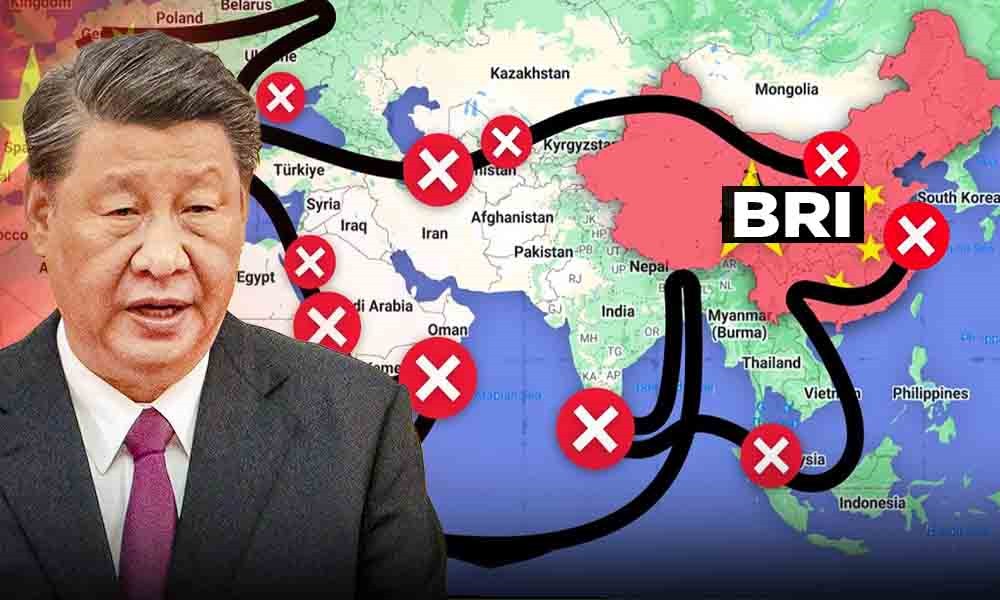
It all started with a grand vision, China, the ancient Middle Kingdom, rising once again to reclaim its place as the world’s economic powerhouse. But instead of conquering lands with armies, it wielded something far more powerful: money. With the launch of the Belt and Road Initiative (BRI) in 2013, Beijing promised to build roads, ports, and railways across Asia, Africa, and beyond, reviving the legendary Silk Road. Nations welcomed the Chinese investment with open arms, eager to modernize their economies. From Sri Lanka’s Hambantota Port to Kenya’s railway connecting Nairobi and Mombasa, massive projects took shape, backed by Chinese loans.
But then, the cracks begin to show. Debt piled up. Governments struggled to repay. Some projects stalled. Others became white elephants, glorious but unsustainable. Was this just bad economics, or was China using debt as a tool for influence? The truth lies in the fine print of these billion-dollar deals. From aggressive lending practices to risky financial models, these projects often carried hidden traps. And as the debt crisis unfolds, one thing is clear: China’s global ambitions come at a heavy price, not just for its partners, but for Beijing itself.
The Nature of Chinese Lending Practices: A Double-Edged Sword
For decades, global lending was dominated by institutions like the World Bank and the IMF, which imposed strict conditions, requiring governance reforms, environmental safeguards, and long repayment schedules. Then came China, rewriting the rules of the game. Unlike traditional lenders, Beijing’s state-backed banks, China Development Bank and the Export-Import Bank of China, offered billions in loans with fewer strings attached. Countries desperate for infrastructure saw this as a golden opportunity. But there was a catch.
China’s loans aren’t just about profit, they’re about power. Unlike private lenders who assess commercial viability, Beijing’s policy banks focus on strategic interests. “China’s lending is largely driven by policy banks, which are less concerned with commercial viability than with strategic objectives,” say financial analysts at the Council on Foreign Relations (CFR). This approach has fueled an estimated $1.1 trillion in overseas lending, making China the world’s largest official creditor, surpassing the World Bank and IMF combined. But while the money flows fast, transparency is often missing.
Lack of Transparency: The Hidden Clauses
China’s “no-strings-attached” loans sound appealing, no demands for governance reforms or environmental impact assessments. But what isn’t highlighted is the secrecy. Loan agreements often contain strict confidentiality clauses, shielding the terms from public scrutiny. The result? Governments and citizens have no idea what their countries are truly committing to, until it’s too late. Take Sri Lanka’s Hambantota Port, a mega-project funded by Chinese loans. Initially hailed as a game-changer, it soon turned into a debt trap.
Unable to repay, Sri Lanka handed over the port on a 99-year lease to China in 2017, a move that fueled global concerns about China’s “debt diplomacy.” A 2023 study by AidData found that nearly 40% of China’s overseas lending is now directed to financially distressed countries, raising alarms about the sustainability of these loans.
High-Interest Rates and Debt Pressure
Chinese loans also come at a premium. Unlike IMF or World Bank loans, which average around 1-2% interest, Chinese loans often charge 4-6%, sometimes higher. A 2022 study by the World Bank revealed that nearly 60% of Chinese overseas loans have shorter repayment periods, forcing countries into tighter repayment cycles. This creates a debt spiral, forcing nations to take out more loans just to repay old ones. For example, Zambia, which borrowed heavily from China for infrastructure projects, defaulted on its debt in 2020. Now, it’s trapped in prolonged negotiations, struggling to restructure over $6.6 billion in Chinese debt.
One of China’s most controversial lending strategies is resource-backed loans, where countries pledge natural resources like oil, minerals, or ports as collateral. While this ensures repayment, it also exposes nations to asset seizures when they fail to meet obligations. Take Angola, which borrowed billions from China by pledging future oil exports. But as oil prices fell, the country struggled to meet payments, forcing it into a cycle of dependency on Chinese loans. A 2023 Chatham House report highlighted how such lending patterns undermine economic sovereignty, as China gains control over critical resources.
China’s lending practices have fueled massive infrastructure growth but at a steep cost. The combination of high-interest rates, secrecy, and collateralization has left many nations drowning in debt, often with no clear way out. As financial experts at The Economist Intelligence Unit put it, “China’s lending model prioritizes control over sustainability, leaving recipient nations vulnerable to financial and strategic leverage.” So, the real question remains, are these loans a path to progress or a carefully crafted trap?
Risk Assessment and Project Viability: Why Chinese Loans Keep Failing
Every grand infrastructure project starts with a vision, a promise of economic transformation. Highways that will boost trade, ports that will turn nations into global hubs, and railways that will connect remote regions to booming markets. But what happens when these dreams clash with reality? Across the world, Chinese-funded projects have repeatedly overestimated returns, underestimated risks, and left nations drowning in debt.
Overestimating Success: When Projections Don’t Match Reality
The problem often starts before a single brick is laid, inflated feasibility studies and ambiguous projections make projects look far more profitable than they actually are. Take Montenegro’s Bar-Boljare Highway, a $1 billion project financed by China’s Exim Bank. The promise? A state-of-the-art highway connecting Montenegro to Serbia, boosting economic growth. The reality? The loan pushed Montenegro’s debt-to-GDP ratio past 100%, while the expected traffic flow never materialized.
Now, the tiny Balkan nation struggles to repay, forced to rely on EU bailouts just to stay afloat. This isn’t an isolated case. According to a 2023 AidData report, nearly 35% of Chinese-funded projects worldwide suffer from major cost overruns or delays. In Africa, over 50% of Chinese-backed infrastructure projects have either stalled or failed to deliver expected economic benefits.
Many recipient countries lack the institutional strength to manage large-scale infrastructure projects. Weak governance, corruption, and economic instability create the perfect storm for financial mismanagement. In countries rich in resources but poor in accountability, loans often disappear into bureaucratic black holes. In Nigeria, billions in Chinese loans for railway expansion projects were lost to corruption scandals, leading to long delays and inflated costs. Similarly, Zambia, once a poster child for Chinese investment, defaulted on its debt in 2020, as government mismanagement and currency devaluation worsened its financial crisis.
Debt as a Geopolitical Tool: Strategic Influence or Debt-Trap Diplomacy?
Beyond economics, China’s loans often serve a deeper strategic purpose, gaining leverage over key assets. When countries fail to repay, China doesn’t just demand cash, it seeks control over critical infrastructure. The most infamous case? Sri Lanka’s Hambantota Port. When Sri Lanka couldn’t meet its debt obligations, China took over the port on a 99-year lease in 2017. This triggered global concerns about “debt-trap diplomacy”, the idea that China intentionally lends to vulnerable nations to gain strategic assets.
Western nations are now raising alarms. The U.S., EU, and Japan have ramped up alternative lending programs, fearing that China’s unchecked influence could reshape global power dynamics. A 2023 study by Chatham House warned that over 20 nations are at risk of “excessive Chinese debt exposure,” potentially compromising their sovereignty.
At first glance, Chinese loans appear to offer quick solutions for struggling economies. But as debt crises mount, projects stall, and strategic assets fall into Chinese hands, nations are realizing the true cost of Beijing’s lending spree. As financial analyst Brad Setser from the Council on Foreign Relations puts it: “China’s lending model often prioritizes influence over long-term financial sustainability. Countries borrowing from China today must ask: Are we building our future, or signing it away?” The question remains: Are Chinese loans truly helping nations rise, or are they burying them under mountains of debt?
The Hidden Costs: How Chinese Debt Reshapes Economies and Societies
When a country takes on debt, the expectation is growth, new roads, ports, and railways driving prosperity. But for many nations tied to Chinese loans, the reality is much darker: ballooning debt, environmental destruction, and economies that remain dependent rather than empowered.
A Ticking Time Bomb: Debt Sustainability Concerns
For years, developing nations have been lured by easy money from China, but now, many are waking up to a financial nightmare. The debt-to-GDP ratios of recipient nations have skyrocketed, pushing some economies to the brink of collapse. Take Zambia, which borrowed heavily from China to fund infrastructure projects. By 2020, its debt-to-GDP ratio surpassed 120%, forcing the country into default, the first African nation to do so in the pandemic era.
In Pakistan, the story is similar: China holds over $30 billion of Pakistan’s external debt, fueling concerns that the nation is edging toward economic freefall. “Chinese debt has become a geopolitical tool as much as an economic one,” warns Brad Setser, senior fellow at the Council on Foreign Relations. “For many nations, default isn’t just a financial risk, it’s a loss of sovereignty.”
When Progress Comes at a Cost: Environmental and Social Fallout
Beyond debt, Chinese mega-projects have left deep scars on the environment and local communities. Infrastructure projects often ignore sustainability regulations, leading to deforestation, biodiversity loss, and pollution. Nowhere is this more evident than in the Amazon, where Chinese-backed hydropower projects have devastated rainforests and displaced Indigenous communities. A 202r Nature Sustainability study found that over 60% of Chinese-funded energy projects in Latin America have had significant environmental consequences.
In Southeast Asia, the China-Myanmar Economic Corridor (CMEC) has triggered massive deforestation and community displacement. Critics argue that the projects prioritize Beijing’s strategic interests over local development. Even in Africa, where China has pumped billions into infrastructure, the projects have left entire communities uprooted. “Infrastructure should empower people, not displace them,” says Anzetse Were, an economist specializing in African development. “But in many cases, Chinese projects have ignored local realities in pursuit of Beijing’s broader ambitions.”
The Illusion of Economic Growth: Who Really Benefits?
The promise of Chinese investment is job creation and economic stimulation. But on the ground, the reality is far less optimistic. A major criticism of Chinese-backed projects is their reliance on Chinese labor and materials, which limits job creation for local workers. Rather than integrating into the local economy, many projects function as “enclaves,” benefiting Chinese firms and workers while offering little to the host nation. Take Kenya’s Standard Gauge Railway (SGR), built with Chinese loans and contractors. Despite costing over $4.7 billion, the project created far fewer jobs for locals than expected, as Chinese workers and materials dominated the construction process.
A 2023 World Bank report noted that in many Belt and Road Initiative (BRI) projects, up to 80% of labor and supplies are sourced from China. This means that while recipient nations accumulate debt, the economic benefits often flow back to Beijing. As Professor Deborah Brautigam, a leading expert on Chinese investment in Africa, explains: “Chinese loans don’t always build self-reliance. Too often, they build dependence.”
For many nations, Chinese-funded projects promise development but deliver financial and social turmoil. As the debt crisis deepens, environmental concerns grow, and local economies struggle to benefit, the question is no longer just about borrowing, it’s about survival. Are these projects truly paving the way for progress, or are they setting the stage for long-term dependence on China?
Is China Changing Course? The Future of Chinese Debt and Global Lending
For years, China’s lending model has drawn criticism, with accusations of “debt-trap diplomacy” and unsustainable financial practices. But Beijing is adapting. Facing global backlash, economic slowdowns, and rising debt distress in borrower nations, China has started to tweak its approach. Is this a genuine course correction or just another strategic maneuver?
China’s Shifting Strategy: More Caution, More Restructuring
In the past, China’s loans were fast, large, and opaque, driven by its ambition to expand influence through the Belt and Road Initiative (BRI). Now, China is rethinking its lending approach. Recent years have seen Beijing quietly restructure billions in debt. According to a 2024 World Bank report, China has renegotiated or restructured over $78 billion in loans across Africa, Latin America, and Asia. Nations like Zambia, Sri Lanka, and Pakistan have all seen loan terms adjusted. “China is no longer just a lender, it’s now a debt manager,” says Alicia García-Herrero, a senior economist at Natixis. “The challenge is balancing its global ambitions with financial realities.”
One clear shift is China’s focus on “small and beautiful” projects, a term coined by Chinese policymakers to indicate a move towards smaller, more sustainable investments rather than billion-dollar megaprojects. This suggests that Beijing is finally acknowledging the risks of large-scale, unchecked lending. However, effectiveness remains questionable. As Zambia has been locked in complex negotiations for years, with Western creditors accusing China of delaying meaningful debt relief.
The Debt-Trap Debate: Who’s Really Responsible?
Critics argue that China’s lending strategy has intentionally ensnared nations in a cycle of dependence. But Beijing and its defenders push back, claiming that debt distress is often the fault of borrower nations. Chinese officials argue that countries voluntarily seek Chinese loans and that mismanagement, corruption, and economic miscalculations, not Beijing’s lending model, are what truly drive nations into financial crises. A 2023 study by the Rhodium Group found that China has not aggressively seized assets in cases of default, contradicting some debt-trap narratives.
For instance, despite Sri Lanka’s Hambantota Port falling under Chinese control, Beijing has refrained from taking similar measures elsewhere. China isn’t the only lender contributing to global debt distress. The IMF, World Bank, and private creditors also hold significant shares of developing nations’ debt. In fact, Western lenders often impose harsher austerity measures than China does. “The debt problem is bigger than China,” argues Harvard economist Carmen Reinhart. “Developing nations are drowning in debt from multiple sources, not just Beijing.”
A Perfect Storm: COVID-19, Recession, and Economic Chaos
If debt crises were bad before the pandemic, COVID-19 made them worse. The global economic downturn wiped out growth, weakened national currencies, and dried up government revenues. China, once eager to finance massive projects, paused new lending in many regions as its own economy slowed dramatically. According to a 2023 Boston University report, Chinese overseas lending collapsed by nearly 75% between 2016 and 2022, a sign that Beijing itself is rethinking its global financing role.
But the damage is already done. Developing nations now face a double burden: repaying old loans while struggling with economic stagnation, high inflation, and weak exports. Many countries that borrowed from China, such as Pakistan and Kenya, are teetering on the edge of default. Even China is feeling the strain. Its own property crisis, sluggish domestic economy, and rising debt at home mean that it can no longer lend as freely as before.
The Future: A New Model or the Same Trap?
China’s lending practices are evolving, but whether this leads to meaningful change or simply a new form of economic leverage remains uncertain. Nations tied to Chinese debt are learning a hard lesson: easy loans can lead to difficult consequences. As the world grapples with economic slowdowns, geopolitical shifts, and growing debt distress, one question remains: Will China’s new lending approach create real partnerships, or is it just a more polished version of the same old trap?
End Note
China’s lending practices have fueled rapid infrastructure growth across the developing world, but they have also contributed to mounting debt burdens, lack of transparency, and geopolitical concerns. While Beijing has begun adjusting its approach, shifting towards debt restructuring and more cautious financing, many recipient nations remain trapped in financial distress.
The future of Chinese lending will depend on greater accountability, sustainable financing models, and responsible debt management from both lenders and borrowers. As global economic uncertainty grows, the question remains: will China’s evolving lending strategy foster true development, or will it continue to be a tool of strategic influence?