China Tried to Challenge Teodoro in Seoul Then | He Responded!
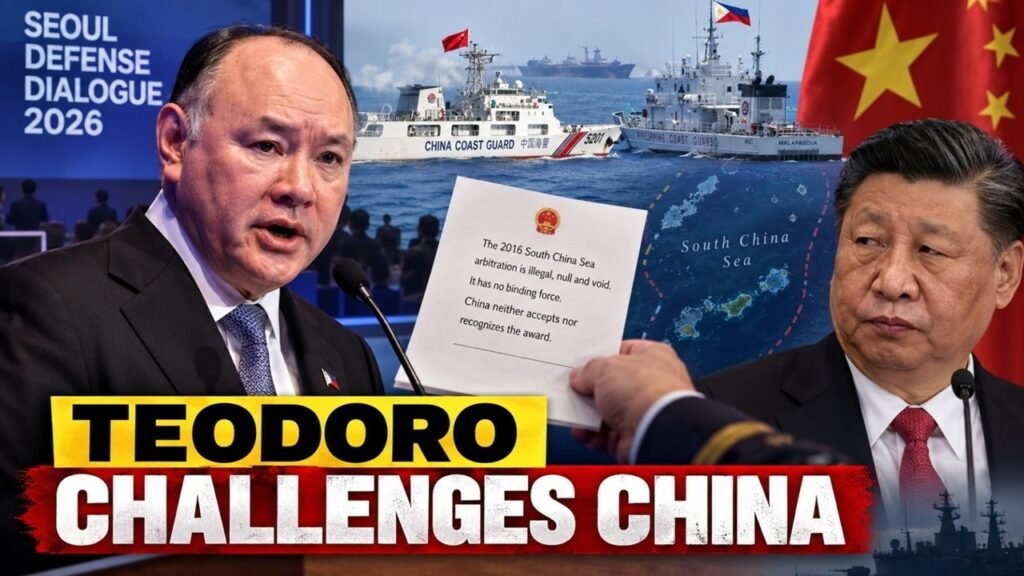
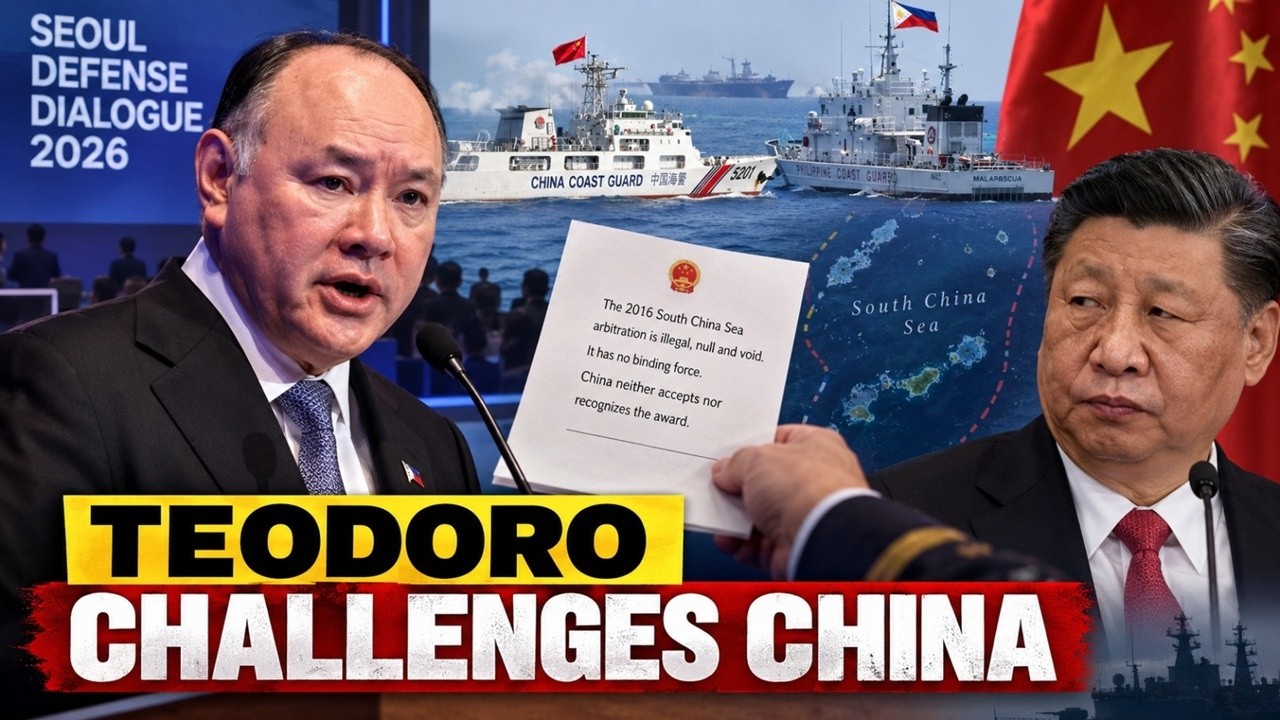
Philippine Defense Secretary Gilberto Teodoro became the focus of a tense exchange at the Seoul Defense Dialogue when a discussion about China’s activities in the South China Sea unexpectedly turned into a direct confrontation over the 2016 arbitration ruling. Teodoro was addressing questions about regional security and China’s conduct in disputed maritime areas when a piece of paper was placed in front of him. According to the account of the incident, the note came from a Chinese military attaché associated with the Chinese Embassy in Seoul. The message was not part of Teodoro’s prepared remarks and was not presented as a question from the moderator, making its appearance particularly notable in the middle of an international security forum. Instead of ignoring the message or dealing with it privately, Teodoro decided to read its contents aloud to the audience, immediately bringing China’s official position into the public discussion.
The note repeated Beijing’s longstanding rejection of the 2016 South China Sea arbitration award. China maintains that it does not accept or recognize the award and considers the arbitration process and its conclusions illegal, invalid and without binding force against China. This position has remained a central part of Beijing’s response to the Philippines since the arbitration case was initiated in 2013 and the final award was issued in 2016. China has argued that it never accepted the arbitration proceedings and that the tribunal was not authorized to decide matters that Beijing considers related to territorial sovereignty and maritime delimitation. The note therefore represented much more than a disagreement over a single court decision. It reflected a dispute that has continued for more than a decade and involves international law, maritime rights, national sovereignty, military power and the strategic balance of the Indo-Pacific.
After reading the message, Teodoro directly challenged China’s position. Referring to China’s refusal to accept the arbitration process under the United Nations Convention on the Law of the Sea, commonly known as UNCLOS, Teodoro said, “Because you don’t want to be subjected to UNCLOS.” He then delivered the line that became the most widely discussed part of the confrontation: “Of course, because you lost.” The comment was unusually blunt for an international defense forum, where officials generally rely on carefully worded diplomatic language.
What was in China’s note?
The substance of the Chinese note was not a new development in Beijing’s South China Sea policy. Instead, it reflected a position China has repeated consistently since the Philippines began arbitration proceedings under UNCLOS. Beijing has argued that the Philippines initiated the case without China’s consent and that the tribunal could not legitimately determine questions that China regards as involving sovereignty, territorial disputes and maritime boundaries. China has therefore rejected the idea that the 2016 award can be treated as a binding settlement of the South China Sea dispute. Understanding this position is important because Beijing’s objection is not limited to the tribunal’s conclusions. China fundamentally disputes the jurisdiction and legal authority of the arbitration process itself.
Beijing has repeatedly emphasized that the South China Sea contains disputes involving multiple countries and that these disagreements should be addressed through negotiations among the directly concerned states. China has particularly promoted bilateral consultations as the preferred approach to managing disputes with the Philippines and other Southeast Asian claimants. From Beijing’s perspective, negotiations allow the countries involved to consider sovereignty, historical claims, maritime boundaries and political interests together. International arbitration, by contrast, can separate particular legal questions from the broader political and territorial dispute. China has argued that this separation is problematic because it believes certain questions cannot be separated from sovereignty and maritime delimitation.
China has also referred to provisions of UNCLOS concerning limitations and exceptions to compulsory dispute settlement. In particular, Beijing has pointed to Article 298, under which states can make declarations excluding certain categories of disputes from compulsory procedures in specified circumstances. China’s legal argument has therefore been that the arbitration tribunal was not entitled to determine matters that Beijing considered to fall into excluded categories. This forms a major part of the disagreement between Manila and Beijing because the Philippines maintains that the case was carefully structured around questions concerning maritime rights and obligations under UNCLOS rather than a request for the tribunal to decide territorial sovereignty over islands.
The dispute also reveals the difference between legal authority and practical enforcement in international politics. An international ruling can provide a legal interpretation, but its practical influence depends partly on whether states recognize it and whether other governments are willing to support the broader principles behind it. The Philippines has attempted to increase the diplomatic weight of the 2016 award by consistently raising it in international forums and by strengthening security relationships with countries that emphasize the importance of UNCLOS and freedom of navigation. China, meanwhile, has continued to argue that the award should not be treated as a legitimate basis for determining its rights in the South China Sea. The note in Seoul therefore represented a much larger contest over which legal narrative will influence the regional order.
What did the 2016 South China Sea arbitration ruling say?
The 2016 South China Sea arbitration ruling is one of the most important legal developments in the modern history of the maritime dispute, but it is also one of the most frequently misunderstood. The ruling did not simply give the South China Sea to the Philippines, nor did it determine ownership of every island, reef and maritime feature in the region. Instead, the arbitration focused on a series of specific questions submitted by the Philippines under UNCLOS. These questions concerned maritime entitlements, the legal status of particular maritime features, historic-rights claims and the legality of certain Chinese activities in areas where the Philippines asserted rights under international maritime law.
The Philippines initiated the arbitration in 2013 under Annex VII of UNCLOS after years of growing disagreement with China over maritime claims and activities in the South China Sea. The Philippine government argued that arbitration could clarify important legal questions even if the tribunal did not decide sovereignty over disputed land territory. China rejected the proceedings from the outset and maintained that the case was fundamentally connected to sovereignty and maritime delimitation. Despite China’s opposition and non-participation, the tribunal proceeded after considering the jurisdictional objections raised by Beijing and eventually issued its final award on July 12, 2016.
One of the most consequential findings concerned China’s historic-rights claims in the South China Sea. The tribunal concluded that, to the extent China claimed historic rights to resources within areas covered by the nine-dash line beyond the maritime entitlements provided by UNCLOS, those claims were not compatible with the convention. This was significant because the nine-dash line has long been associated with China’s broad claims across large parts of the South China Sea. The ruling did not decide every aspect of the political meaning of the line, but it rejected the idea that historic rights could be used to claim resources throughout maritime areas where such rights exceeded the entitlements recognized under UNCLOS.
The tribunal also examined the legal status of various maritime features in the South China Sea. Under UNCLOS, different types of maritime features can generate different maritime zones. Islands capable of sustaining human habitation or economic life of their own can potentially generate an exclusive economic zone and continental shelf, while rocks and other features may have more limited entitlements. Some features that had been treated in political discussions as potential sources of extensive maritime zones were determined by the tribunal not to generate the full range of maritime entitlements claimed by the parties. These findings were important because the legal status of individual features can significantly affect the size and location of surrounding maritime zones.
Why Does China Reject the 2016 Arbitration Award?
China’s rejection of the 2016 South China Sea arbitration award is rooted primarily in its disagreement with the jurisdiction, legal basis and authority of the arbitration process. Beijing has consistently maintained that it never accepted the Philippines’ decision to initiate the case and did not agree to have the dispute resolved through an international tribunal. From China’s perspective, the Philippines attempted to use UNCLOS to address issues that Beijing considers inseparable from territorial sovereignty and maritime delimitation. China argues that questions concerning ownership of islands, sovereignty over maritime features and the drawing of maritime boundaries cannot simply be transformed into questions of maritime law and then submitted to compulsory arbitration. This position has remained a fundamental part of Beijing’s response to the award since the case began.
China has also argued that the Philippines’ arbitration case ignored the broader political and historical nature of the South China Sea dispute. Beijing maintains that the maritime region contains overlapping claims involving several countries and that these disputes should be resolved through negotiations between the states directly concerned. China has repeatedly emphasized dialogue and bilateral consultation as the preferred way of managing disagreements with the Philippines. From Beijing’s point of view, an international tribunal cannot provide a comprehensive solution to a dispute involving sovereignty, history, maritime boundaries and regional politics. China therefore considers the 2016 ruling an outcome of a process that it did not accept rather than a legitimate settlement of its disagreement with Manila.
Another important part of China’s argument involves UNCLOS itself. Beijing has referred to provisions within the convention that allow states to exclude certain categories of disputes from compulsory dispute-settlement procedures. China has particularly emphasized Article 298, which permits states, under specified circumstances, to make declarations excluding certain disputes, including some matters involving maritime delimitation, historic bays or titles and military activities. China argues that the Philippines’ case touched on matters that fell within these excluded areas or were too closely connected to them for compulsory arbitration to apply. Manila, however, has maintained that its submissions were carefully framed around the interpretation and application of UNCLOS rather than a request for the tribunal to decide sovereignty over disputed land territory.
Why Did Teodoro Read the Note Aloud?
Gilberto Teodoro’s decision to read the Chinese note aloud transformed a potentially private diplomatic interaction into a public confrontation. The note could have been ignored, handed to an aide or addressed privately after the session, but Teodoro chose to bring its contents directly into the discussion. That decision was significant because the message concerned one of the most sensitive issues in the China-Philippines relationship: China’s rejection of the 2016 arbitration ruling. By reading the note in front of an international security audience, Teodoro ensured that Beijing’s position became part of the public conversation taking place at the Seoul Defense Dialogue.
The setting was particularly important. The Seoul Defense Dialogue is not a private bilateral meeting between China and the Philippines. It brings together defense officials, military representatives, policymakers and security experts from different countries. Discussions in such forums often focus on regional stability, military cooperation, strategic competition and emerging security threats. Bringing the South China Sea arbitration dispute into this environment therefore gave the disagreement a broader regional dimension. Teodoro was not simply responding to a Chinese official; he was addressing an audience that included people with a direct interest in the future security architecture of the Indo-Pacific.
Reading the note aloud also allowed Teodoro to challenge China’s narrative in real time. Beijing’s position was that the arbitration was illegitimate and without binding force against China. Manila’s position is essentially the opposite: the Philippines considers the arbitration process valid under UNCLOS and views the award as an important legal foundation for understanding its maritime rights. By reading the Chinese message publicly and responding immediately, Teodoro prevented the Chinese position from remaining an unchallenged statement and instead turned it into the starting point for a debate.
The decision also reflected the increasingly public nature of the China-Philippines dispute. Maritime confrontations in the South China Sea are no longer discussed only through traditional diplomatic channels. Governments now release statements, publish videos, hold press conferences and raise individual incidents at international meetings in an effort to shape public and international understanding. The Philippines has increasingly used international forums to highlight what it describes as coercive behavior by China, while Beijing has accused Manila of exaggerating incidents and involving outside powers in what China regards as a bilateral dispute.
Teodoro’s response therefore had both legal and strategic dimensions. On the legal side, he defended the relevance of UNCLOS and the 2016 arbitration award. On the political side, he emphasized that the Philippines would not quietly accept China’s rejection of the ruling. His decision to answer publicly also sent a message to other countries in the room that Manila intends to continue raising the South China Sea issue internationally. This is particularly relevant as the Philippines strengthens its defense relationships with countries including the United States, Japan and Australia and seeks greater cooperation with other Indo-Pacific partners.
What Did Teodoro Mean by “Of Course, Because You Lost”?
Gilberto Teodoro’s statement, “Of course, because you lost,” became the most memorable line from the Seoul confrontation, but its meaning is closely connected to the decade-long dispute over the 2016 arbitration award. Teodoro was responding to China’s rejection of the tribunal’s decision and was effectively arguing that Beijing’s refusal to accept the ruling is linked to the fact that the award did not support China’s broader legal position in the South China Sea. The statement was deliberately blunt and political rather than a detailed legal explanation, but it communicated the Philippines’ frustration in a way that was immediately understandable to the audience and the wider public.
The underlying issue is that the 2016 tribunal rejected important aspects of China’s maritime claims as they were presented in relation to UNCLOS. Among its findings, the tribunal concluded that there was no legal basis under the convention for China to claim historic rights to resources within areas of the South China Sea beyond the maritime entitlements permitted by UNCLOS. The tribunal also made findings concerning the status of maritime features and China’s activities in areas where the Philippines claimed sovereign rights. For Manila, these findings represented a major legal victory because they supported the Philippines’ interpretation of its maritime rights.
The reaction from the audience was also significant because it demonstrated that the confrontation had moved beyond the narrow legal dispute. Applause indicated that Teodoro’s response had political resonance within the forum, although it should not automatically be interpreted as unanimous international support for every Philippine position. Different countries in the Indo-Pacific have different relationships with China and different approaches to maritime disputes. Some governments emphasize international law and freedom of navigation, while others seek to avoid direct confrontation with Beijing because of their economic and strategic relationships with China.
The phrase ultimately became important because it symbolized the sharp divide between Manila and Beijing. The Philippines views the arbitration award as an important legal victory that clarified several aspects of its maritime rights. China views the arbitration as an illegitimate process that cannot determine Chinese rights. Teodoro’s remark therefore captured the political dimension of a legal disagreement that remains unresolved. It also demonstrated why the South China Sea dispute continues to generate strong reactions even years after the tribunal issued its award.
About Indo-Pacific Report
For more geopolitical analysis, strategy coverage, and Indo-Pacific security reporting, visit Indo-Pacific Report:
Website
Facebook
YouTube
China Tried to Challenge Teodoro in Seoul Then | He Responded!