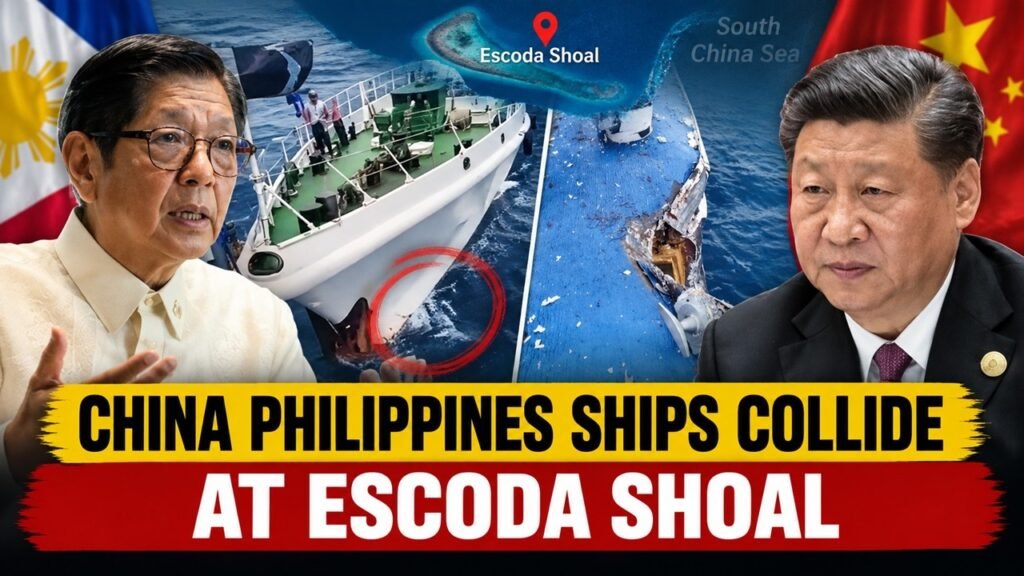
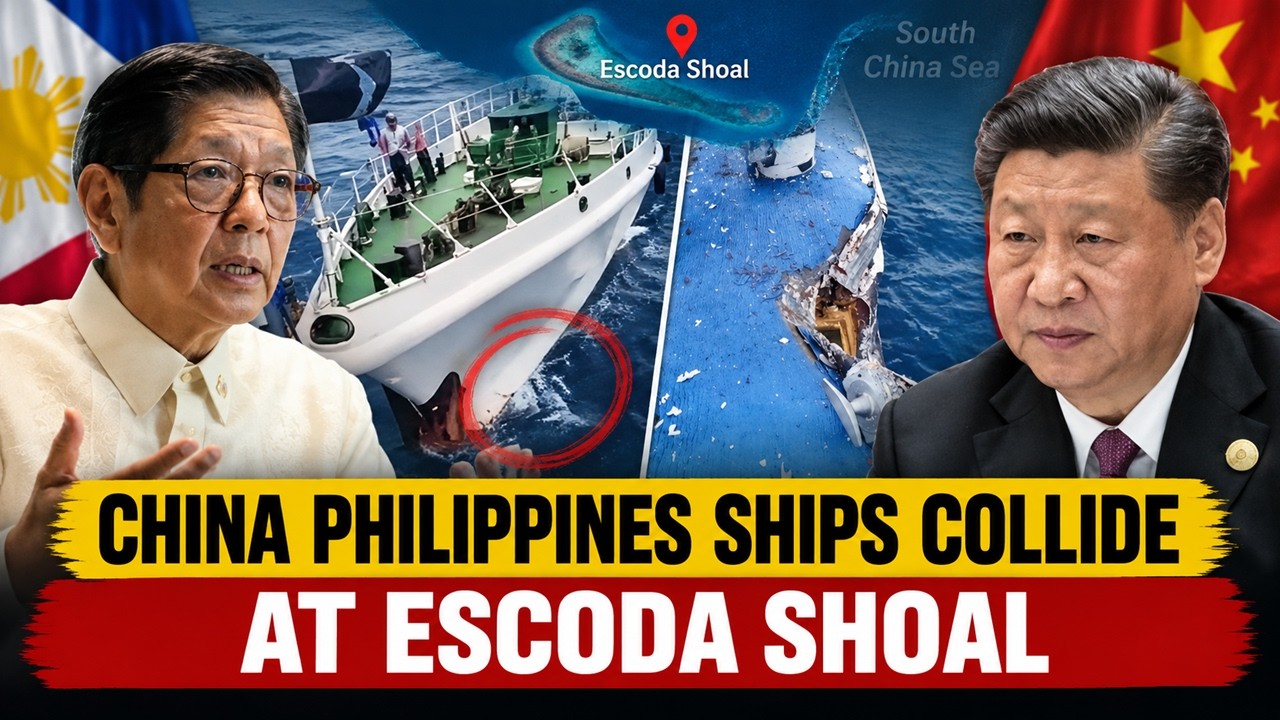
China Philippines Ships Collide AGAIN Near Sabina Shoal at Escoda Shoal
Taiwan’s transfer of a retired coast guard vessel to the Philippines may look like a relatively small development, but the wider regional context makes it worth watching. The vessel, formerly known as Lienchiang, has reportedly been transferred to the Philippines and registered as Bling No. 1, where it is intended for law-enforcement and maritime-security duties. At first glance, there is nothing extraordinary about an old patrol vessel changing ownership. It is not a modern frigate, it is not equipped like a frontline naval combatant, and it does not fundamentally alter the military balance in the South China Sea. However, maritime security is not built only around large warships and advanced weapons. It also depends on how many vessels a country can actually keep at sea, how frequently those vessels can patrol, and how effectively they can respond to incidents across a huge maritime area.
This is particularly important for the Philippines because of its geography. The country is an archipelago with thousands of islands and an enormous maritime area that requires continuous monitoring. Philippine authorities have to deal with search-and-rescue operations, fisheries protection, maritime law enforcement, environmental monitoring, civilian maritime activity and security concerns in strategically important waters. A single vessel can only operate in one location at a time. If that vessel is conducting a long patrol, undergoing maintenance or responding to an emergency, it is unavailable for another mission somewhere else. This creates what can essentially be called a numbers problem. A country may possess highly capable ships, but if it does not have enough vessels to maintain a persistent presence, its overall maritime coverage remains limited.
That is where a vessel such as Bling No. 1 can become useful. Its importance is not necessarily connected to combat power. Instead, its value comes from its ability to perform routine maritime duties and potentially free larger vessels for more demanding assignments. A coast guard fleet requires different types of ships for different missions. Large offshore patrol vessels can undertake long-distance operations, while smaller and medium-sized vessels can deal with routine patrols, law enforcement, rescue support and other everyday responsibilities. When these different platforms operate together, the fleet becomes more flexible and capable of maintaining a presence across several areas at the same time.
What Exactly Did Taiwan Transfer to the Philippines?
The vessel transferred by Taiwan is identified as Lienchiang, a Kinmen-class patrol and rescue vessel associated with Taiwan’s Coast Guard Administration. The ship entered Taiwanese service in 2008 and was retired in 2023. Following its transfer to the Philippines, reports identified it as Bling No. 1, a Philippine law-enforcement vessel. The vessel is roughly 61 metres long and is generally described as being in the 500-tonne class, although reported displacement figures vary depending on the source and measurement used.
Understanding the original purpose of Lienchiang is important because it explains why the ship should not be described as a conventional warship. It was designed for coast guard duties rather than for high-intensity naval combat. Its missions were associated with maritime patrol, rescue, law enforcement and other activities that require a vessel to remain operational at sea for extended periods. That makes it particularly relevant to the type of maritime responsibilities that the Philippine Coast Guard performs.
The vessel was reportedly capable of reaching speeds of around 30 knots, giving it the ability to respond relatively quickly to incidents at sea. Its range also allowed it to conduct longer patrols rather than being restricted to immediate coastal operations. These capabilities can be useful for maritime law enforcement because coast guard vessels often have to travel considerable distances to respond to incidents, monitor activity or assist civilian vessels.
How China Took Over Mischief Reef – Can the Philippines Stop It?
However, the transfer should not be exaggerated. Taiwan retired the vessel before transferring it, and reports indicate that its original weapons were removed. These included a 20 mm cannon and a .50-caliber machine gun. That means the vessel’s current role should be understood primarily through maritime security and law enforcement rather than through offensive naval operations. Calling it a major Philippine warship would create a misleading picture of what has actually happened.
Its usefulness comes from a different source. A coast guard vessel does not have to be heavily armed to be valuable. It can patrol fishing areas, support search-and-rescue operations, monitor maritime activity, assist civilian vessels and provide a visible government presence. These activities are particularly important in the South China Sea, where maritime disputes frequently involve coast guards and civilian vessels rather than conventional naval forces. The Philippine Coast Guard also needs vessels that can operate regularly without relying exclusively on its largest and most expensive platforms. If a large offshore patrol vessel is assigned to a strategically sensitive mission, it may not be available for routine law enforcement elsewhere. A smaller vessel can take over some of those routine duties, allowing the larger ship to remain available for missions where its greater size, endurance and equipment are required.
Why One More Philippine Coast Guard Vessel Can Make a Difference
The most important part of this story is the simple fact that maritime security requires presence. A government cannot maintain a physical presence across the sea through statements, diplomatic protests or surveillance data alone. At some point, a vessel or aircraft has to be available to conduct the patrol, inspect activity, assist a civilian ship or respond to an emergency. This makes the number of operational platforms an important part of maritime capability. The Philippines faces a particularly difficult version of this problem because of its geography. Its islands are spread across a large area, and its maritime responsibilities extend far beyond the immediate waters around major population centres. Philippine authorities have to monitor fishing activity, protect maritime resources, enforce laws, respond to accidents, conduct search-and-rescue missions and maintain government presence in waters where maritime disputes can occur.
Imagine a Philippine patrol vessel travelling to a distant maritime area for a long mission. While that ship is operating there, it cannot simultaneously patrol another area hundreds of kilometres away. If another vessel is undergoing maintenance, the number of available ships becomes even smaller. If an emergency occurs at the same time, authorities have fewer options for responding quickly. This is why fleet size and availability matter alongside the sophistication of individual ships. An additional vessel can help reduce that pressure. Bling No. 1 does not have to perform every mission or operate in the most dangerous waters to provide value. It can potentially take responsibility for routine patrols, law enforcement, fisheries monitoring, rescue support and other lower-intensity duties. That can allow larger vessels to concentrate on missions that require greater endurance, sensors, communications equipment or other capabilities.
This is sometimes described as fleet density. The idea is straightforward: the more usable platforms a country has, the more easily it can maintain a persistent presence across multiple areas. Of course, simply owning ships is not enough. A vessel only adds real capability if it can be crewed, maintained, supplied and deployed. A ship sitting permanently in port because of mechanical problems does not provide the same value as an operational ship that can actually go to sea. That is why the Philippine Coast Guard’s challenge is not simply about acquiring the most advanced vessels available. It is about developing a balanced fleet in which different ships perform different functions. Large vessels can handle extended patrols and demanding operations, while smaller platforms can deal with routine missions. Fast craft can respond to incidents closer to shore, while larger cutters can remain at sea for longer periods. Surveillance systems can provide information, while patrol vessels provide physical presence.
The South China Sea Is Not Always About Warships
When people hear about tensions in the South China Sea, they often imagine destroyers, frigates, submarines and fighter aircraft. But much of the competition in the region happens at a much lower level. Coast guard vessels, fishing boats, maritime-surveillance aircraft, drones and civilian ships are frequently involved in situations that can have strategic consequences without becoming conventional military confrontations. This is one reason why a retired coast guard vessel transferred to the Philippines can be relevant even though it has limited military capability. The South China Sea is a heavily contested maritime environment where several countries have overlapping claims, important fishing grounds, major shipping routes and significant economic interests. For the Philippines, maintaining a visible presence in its maritime areas is not only a military issue. It is also connected to law enforcement, fisheries protection, maritime safety and the protection of civilian activity. A Philippine Coast Guard vessel operating in an area can demonstrate that Manila is actively carrying out its responsibilities without necessarily turning the situation into a direct naval confrontation.
This type of competition is often described as “gray-zone” activity. The term generally refers to actions that take place between normal peacetime behaviour and open armed conflict. A country can use coast guard vessels to patrol an area, inspect vessels, escort fishing boats, conduct search-and-rescue operations or monitor activity while avoiding the kind of military action that could trigger a much more serious confrontation. The result is that coast guard ships can become important instruments of national policy even when they are not designed for high-intensity warfare. The difference between a navy and a coast guard becomes especially important in these circumstances. A naval warship is primarily designed to fight and deter other military forces. A coast guard vessel has a broader law-enforcement and maritime-security role. It may carry fewer weapons, but it can remain in disputed or sensitive waters while carrying out missions that are officially presented as law enforcement or maritime safety. This creates a different type of presence.
For the Philippines, the ability to maintain that presence depends heavily on the number of available vessels. If a coast guard ship is already conducting a long patrol in one part of the country’s maritime area, it cannot immediately respond to an incident somewhere else. If several vessels are undergoing maintenance at the same time, the pressure on the remaining fleet becomes greater. This is why adding even a relatively modest vessel can have practical consequences. The value of Bling No. 1 therefore comes from what it can potentially do repeatedly rather than from what it can do in a single dramatic confrontation. If it can conduct routine patrols, assist with search and rescue, support fisheries enforcement and contribute to maritime monitoring, it becomes another available platform for the Philippine government. That can help reduce the operational burden on larger vessels and allow them to focus on missions that require greater capability.
What Does Taiwan’s Move Mean for China?
China is naturally an important part of the story because Taiwan’s relationship with Beijing makes almost any significant Taiwanese international activity politically sensitive. Beijing considers Taiwan part of China and strongly objects to international actions that it believes treat Taiwan as a separate sovereign state. At the same time, the Philippines maintains its One China policy and does not have formal diplomatic relations with Taiwan. These political realities create clear limits around how Manila and Taipei can publicly develop their relationship. That is why the transfer of a coast guard vessel is particularly interesting. Taiwan is not transferring a modern naval frigate to the Philippine Navy. It is transferring a retired maritime-security vessel that has reportedly been registered as a Philippine law-enforcement ship. This allows the two sides to establish a practical connection without presenting the development as a formal military alliance.
The distinction matters because diplomatic relationships in the Indo-Pacific are often more complicated than simple alliances. Countries can cooperate in one area while maintaining different positions in another. The Philippines can maintain its One China policy while engaging Taiwan in practical areas such as trade, tourism, fisheries, maritime safety, disaster response and other forms of non-diplomatic cooperation. The transfer of Bling No. 1 fits more naturally into this category than into the category of formal defence cooperation. From China’s perspective, the broader concern would be the possibility of Taiwan developing deeper practical relationships with countries in Southeast Asia. A single retired ship is limited in military terms, but repeated interactions can create institutional relationships between agencies, officials and maritime personnel. Over time, those connections can become more significant if cooperation expands into additional areas.
That does not mean the transfer itself proves that Taiwan and the Philippines are preparing for a military partnership against China. There is no evidence that this vessel creates a formal defence arrangement. It would also be inaccurate to suggest that the ship dramatically changes the balance of power in the South China Sea. Its capabilities are simply not on that scale. The more measured interpretation is that Taiwan has found a practical channel for engagement with a strategically important Southeast Asian country. The Philippines is important because of its location, its maritime territory and its alliance and security relationships with several regional partners. Taiwan is geographically close to the northern Philippines, and both sides have interests connected to safe sea lanes, fisheries, disaster response and maritime stability.
Why the Coast Guard Channel Matters for Taiwan and the Philippines
The coast guard channel is important because it provides Taiwan and the Philippines with a way to cooperate in areas that are strategically relevant but politically less sensitive than a formal military partnership. Maritime safety, search and rescue, fisheries protection, disaster response and law enforcement are all necessary functions for countries surrounded by busy and sometimes contested waters. Cooperation in these fields can produce practical benefits without requiring either side to announce a major change in its diplomatic position. For Manila, this creates an opportunity to strengthen maritime capacity while continuing to maintain its established relationship with Beijing. The Philippines does not need to change its One China policy simply because it accepts a retired coast guard vessel from Taiwan. The transfer can be presented as a practical maritime-security arrangement rather than as diplomatic recognition of Taiwan.
For Taipei, the arrangement provides another way to build functional relations with the Philippines. Taiwan has limited formal diplomatic space internationally, but it maintains extensive unofficial relationships with many countries. Maritime cooperation can become one part of that wider network because coast guard agencies often have responsibilities that naturally cross national boundaries. Fishing activity, search-and-rescue incidents, typhoons, shipping safety and maritime emergencies do not stop at political borders. This makes practical cooperation particularly relevant in the Indo-Pacific. The region experiences frequent natural disasters, heavy commercial shipping activity and extensive fishing operations. Countries need mechanisms for communication and coordination even when they do not share formal diplomatic relationships. Coast guard interaction can help develop those mechanisms.
There is also an institutional benefit. When maritime officials and crews from different countries interact, they can develop familiarity with procedures, communications and operational practices. That does not automatically produce a military alliance, but it can make future cooperation easier. Training exchanges, port visits, technical discussions and humanitarian exercises can gradually create relationships that remain useful during emergencies. The Philippine Coast Guard already has experience working with multiple international partners. Japan has provided major assistance to the organization, including multi-role response vessels and technical support. The United States conducts maritime cooperative activities with Philippine forces, while Australia and other partners also participate in regional maritime-security activities. Taiwan’s contribution is much smaller in scale, but it adds another layer to this growing network.
This is why it would be misleading to look at Bling No. 1 as an isolated event. The Philippines is developing maritime capacity through several different channels at the same time. Some partners provide vessels. Others provide training. Some support surveillance and communications. Others conduct exercises or provide institutional assistance. The result is a more diverse maritime-security environment in which Manila has access to multiple sources of support.
About Indo-Pacific Report
For more geopolitical analysis, strategy coverage, and Indo-Pacific security reporting, visit Indo-Pacific Report:
Website
Facebook
YouTube
China Philippines Ships Collide AGAIN Near Sabina Shoal at Escoda Shoal