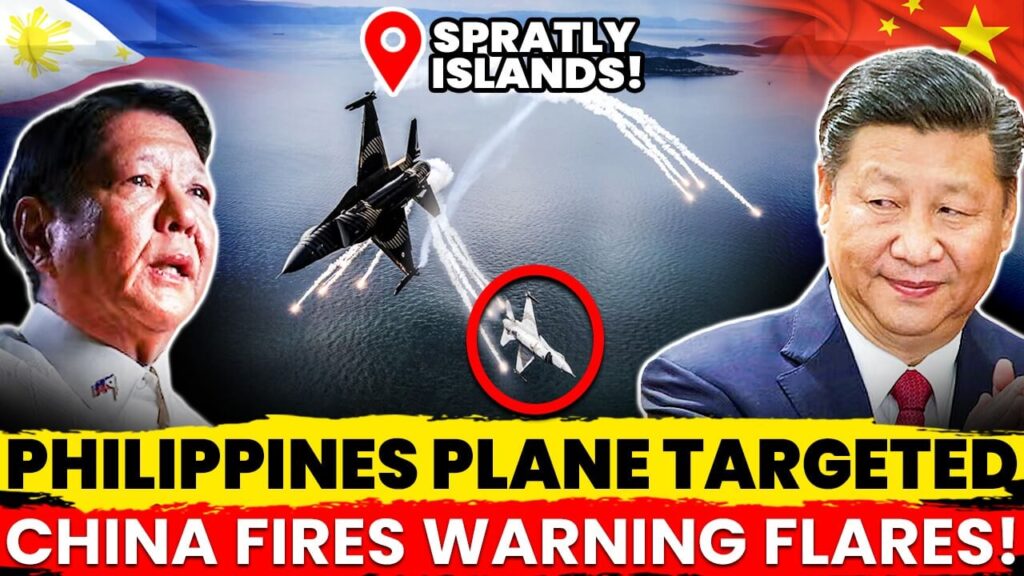
China Fires Flares at Philippines Aircraft as New EW Systems Activate in Spratlys
A Chinese vessel firing military-grade flares at a Philippine patrol plane, just hours after new PLA electronic-warfare systems were activated across the Spratlys, signals a dramatic escalation in the West Philippine Sea. This is not an isolated incident. It is the opening move in a strategy where China seeks to dominate the electromagnetic battlespace, restrict Philippine operations, and enforce control of contested airspace without firing a missile.
The new EW systems lighting up on Fiery Cross, Subi, and Mischief Reefs represent a shift toward full-spectrum warfare, a type of signal-jamming and radar interference similar to what China has used against Japan near Okinawa, Taiwan’s early-warning radars, and even U.S. military aircraft over the Pacific. Beijing is now exporting these tactics deeper into Southeast Asia.
Behind the flare attack lies a broader plan: to build an A2/AD bubble over the Spratlys, intimidate Manila into self-censorship, test U.S. treaty commitments, and reshape negotiations by demonstrating its ability to blind aircraft, disrupt communication, and seize the informational high ground. Other small states have faced similar pressure: Taiwan with radar-locks, Japan with aggressive PLA flybys, Vietnam with oil rig standoffs, but the Philippines is now the primary testing ground for China’s next wave of coercive power.
This escalation poses severe risks: accidental shootdowns, loss of GPS or cockpit visibility, jamming of PH radars, and spillover into a Taiwan crisis where China could blind Philippine surveillance to block allied movements. As joint PH–U.S.–Japan patrols increase, China’s actions grow bolder, mirroring the same pattern seen in Beijing’s clashes with Canadian and Australian aircraft in the South China Sea last year.
To respond, the Philippines must harden its aircraft, modernize airpower, build EW counter-strategies, increase joint patrol transparency, and escalate diplomatic pressure, just as Japan did after its radar-lock confrontations, and as South Korea did after repeated air-defense identification zone violations.
The flare incident and EW activation reveal a new truth: China is preparing to control the Spratlys not only with ships and island bases, but through electronic dominance, psychological intimidation, and information warfare. This is Beijing’s playbook for winning without fighting, and right now, the Philippines, like Taiwan and Japan before it, stands at the front edge of that strategy.
THE NEW ELECTRONIC WARFARE SYSTEMS — WHAT CHINA ADDED IN THE SPRATLYS
In the days surrounding the flare incident, defense analysts detected a significant uptick in electronic warfare (EW) activity emanating from major Chinese outposts in the Spratlys. Newly activated systems include advanced jamming arrays, directional interference emitters, signal-intelligence (SIGINT) receivers, and equipment believed capable of disrupting satellite uplinks. These are not defensive tools; they are the backbone of a modern electromagnetic battlespace, designed to disable, mislead, or blind adversary forces long before any physical confrontation begins.

Modern EW systems give China the ability to shut down radar networks, disrupt aircraft navigation, interfere with GPS and AIS signals, and sever communications between Philippine patrols and command centers. They can degrade or blind surveillance aircraft, drones, and maritime patrol assets by flooding their sensors with electronic noise. These systems also provide China with a continuous picture of Philippine and U.S. patrol patterns, allowing the PLA to anticipate movements, prepare intercepts, and execute coordinated coercive actions with little warning. In short, EW gives China an invisible but powerful tool to control the tempo and safety of operations in contested airspace.
Satellite and reconnaissance data indicate that these EW platforms are now active across China’s “big three” fortresses, Fiery Cross Reef, Subi Reef, and Mischief Reef. Additionally, smaller outposts appear to be integrated through networked EW nodes, forming a linked electronic shield across much of the Spratlys. This network allows China to project influence far beyond the reefs themselves, extending coverage over vital sea lanes inside the Philippine EEZ.
China’s timing is equally deliberate. The activation of these systems coincides with an increase in PH–U.S.–Japan patrols, joint surveillance flights, and trilateral exercises in the region. By supercharging its EW footprint, Beijing aims to dominate the invisible battlefield, the electromagnetic spectrum, where modern conflicts are won or lost. At the same time, it seeks to create a sensor-denial zone around its artificial islands, masking military build-ups, troop rotations, and the deployment of advanced weapons systems. This move is not merely tactical; it is strategic preparation for a future in which China controls the Spratlys not just physically, but electronically.
THE INCIDENT — WHAT EXACTLY HAPPENED IN THE AIR
The confrontation began during what Philippine defense officials described as a routine and lawful patrol inside the country’s Exclusive Economic Zone. As the Philippine aircraft flew along a pre-approved and internationally recognized route near Subi Reef, a Chinese vessel, potentially coordinated with supporting aircraft, launched multiple military-grade flares directly toward the patrol plane. Unlike earlier standoffs that relied on radio warnings, tailing, or aggressive maneuvering, this encounter involved a kinetic, high-risk action at close range, marking a dangerous escalation in China’s air behavior over the Spratlys.
Flares may appear non-lethal, but in aviation, they are anything but benign. Burning at extreme temperatures and producing intense bursts of light, they can temporarily blind pilots, overwhelm cockpit sensors, disrupt navigation equipment, and force sudden evasive action. Global aviation standards treat close-range flare deployment as hazardous because even a slight misjudgment can lead to loss of control. By firing flares at a low-speed Philippine patrol aircraft, one that posed no threat and carried no offensive capability, China demonstrated a new willingness to court accident, escalation, or miscalculation to intimidate and impose dominance over contested airspace.
The Armed Forces of the Philippines responded with urgency and precision. The crew immediately logged the encounter, and defense operators matched radar data and flight telemetry to confirm the aircraft’s legal position within Philippine territory. This rapid verification ensured that China could not distort the facts or claim a violation of its expansive and internationally rejected airspace assertions. Manila then activated diplomatic channels, filing protests and publicly exposing the incident to highlight just how dangerously China was willing to operate.
In doing so, the Philippines made clear that this was not an error, not a miscommunication, but a deliberate escalation that fits an increasingly alarming pattern of PLA actions in the air and sea. This flare attack is now recognized as one of the clearest indicators that China is testing limits, probing responses, and pushing the boundaries of acceptable behavior in an environment where a single wrong move could spark a regional crisis.
CHINA’S STRATEGIC OBJECTIVES — THE BROADER PLAN BEHIND THE ESCALATION
China’s recent actions in the Spratlys, from firing flares at a Philippine patrol plane to activating advanced EW systems, are not isolated provocations. They fit into a broader strategic blueprint aimed at reshaping the balance of power in the West Philippine Sea. At the heart of this plan is the creation of a full-spectrum A2/AD (Anti-Access/Area Denial) bubble over the Spratly Islands. By integrating long-range radar, anti-ship and surface-to-air missiles, and powerful electronic-warfare capabilities, Beijing seeks to build a zone where it can see everything, jam anything, and intimidate anyone who enters. This bubble would allow China to monitor Philippine, U.S., and allied patrols in real time, while degrading their ability to navigate, communicate, or defend themselves.
Another key objective is psychological and political pressure on Manila. By making every air patrol near China’s artificial outposts feel risky, unpredictable, or outright dangerous, Beijing aims to instill caution in Philippine pilots and create a climate where the AFP hesitates to carry out lawful missions. The goal is subtle but powerful: if routine patrols become stressful and hazardous, China can slowly normalize the idea that these waters and skies are its domain, even without achieving legal recognition. Intimidation becomes a tool for political shaping.
At the same time, China is probing the limits of the U.S.–Philippines Mutual Defense Treaty. The flare incident is an ideal test case: aggressive enough to raise alarms, but not lethal enough to trigger an automatic response. Beijing wants to observe how Washington reacts when Philippine aircraft are threatened. Will the U.S. issue warnings? Increase flights? Deploy assets? Or remain cautious? China’s silent question is pointed: If we injure or endanger PH personnel without firing a missile, will the Americans respond? The answer will shape Beijing’s future risk-taking.
Finally, these escalatory steps enhance China’s negotiating leverage in any future bilateral or multilateral talks. By demonstrating the ability to blind aircraft, disrupt communications, and escalate at will, Beijing positions itself as the dominant power in any diplomatic conversation. The message is simple: China can dictate the tempo of tension, and unless challenged by unified regional action, it can impose its preferred outcomes both at the table and on the water.
Through these coordinated moves, China is not merely reacting to Philippine or allied patrols; it is engineering a new strategic reality in the Spratlys, one where intimidation, information dominance, and calibrated risk-taking become tools of territorial control.
IMPLICATIONS FOR PHILIPPINE SECURITY — THE MOST SERIOUS RISKS
China’s flare attack and activation of electronic-warfare systems carry profound consequences for Philippine security, beginning with the direct danger posed to aircrews. Military-grade flares can temporarily blind pilots, obscure cockpit visibility, or confuse onboard sensors, risks that increase dramatically when deployed at close range. Combined with electronic jamming, which can interfere with navigation systems and force pilots to rely on degraded instruments, China’s actions create conditions where even a routine patrol flight could become hazardous or uncontrollable. In this environment, a single misjudgment or hardware malfunction could lead to a catastrophic accident.
Philippine patrol operations now enter a far more complex and uncertain phase. EW interference means aircraft may lose GPS signals, encrypted communications, or radar feeds while operating near Chinese outposts. This undermines situational awareness and creates operational blind spots at exactly the moment when China is expanding its presence. Future patrols must now prepare for contested electromagnetic conditions, which slow reaction times, complicate mission planning, and put additional stress on pilots and mission planners.
The threat extends beyond aircraft to ground-based military installations, particularly those in Palawan and the surrounding areas. China’s EW systems can disrupt radar sites, degrade naval communications, and interfere with the early-warning networks that the AFP relies on to monitor movements in the West Philippine Sea. Any degradation in this radar chain creates opportunities for Chinese vessels or aircraft to maneuver undetected, reducing the Philippines’ ability to track incursions or respond promptly to hostile actions.
The national security implications are even broader. China’s EW footprint gives it the capability to disrupt civilian and military communication lines, potentially affecting maritime safety, commercial aviation, and local communities in Western Luzon and Palawan. By degrading Philippine situational awareness across contested waters, Beijing strengthens its ability to shape events on the ground, in the air, and across the electromagnetic spectrum. In the worst case, China could use EW dominance to blind Philippine forces during a crisis while simultaneously pushing aggressive maneuvers, achieving tactical gains without firing a shot.
Collectively, these risks underscore a stark reality: the battle for control of the West Philippine Sea is no longer just about ships and aircraft; it is about the fight for information, signals, and perception. And right now, China is trying to seize that advantage.
INTERNATIONAL REACTIONS — A REGIONAL FLASHPOINT
China’s flare attack on a Philippine patrol aircraft, combined with the activation of new electronic-warfare systems, immediately drew international attention, triggering concern from allies who see the West Philippine Sea as a growing flashpoint. In Washington, officials are expected to issue a firm condemnation rooted in the U.S.–Philippines Mutual Defense Treaty, emphasizing that any armed attack on Philippine aircraft in the Pacific, including the West Philippine Sea, would invoke treaty considerations. U.S. statements typically highlight the dangerous and destabilizing nature of PLA actions, warning that such reckless conduct increases the risk of miscalculation and undermines regional stability. For Washington, this incident is more than a bilateral issue; it is another sign that Beijing is testing the limits of allied commitments.
Japan’s reaction is shaped by its own escalating tensions with China. Having recently experienced radar-lock incidents and aggressive PLA air maneuvers, Tokyo views the flare attack as part of a wider pattern of coercive behavior in Asia’s contested airspaces. As a result, Japan is likely to expand surveillance coordination and information-sharing with the Philippines, reinforcing a growing trilateral security network with the U.S. Tokyo’s strategic concern is clear: if China becomes emboldened in the West Philippine Sea, similar tactics may intensify near Okinawa, the Senkaku, and Taiwan, areas Japan is sworn to defend.
Australia, the European Union, and Southeast Asian neighbors are also paying close attention. Canberra is expected to issue statements underscoring the importance of freedom of overflight, safe aviation practices, and adherence to international law. European partners, increasingly involved in Indo-Pacific security, may also voice sharper criticism, linking the incident to a broader trend of coercion. Several states, including Australia, Japan, and possibly even South Korea, are now more willing to join multilateral patrols or joint surveillance flights with the Philippines, signaling that Chinese escalation will only strengthen cooperation among regional democracies.
China’s official position, as predictable as it is contradictory, will likely frame the incident as a “response to Philippine provocation”, denying the use of dangerous measures despite clear visual and radar evidence. Beijing claims its actions are “defensive,” even as they occur around reefs it illegally occupies and militarizes. This pattern of denial is a familiar diplomatic tactic: shift blame, muddy the narrative, and normalize behavior that violates international aviation norms while expanding de facto control over the Spratlys.
These reactions show that the flare incident is not merely a bilateral dispute; it is a regional test case for how far China is willing to push and how strongly the international community is prepared to push back.
HOW THIS FITS INTO CHINA’S LONG-TERM MILITARY BLUEPRINT
China’s flare attack and EW escalation in the Spratlys are not improvisations; they are deliberate steps within a long-term military blueprint that aims to secure sea–air dominance across the South China Sea by 2030. The PLA Navy is rapidly expanding toward a projected 450+ ships, including more aircraft carriers, amphibious assault ships, and destroyers equipped with advanced electronic-warfare suites. These platforms are designed not only to project power but to suppress the sensors and communications of any state that challenges China’s maritime claims. Controlling the skies and seas around the Spratlys is a prerequisite for the regional dominance Beijing envisions.
Another major pillar of this blueprint is preparation for a Taiwan contingency, where China expects to confront U.S. and allied forces across multiple domains, including the electromagnetic spectrum. The flare incident and new EW activations serve as real-world rehearsals: China is testing its ability to jam, blind, and intimidate allied aircraft without escalating into outright conflict. These actions fall squarely within the PLA’s gray-zone doctrine, which aims to push boundaries, normalize aggression, and shape the battlespace well before any military confrontation begins.
The Spratlys themselves are central to this long-term strategy. China has transformed its artificial islands into forward operating platforms capable of hosting fighter aircraft, bombers, missile batteries, radar systems, and electronic-warfare nodes. By hardening these bases and integrating them into a larger command network, Beijing seeks to establish a strategic foothold that can deny access to U.S. and allied forces during a crisis. In a Taiwan scenario, the Spratlys could function as staging points for amphibious units, maritime militia swarms, long-range strike operations, or logistics support, expanding China’s operational reach deep into Southeast Asia.
Viewed through this lens, the flare incident is not simply a tactical encounter. It is a small move in a much larger game, revealing how China is shaping the battlespace, rehearsing future conflicts, and laying the foundations for regional military dominance.
WHAT THE PHILIPPINES MUST DO — A STRATEGIC RESPONSE FRAMEWORK
China’s flare attack and the activation of advanced EW systems demand more than routine diplomatic protests; they require a comprehensive, multi-domain Philippine response. The first pillar of this response is strengthening air patrol safety. The AFP must equip its aircraft with hardened cockpit shielding to protect pilots from blinding light bursts, while integrating anti-jamming modules and EW-resistant navigation tools to maintain flight safety when GPS or communications are disrupted. As threats escalate, patrol missions may also need combat-ready escorts, ensuring Philippine aircraft are never left alone in contested airspace where China is increasingly aggressive.
Modernizing Philippine airpower is equally urgent. The acquisition of the KF-21 Boramae would finally give the AFP a true multirole fighter capable of deterring aggressive intercepts, while AEW&C aircraft would provide the long-range situational awareness necessary to detect and avoid hostile EW zones. Developing a fleet of UAVs and UCAVs with EW-resistant systems would further extend surveillance reach without placing pilots at risk. Airpower modernization is not symbolic; it is essential for credible deterrence and operational safety.
The Philippines must also invest in a dedicated electronic warfare counter-strategy. Passive detection stations and direction-finding arrays can help identify, map, and analyze PLA jamming patterns, allowing the AFP to adapt flight routes, mitigate interference, and expose China’s actions to global scrutiny. Partnerships with U.S. and Japanese EW specialists will be crucial, as both countries possess deep experience with PLA signal interference and advanced capabilities to counter it.
Increasing joint patrols and operational transparency is another vital step. China’s strategy thrives in ambiguity; coordinated PH–U.S.–Japan patrols, with real-time incident reporting and satellite-backed verification, deny Beijing the ability to distort facts or claim provocation. Shared flights also reinforce deterrence by demonstrating that any threat to Philippine aircraft risks involvement from multiple militaries, raising the strategic cost for China. ASEAN vs EU: Who Will Dominate the Global Economy Next?
Finally, Manila must escalate its diplomatic and legal responses. The flare incident should be documented and presented before UNCLOS bodies and international aviation organizations as evidence of unsafe and illegal behavior. The Philippines should also work through ASEAN, the Quad, and European partners to build a coordinated regional narrative that isolates China diplomatically. Strategic communication is critical: the world must see that Beijing, not Manila, is destabilizing the region through dangerous and reckless actions.
These measures form a layered Philippine response that strengthens national security, protects aircrews, enhances alliance cooperation, and raises the political and operational cost of Chinese aggression.
POSSIBLE SCENARIOS — WHERE THIS ESCALATION COULD LEAD
China’s use of flares and electronic warfare in the Spratlys is not just a snapshot in time; it opens up a range of dangerous futures. Some are accidental, some are deliberate, and one depends on whether sustained pressure can actually force Beijing to recalibrate.
Scenario 1:
Accidental Shootdown Risk: In the most immediate and chilling scenario, flares or aggressive jamming cause a Philippine aircraft to lose control. A pilot briefly blinded, a navigation system degraded at low altitude, a sudden evasive maneuver near a reef or ship, it doesn’t take much for a routine patrol to turn into a fatal crash. Beijing could then claim it was an accident or blame “unsafe PH flying,” while Manila and its allies confront the reality that a life has been lost due to reckless Chinese actions short of firing a missile.
Scenario 2:
PLA Jams PH Aircraft During a Taiwan Crisis: In a broader regional conflict, such as a Taiwan contingency, China could weaponize its Spratly-based EW systems to blind Philippine radars and aircraft just as U.S. and allied forces surge through the area. Philippine early-warning sites on Palawan and adjacent regions could suddenly lose feeds, GPS, or communications as PLA systems prioritize jamming across the Luzon–Spratlys corridor. The aim would be to keep the Philippines uncertain, reactive, and hesitant, limiting its ability to support allies or even monitor what is happening in its own EEZ.
Scenario 3:
Multilateral Patrol Confrontation: As PH–U.S.–Japan and other partners increase joint patrols, China may respond by raising the temperature even further. A confrontation could unfold where multiple allied aircraft operate in contested airspace and a PLA asset again resorts to flares, close passes, or radar-locks. One misstep, one collision risk, one misread maneuver, and the crisis stops being bilateral. Suddenly, China is facing not just the Philippines, but a coalition angered by a near-disaster or actual incident involving several flags in the same sky.
Scenario 4:
Diplomatic Breakthrough Under Pressure: There is also a less dramatic, but strategically meaningful, path. If the Philippines, backed by allies and international institutions, consistently exposes these unsafe actions, raises the diplomatic cost, and hardens its own defenses, Beijing may quietly recalibrate. Without admitting fault, China could instruct its units to limit flare use, tone down jamming near foreign aircraft, or rely more on radio warnings. This would not end coercion, but it could push China back from the brink of catastrophic miscalculation, buying time for Manila to strengthen deterrence.
CONCLUSION — THE AIRSPACE ABOVE THE SPRATLYS IS CHANGING FAST
The firing of military-grade flares at a Philippine aircraft, combined with the activation of new Chinese electronic-warfare systems, marks a clear shift from maritime harassment to air and electromagnetic coercion. This is not just another entry on a long list of incidents at sea. It is a signal.
A signal that China intends to control the Spratlys not only with ships and runways, but through information warfare, electronic dominance, and calculated intimidation from the sky down to the spectrum. The battlespace above and around these reefs is being rewired, and the Philippines is being forced to operate in an environment where every patrol risks not only confrontation but potential blindness.
How Manila responds in the coming months will determine more than the fate of individual flights. It will shape the future of air safety, regional deterrence, and Philippine sovereignty in the West Philippine Sea. If China is allowed to normalize flares and jamming as routine tools of pressure, the threshold for crisis will only drop further.
If, instead, the Philippines pairs resilience, alliance coordination, and strategic clarity, this moment of escalation could become the turning point that convinces Beijing its tactics are too costly to sustain. The airspace above the Spratlys is changing fast. The question now is whether the Philippines and its allies, change fast enough to meet it.