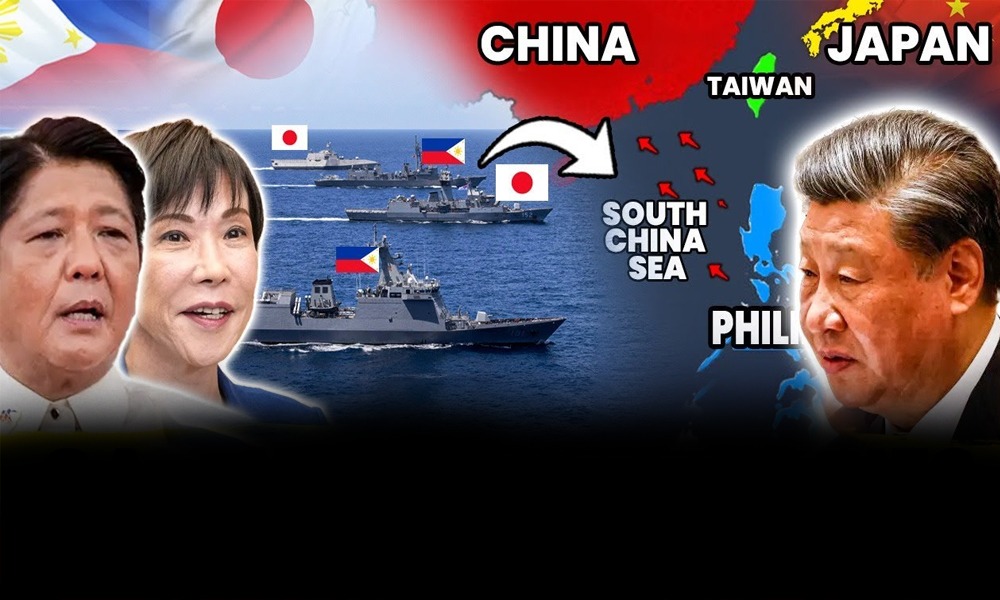
For the first time in modern Asian geopolitics, Japan and the Philippines, two U.S. allies with very different histories and defense traditions, have entered a legally binding military pact that allows their troops, ships, and aircraft to operate on each other’s soil. It is a dramatic evolution, something almost unthinkable a decade ago, yet it is now happening at speed. Japanese forces can deploy to Philippine bases, and Philippine units can train in Japan, forming a defense architecture that directly challenges Beijing’s assumptions about regional dominance. Their cooperation is accelerating, China is reacting with sharper maritime aggression, and the region is tightening around a new strategic question: can this emerging Tokyo–Manila partnership truly deter China’s expanding power?
This question matters now more than ever. Chinese coercion in the South China Sea has grown bolder, turning routine patrols into violent confrontations as Philippine vessels are struck with water cannons, rammed at close range, and jammed by electronic interference. In the East China Sea, Japanese forces are facing their own pressure around the Senkaku Islands, while Tokyo positions missiles and surveillance systems in preparation for any conflict that may spill from the Taiwan Strait. Manila has already acknowledged that it cannot remain on the sidelines if Taiwan is attacked; geography alone forces it into the center of any crisis. And as tensions mount on every front, the Philippines has shifted rapidly from decades of internal security operations to its first real external defense posture in the modern era.
Japan and the Philippines now find themselves linked not just by treaties, but by shared vulnerabilities, shared strategic fears, and an increasingly aligned sense of urgency. Their cooperation is bolstered by the United States, which sees both countries as anchors of its Indo-Pacific strategy. Joint patrols, intelligence sharing, and coordinated messaging are becoming routine. The pace of collaboration is faster than anything Asia has seen since the end of the Cold War.
Yet the core question remains unresolved: is this combined diplomatic, military, and strategic force strong enough to make Beijing hesitate? Deterrence is not about matching China vessel-for-vessel or missile-for-missile. It is about shaping China’s calculations—raising the costs, the risks, and the uncertainty of escalation. Whether Japan and the Philippines can achieve that, together and backed by the United States, will define the security landscape of the Indo-Pacific for years to come.
REGIONAL SHIFTS — WHY JAPAN & THE PHILIPPINES ARE MOVING CLOSER
The tightening partnership between Japan and the Philippines is not happening in a vacuum; it is unfolding in a region being reshaped by China’s rapid military expansion and increasingly aggressive behavior at sea. The PLA Navy has grown into the world’s largest by sheer number of ships, and Beijing is using that power not as a distant symbol but as a daily tool of coercion across the West Philippine Sea and East China Sea. Chinese Coast Guard and militia vessels have intensified their harassment of Philippine resupply missions, firing high-pressure water cannons, conducting dangerous blocking maneuvers, ramming smaller boats, and even using lasers to blind crews. Scarborough Shoal and Second Thomas Shoal have transformed into frontline arenas where China asserts control through constant presence, overwhelming numbers, and aggressive tactics meant to send one message: resistance is futile.
Japan is facing its own version of this tightening squeeze. Chinese aircraft and ships are conducting more frequent and more complex maneuvers around the Senkaku Islands, testing Japan’s air defenses and forcing its Coast Guard into near-daily scrambles. At the same time, Beijing has expanded air and naval activity around Taiwan—an island whose fate is inseparable from Japan’s own security. Every missile China fires into waters around Taiwan lands uncomfortably close to Japan’s southwest islands. Every PLA exercise rehearsing blockade scenarios threatens the sea lanes that keep Japan’s economy alive.
Both countries also face pressures that go beyond the visible confrontations at sea. Economic coercion, cyber intrusions, disinformation campaigns, and political intimidation have become part of China’s wider playbook. These pressures remind Tokyo and Manila that Beijing’s strategy is multi-layered and persistent. They also shows a deeper realization: the crises each country faces are not isolated. A clash in the West Philippine Sea is connected to tensions in the East China Sea. Aggression around Taiwan affects both nations directly. And China’s pursuit of regional dominance does not stop at maritime boundaries; it moves through trade, technology, diplomacy, and information.
This shared sense of vulnerability is what now binds Japan and the Philippines closer than ever. Both governments understand that no problem in the Indo-Pacific stays local for long. A crisis in one area ripples across the region. The security of Taiwan affects the Philippines; the defense of the Senkaku Islands affects Japan’s ability to support allies; and China’s push into the West Philippine Sea has implications that stretch from Luzon to Okinawa. In that interconnected environment, Tokyo and Manila no longer see cooperation as optional or symbolic. They see it as essential survival strategy — the only realistic way to balance China’s expanding power and safeguard their own territorial and political futures.
THE JAPAN–PHILIPPINES RECIPROCAL ACCESS AGREEMENT (RAA)
The turning point in Japan–Philippines security relations came with the signing of the Reciprocal Access Agreement, a pact finalized in July 2024 and entering into force in September 2025. For decades, the idea of Japanese troops operating on Philippine soil or Philippine forces training in Japan, was politically impossible. But the strategic environment has shifted so dramatically, and Chinese pressure has grown so intense, that both nations chose to break historical precedents in favor of hard security cooperation. The RAA formalizes what was once unimaginable: the legal ability for Japanese and Philippine forces to deploy, train, and operate inside each other’s territory, complete with simplified logistics, rapid troop movement, and shared military infrastructure.
The agreement is historic not just for Manila, but for Tokyo. This is Japan’s first-ever RAA with a Southeast Asian country, symbolizing its emergence from decades of strict postwar military restraint. It reflects a Japan that now sees regional defense as inseparable from its own national survival, and a Philippines that understands it must build a web of security partnerships stronger than any one alliance. The RAA is more than a treaty; it is a statement that the two nations have decided their defense futures are intertwined, their vulnerabilities shared, and their responses increasingly unified.
The ink had barely dried on the agreement when both sides moved to test it. In October 2025, they launched their first joint drill under the new pact, a multi-domain exercise that extended across air, sea, land, and cyber elements. It wasn’t a symbolic handshake; it was an operational stress test. Japanese Self-Defense Forces trained side-by-side with Filipino troops in amphibious operations, coastal defense, cyber resilience, and rapid disaster response. Maritime units coordinated patrols and surveillance drills across contested waters. Air assets from both countries rehearsed deployment procedures that would allow immediate mobilization if a crisis struck the region.
The message from that first drill was unmistakable: this is not a slow or cautious alignment. Tokyo and Manila intend to use the RAA immediately, extensively, and strategically. It is a partnership built with the urgency of the moment and one designed to function in the real world, not just in diplomatic announcements.
Why the U.S. Wants Taiwan to Fund Philippines EDCA Military Bases?
JAPAN’S GROWING SECURITY ROLE — A NEW PILLAR OF ASIAN DEFENSE
Japan’s security posture is transforming at a pace unseen since the end of World War II. What began as cautious rearmament has now become an assertive, forward-leaning strategy shaped by the reality that the next major flashpoint in Asia may erupt just a few hundred kilometers from Japan’s southwestern islands.
That shift became unmistakable when Defense Minister Shinjiro Koizumi traveled to Yonaguni, Japan’s westernmost island, just 110 kilometers from Taiwan, to oversee the deployment of medium-range surface-to-air missile systems. The message was clear: Japan is preparing its front line not for symbolic presence, but for real operational readiness. Tokyo insists these deployments are aimed at deterrence, not provocation, yet Beijing sees them as evidence that Japan is aligning itself fully with the U.S. strategy to contain China.
These moves extend beyond Japan’s own borders. Tokyo is strengthening Philippine maritime defense in ways that would have seemed unimaginable a decade ago. Japan has floated the offer of up to six Abukuma-class naval vessels, explored joint shipbuilding projects, expanded coast guard training, and furnished Manila with maritime radars and surveillance equipment. In the Philippine Navy and Coast Guard, Japan is becoming a central pillar of capacity-building, quietly shaping the region’s ability to resist maritime coercion.
All of this fits into Japan’s broader military transformation: the largest defense buildup since World War II, a soaring defense budget, and a tighter alignment with U.S. Indo-Pacific objectives. Tokyo is preparing for the hardest scenario imaginable, a conflict involving Taiwan, the Philippines, or Japan itself and building the capability to respond decisively.
Can Japan and the Philippines Stop China?
CHINA’S RESPONSE — ESCALATION, PRESSURE, AND SIGNALING
Beijing’s reaction to Japan’s growing regional role has been swift and severe. When Japanese officials made remarks supporting Taiwan’s security, China retaliated with broad economic punishment: halting Japanese seafood imports, issuing travel advisories, prompting nearly 500,000 flight cancellations, and allowing nationalist rhetoric to surge online. Even diplomatic officials joined in, the Chinese consul in Osaka infamously amplified veiled threats toward Japan, framing Tokyo as a direct meddler in the Taiwan question.
The Philippines has faced a different but equally hostile response. Chinese Coast Guard vessels have escalated their aggression with repeated water-cannon assaults, ramming of smaller Philippine boats, laser harassment, and constant blocking of resupply missions at Second Thomas Shoal. Chinese officials insist the Philippines is “operating in Chinese waters,” attempting to reframe Manila’s own EEZ as contested territory under Chinese authority.
Behind these visible confrontations lies Beijing’s deeper strategy: break the emerging Japan–Philippines–U.S. alignment before it solidifies. China has increased political pressure on President Marcos Jr., especially after his candid acknowledgment that a Taiwan conflict would inevitably involve the Philippines. Beijing knows that a unified front poses the greatest challenge to its long-term objectives. Fragmenting it, through coercion, intimidation, or economic leverage—is key to China’s calculus.
THE U.S. FACTOR — A TRIANGULAR ALLIANCE IS EMERGING
The Japan–Philippines partnership does not stand alone; it is anchored within a much larger U.S.-led security architecture. In November 2025, the three countries held their most significant trilateral exercise yet in the West Philippine Sea, an unmistakable demonstration of integrated maritime preparedness. Surface ships maneuvered together, aircraft coordinated patrol routes, and cyber units synchronized defenses. It was a rehearsal for the scenario everyone hopes to avoid but must realistically prepare for.
Washington has spent the last decade steadily tightening ties with both allies. Through EDCA, the U.S. has gained rotational access to key Philippine bases, many located close to Taiwan or the South China Sea. With Japan, the long-standing security treaty remains the cornerstone of East Asian defense. Quietly, the U.S. also encouraged the Japan–Philippines RAA, knowing that a stronger link between its two closest Indo-Pacific partners strengthens the first island chain from both ends.
From Beijing’s perspective, all of this looks like encirclement. It sees a hardening line of deterrence stretching from Japan’s Nansei Islands to Luzon, reinforced by the U.S.–Japan alliance and Washington’s renewed military presence in the Philippines. To China, this is not coincidence, it is a coordinated architecture designed to contain its rise.
Can the Philippines Be the World’s Next Big Tech Hub?
THE PHILIPPINES’ CALCULATIONS & THE RISKS IT FACES
President Marcos Jr. has already stated what previous administrations hesitated to admit: a Taiwan conflict will inevitably involve the Philippines. Geography alone ensures this, Philippine airspace, sea lanes, and bases sit along the primary routes for any response. The presence of more than 160,000 Filipino workers in Taiwan adds another layer of unavoidable obligation.
Yet Manila faces internal pressures. Many Filipinos see the South China Sea, not Taiwan, as the primary national security concern. Others worry about sovereignty questions raised by foreign troop presence under EDCA and the RAA. There is also the uncertain question of obligations: what exactly must Manila do if Japan or the U.S. requests support during a Taiwan contingency?
Despite these concerns, the strategic benefit is undeniable. Japan bolsters the Philippines’ naval strength, provides advanced technology, and supports its modernization drive. For the first time, Manila has partners willing to help it push back against maritime coercion, not just with words, but with ships, radars, and joint operations.
CAN JAPAN & THE PHILIPPINES DETER CHINA? THE CORE ANALYSIS
Deterrence in Asia is no longer about matching China platform for platform. It is about shaping Beijing’s perception of cost and risk. And in this regard, Japan and the Philippines possess complementary advantages that matter more collectively than separately. Japan brings advanced naval and air power, cutting-edge missile systems, and world-class surveillance capabilities. The Philippines brings geography, the chokepoints, airspace, and sea corridors that shape China’s ability to project force. Together, backed by the United States, they form a multi-directional deterrent that complicates China’s planning. The RAA further strengthens this by enabling rapid deployment of Japanese forces into Philippine territory during a crisis. But limitations remain. Japan’s constitution still imposes constraints. The Philippines faces capability gaps. China maintains overwhelming military superiority. And deterrence, by its nature, always carries the risk of provoking further pressure. The real key is the triangular structure: Japan + Philippines + United States. When these three act in alignment, the deterrent effect multiplies. Add Australia, and the geometry becomes even harder for China to ignore.
The Philippines: Southeast Asia’s Hidden Economic Giant Set to Soar by 2039!
FUTURE TRAJECTORY — WHAT COMES NEXT
Joint exercises between Japan and the Philippines are set to become routine, expanding into air and missile defense coordination, anti-submarine warfare, and cyber operations. Japan is positioning itself as the Philippines’ most consistent defense partner in Southeast Asia, exploring arms exports, technology transfers, and deeper coast guard cooperation. Manila’s modernization, long stalled by bureaucracy and budget constraints, is finally accelerating with Japanese support.
What is emerging is a new Indo-Pacific security architecture, one where the Philippines is no longer a weak link but a central hub.
CONCLUSION — SO, CAN THEY DETER CHINA?
Japan and the Philippines cannot match China’s military power on their own. But deterrence does not hinge on matching strength, it hinges on altering the opponent’s calculations. Together, and reinforced by the United States, Tokyo and Manila form a fast-emerging deterrent triangle. Alone, neither can stop China. Together, with overlapping alliances, shared deployments, rapid access agreements, and coordinated exercises, they can raise the cost of aggression, slow Beijing’s advances, and reshape the balance of power in the Indo-Pacific. This alliance will not end China’s ambitions. But it can make those ambitions far more difficult and far more dangerous, for Beijing to pursue.