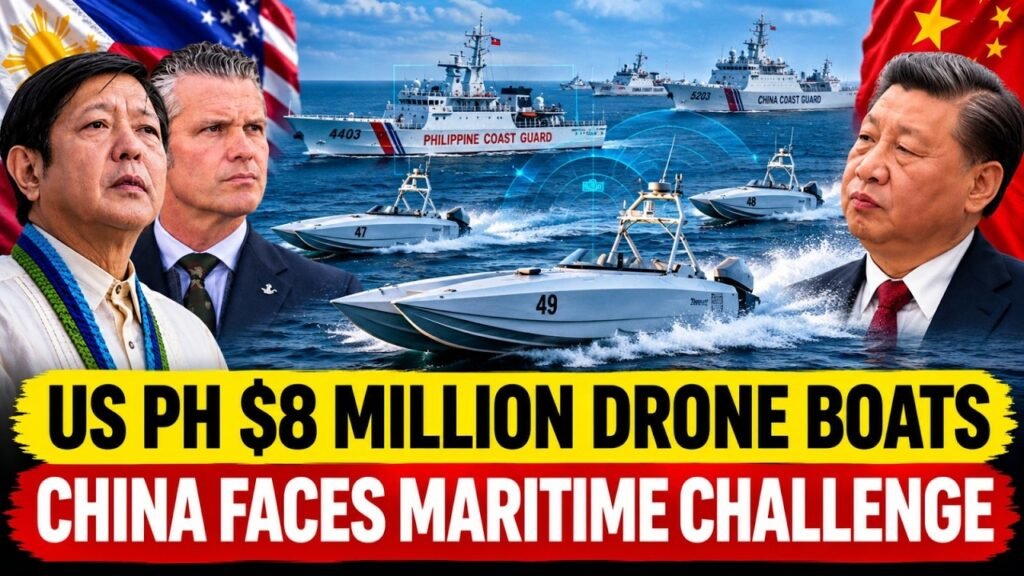
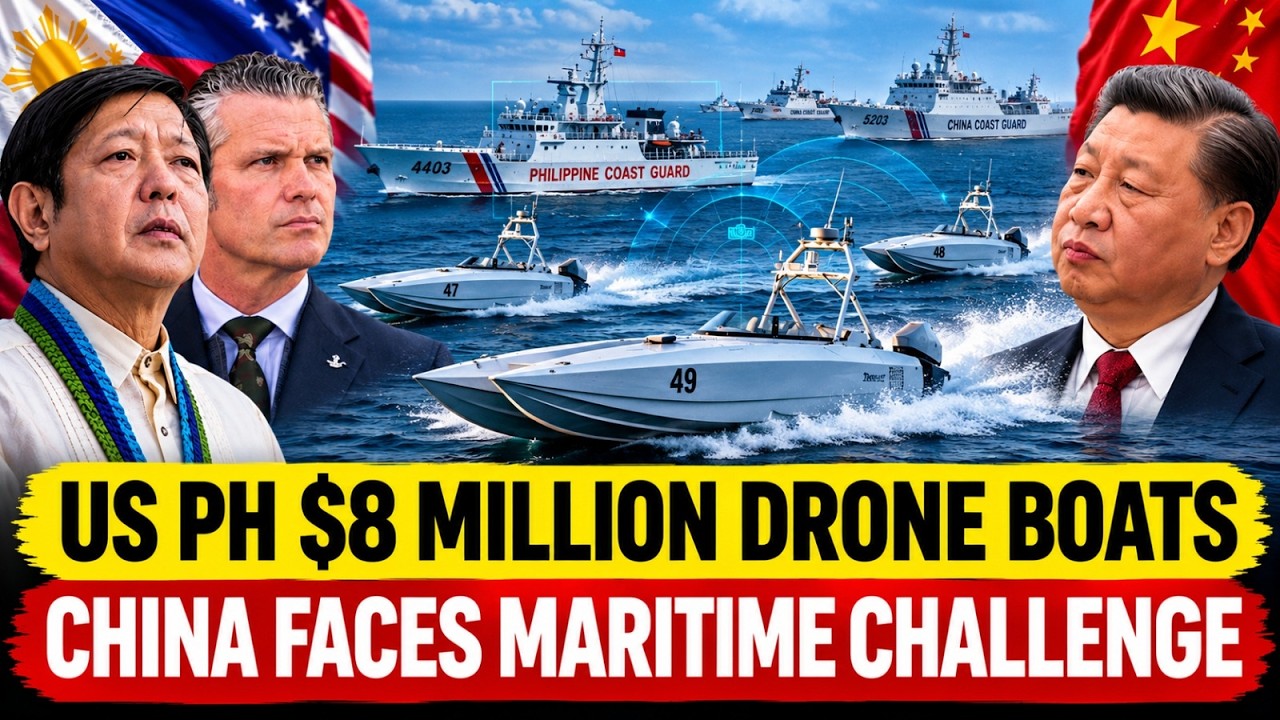
US Gives Philippines $8 Million Drone Boats — China Faces a New Maritime Challenge
The balance of maritime power in the Indo-Pacific is becoming increasingly dependent on advanced technology, surveillance capabilities, and the ability to monitor strategic waterways. In this changing security environment, the United States has taken another important step to strengthen the Philippines’ maritime defense capabilities by transferring two advanced unmanned surface vessels worth more than $8 million. The development raises an important question: can relatively small, unmanned boats help the Philippines challenge China’s growing maritime influence in the South China Sea? On November 4, 2026, the United States formally transferred two Devil Ray T38 unmanned surface vessels to the Philippine Marine Corps during a handover ceremony at Subic Bay. US Ambassador Lee Lipton presented the vessels to Philippine Marine Corps Deputy Commandant Brigadier General Bayani Curaming. Although the delivery involves only two boats, its strategic importance extends beyond the number of platforms involved.
The Philippines faces a difficult security situation because it cannot compete with China’s military strength by simply building a navy of comparable size. China possesses a much larger fleet, extensive coast guard capabilities, and significant resources for maintaining its presence across disputed maritime areas. Manila, therefore, needs alternative ways to improve its defense capabilities without depending entirely on expensive conventional warships. Unmanned maritime systems offer one possible solution by allowing military personnel to monitor important waterways, gather information, and support maritime operations without placing a crew aboard every vessel.
The American transfer is particularly important because it supports the Philippines’ growing interest in modern surveillance technology and autonomous maritime operations. Instead of relying exclusively on traditional patrol ships, the country is gradually exploring a more flexible defense structure that combines unmanned vessels, aircraft, coastal surveillance systems, intelligence networks, and conventional naval platforms. The real question is not whether two drone boats can defeat China’s powerful navy, but whether they can help the Philippines become more aware of maritime activity and better prepared to protect its national interests.
What Are the Devil Ray T38 Drone Boats Given to the Philippines?
The Devil Ray T38 is an advanced unmanned surface vessel manufactured by Florida-based Maritime Tactical Systems, commonly known as MARTAC. Unlike traditional naval patrol boats, these vessels are designed to operate without a crew physically onboard. They can be controlled remotely by operators and also have autonomous operating capabilities, allowing them to perform selected missions with reduced direct human involvement. Their design makes them particularly useful for maritime surveillance, reconnaissance, and other operations where collecting information is more important than carrying a large crew. The T38 features a catamaran-style design, approximately 12.2 metres in length, with an inboard diesel engine. Published specifications describe a maximum payload capacity of approximately 1,814 kilograms and burst speeds exceeding 50 knots. These characteristics provide the platform with the ability to carry different types of mission equipment while maintaining the speed and flexibility needed for maritime operations. Its communication options include line-of-sight and satellite-based systems, allowing operators to control the vessel and receive information depending on operational requirements.
One of the most important advantages of the Devil Ray T38 is its ability to support different missions through interchangeable equipment and configurations. Depending on the systems installed, it can be used for intelligence gathering, surveillance, reconnaissance, maritime monitoring, and the integration of electronic warfare or mine-countermeasure equipment. It may also support logistical transportation and the deployment of smaller unmanned systems. This flexibility makes the vessel useful for a country such as the Philippines, which needs to monitor large maritime areas with limited resources. However, it is important to understand that an unmanned surface vessel is not the same as an underwater submarine or an automatically armed attack boat. The November 2026 transfer does not establish that the two Philippine vessels are equipped with weapons. Their actual operational role will depend on their configuration, installed equipment, assigned missions, and the rules governing their use. Their primary significance lies in their ability to provide additional maritime awareness and support Philippine military operations without requiring sailors to remain physically onboard during every mission.
Philippines Needs Advanced Maritime Surveillance Technology
The Philippines has one of the most challenging maritime security environments in Southeast Asia. As an archipelagic country consisting of thousands of islands, it has extensive coastlines and maritime interests spread across a vast geographical area. Monitoring these waters requires significant naval resources, continuous surveillance, and effective coordination between different security agencies. Even a modern navy cannot maintain a permanent crewed presence in every important maritime location. China’s growing maritime presence makes this challenge even more complicated. Its capabilities extend beyond the conventional navy and include a large coast guard and maritime militia presence. These different maritime forces operate across the South China Sea, creating a complex environment in which Philippine authorities must constantly identify vessels, monitor movements, and understand changing situations. For Manila, maintaining an accurate picture of maritime activity is essential to protecting its maritime interests and responding to potential security incidents.
The third challenge is financial and logistical. Maintaining a large conventional fleet requires substantial spending on ships, personnel, fuel, repairs, training, and infrastructure. For a country that needs to protect a large maritime area, investing exclusively in expensive warships may not be the most practical approach. Unmanned systems can offer another way to distribute surveillance capabilities, although they are not inexpensive or maintenance-free. Their long-term effectiveness depends on trained operators, spare parts, software support, reliable communications, and proper technical infrastructure. The Philippines does not need to replace its conventional navy with drone boats. Instead, it needs to develop a balanced maritime defense system in which different platforms perform different responsibilities. Conventional warships can provide presence and operational support, patrol aircraft can monitor large areas, coastal sensors can track maritime movements, and unmanned vessels can contribute additional surveillance information. When these capabilities work together, they can help Philippine authorities make better-informed decisions.
Why Subic Bay Is Strategically Important for the New Drone Boat Programme
The selection of Subic Bay for the handover of the two Devil Ray T38 vessels is strategically significant. Located in the Philippines, Subic Bay has a long history of military and maritime importance. It previously served as one of the largest American naval facilities outside the United States and continues to play an important role in the country’s commercial, logistical, and maritime activities. Its location and existing infrastructure make it a useful site for developing new maritime technologies and supporting defense cooperation between Washington and Manila. The transfer also coincided with the opening of MARTAC’s Unmanned Center of Excellence at Subic Bay. The facility is intended to support the operation and maintenance of unmanned maritime systems, provide technical assistance, train Philippine personnel, and improve access to spare parts. This development could become an important part of the Philippines’ long-term efforts to build its own expertise in autonomous maritime technology.
The importance of this center goes beyond the physical delivery of two vessels. Advanced military equipment does not automatically become an effective defense capability simply because it has been transferred to a country’s armed forces. Operators must understand how to use the systems, maintenance teams must be able to identify technical problems, and spare parts must remain available when equipment requires repairs. Without these essential support arrangements, even sophisticated technology can become difficult to operate consistently. Developing local technical expertise could help the Philippines reduce its dependence on external assistance over time. Philippine personnel who receive proper training may gradually develop the ability to maintain, operate, and support unmanned vessels independently. This would be particularly important if Manila decides to expand its unmanned maritime fleet in the coming years. A local support facility could also create opportunities for technical cooperation, employment, and the development of a broader defense technology ecosystem. The long-term success of the Subic Bay center will depend on how effectively it supports Philippine military requirements. If the facility becomes a reliable source of training, maintenance, and technical knowledge, its contribution could extend well beyond the initial two-vessel transfer. In that sense, the development of local infrastructure may prove just as important as acquiring the vessels themselves.
US and Philippines to Strengthen Coastal Defence Capabilities in Palawan to Deter China!
Philippines Is Building a Larger Fleet of Unmanned Maritime
The two newly transferred Devil Ray T38 vessels are not the first unmanned maritime platforms received by the Philippines. Manila has already taken steps toward incorporating autonomous systems into its naval operations, indicating that the November 2026 transfer is part of a wider modernization effort rather than an isolated development. In mid-2024, the Philippine Navy received one Devil Ray T38 and four MANTAS T12 unmanned surface vessels. This delivery provided an initial foundation for Philippine unmanned surface operations and helped introduce the military to the practical requirements of operating autonomous maritime platforms. The experience gained through these earlier systems could support future efforts to expand and improve the country’s unmanned maritime capabilities
The broader objective could eventually involve combining surface vessels, underwater-capable systems, surveillance aircraft, coastal radar, communication networks, and conventional naval ships into a connected maritime monitoring structure. Such an approach would allow Philippine authorities to collect information from different sources and develop a more complete understanding of activity across strategically important waters. There is also a separate development involving future American assistance. USNI News reported in June 2026 that Washington’s asymmetric capabilities programme envisioned transferring lethal drone capabilities to the Philippines by 2027. However, this reported future plan should not be confused with the November handover. The two Devil Ray T38 vessels should not automatically be described as armed platforms, and a proposed future capability should not be presented as equipment that has already been delivered. The important point is that the Philippines is gradually incorporating unmanned technology into its defense planning. The success of this approach will depend on whether Manila can move beyond acquiring individual platforms and develop an integrated system that connects surveillance, communication, intelligence, and military decision-making.
Strengthening the Philippines’ Maritime Defense Capabilities
The transfer of two advanced unmanned vessels reflects the wider American strategy of strengthening security partnerships across the Indo-Pacific. Washington increasingly recognizes that regional stability cannot depend entirely on the direct deployment of American military forces. Stronger regional partners can improve their own defense capabilities, monitor important waterways, and contribute to a more balanced regional security environment. The Philippines occupies a strategically important position in the western Pacific. Its geographical location places it near several important maritime routes and contested areas in the South China Sea. It is also a longstanding American treaty ally, with a defense relationship supported by the Mutual Defense Treaty, military exercises, training programmes, and security cooperation. Strengthening Philippine maritime capabilities therefore serves both countries’ security interests.
From Washington’s perspective, unmanned vessels offer an opportunity to support an asymmetric defense strategy. Instead of helping the Philippines compete with China by matching every conventional warship with another warship, the United States can support alternative technologies that improve surveillance, reconnaissance, and operational flexibility. These systems may help Manila monitor maritime activity more effectively without requiring the same financial investment associated with building a much larger conventional fleet. The approach also reflects a broader shift in modern military planning. Defense capabilities are increasingly built around networks of sensors, unmanned systems, communication technologies, intelligence platforms, and conventional forces. A relatively small platform can become strategically useful when its information is shared with other military systems and used to support operational decisions.
However, the transfer should be understood within its actual limits. It does not establish a new American military base in the Philippines, automatically change the legal status of disputed maritime territories, or create an automatic military response against China. Its importance lies in improving the Philippines’ potential ability to monitor its maritime surroundings and strengthening the defense partnership between Manila and Washington. For the United States, a more capable Philippine military could contribute to regional security and improve the ability of an important treaty ally to protect its own maritime interests. For the Philippines, access to American technology, training, and technical support offers another opportunity to modernize its defense structure while developing capabilities suited to its geographical and financial realities.
Can Philippine Drone Boats Challenge China’s Maritime Dominance
China’s maritime advantage in the South China Sea is based on more than the size of its conventional navy. Its coast guard, maritime militia, surveillance systems, and extensive maritime infrastructure also contribute to its regional presence. This creates a difficult environment for the Philippines, which must monitor different types of vessels and respond to changing situations across a large maritime area. The introduction of unmanned surface vessels could help Manila improve its ability to observe and document maritime activity. A drone boat operating in a selected area may collect information that can be shared with Philippine naval units, surveillance aircraft, coastal monitoring systems, and command centers. When information from different platforms is combined, authorities can develop a clearer understanding of what is happening at sea. One important advantage of unmanned surveillance is that it can reduce the need to place personnel aboard every monitoring platform. In sensitive maritime situations, this may provide Philippine authorities with an additional option for gathering information while limiting the direct exposure of sailors. However, unmanned vessels are not immune to danger. They can still be detected, intercepted, damaged, disrupted, or lost during operations. The potential deterrence value of these platforms also deserves attention. Deterrence is not based exclusively on possessing more weapons or larger warships. It can also depend on the ability to observe developments, understand an opponent’s activities, and communicate reliable information to decision-makers. A country that has a better understanding of its maritime environment may be in a stronger position to assess incidents and respond appropriately.
Challenges That Could Limit the Effectiveness of Philippine Drone Boats
Despite their technological advantages, unmanned surface vessels are not a complete solution to the Philippines’ maritime security problems. There is a considerable difference between receiving advanced military equipment and developing a reliable operational capability. The two Devil Ray T38 vessels represent a useful addition to the country’s defense inventory, but their actual contribution will depend on how effectively they are operated and supported. The first major limitation is the small number of platforms. Two vessels cannot provide continuous surveillance across the entire South China Sea or cover every important maritime approach around the Philippines. Their usefulness will depend on where they are deployed, how long they can remain operational, and whether they are coordinated with other military assets. They may improve monitoring in selected areas, but they cannot eliminate the broader surveillance challenges faced by Manila. The second challenge involves communication systems. Unmanned vessels require reliable links between the platform and its operators. Line-of-sight communication has geographical limitations, while satellite-based communication requires appropriate infrastructure and dependable connectivity. Electronic interference, signal disruption, and cybersecurity threats could create difficulties during operations. Autonomous functions may allow vessels to continue selected activities when communication is interrupted, but secure command arrangements will remain essential. The third challenge is the difference between identifying a vessel and deciding how to respond to it. A drone boat may detect an unfamiliar ship or record unusual maritime activity, but the information must be analyzed before authorities can determine what is happening. Philippine officials must assess the situation, establish whether the activity violates applicable laws or creates a security threat, and decide which agency should take responsibility for responding. Technology can improve information collection, but it cannot replace sound judgment and effective decision-making.
Another important issue is the integration of different systems. The Philippines may acquire more unmanned vessels, surveillance aircraft, coastal sensors, and other advanced platforms, but these systems must be able to exchange useful information. If different military services operate separate networks that cannot communicate effectively, the country may struggle to develop a complete maritime picture. Integration between the Philippine Navy, Marine Corps, coast guard, and relevant command centers will therefore be essential. Maintenance and training will also influence the programme’s long-term success. Unmanned vessels require technical expertise, software updates, spare parts, regular inspections, and trained personnel. The Philippines must develop a sustainable support structure so that its systems remain operational after the initial delivery and training period. Without these arrangements, the benefits of advanced technology could be significantly reduced. Ultimately, the biggest challenge is not simply acquiring more drone boats. It is developing the technical, organizational, and operational capabilities needed to use them effectively. The Philippines must ensure that its unmanned platforms become connected elements of a wider maritime security network rather than isolated pieces of military equipment.
What Could Be the Next Step in the Philippines’ Maritime
The latest transfer could become part of a larger Philippine effort to modernize maritime surveillance and strengthen its defense capabilities. In the coming years, Manila may explore using different autonomous platforms across strategically important maritime approaches, including the West Philippine Sea and the Luzon Strait. However, the deployment of the two newly transferred vessels in these specific areas should not be assumed. Their actual locations and missions will depend on Philippine military planning and operational requirements. The development of unmanned maritime technology is also taking place alongside conventional defense modernization. The Philippines continues to focus on strengthening its naval capabilities, improving coastal defense, upgrading military infrastructure, and expanding international security partnerships. These efforts are important because autonomous systems cannot perform every mission required to protect a country’s maritime interests.
Conventional warships remain necessary for maintaining naval presence, supporting maritime operations, and responding to security incidents. Coast guard vessels are important for law enforcement and maritime safety, while patrol aircraft can cover large areas and provide additional information. Unmanned surface and underwater systems can complement these platforms by collecting information and supporting selected missions. The next stage will require greater investment in training, communication infrastructure, maintenance facilities, and data-sharing arrangements. Philippine personnel must be able to operate different systems, understand the information they collect, and communicate it to the authorities responsible for making decisions. The ability to connect these capabilities may ultimately prove more important than simply increasing the number of unmanned vessels. The Philippines will also need to maintain a realistic approach toward its defense priorities. Autonomous systems can provide useful advantages, but they should form part of a balanced modernization strategy rather than become a substitute for conventional naval and coast guard capabilities. The objective should be to create a flexible maritime defense structure that uses available resources efficiently while improving the country’s ability to monitor and protect its maritime interests.
What the $8 Million US Drone Boat Transfer Means for China
The transfer of two Devil Ray T38 unmanned surface vessels may appear relatively small compared with the scale of military competition between the United States and China. However, the development reflects an important change in how countries are approaching maritime security in the Indo-Pacific. Modern defense planning is increasingly focused on combining traditional military platforms with autonomous technology, surveillance networks, and information-sharing systems. For China, the development indicates that the Philippines is looking beyond conventional naval modernization to improve its maritime monitoring capabilities. Manila understands that it cannot match China’s military resources directly, but it can explore technologies that help reduce surveillance gaps and improve operational awareness. This does not mean that the Philippines has suddenly gained the ability to challenge the Chinese Navy on equal terms. It means that the country is developing additional tools to protect its interests.
However, technological progress must be accompanied by responsible military planning and effective communication. The introduction of more autonomous platforms into contested maritime environments could create additional operational complexity. Clear procedures, reliable command arrangements, and appropriate safeguards will be necessary to reduce misunderstandings and prevent unnecessary escalation. The long-term impact of the American transfer will therefore depend on how the Philippines uses the technology and whether it can develop a sustainable maritime surveillance system. The two boats alone will not transform the regional balance of power, but they represent another step in the country’s effort to strengthen its maritime defense capabilities.
Conclusion: Two Drone Boats, but a Much Bigger Strategic Message
The American transfer of two Devil Ray T38 unmanned surface vessels, valued at more than $8 million, is an important development in the modernization of Philippine maritime defense. Although the delivery does not fundamentally change the military balance in the South China Sea, it demonstrates the growing importance of autonomous technology in regional security planning. For the Philippines, these platforms offer another way to improve maritime surveillance, collect information, and support operations without placing personnel aboard every monitoring vessel. The development also reflects a wider shift in the defense relationship between the United States and the Philippines. Beyond traditional military assistance, cooperation is increasingly extending into autonomous systems, technical training, maintenance infrastructure, and emerging defense technologies. The opening of MARTAC’s Unmanned Center of Excellence at Subic Bay could be particularly important if it helps Philippine personnel develop the expertise needed to operate and maintain these systems independently.
However, the real test will begin after the delivery. The Philippines must ensure that its unmanned vessels are properly maintained, connected to reliable communication networks, and integrated with existing naval and surveillance capabilities. Without effective training, technical support, and coordination, even advanced equipment may have limited operational value. China’s maritime strength remains considerably greater, and two unmanned boats cannot independently change that reality. But the Philippines is gradually exploring a different approach to maritime defense, one based on better surveillance, distributed capabilities, and the effective use of modern technology. The objective is not simply to acquire more vessels, but to develop a stronger understanding of what is happening across its maritime environment. Ultimately, the significance of the $8 million transfer lies in the strategic direction it represents. The future of maritime security will increasingly depend on how effectively countries combine conventional warships, autonomous platforms, aircraft, sensors, and intelligence networks. The Philippines has taken another step toward that model. Whether these two Devil Ray T38 vessels become a meaningful part of its national maritime defense system will depend on what Manila does next.
About Indo-Pacific Report
For more geopolitical analysis, strategy coverage, and Indo-Pacific security reporting, visit Indo-Pacific Report:
Website
Facebook
YouTube