Philippines’ New Port Deal With Belgium — What It Means for China
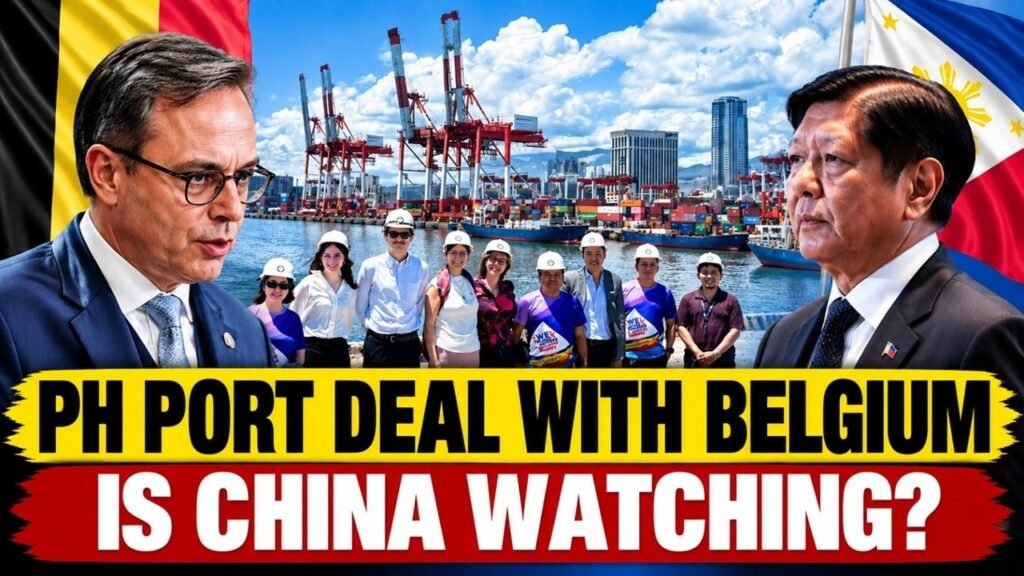
The Philippines is entering a new stage of port modernization, and Belgium is becoming part of that process in a way that goes beyond the construction of new terminals and berths. On September 21, 2026, the Philippine Ports Authority (PPA) and Port of Antwerp-Bruges International (PoABI) signed a five-year Memorandum of Understanding covering cooperation in port development and management. The agreement brings together two very different maritime systems, but the objective is practical: to exchange knowledge and experience that can help Philippine ports become more efficient, better coordinated, safer, more sustainable and more prepared for future investment. The areas covered by the agreement include port operations, planning and optimization, digitalization, smart-port applications, sustainability, safety, risk management, service quality, governance, capacity building, crisis and emergency response, cruise-port development, public-private partnership readiness and potential investment opportunities.
The agreement is important because the Philippines does not simply need more ports. It needs ports that can handle increasing cargo and passenger activity more efficiently. The country is an archipelago of more than 7,600 islands, which makes maritime transportation essential for domestic connectivity as well as international trade. Ports connect agricultural producers with markets, manufacturers with suppliers, businesses with customers and islands with one another. They also provide the physical infrastructure through which imports and exports enter and leave the country. When a port operates efficiently, the benefits can reach far beyond the terminal itself. When congestion, delays or poor coordination occur, the effects can spread into trucking, warehousing, manufacturing, retail and other parts of the economy.
That is why the Belgian partnership should not be understood simply as another foreign infrastructure announcement. The immediate agreement does not announce the construction of a new Belgian-built mega-port in the Philippines, and it does not by itself represent a specific multibillion-dollar financing commitment. Instead, it creates a five-year framework for cooperation. Belgium is potentially bringing something that is less visible than a crane or a new berth but can be equally important over the long term: experience in how a complex port ecosystem is planned, operated, digitized, coordinated and managed. The distinction matters because infrastructure and management are closely connected. A new terminal can increase physical capacity, but poor scheduling can still create delays. A larger berth can accommodate more vessels, but fragmented information can still prevent efficient operations. A modern passenger facility can increase capacity, but weak coordination can reduce its benefits. The real objective of port modernization is therefore not simply to build more infrastructure. It is to make infrastructure work better.
Philippine Ports Are Handling More Cargo, More Containers
The scale of the Philippine maritime system explains why the country is looking beyond physical expansion. According to Philippine Ports Authority figures, total cargo throughput reached 308.5 million metric tons in 2025, an increase of 6.6 percent compared with the previous year. Foreign cargo accounted for 194.41 million metric tons, while domestic cargo reached 114.09 million metric tons. Container traffic surpassed 8 million TEUs, while vessel calls reached 664,817. RoRo traffic reached 12.81 million vehicles, representing an increase of 13.3 percent from 2024. These figures provide a clear picture of the pressure being placed on the country’s port infrastructure and operating systems.
Every increase in cargo creates additional requirements. More containers require additional handling capacity, storage, tracking and transportation. More vessels require more accurate berth scheduling and stronger coordination between ports, shipping lines and terminal operators. More RoRo vehicles create additional demand for vehicle processing, passenger movement and road connectivity. Higher passenger volumes require terminals that can manage larger numbers of travelers during peak periods. At the same time, government agencies must coordinate regulatory, security and operational functions without creating unnecessary delays.
This is why simply building more infrastructure cannot solve every port problem. A port may have enough physical space but still experience congestion because trucks arrive at the wrong times. A terminal may have modern equipment but still perform inefficiently because cargo information is not available quickly enough. A berth may be physically capable of handling large vessels but remain underutilized because scheduling systems are not properly integrated. Modern port management is therefore increasingly focused on maximizing the productivity of infrastructure that already exists while building new capacity where it is genuinely required.
The Philippine challenge is also different from that of countries that can concentrate their maritime traffic around one or two major gateways. The Philippines has a large number of ports serving different regions and different types of traffic. Some facilities handle international containers, others focus heavily on domestic cargo, passengers, RoRo services, tourism, agricultural products or regional trade. This means modernization cannot follow a single formula. Authorities have to determine what each port needs while also understanding how that port fits into the wider national network.
This is one of the areas where international port-management experience can become useful. Rather than simply asking where the next terminal should be constructed, planners can examine how cargo flows through the network, where bottlenecks occur, how different facilities complement one another and which investments can produce the greatest operational improvement. The objective is not necessarily to make every port large. It is to make the overall network more capable.
Why Port of Antwerp-Bruges Is the Partner
Port of Antwerp-Bruges is relevant to the Philippines because of the scale and complexity of the system it operates. The port recorded 266.5 million tonnes of maritime throughput in 2025 and handled more than 13.5 million TEUs of container traffic. It is also a major industrial and logistics ecosystem, with more than 1,400 companies and extensive activity involving containers, general cargo, vehicles, energy and industry. These figures do not mean the Philippines should attempt to copy Antwerp’s infrastructure. The more important lesson is the experience of managing a large and interconnected maritime system. A major international port is an ecosystem rather than simply a collection of berths. Ships have to arrive safely and according to schedule. Terminals need to coordinate with shipping lines. Cargo has to be processed and transferred efficiently. Logistics companies need accurate information. Government agencies need to coordinate inspections, security and regulatory functions. Infrastructure must be maintained. Emergencies have to be managed. Industrial companies depend on reliable access to maritime services. Digital systems need to connect different parts of the operation.
The September 2026 MOU is focused on many of these same areas. It includes port operations, planning and optimization, port and terminal performance, digitalization, smart-port applications, safety and operational risk management, sustainability, green-port operations, service quality, governance and crisis response. It also includes PPP operational readiness and the exploration of potential investment opportunities. This means the cooperation is broad enough to cover both day-to-day port management and longer-term development strategy.
Port of Antwerp-Bruges International can potentially contribute through technical exchanges, advisory services, training, strategic planning and knowledge transfer. The organization has experience working with ports and terminals beyond Belgium, giving it a role that extends beyond operating a single European port. For the Philippines, this creates an opportunity to learn from international practices while adapting them to local conditions.
The word “adapt” is important. Philippine ports operate under different geographical, regulatory and commercial circumstances. The country has an archipelagic structure, different cargo patterns and a large domestic shipping network. It would not make sense to copy every aspect of a European port. What can be valuable is identifying principles that improve planning, information management, operational efficiency, safety, sustainability and investment preparation.
That is also why the September MOU should not be described as a guaranteed investment package. It establishes a framework for cooperation. Specific infrastructure projects, financing arrangements or investments would require separate decisions, feasibility work, approvals and agreements. The immediate contribution is therefore primarily about expertise and institutional capacity rather than a confirmed Belgian construction program.
Digitalization Could Be One of the Biggest Changes
One of the most significant parts of the agreement is its focus on digitalization and smart-port applications. Modern ports increasingly depend on real-time information because physical infrastructure only delivers its full value when operators know how to use it efficiently. A vessel’s expected arrival time affects berth allocation. Cargo information affects terminal planning. Truck schedules affect gate congestion. Passenger information affects terminal management. Weather data can affect vessel movements and emergency planning. When information is fragmented, delays can occur even when physical capacity is available. Smart-port systems attempt to solve some of these problems by improving how information is collected, shared and used. Real-time information can allow port managers to see where congestion is developing. Better scheduling can help coordinate vessels, trucks and terminals. Digital cargo tracking can improve visibility for businesses. Integrated systems can reduce duplication between agencies. Data can also help authorities understand long-term trends and make better infrastructure decisions.
For the Philippines, this could be especially important because port activity is distributed across a large geographical area. A digitalized system can potentially give authorities a more complete picture of what is happening across multiple facilities. Instead of relying only on individual reports, decision-makers can increasingly use data to identify bottlenecks, compare performance and plan responses.
However, digitalization is not simply about buying software. A smart port requires compatible systems, reliable data, trained personnel, cybersecurity protections and clear institutional responsibilities. Government agencies and private operators must be able to exchange information and use it in their daily decisions. If technology is installed without changing outdated processes, the expected benefits may not materialize. That is why Belgian experience could be useful. Port digitalization involves years of operational learning. The important questions are not only which technology to install but also how information should move between organizations, how managers should use it, how performance should be measured and how digital systems should support physical infrastructure. The next generation of Philippine port modernization may therefore involve two kinds of investment at the same time. One is physical: terminals, berths, dredging, equipment and roads. The other is digital: information platforms, monitoring systems, data integration and smart-port applications. The combination could help Philippine ports make better use of existing infrastructure while also preparing for future capacity.
Green Ports and Offshore Wind Could Create New Opportunities
Sustainability is another major component of the Belgium-Philippines partnership. The MOU includes green-port operations and sustainability, connecting the agreement to a wider global shift toward cleaner and more resilient maritime infrastructure. For Philippine ports, this can involve energy efficiency, cleaner equipment, renewable energy, environmental management, resilience planning and other measures that reduce the environmental impact of port activity. But the connection becomes even more interesting when offshore wind is considered. During Belgium’s March 10–18, 2026 port mission to the Philippines, Belgian officials highlighted offshore wind as an area where Belgian experience could be useful. Belgium has developed expertise in maritime logistics, industrial port operations and offshore energy, while the Philippines has substantial ambitions for offshore wind development. Offshore wind requires ports capable of handling very large components and specialized maritime equipment. Turbine components have to be transported, stored and assembled. Construction vessels require suitable access and support facilities. Maintenance activities need reliable ports. Industrial suppliers need logistics connections. This means the port itself becomes part of the renewable-energy infrastructure. For Philippine ports, this could create a new source of future demand. A port that is modernized today may eventually support not only conventional cargo but also offshore-energy construction, maintenance and industrial supply chains. That can create additional demand for warehouses, engineering services, vessel support, logistics providers and specialized workers.
This is why green-port development should not be viewed only as an environmental requirement. It can also be part of industrial strategy. If the Philippines develops the infrastructure needed to support offshore wind, ports can become important platforms for the country’s emerging renewable-energy economy. Sustainability is also closely connected to resilience. Philippine ports operate in an environment exposed to typhoons, flooding, coastal hazards and other disruptions. A modern port therefore needs more than environmentally friendly equipment. It needs infrastructure and operating systems capable of recovering from disruptions. Emergency response, crisis planning, risk management and reliable communication become essential.
Why Balabac Is Becoming America’s New Military Gateway to the South China Sea?
PPP Readiness Could Help Turn Port Plans Into Long-Term Projects
The agreement also covers public-private partnership capacity building and potential investment opportunities. This is an area where careful wording is important because the MOU does not itself represent a confirmed Belgian financing commitment. It creates an opportunity for cooperation and exploration. Any actual investment would require specific projects, financial structures, approvals and separate agreements. PPP readiness matters because port infrastructure is a long-term asset. A project needs more than a construction plan. Authorities must understand expected demand, operating costs, revenue sources, maintenance responsibilities, commercial risks and the allocation of responsibilities between government and private participants. A project can be technically attractive but financially difficult. Another can have strong demand but require a better operating model. A third may be commercially viable but depend on government investment in roads, utilities or other supporting infrastructure. PPP preparation helps identify these issues before major capital is committed.
The Philippines already has a substantial port-development pipeline. Projects include expansion, rehabilitation, dredging, passenger facilities, RoRo infrastructure and navigation improvements in different regions. The challenge is therefore not simply identifying what should be built. It is deciding which projects should be prioritized, how they should be structured and how they should operate over decades. This is another area where international port-management experience can potentially help. A major port operator understands that the economic life of infrastructure extends far beyond construction. A terminal must attract and handle traffic. Equipment needs maintenance. Staff need training. Digital systems require upgrades. Safety systems must be continuously tested. Commercial models must remain viable as demand changes.
If Philippine authorities can strengthen these aspects of project preparation, the impact could extend beyond projects involving Belgian expertise. Better planning methods can potentially be applied across the broader port-development pipeline.
The Philippines Is Modernizing a Network, Not Just Individual Ports
The geographical structure of the Philippines makes network-level port planning particularly important. Different ports serve different functions, and the needs of a major commercial gateway can be completely different from those of a regional passenger or RoRo facility. Some ports require deeper channels, while others need terminal rehabilitation, additional passenger capacity, better cargo facilities or improved digital systems. The PPA’s infrastructure and procurement activities span different parts of Luzon, Visayas and Mindanao. Projects and activities involve places such as Pio Duran, Maasin, Jasaan, Matnog, Plaridel, Catbalogan, Jagna, Tubigon, Lucena, Lazi and Dingalan, among many others. These facilities do not have identical requirements. Some may need expansion, others rehabilitation, dredging, passenger facilities, RoRo infrastructure or navigation improvements.
This diversity creates a major management challenge. The Philippines cannot modernize the entire system using one standard template. Each port needs to be assessed according to its traffic, location, economic role and future demand. At the same time, each port needs to be understood as part of a wider network.
For example, improving one port can change cargo flows to another. Expanding passenger capacity in one location may affect schedules and traffic at neighboring facilities. Improving a regional port can strengthen supply chains for surrounding provinces. Building new industrial capacity can create demand for supporting maritime infrastructure. This is why network-level planning can be as important as individual construction projects. The objective is not simply to make each facility larger. It is to ensure that investments complement one another.
The September 21 MOU did not appear out of nowhere. Belgium had already been developing closer engagement with the Philippine maritime sector. From March 10 to 18, 2026, Belgium organized a major Port of Antwerp-Bruges mission to the Philippines. The delegation met with the Philippine Ports Authority, the Maritime Industry Authority and the Public-Private Partnership Center and visited Cebu, Subic and Bataan. The March mission was important because it allowed Belgian representatives to examine different parts of the Philippine port system and discuss areas of possible cooperation. Those discussions included modernization, digitalization, sustainability, maritime logistics, PPP opportunities and offshore wind.
The sequence provides useful context for understanding the September agreement. International cooperation usually develops through stages. Initial meetings allow both sides to identify needs. Technical missions provide a better understanding of local conditions. Formal agreements then create a structure for longer-term cooperation.
That appears to be what happened between Belgium and the Philippines. The March mission provided an opportunity for direct engagement, while the September MOU created a five-year framework for cooperation. The important question now is what follows. The agreement can lead to technical exchanges, training, advisory projects, planning support and potentially specific project opportunities. But those outcomes depend on implementation.
EU-Philippines Trade Developments Increase the Importance of Efficient Logistics
The port agreement also comes during a broader period of economic engagement between the Philippines and Europe. On September 22, 2026, one day after the port MOU, the European Union and the Philippines announced substantial agreement in their negotiations for a free trade agreement. The European Commission said the proposed agreement would liberalize more than 94 percent of tariff lines covering more than 97 percent of bilateral trade. The trade negotiations and port agreement are separate developments, and there is no basis for saying that one caused the other. However, the timing highlights a broader economic relationship in which logistics will remain important.
The European Commission reported that EU-Philippines trade in goods totaled €17.6 billion in 2025, while trade in services reached €10.3 billion in 2024. The EU was the Philippines’ fourth-largest trading partner in 2025, representing 8.3 percent of the country’s total goods trade. If trade and investment expand, companies will need reliable logistics infrastructure to move products between markets. A trade agreement can reduce commercial barriers, but businesses still depend on ports, shipping connections, roads, warehouses and other logistics services.
For an archipelagic country, the role of ports is particularly important because maritime transportation is deeply integrated into domestic and international supply chains. Better port performance can therefore support broader economic objectives even when port modernization and trade policy are formally separate initiatives.
What Belgium Is Actually Bringing to Philippine Ports
The simplest answer is that Belgium is bringing experience in port management, operations, planning, digitalization, sustainability, safety and investment preparation rather than simply promising to build a new port. The September MOU provides a framework for knowledge exchange and capacity building between the Philippine Ports Authority and Port of Antwerp-Bruges International. That experience can potentially help Philippine authorities examine how ports are planned and optimized, how digital systems can improve operations, how safety and risk can be managed, how green-port practices can be introduced and how projects can be prepared for public-private participation.
The value of this cooperation may be difficult to measure immediately because institutional improvements take time. A new terminal can be photographed when it opens. Better planning systems are less visible. Better scheduling may simply mean that delays happen less often. Better data systems may allow a problem to be identified before the public notices it. Better emergency planning may only become visible when a major disruption occurs. This is why the partnership should be judged by outcomes rather than the signing ceremony. The key question is whether Philippine ports become more capable as a result of the cooperation.
The five-year duration of the MOU provides a useful period for measuring practical progress. Several indicators will matter. Philippine authorities will need to see whether digital systems improve coordination, whether port planning becomes more data-driven, whether operational bottlenecks are reduced, whether safety systems become stronger and whether PPP preparation improves the quality of future projects. Sustainability initiatives will also need to move beyond policy language. Green-port programs will be more meaningful if they produce measurable improvements in energy efficiency, environmental performance and resilience. Offshore-wind ambitions will provide another test because ports will need specialized capabilities if they are to support large-scale offshore-energy development. Another important measure will be whether knowledge spreads across the wider Philippine port network. If training and technical cooperation benefit only one project, the impact will remain limited. If lessons are incorporated into broader standards, operating procedures and training programs, the benefits could reach many more facilities. This is where the partnership has the potential to become more important than a single infrastructure project. A new terminal serves one location. Better management practices can potentially improve multiple locations. The Philippine port system is large enough that even modest efficiency improvements can have wider economic effects. When millions of containers, vehicles and passengers move through the network, better scheduling, information sharing and coordination can influence the performance of many businesses.
The Bigger Story Is Not More Ports
The most important lesson from the Belgium-Philippines partnership is that port modernization is becoming a management challenge as much as a construction challenge. The Philippines will continue to need new berths, terminals, dredging projects, passenger facilities, navigation improvements, equipment and other physical infrastructure. But those assets will only deliver their full value when the systems behind them operate effectively. A modern port needs reliable infrastructure, but it also needs accurate information. It needs digital systems, but it also needs trained people who can use them. It needs private investment, but it also needs strong project structures. It needs sustainability goals, but it also needs operational changes that make those goals real. It needs emergency plans, but it also needs organizations capable of coordinating during a crisis.
This is where Belgium’s experience can potentially contribute. Port of Antwerp-Bruges operates within one of Europe’s most complex maritime and industrial environments, while the Philippines faces its own unique challenge of managing a geographically dispersed port network across thousands of islands.
The two systems cannot simply be copied from one another. But experience in planning, optimization, digitalization, safety, sustainability and governance can potentially be adapted to Philippine circumstances. The real test will come when the system is under pressure. When cargo volumes rise, when vessels arrive late, when bad weather disrupts schedules, when terminals become congested or when a new industry requires specialized maritime logistics. That is when port management becomes visible. A port is not modern simply because it has a new crane, a larger terminal or a digital platform. It is modern when its infrastructure, people, information and institutions work together to provide reliable, safe and efficient service. The September 21, 2026 agreement between the Philippine Ports Authority and Port of Antwerp-Bruges International therefore represents a framework rather than a finished transformation. Belgium is bringing international port-management experience, technical knowledge and capacity-building opportunities. The Philippines is bringing a large and growing maritime system with significant infrastructure needs and enormous economic importance. If the partnership succeeds in improving planning, strengthening digital coordination, increasing investment readiness, supporting greener operations and transferring practical knowledge across the wider port network, its impact could extend far beyond any single Philippine facility.
About Indo-Pacific Report
For more geopolitical analysis, strategy coverage, and Indo-Pacific security reporting, visit Indo-Pacific Report:
Website
Facebook
YouTube
Philippines’ New Port Deal With Belgium — What It Means for China