Marcos Rejects China’s Permission Demand Philippines to Resupply Sierra Madre
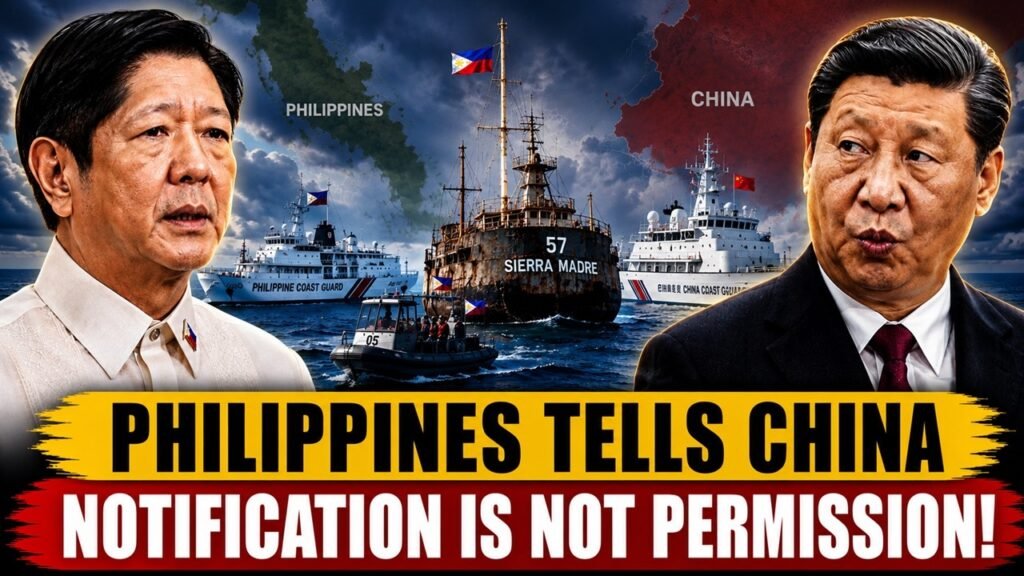
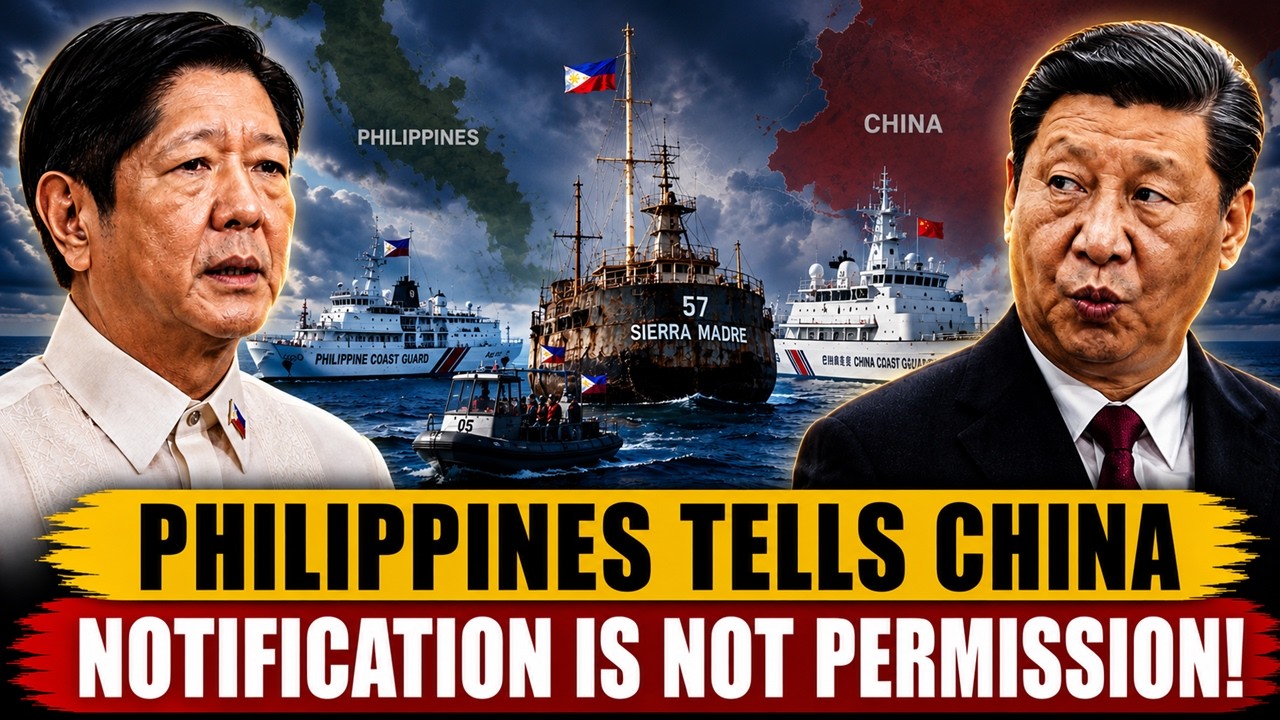
The latest development between the Philippines and China has once again placed the BRP Sierra Madre at the center of the South China Sea dispute. President Ferdinand Marcos Jr. has made it clear that the provisional arrangement between Manila and Beijing for the rotation and resupply of Philippine personnel at Second Thomas Shoal does not mean that China has been given authority to decide whether Philippine vessels can reach the outpost. The distinction is important because Manila describes the arrangement as a notification mechanism rather than a permission system. In practical terms, the Philippines informs China about planned movements, but Philippine authorities maintain that they are not asking Beijing for approval before carrying out their missions. This may appear to be a small procedural difference, but strategically it could determine whether the arrangement remains a useful tool for reducing tensions or eventually becomes a mechanism that gives China greater influence over Philippine operations.
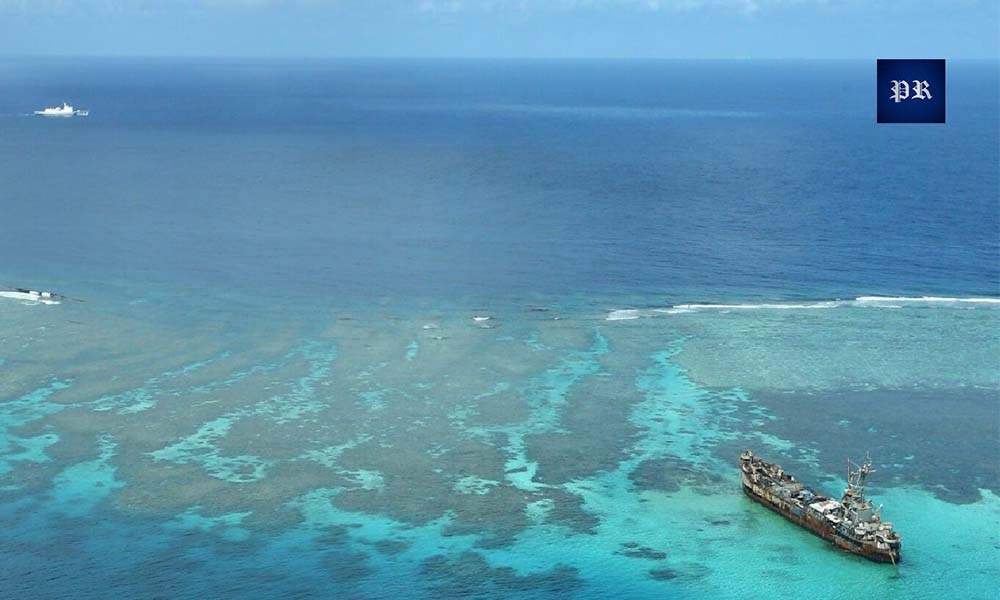
The issue is particularly sensitive because the BRP Sierra Madre is not simply an old military ship. Since being deliberately grounded at Second Thomas Shoal in 1999, the vessel has served as a Philippine military outpost and has become an important symbol of Manila’s continued presence in the disputed South China Sea. Philippine personnel stationed on the vessel depend on regular resupply missions for food, water, fuel, equipment and other necessities. Every mission therefore has to balance two competing priorities: keeping the outpost operational while avoiding a confrontation with Chinese maritime forces. The arrangement with Beijing was introduced against this background, but Manila now has to ensure that the mechanism designed to reduce the risk of confrontation does not gradually create a situation in which China gains the practical ability to influence or restrict Philippine movements.
Why the BRP Sierra Madre Matters to the Philippines
The strategic importance of the BRP Sierra Madre comes from its location rather than the condition of the ship itself. The vessel is old, heavily deteriorated and not comparable with modern warships operating in the region. Yet its continued presence at Second Thomas Shoal gives the Philippines a physical foothold in an area where China maintains competing claims and has significantly increased its maritime presence. For Manila, maintaining personnel aboard the Sierra Madre is therefore closely connected to maintaining its position at the shoal. If the Philippine outpost were abandoned, the strategic situation could change considerably, particularly because China has been seeking to strengthen its practical control and presence across contested areas of the South China Sea.
The Philippine government consequently has a strong reason to continue supplying the personnel stationed there. A military outpost cannot survive without regular logistical support, and the distance and contested environment make every resupply mission more complicated than a normal military operation. Philippine vessels must travel through waters where Chinese coast guard and other maritime forces are active. When vessels from both countries operate in close proximity, the possibility of dangerous maneuvers, blocking attempts, collisions or physical confrontations increases. This is why the Sierra Madre has become one of the most closely watched flashpoints in the Philippines-China relationship. What appears to be a small logistical mission can quickly become an international incident involving two governments and, potentially, their wider security partners.
Philippines Is Finally Getting 2 Submarines — China Will Have to Rethink the South China Sea
Notification Is Not Permission
At the heart of the current issue is a distinction that may sound simple but has major legal and strategic significance: notification is not the same as permission. Manila says that Philippine authorities notify China about resupply and personnel rotation missions so that Chinese forces are aware of what is happening at sea. The purpose is to reduce uncertainty and avoid dangerous encounters. But notification, from the Philippine perspective, does not mean that China has been given the right to approve or reject a Philippine mission. That principle is essential to Manila because accepting a requirement for Chinese permission could create an entirely different relationship around Second Thomas Shoal.
The difference becomes clearer when considering how such an arrangement could evolve. If the Philippines tells China that a vessel is approaching the Sierra Madre, that is communication. If China responds by acknowledging the information but does not claim the authority to stop the mission, the arrangement can continue functioning as a deconfliction mechanism. However, if China eventually begins insisting that Philippine vessels cannot proceed without Chinese approval, the nature of the arrangement would change. It would no longer simply be about avoiding misunderstandings between two maritime forces. It would begin to resemble a system in which Beijing exercises practical control over Philippine operations. Manila has therefore been careful to emphasize that the provisional arrangement does not surrender Philippine rights or give China permission to determine when Philippine vessels can reach the Sierra Madre.
The Legal Battle Behind the Sierra Madre Dispute
The dispute around the BRP Sierra Madre cannot be understood only through military movements and confrontations at sea. At its core, the South China Sea issue is also a major legal dispute involving competing interpretations of maritime rights, sovereignty and international law. For the Philippines, the United Nations Convention on the Law of the Sea, commonly known as UNCLOS, is central to its position. Manila has repeatedly argued that its maritime rights should be understood within the framework established by UNCLOS, while China maintains a much broader position regarding its rights and interests in the South China Sea. This legal disagreement is one reason why even a practical arrangement over resupply missions can carry significant political consequences.
The 2016 South China Sea arbitration remains particularly important for the Philippines. The arbitral tribunal rejected the legal basis for China’s expansive historic-rights claims insofar as they exceeded the maritime entitlements recognized under UNCLOS. China rejected the tribunal’s decision and has continued to maintain its own position. Manila, however, continues to regard the ruling as an important foundation for its legal and diplomatic arguments. This means the Philippines has to be careful whenever it enters practical arrangements with China. A temporary agreement designed to prevent dangerous encounters should not be interpreted as an abandonment of the country’s broader legal position. This is precisely why Philippine officials continue to stress that communication with China does not mean accepting Chinese sovereignty over Second Thomas Shoal.
Why Every Resupply Mission Can Become a Crisis
A resupply mission to the Sierra Madre may appear routine from a logistical perspective, but the geography and political environment around Second Thomas Shoal make every mission potentially dangerous. Philippine vessels have to operate in an area where Chinese maritime forces are also present, and the two sides do not agree on the legal status of the shoal. Because of that disagreement, the same movement can be interpreted very differently by Manila and Beijing. The Philippines can view a mission as a legitimate operation to support its own personnel, while China can portray the same activity as an attempt to strengthen the Philippine position in a disputed area.
This creates a dangerous environment in which even a minor maritime incident can have consequences far beyond the vessels involved. When ships operate close to one another, aggressive maneuvering, blocking, water-cannon incidents, collisions or other forms of interference can cause injuries or damage. Once personnel are injured, domestic political pressure can increase rapidly. Government officials may be forced to respond more strongly, military forces may be placed on higher alert, and diplomatic relations can deteriorate within hours. The danger is therefore not limited to an intentional decision by either government to start a confrontation. Miscalculation or an accident can also create a crisis.
Marcos’ Broader Strategy Toward China
The Sierra Madre issue is only one part of President Ferdinand Marcos Jr.’s broader strategy toward China. Manila is trying to protect Philippine maritime interests while avoiding a direct confrontation that could damage the country’s security and economic interests. This has created a difficult balancing act. The Philippines has strengthened its defense and security cooperation with the United States and other partners, but at the same time it continues to maintain diplomatic channels with Beijing. The government understands that China is not only a strategic competitor but also a major economic power and an important regional actor. Completely cutting diplomatic engagement would therefore create its own risks.
Marcos’ approach can be understood as an attempt to separate areas of competition from areas where cooperation remains possible. The Philippines can firmly defend its maritime position while continuing to communicate with China about preventing accidents at sea. It can object to Chinese actions in disputed waters while still exploring economic opportunities. This approach does not mean that Manila has abandoned its position on the South China Sea. Instead, it reflects the reality that countries can compete in one area while cooperating in another. The challenge for Marcos is ensuring that cooperation does not gradually weaken Philippine strategic freedom.
What Happens Next at Second Thomas Shoal?
The next Philippine resupply missions will be one of the clearest tests of whether the provisional arrangement is actually working. The most important question will be whether Philippine vessels can reach the BRP Sierra Madre with fewer dangerous encounters. If the notification process allows both sides to understand what is happening and reduces the likelihood of collisions or confrontations, Manila will have a strong argument that the mechanism is achieving its immediate purpose. A reduction in tensions would benefit both countries because neither side wants a relatively small maritime incident to develop into a wider military or diplomatic crisis.
Another important issue will be whether China begins demanding additional conditions. A simple notification system is relatively straightforward: the Philippines informs China about a planned operation, and both sides use the information to reduce the risk of an unexpected encounter. But if Beijing begins demanding detailed operational information or attempting to determine the route, timing or conditions under which Philippine vessels can approach the Sierra Madre, the situation could become more complicated. Such developments would not necessarily mean that the Philippines had surrendered its sovereignty, but they could indicate that China was attempting to gain greater operational influence.
The Real Question Is Not Whether Manila Made a Deal
The central question surrounding the Sierra Madre is not simply whether the Philippines and China reached an understanding. The more important question is what that understanding means in practice. Based on Manila’s stated position, the provisional arrangement does not give China the authority to decide whether Philippine vessels can reach Second Thomas Shoal. Instead, it is intended to provide a communication mechanism that can reduce the danger of confrontation while allowing the Philippines to continue supporting its personnel at the outpost. That distinction is essential because cooperation at sea does not automatically mean that one country has accepted the other country’s sovereignty claims.
For the Philippines, the challenge will be maintaining this boundary over the long term. Manila needs to keep its diplomatic channels with Beijing open because communication can help prevent dangerous incidents. At the same time, it needs to make sure that communication does not become dependence. If China can eventually decide when Philippine vessels can approach the Sierra Madre, then a mechanism originally designed to reduce tensions would have taken on a very different meaning. Manila would face a difficult strategic situation in which its legal position remained unchanged on paper while its freedom of action became increasingly restricted in practice.
That is why the next phase of the Sierra Madre dispute deserves close attention. The BRP Sierra Madre may be an aging ship, but its strategic importance is much greater than its physical condition suggests. It represents the continued Philippine presence at Second Thomas Shoal and has become a test of whether Manila can defend its maritime interests while managing the risks of confrontation with China. Marcos is attempting to draw a clear line between communication and control, and that line will ultimately be tested not by political statements but by what happens when the next Philippine vessel approaches the shoal.
About Indo-Pacific Report
For more geopolitical analysis, strategy coverage, and Indo-Pacific security reporting, visit Indo-Pacific Report:
Website
Facebook
YouTube