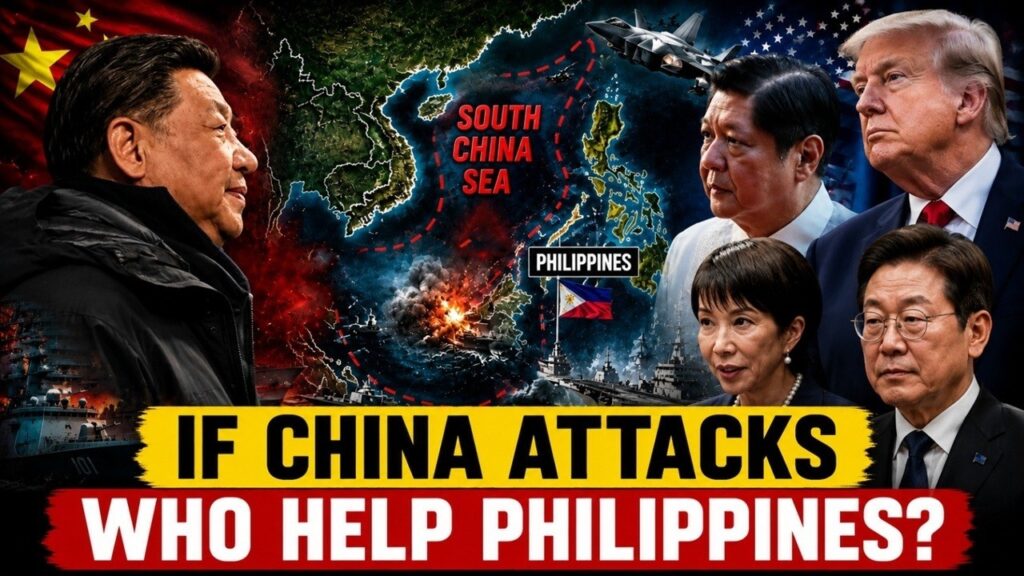
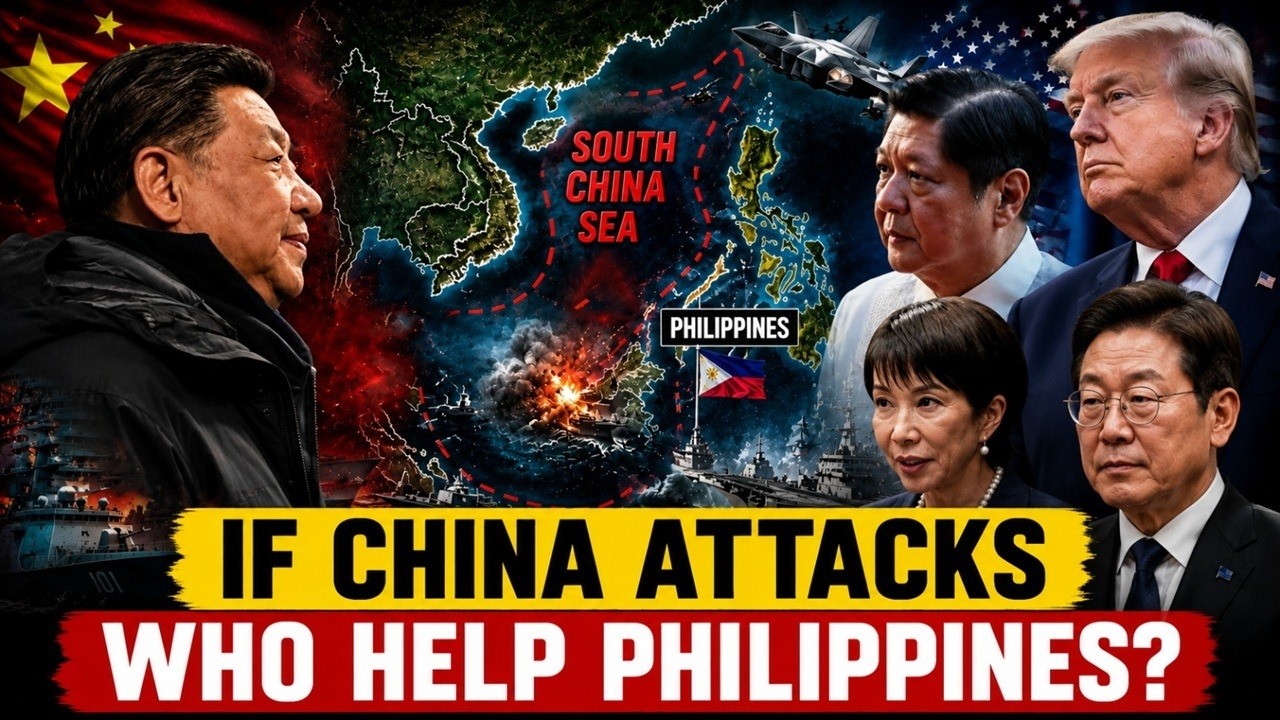
If War Breaks Out Between China and the Philippines, Who Would Support Manila?
A Regional War, Not Just a Bilateral Conflict Imagine the flashpoint: a Chinese coast guard vessel fires water cannons at a Philippine supply boat near Second Thomas Shoal. Manila responds. Shots are fired. The question that follows is not just military. It is geopolitical. It reshapes every alliance, every trade route, and every strategic calculation across the Indo-Pacific.
A China-Philippines conflict would not stay bilateral for long. The South China Sea carries roughly $3.4 trillion in annual trade. More than half of the world’s maritime freight tonnage passes through these waters. Beneath them lie an estimated 125 billion barrels of oil and 500 trillion cubic feet of natural gas. The sea is not a peripheral waterway. It is the economic circulatory system of the Asia-Pacific.
China claims roughly 90 percent of the South China Sea through its so-called nine-dash line — a claim the Permanent Court of Arbitration rejected in 2016, calling it incompatible with international law. Beijing ignored the ruling. Manila accepted it. That legal and strategic standoff has never been resolved. It has only intensified.
The real question today is this: if armed conflict erupts between China and the Philippines, which countries would actually stand with Manila — and how far would they go?
The United States — The Indispensable Partner
The answer starts in Washington. The 1951 Mutual Defense Treaty between the United States and the Philippines is the cornerstone of Manila’s security architecture. Article IV of the treaty commits both parties to act against armed attacks in the Pacific — including attacks on Philippine armed forces, public vessels, and aircraft in the South China Sea.
In 2023, Secretary of State Antony Blinken reaffirmed that the treaty applies to the South China Sea. That was not a minor diplomatic footnote. It was a strategic signal to Beijing: attack the Philippines, and the United States will respond.
Under the Enhanced Defense Cooperation Agreement, the United States now has access to nine military bases in the Philippines, up from five in 2023. Four of those bases are in Luzon — the island closest to Taiwan. That proximity matters enormously. The Philippines is not just a treaty ally. It is a strategic platform.
In a conflict scenario, U.S. support would likely include intelligence, surveillance, and reconnaissance assets; air and naval power projection; logistics and resupply operations; and potentially direct military intervention depending on the nature and scale of Chinese action. The United States would not enter lightly. But it would enter.
As Admiral John Aquilino, former commander of U.S. Indo-Pacific Command, stated plainly: “The threat is the most dangerous we’ve seen since World War II.” Washington understands the stakes. The Philippines is not a peripheral concern. It is central to U.S. strategy in the Western Pacific.
U.S. Gives Philippines Eyes to Deter China in the South China Sea
Japan — The Quiet but Critical Partner
Japan would not send fighter jets to dogfight over the Spratly Islands. Its constitution and domestic politics make combat deployment politically untenable in the short term. But to dismiss Japan as a bystander would be a serious analytical error.
Tokyo and Manila have deepened their defense ties substantially over the past three years. In 2024, Japan signed a Reciprocal Access Agreement with the Philippines — the first Japan has signed with a Southeast Asian country. Japanese coast guard vessels have conducted joint patrols with their Philippine counterparts. Tokyo has transferred radar systems, patrol vessels, and defense equipment under its Official Security Assistance framework.
Japan’s strategic logic is straightforward and self-interested. China’s maritime expansion in the South China Sea does not stop there. The same assertiveness that threatens Philippine sovereignty in the Spratlys also threatens Japan’s southwestern island chain, including the Senkaku Islands. For Tokyo, the South China Sea is not someone else’s problem. It is a preview of its own.
In a conflict, Japan would almost certainly provide intelligence sharing, logistical support, radar and surveillance data, coast guard assets, and economic assistance to Manila. Diplomatically, Tokyo would work to internationalize the crisis, bring it to the United Nations Security Council, and mobilize G7 condemnation. That is not nothing. That is substantial strategic weight applied through non-combat means.
Australia — America’s Most Reliable Regional Ally
Australia’s strategic posture in the Indo-Pacific has shifted dramatically since 2021. The AUKUS partnership — bringing together Australia, the United Kingdom, and the United States — is a generational commitment to reshaping the regional balance of naval power. Canberra is acquiring nuclear-powered submarines. It is deepening defense integration with Washington at every level.
Australia has also expanded direct engagement with the Philippines. Joint maritime patrols, military exercises, and defense cooperation agreements have all increased. Canberra understands that a Chinese-controlled South China Sea would fundamentally compromise Australia’s northern maritime approaches and its access to critical trade routes.
In a conflict scenario, Australian support would likely be substantial. Naval deployments alongside U.S. forces, intelligence sharing through the Five Eyes network, air support, and logistics are all plausible contributions. Australia would not act unilaterally, but as part of a U.S.-led coalition, it would be among the most capable and committed participants.
The ANZUS Treaty also matters here. Under Article IV, an attack on the armed forces, public vessels, or aircraft of either party in the Pacific would trigger consultations and collective response. Australia’s obligations are real, not merely rhetorical.
South Korea, Vietnam, and the Regional Calculation
South Korea presents a study in constrained partnership. Seoul is a major U.S. ally, a significant arms exporter — its KF-21 fighter and FA-50 light combat aircraft are actively marketed to Manila — and a country that understands Chinese coercion from its own experience. But South Korea has an existential problem sitting on its northern border. North Korea consumes Seoul’s strategic bandwidth. Direct military deployment to the South China Sea is unlikely. Logistics, equipment, and intelligence support are more probable.
Vietnam is the most interesting case in Southeast Asia. Hanoi has its own bitter territorial disputes with China — the Paracel Islands, the Spratlys, and a long history of Chinese aggression going back centuries. In 1974, China seized the Paracels by force from South Vietnam. In 1988, Chinese forces killed 64 Vietnamese sailors in a naval engagement at Johnson South Reef. The memory runs deep.
Vietnam’s “Four No’s” policy — no military alliances, no foreign bases, no alignment with one country against another, no use or threat of force — formally constrains its options. But strategic autonomy and quiet balancing are not the same as passivity. Vietnam would likely share intelligence, coordinate diplomatically, and apply independent pressure on China in contested areas. It would not fight alongside Manila. But it would make Beijing’s strategic calculus more complicated.
The Maritime Middleweights — Singapore, Indonesia, Malaysia
Singapore punches far above its weight class militarily. Its armed forces are among the most capable in Southeast Asia. It hosts a substantial U.S. naval presence at Changi Naval Base, where American aircraft carriers routinely dock. But Singapore’s foreign policy is built on a foundational principle: do not be forced to choose between Washington and Beijing.
In a conflict, Singapore would provide indirect support — port access for U.S. and allied vessels, logistical facilitation, and quiet diplomatic engagement. It would not join combat operations. But strategic geography makes Singapore’s cooperation important regardless of formal commitments.
Indonesia is a different calculation entirely. Jakarta controls the Malacca Strait, the Lombok Strait, and the Sunda Strait — the three most critical maritime chokepoints connecting the Pacific and Indian Oceans. In 2019 and 2020, Indonesia deployed naval vessels to the North Natuna Sea after Chinese coast guard ships repeatedly intruded into its exclusive economic zone. Jakarta called them out directly, unlike many ASEAN members who avoid confrontation.
But Indonesia is also ASEAN’s largest economy, a self-proclaimed non-aligned power, and deeply reluctant to be drawn into great-power competition. Its support in a conflict would be diplomatic and humanitarian, not military. Malaysia is similar — it has quiet South China Sea disputes of its own with China, but economic ties with Beijing constrain its public posture.
India — The Strategic Balancer of the Indo-Pacific
India’s role would be defined by strategic geography more than formal alliance. New Delhi is not a treaty ally of Manila. It has no obligation to fight. But India is a Quad partner — alongside the United States, Japan, and Australia — and it views Chinese maritime expansion through a lens shaped by its own ongoing border tensions with Beijing.
The 2020 Galwan Valley clash, where Indian and Chinese soldiers fought in hand-to-hand combat along the Line of Actual Control, sharpened Indian strategic thinking considerably. New Delhi has since accelerated defense cooperation across the Indo-Pacific, including arms sales to the Philippines. Manila has acquired BrahMos supersonic anti-ship cruise missiles — a joint India-Russia development — which significantly enhances Philippine deterrence capability against Chinese naval assets.
In a conflict scenario, India would likely maintain naval presence in the Indian Ocean to monitor and complicate Chinese logistics, provide diplomatic backing and intelligence, and deepen economic engagement with Manila. Direct intervention would remain off the table. But India’s strategic shadow over the Indian Ocean — through which Chinese supply lines must pass — gives New Delhi considerable leverage without firing a single shot.
Taiwan — The Silent Stakeholder
Taiwan’s position is the most paradoxical in this entire analysis. Taipei would almost certainly support Manila’s cause intellectually, strategically, and perhaps through intelligence channels. Shared anxiety about Chinese military aggression creates natural alignment. Both Taiwan and the Philippines watch the same adversary conduct the same pattern of incremental coercion.
But Taiwan cannot act openly. Its own survival is the first-order strategic priority. Any overt support for Manila would invite accelerated pressure from Beijing. Taiwan’s contribution would remain in the shadows — intelligence sharing, diplomatic signaling, and the simple strategic fact that any Chinese military operation against the Philippines would risk exposing Taiwan to reduced Chinese surveillance and force attention.
There is a harder point here. Taiwan’s own situation informs how every actor in the region reads a China-Philippines conflict. If Beijing can coerce Manila into submission without triggering a meaningful allied response, the lesson for Taiwan — and for every country watching — is that the United States does not honor its commitments. The credibility of deterrence across the entire Indo-Pacific would be at stake.
The Quad — Strategic Coordination Architecture
If a China-Philippines conflict materialized, the Quad — the United States, Japan, Australia, and India — would likely become the most important strategic coordination platform in the Indo-Pacific. Not a formal alliance. Not a military command structure. But a framework for intelligence fusion, diplomatic messaging, economic pressure, and strategic signaling.
The Quad’s value is precisely its informality. It creates coordination without the treaty obligations that might deter participation. Japan can contribute without deploying combat troops. India can signal without triggering its own confrontation with China. Australia and the United States can lead without appearing to act unilaterally.
In 2023, Quad leaders issued a joint statement condemning “destabilizing and coercive actions in the South China Sea” — language that would acquire operational meaning in a conflict scenario. The Quad is not a paper tiger. It is a coalition in formation.
Who Stays Neutral — and Why It Matters
ASEAN consensus in a conflict is essentially impossible. The bloc operates by unanimity. Cambodia and Laos, both deeply tied to Chinese investment, would block any collective condemnation. Thailand, a U.S. treaty ally with limited recent engagement, would likely remain passive. Brunei has South China Sea claims but tiny military capacity.
But neutrality is not without strategic consequence. Every country that refuses to support China’s narrative — even while staying militarily passive — contributes to Beijing’s diplomatic isolation. The global majority does not support Chinese territorial claims. Even the Gulf states, even many of China’s African partners, have not endorsed Beijing’s nine-dash line position. Diplomatic isolation is a form of strategic cost.
The economic stakes ensure that no country remains truly unaffected. A conflict in the South China Sea would disrupt semiconductor supply chains centered on Taiwan, throttle energy flows to Japan and South Korea, spike insurance costs for global shipping, and send commodity markets into crisis. Even countries sitting out the military dimension cannot escape the economic blast radius.
Europe and the Wider Stakes
Europe’s role would be secondary but not irrelevant. The United Kingdom, with its “tilt to the Indo-Pacific” and recent carrier strike group deployments in the region, has signaled genuine engagement. France maintains permanent military presence in the Indo-Pacific through its overseas territories — New Caledonia, French Polynesia, Reunion — and has the naval capacity to conduct independent operations. HMS Queen Elizabeth and FS Charles de Gaulle are real instruments of power, not ceremonial gestures.
The European Union would likely respond through the tools it commands best: economic sanctions, export controls, diplomatic pressure, and humanitarian assistance. Germany and other EU member states would apply economic pressure on Beijing. NATO as an institution would not intervene — the North Atlantic Treaty applies to the North Atlantic. But many NATO members would support U.S. operations individually, providing the informal coalition with transatlantic depth.
Strategic Assessment — A Coalition, Not a Single Ally
The central conclusion of this analysis is simple but profound. A conflict between China and the Philippines would almost certainly not remain bilateral. It would not be won or lost purely on the waters of the South China Sea. It would be decided by the breadth and depth of the coalition Manila can assemble — and by whether Beijing calculates that the costs of conflict outweigh the strategic gains.
Only a handful of countries — most notably the United States, Australia, and potentially Japan in non-combat roles — would provide substantial military support to Manila. But military power is not the only form of strategic weight. Intelligence from the Five Eyes network. Logistical support from Singapore and Japan. Economic pressure from the G7. Diplomatic isolation through the UN and international courts. Naval signaling from India in the Indian Ocean. These instruments, applied collectively, create a strategic environment in which Chinese coercion becomes extraordinarily costly.
Robert Kaplan once wrote that the South China Sea is “the Mediterranean of the 21st century” — a theater where great powers project influence, where geography determines destiny, and where the rules of the international order are either enforced or abandoned. The Philippines sits at the center of that theater. Its defense is not merely a bilateral obligation. It is a test of the entire post-1945 security architecture.
John Mearsheimer’s offensive realism predicts that rising powers will challenge existing orders. China is doing precisely that — methodically, incrementally, and with extraordinary patience. The question is whether the coalition of powers committed to a rules-based Indo-Pacific possesses sufficient resolve, coordination, and strategic endurance to raise the cost of Chinese aggression high enough to deter it.
In the end, the most important word in this analysis is deterrence. The goal is not to fight China. The goal is to convince Beijing that fighting would be catastrophic — that the coalition arrayed against it is broad, credible, and willing to absorb costs. If that message lands clearly, the conflict may never happen. If it does not, Manila will not stand alone. But the price of that solidarity — in lives, in treasure, in regional stability — would be staggering for everyone.
The South China Sea is where the rules-based order will either hold or fracture. That is why it matters. Not just to the Philippines. To all of us.
If War Breaks Out Between China and the Philippines, Who Would Support Manila?