A Russian Drone Hit a Chinese Ship Near Ukraine. The Timing Could Not Have Been Worse for Moscow
By Indo-Pacific Report | May 2026
Russia and China present themselves to the world as close strategic partners — a relationship built on shared opposition to US-led international order, deep economic ties, and regular high-level diplomacy between Vladimir Putin and Xi Jinping. That partnership has survived a lot. It is now being tested by something neither side planned.
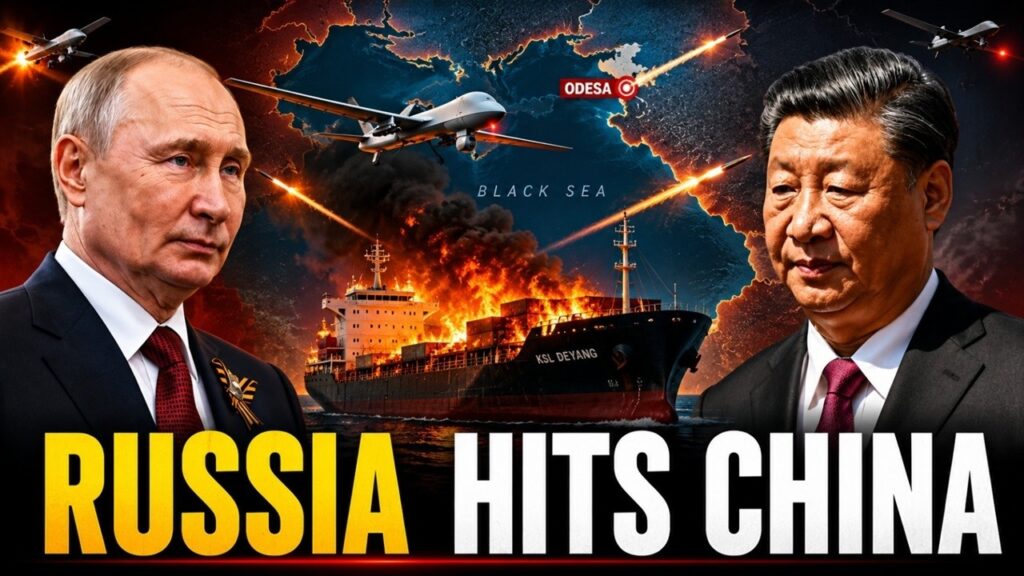
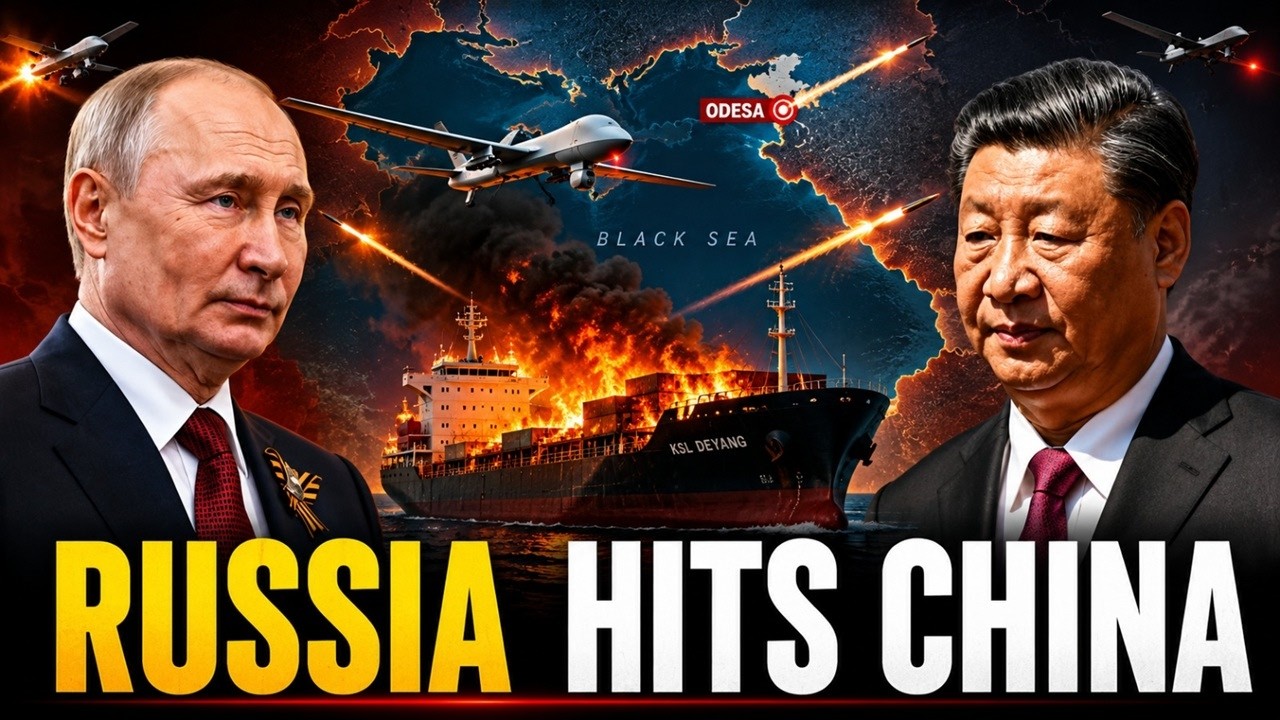
A Russian drone strike hit the KSL Deyang, a Chinese-owned cargo vessel, near the Ukrainian port city of Odesa. The ship was carrying a Chinese crew at the time of the attack. Photos released after the incident showed visible fire damage on the hull. The crew survived, and the vessel continued its journey, but the political fallout from the strike was immediate.
What made the incident particularly difficult for Moscow was the timing. The strike happened just one day before President Putin boarded a plane to Beijing for talks with Xi Jinping. Russia’s most important ally had just watched one of its commercial ships get hit by a Russian drone, and the two leaders were scheduled to sit across a table from each other within 24 hours.
What Happened: The Strike on the KSL Deyang
According to Ukrainian officials, Russian drones struck two civilian cargo vessels that were approaching ports in the Odesa region. One of those vessels was the KSL Deyang, which Ukraine identified as Chinese-owned and crewed.
The attack happened during one of the largest Russian drone and missile barrages of the entire war. Ukraine reported that Russia launched 524 drones and 22 missiles in the same wave of strikes, targeting multiple locations across the country with particular focus on port facilities and infrastructure in the Odesa area. The scale of that attack made it harder for Ukrainian air defenses to intercept every incoming threat — which is precisely the logic behind Russia’s strategy of overwhelming volume.
The Black Sea port region around Odesa has been a consistent Russian target throughout the war. Ukraine’s ability to export goods — particularly grain and agricultural products that are critical to global food supply chains — runs primarily through these ports. Disrupting that export capacity has been a strategic objective for Russia since the early stages of the conflict, and attacks on shipping and port infrastructure have been a regular feature of the war in this region.
https://indopacificreport.com/ukraines-drones-are-now-striking-deep-inside-russia/
The KSL Deyang was not a military vessel. It was a commercial cargo ship engaged in normal trade, approaching a Ukrainian port in the same way thousands of ships do each year. The fact that it was Chinese-owned did not protect it from the attack — and that is the core of the diplomatic problem that followed.
Zelenskyy’s Response: Russia Knew What It Was Hitting
Ukrainian President Volodymyr Zelenskyy moved quickly to draw maximum diplomatic attention to the incident. In public statements following the strike, he said Russia could not have been unaware that the vessel was connected to China. The implication was direct: this was not a case of mistaken identity or collateral damage, but a deliberate or at minimum reckless attack on a ship with clear Chinese ownership and crew.
Ukraine’s interest in pressing the point is straightforward. If the incident creates friction between Russia and China — or at least forces Beijing into the uncomfortable position of publicly responding to an attack on its commercial interests — it serves Ukraine’s broader diplomatic strategy of complicating and isolating Moscow internationally.
Russia has not officially acknowledged or commented on the specific strike. That silence is itself significant. Acknowledging the attack would require either justifying a strike on a Chinese-linked vessel, which would damage relations with Beijing, or admitting a targeting error in a contested combat zone, which would raise questions about the reliability of Russia’s drone warfare. Staying quiet is the easier short-term option, even if it leaves the incident unaddressed.
The absence of a Russian denial also matters. Ukraine released photographs showing fire damage on the KSL Deyang. If the strike had not occurred, Russia would have strong incentive to rebut the claim directly. The silence suggests the basic facts of the incident are not in dispute.
Why the Timing Matters: Putin’s Beijing Visit
The visit of a Russian head of state to China is not a minor diplomatic event. Putin’s trips to Beijing are closely watched by governments around the world as indicators of how deep the Russia-China alignment actually runs — whether it is a genuine strategic partnership or a marriage of convenience held together by shared opposition to Washington.
Arriving in Beijing one day after a Russian drone had hit a Chinese cargo ship created an immediate awkwardness. Xi Jinping and Chinese officials would have been fully briefed on the incident before Putin landed. The discussions that were meant to project unity and partnership between the two countries were instead preceded by an event that highlighted a real tension: Russia’s war in Ukraine is creating risks and costs for Chinese commercial interests that Beijing did not sign up for.
China’s economic relationship with the Black Sea region is substantial. Chinese shipping companies operate cargo routes through these waters, Chinese goods move through Ukrainian and regional ports, and Chinese commercial interests are exposed to the risks that Russia’s ongoing drone and missile campaign creates for civilian shipping in the area. An attack on a Chinese vessel is not an abstract diplomatic inconvenience — it is a direct cost imposed on Chinese business by Russian military operations.
Whether Xi raised the incident directly in his meetings with Putin is not publicly known. The joint statements and public communications from summits like these are carefully managed to emphasize unity. But the incident would have been present in the room, shaping the atmosphere of a meeting that both sides needed to go well.
China’s Difficult Position: Partner, Not Participant
China’s relationship with Russia since the invasion of Ukraine has required a consistent balancing act. Beijing has refused to condemn the invasion, has deepened economic ties with Moscow to help cushion the impact of Western sanctions, and has provided political cover for Russia in international forums. At the same time, China has been careful to avoid direct military assistance to Russia that would trigger secondary sanctions from the United States and Europe — a red line Beijing has so far maintained, at least formally.
The KSL Deyang incident puts pressure on a specific part of that balance. China has significant commercial interests tied to stable shipping lanes and functioning port infrastructure. Those interests extend into the Black Sea region, where Russia’s war has made maritime trade genuinely dangerous. Every Chinese commercial vessel that operates in those waters faces a risk that did not exist before February 2022.
Beijing cannot simply ignore an attack on its own ships. Doing so would signal to Chinese commercial operators that their government will not defend their interests, and would allow Russia to treat Chinese vessels as acceptable collateral damage in a war China nominally supports. But pressing Moscow too hard risks the broader partnership that Beijing values for its own strategic reasons — particularly as a counterweight to American pressure on China in the Indo-Pacific.
This tension is unlikely to break the Russia-China relationship. The partnership is held together by interests that are larger and more durable than a single drone strike. But incidents like this expose the real limits of the alignment — the places where Russian military behavior creates costs for China that Beijing did not choose and cannot fully control.
The Broader Picture: Civilian Shipping in a War Zone
The attack on the KSL Deyang is not an isolated incident. It is part of a pattern that has been building throughout the Ukraine war. Russia has consistently targeted port facilities, grain storage infrastructure, and maritime shipping routes in and around the Black Sea. Ukraine has responded with its own drone strikes against Russian naval assets and territory. Both sides have escalated their use of long-range strikes, and civilian shipping has repeatedly been caught in the middle.
The consequences of that pattern reach well beyond Ukraine and Russia. The Black Sea is a major conduit for global food exports, particularly wheat and sunflower oil from Ukraine and the broader region. Disruptions to shipping in these waters drive up prices for grain-importing countries across the Middle East, Africa, and Asia — populations that had no role in the conflict but bear some of its costs.
International shipping companies have responded by adjusting routes, demanding higher risk premiums, and in some cases avoiding the region entirely. That adds cost and complexity to supply chains that were already under pressure from earlier disruptions. The more the war continues, and the more Russia escalates its attacks on port and maritime infrastructure, the greater the impact on global trade flows that run through or depend on the Black Sea corridor.
The KSL Deyang attack is a reminder that in modern drone warfare, the boundary between military and civilian targets is not always respected — whether by accident or design. Commercial vessels flying third-country flags, carrying crews from nations not party to the conflict, operate in these waters at genuine risk. That is a problem not just for the shipping industry but for the international norms around protection of neutral civilian commerce during armed conflict.
What This Event Reveals About the Russia-China Partnership
The Russia-China relationship is often described in sweeping terms — an axis of autocracies, a new Cold War bloc, a partnership with no limits. The reality is more complicated, and the KSL Deyang incident is a small but clear illustration of why.
China needs Russia as a strategic counterweight to the United States. Russia needs China as an economic lifeline. Both governments benefit from projecting an image of solidarity. But their interests are not identical, and the Ukraine war generates costs and complications for China that Beijing would not have chosen. Chinese commercial shipping in contested waters, Chinese companies navigating Western sanctions to maintain Russia trade, and Chinese diplomats managing the international reputational damage of being seen as Moscow’s primary backer — these are all real burdens that the partnership imposes on Beijing.
Russia, for its part, needs to manage the relationship carefully. China is not a junior partner that can be taken for granted. Beijing has its own interests, its own red lines, and its own assessment of how far the partnership should extend. A Russia that repeatedly creates diplomatic problems for China — including by hitting Chinese ships — risks straining a relationship it depends on heavily for economic survival.

Neither side wants the partnership to fracture. But events like this one chip away at the seamless unity that both governments like to project. The drone that hit the KSL Deyang did not break Russia-China relations. But it put a visible crack in the narrative that the two countries are moving in perfect alignment.
The Takeaway
A single drone strike on a cargo ship would ordinarily be a footnote in a war that has involved thousands of missiles, hundreds of thousands of casualties, and years of sustained destruction. What made the attack on the KSL Deyang significant was its target, its crew, and its timing.
Russia hit a Chinese-owned vessel with a Chinese crew, one day before its president flew to Beijing to reaffirm the most important strategic partnership Moscow has. That created a diplomatic situation that required careful management on both sides — and that revealed, in miniature, the real tensions that exist within an alliance both governments prefer to present as unconditional.
The Black Sea will remain dangerous for as long as the Ukraine war continues. Civilian shipping will continue to carry risks it should not have to carry. And the gap between how Russia and China describe their partnership and how it actually functions will continue to be tested by the unpredictable friction of a war that shows no clear signs of ending.
Follow Indo-Pacific Report for More Global Security Analysis
For ongoing coverage of the Ukraine war, Black Sea security, China-Russia relations, and Indo-Pacific developments, follow Indo-Pacific Report across all platforms:
Website
Facebook
YouTube