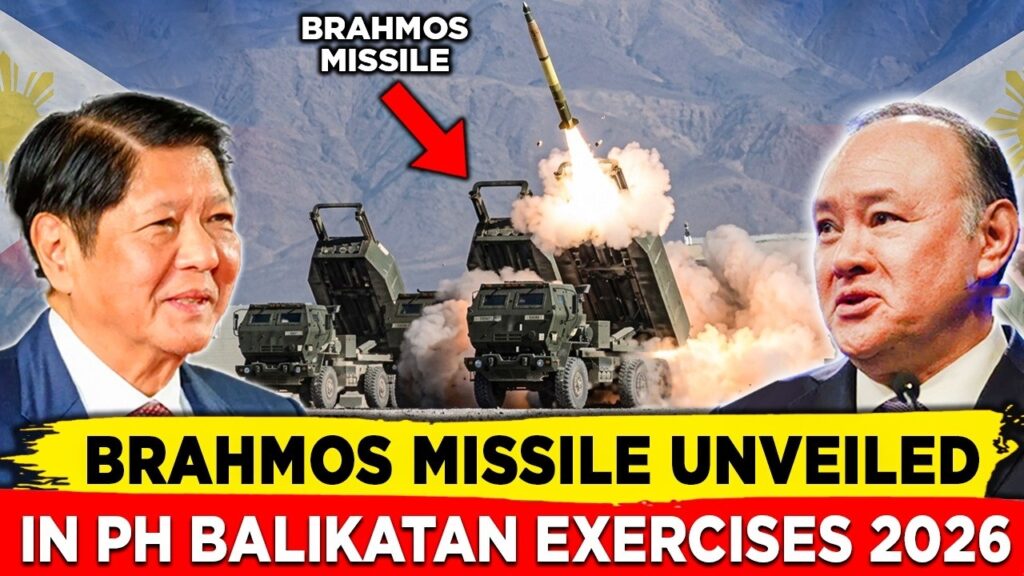
BrahMos Missile at Balikatan 2026: How the Philippines Just Changed the South China Sea
By IndoPacific Report | April 24, 2026 | 12 min read
On April 20, 2026, the Philippines made the loudest military statement in its modern history. At the opening of Balikatan 2026 — the biggest iteration of the exercise ever staged — Manila announced that its BrahMos supersonic cruise missile would be integrated into a live joint maritime strike simulation off Northern Luzon. Joining the drill: the United States, Japan, and six other allied nations.
No missile was actually fired that day. But every sensor was live. Every fire-control system was active. Every targeting radar was locked.
The Philippines was not just testing a weapon. It was sending a signal — one Beijing could not ignore and could not intercept.
The Weapon: What BrahMos Actually Is
India built it. The Philippines bought it. Now China has to live with it.
The BrahMos is not just another missile in Southeast Asia’s inventory. It travels at Mach 2.8 — nearly three times the speed of sound — and covers 290 kilometres before most radar systems have time to generate a response. It flies low, hugs the ocean surface, shifts trajectory mid-flight, and strikes with a warhead between 200 and 300 kilograms.
A subsonic missile gives a target ship roughly six to eight minutes to respond. BrahMos gives it less than two.
The Philippine Marine Corps’ Coastal Defense Regiment received the first battery in April 2024, unveiled it publicly in November 2025, and is now rehearsing it in a live joint strike drill alongside eight allied nations. The $375 million purchase signed in January 2022 has become the sharpest coastal defence asset in Southeast Asia.
Dr. Harsh Pant of the Observer Research Foundation described BrahMos as signalling that the first island chain is “no longer a soft underbelly.” When Philippine officials call it their most powerful weapon, they are not boasting. They are marking a coordinate — one that sits squarely inside China’s maritime expansion zone.
Balikatan 2026: Bigger, Broader, More Lethal
This is not the Balikatan your grandfather remembers.
For decades, these drills were small and mostly focused on counter-terrorism in Mindanao. That era is over. Balikatan 2026 — the 41st edition — runs from April 20 to May 8 and involves over 17,000 troops from eight nations: the Philippines, the United States, Australia, Canada, France, Japan, New Zealand, and the United Kingdom. Another 17 countries — including South Korea, Germany, Vietnam, Indonesia, and Singapore — are watching as observers.
The drills span Luzon, Palawan, the Visayas, and Mindanao — covering air, land, sea, cyber, space, and what the AFP now officially calls the cognitive domain. The centrepiece event, scheduled for May 5 off Zambales, will see a decommissioned Philippine vessel sunk by coordinated allied fire. President Marcos Jr. is expected to attend in person.
Dr. Collin Koh of Singapore’s S. Rajaratnam School of International Studies describes Balikatan 2026 as having evolved from a bilateral exercise into “a de facto multilateral deterrence rehearsal.”
AFP Chief General Romeo Brawner put it plainer: “Stand together. Act together. And when necessary — defend together.”
Philippines Opens New Luzon Strait Base to Bolster Deterrence Against China
Four Missile Systems. Four Nations. One Strike Wall.
Imagine four different missile systems — from four different nations — all trained to communicate with each other in real time. That is what is being rehearsed right now on Philippine soil.
BrahMos (Philippines)
Mach 2.8. 290 km range. Ocean-hugging flight path. Reaction time under two minutes. Already operational with the Philippine Marine Corps.
🇺🇸 Typhon Mid-Range Capability (United States)
A ground-based launcher firing Tomahawk Land Attack Missiles and SM-6 interceptors, with reach estimated at over 1,000 nautical miles — placing much of southeastern China’s coastline within range. Beijing has demanded its removal from Philippine soil. Manila refused.
NMESIS (United States)
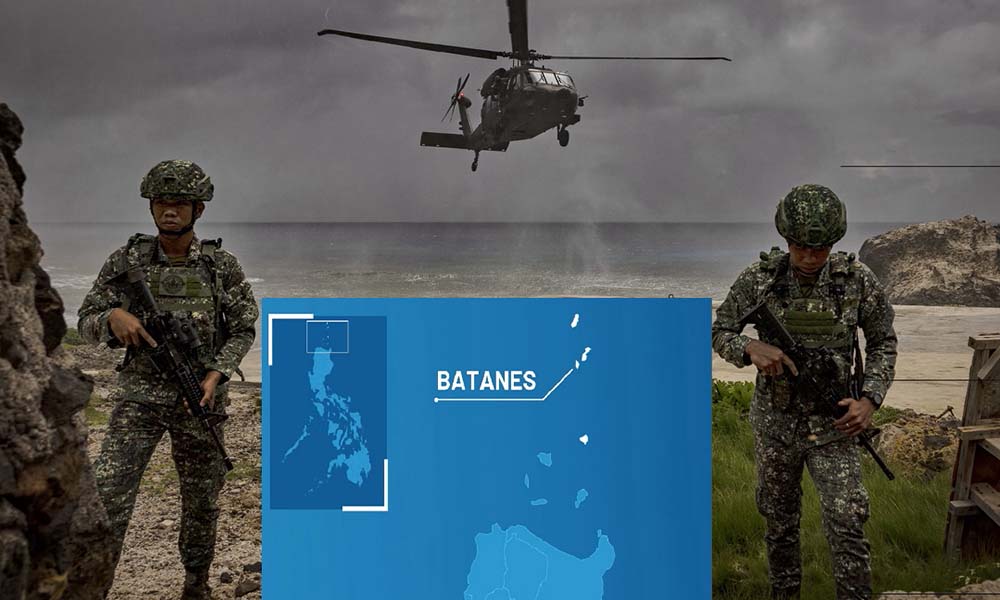
Naval Strike Missiles mounted on light tactical vehicles. Mobile, concealable, deployable into jungle terrain. Currently positioned in Batanes — the Philippines’ northernmost province, directly in the Luzon Strait between Luzon and Taiwan.
Type 88 Surface-to-Ship Missiles (Japan)
Being fired on Philippine soil for the first time in history. Ground-launched, anti-ship, with a 150 km range. A weapon Japan has never deployed outside its own territory — until now.
Military strategists call this layered deterrence — and it is the most concrete version of it ever assembled in Southeast Asia. As Oriana Skylar Mastro of Stanford’s Freeman Spogli Institute has argued, China’s greatest vulnerability in any Taiwan contingency is not American carriers — it is the first island chain being weaponised from multiple directions simultaneously.
US Balikatan exercise director Lt. Gen. Christian Wortman said it directly: “We think it’s important that we gain experience planning, coordinating and integrating these capabilities, which have the potential to be more powerful when incorporated or applied together.”
That is the sentence Beijing should be studying.
The Japan Factor: Allies That Were Once Enemies
Eighty years ago, Japanese soldiers last stood on Philippine soil as an occupying force. This week, they stand there as allies.
Japan deployed approximately 1,400 combat troops to Balikatan 2026 — its largest military presence on Philippine soil since World War II. Japan brought the helicopter carrier JS Ise, destroyer JS Ikazuchi, landing ship JS Shimokita, C-130H transport aircraft, and its Type 88 missile system.
This follows the Reciprocal Access Agreement that came into force in September 2025 — a treaty allowing Japanese troops to deploy to the Philippines and Filipino troops to deploy to Japan. AFP Chief Brawner captured the historic weight of it with one sentence: “Before, we were on opposite sides. This time, we find ourselves on the same side.”
The timing is deliberate. Just three days before Balikatan opened, a Japanese destroyer transited the Taiwan Strait — a passage Beijing called “a deliberate provocation.” And now Japanese troops are on Philippine soil, firing missiles into the South China Sea.
Professor Ken Jimbo of Keio University has argued that Japan’s strategic calculus has fundamentally shifted: Tokyo no longer sees its defense perimeter as ending at its own coastline. What happens in the West Philippine Sea, in the Luzon Strait, in the Bashi Channel — it all feeds directly into Japan’s survival calculation.
China’s Response: ‘Playing With Fire’
Beijing did not stay quiet. It never does.
The moment Balikatan opened, China’s Foreign Ministry spokesperson Guo Jiakun issued a warning: “Blindly binding themselves together in the name of security will only be akin to playing with fire — ultimately backfiring upon themselves.”
Beijing also sent a naval destroyer group to the western Pacific near Japan’s Amami Oshima island to test what it called “operational capabilities.” Meanwhile, Chinese state media tied energy relief — fertiliser contracts and hints of oil and gas talks — to diplomatic compliance. Carrots and sticks. Simultaneously.
Manila did not flinch. AFP Rear Admiral Roy Vincent Trinidad called China’s warning “expected” but flatly “irrelevant.” He named China’s “rapid military buildup,” “illegal presence,” and “coercive actions” in the West Philippine Sea as the actual source of instability in the region — on camera, at a press briefing, for the international record.
Dr. Ian Storey of Singapore’s ISEAS-Yusof Ishak Institute notes that China’s grey-zone strategy depends on the target state being diplomatically isolated, economically dependent, and militarily weak. The Philippines in 2026 is none of those things anymore. Beijing’s increasingly shrill warnings are, in a way, the clearest proof of that.
Will Deterrence Hold?
Nobody can answer that with certainty. Not Washington. Not Manila. Not Beijing.
That is the nature of deterrence — it only works until it doesn’t. But here is what we can say in April 2026: the deterrence architecture across the first island chain is more real, more armed, and more multilateral than at any point since the Cold War. The Philippines and the United States have conducted over 500 military exercises since 2024 — more than one a day — and Washington has committed $144 million in infrastructure investment under the Enhanced Defense Cooperation Agreement, opening nine Philippine military sites to American forces.
As Lowy Institute analysts have observed, China’s continued threats are doing something Beijing never intended — they are “strengthening other countries’ resolve.” Every water cannon fired at a Philippine vessel. Every floating barrier at Scarborough Shoal. Every ‘playing with fire’ warning from Beijing. Each one has added another nation to the coalition, another missile battery to the arc.But deterrence is not just hardware. The 2026 US National Defense Strategy has a credibility gap: it emphasises deterrence by denial along the first island chain, yet the word Taiwan does not appear in the document once. If Beijing reads that omission as hesitation, the entire architecture built on Philippine soil becomes a bluff waiting to be called.
The great deterrence theorist Thomas Schelling argued it decades ago — and his insight has never aged: “The power to hurt is bargaining power, but only if your adversary believes you will use it.”China is watching Balikatan 2026 carefully. It is calculating. And the answer it reaches — about American resolve, Philippine will, and Japanese commitment — will determine whether this extraordinary display of allied military power becomes the foundation of lasting peace in the Indo-Pacific, or simply the most elaborate rehearsal for a war nobody wanted but nobody was willing to prevent.
That is the question your generation will have to answer.
Quick Facts: Balikatan 2026 at a Glance
Metric Detail
Dates April 20 – May 8, 2026
Troops 17,000+ from 8 nations
Full Participants Philippines, USA, Australia, Canada, France, Japan, New Zealand, UK
Observer Nations 17 countries including South Korea, Germany, Vietnam, Indonesia, Singapore
Missile Systems BrahMos, Typhon MRC, NMESIS, Japan Type 88
Key Event Live maritime strike, May 5 off Zambales
BrahMos Speed Mach 2.8 (~3,400 km/h)
BrahMos Range 290 km
BrahMos Cost $375 million (signed Jan 2022)
US EDCA Investment $144 million in PH military infrastructure
US-PH Exercises (since 2024) 500+ (more than 1 per day)
Sources & Expert Citations
• Dr. Harsh Pant — Observer Research Foundation (India-Philippines defence partnership)
• Dr. Collin Koh — S. Rajaratnam School of International Studies, Singapore (Balikatan as multilateral deterrence rehearsal)
• Oriana Skylar Mastro — Stanford University, Freeman Spogli Institute (China’s first island chain vulnerability)
• Lt. Gen. Christian Wortman — US Balikatan Exercise Director 2026 (integrated strike capabilities)
• Dr. Ian Storey — ISEAS-Yusof Ishak Institute, Singapore (grey-zone strategy analysis)
• Professor Ken Jimbo — Keio University, Japan (Japan’s defense perimeter shift)
• Elbridge Colby — Former US Deputy Assistant Secretary of Defense (first island chain strategy)
• Thomas Schelling — Nobel Laureate, deterrence theory (‘The Strategy of Conflict’)
• AFP Chief Gen. Romeo Brawner — Opening ceremony address, Balikatan 2026
• RADM Roy Vincent Trinidad — AFP West Philippine Sea spokesperson, April 2026 briefing