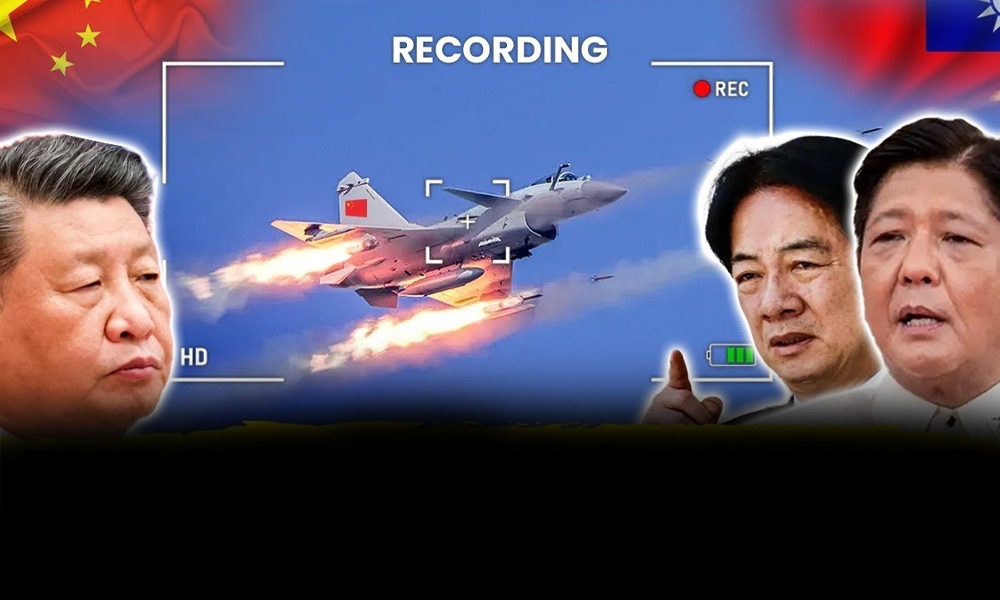
Taiwan now stands at a decisive moment as Chinese pressure reaches historic highs across its skies and seas, raising a fundamental question with enormous strategic consequences: should Taipei expose Beijing’s airspace and EEZ violations the way the Philippines exposes coercion in the South China Sea? Chinese military activity has surged at a scale the world rarely sees, over three thousand PLA aircraft entered Taiwan’s ADIZ last year, median-line crossings are routine, and naval encirclement drills now simulate early-strike and blockade scenarios. Yet Taiwan’s voice remains far quieter than China’s, limited by diplomatic isolation and overshadowed by Beijing’s well-funded information apparatus, which shapes global narratives before Taiwan even speaks.
By contrast, the Philippines has rewritten the rules of the information battlefield. Manila’s real-time transparency, from laser attacks to water cannons to ramming incidents, has exposed China’s gray-zone tactics with irrefutable evidence and shifted global opinion dramatically. That success is pushing experts to ask whether Taiwan should follow the same path. The Philippines’ model has proven that when a smaller nation documents every act of coercion, Beijing loses control of the narrative, diplomatic pressure rises, and international sympathy grows.
Supporters of a Taiwan transparency strategy argue that it would expose China’s daily gray-zone pressure, strengthen international backing, counter Beijing’s propaganda, unify Taiwan’s domestic audience, and synchronize Taipei with emerging regional partners like Japan, the Philippines, and Australia, forming what some call an “Asian Transparency Network.” But others warn that Taiwan must be cautious. Transparency could be misread by Beijing as provocation, spark even more PLA incursions, expose Taiwan’s own defensive weaknesses, invite economic retaliation, fuel diplomatic isolation, or trigger massive cyberattacks on Taiwan’s already overstretched systems.
This leaves Taiwan with a difficult middle path: a smart transparency strategy that focuses on revealing patterns rather than every incident, coordinates data with allies, uses academic and civilian channels to avoid escalation, relies on satellite and OSINT imagery for credibility, and humanizes the impact of China’s behavior on civilians, trade routes, and regional stability. Case studies from the Philippines, Japan, Lithuania, and even pre-war Ukraine all show that transparency, when done correctly, strengthens a nation’s strategic position and limits an aggressor’s ability to control the story.
In the end, the assessment becomes clear: Taiwan should expose China’s violations, but only with precision, discipline, and strategic intent. In an Indo-Pacific era where narratives increasingly shape deterrence, silence is no longer strength. The truth, presented calmly, professionally, and consistently, may be one of Taiwan’s most powerful defenses long before conflict ever breaks out.
THE PHILIPPINES’ TRANSPARENCY MODEL — WHAT TAIWAN COULD LEARN
What Taiwan could learn from the Philippines isn’t just a strategy, it’s a mindset. Manila decided that if China was going to pressure it, the world deserved to see every second of it, unfiltered. So when Chinese ships fired lasers that temporarily blinded Filipino crewmen, when water cannons smashed into wooden supply boats, when rammings sent sailors scrambling for balance, the Coast Guard didn’t hide it. They filmed it. They named it. They released it. Even drones were sent to quietly record the enormous swarms of Chinese militia boats that China never wanted the world to notice. And instead of letting agencies speak separately, the Philippines made it a national effort: soldiers, coast guard officers, and diplomats all delivering the same message, backed by a public campaign, “Our Sea, Our Right”, that ordinary Filipinos could feel in their hearts, not just read in statements. Then Manila took the story global, bringing foreign embassies to briefings, giving raw footage to international media, and making sure the world understood the pressure being applied to a much smaller country. That effort changed everything. What used to be silent intimidation suddenly carried consequences. China felt the diplomatic heat, allies started offering more support, and global sympathy shifted firmly toward Manila. The Philippines showed that transparency can turn fear into strength, and that even a smaller nation can rally the world simply by telling the truth out loud.
SHOULD TAIWAN COPY THIS MODEL? — ARGUMENTS FOR
If Taiwan ever chose to follow the Philippine model, the strongest argument in its favor is simple: the world cannot defend what it cannot see. China’s gray-zone pressure thrives in silence, the median-line crossings, the intimidation flights, the naval encirclement drills that edge closer to blockade rehearsals. If Taiwan began exposing these patterns the way Manila exposes water-cannon attacks and swarming tactics, the global audience would finally see how relentless and calculated Beijing’s pressure really is. Transparency would also give Taiwan something it desperately needs: legitimacy in the information space. Allies respond faster and more firmly when the evidence is public, when visuals and data replace vague warnings, and when the scale of the threat becomes undeniable. By revealing the truth, Taiwan could counter Beijing’s favorite narrative, the claim that these flights and drills are just “routine training” and instead shape global perception long before any crisis erupts. A transparency campaign would also strengthen Taiwan internally by helping its own citizens understand the threat they are living under every day, building support for defense reforms and higher military spending. And there’s a regional angle too: the Philippines, Japan, and Australia already exchange real-time maritime threat information; if Taiwan joined that rhythm, the region could form an informal “Asian Transparency Network,” a shared lens that exposes China’s pressure on every front. In that network, Taiwan wouldn’t be standing alone, it would be part of a unified regional voice revealing a truth Beijing can no longer hide.
ARGUMENTS AGAINST: WHY TAIWAN SHOULD BE CAUTIOUS?
But Taiwan also has powerful reasons to be cautious, because what works for Manila may not translate cleanly to an island facing far greater stakes. Transparency, for all its strengths, could be seen by Beijing as a direct challenge, almost a public shaming, and China does not tolerate embarrassment lightly. If Taiwan starts exposing every median-line crossing, every intimidation flight, every encirclement pattern, the PLA could retaliate by increasing the tempo even further, turning the skies and seas around the island into an even more crowded and dangerous arena. Taiwan’s vulnerability makes the risk heavier; unlike the Philippines, which faces harassment at sea, Taiwan sits at the frontline of a potential full-scale invasion. Revealing too much might expose operational gaps, radar blind spots, or response limits, weaknesses China could exploit. And Beijing has a track record of weaponizing Taiwan’s economy the moment political tensions rise: pineapples banned, fishery products blocked, passenger travel restricted, shipping pressured through back channels. A transparency campaign could invite more of that punishment. Diplomatically, China could twist Taiwan’s openness into a new excuse to intensify international pressure, rallying sympathetic states to isolate Taipei even further. Then there is the cyber dimension, Taiwan already faces millions of cyberattacks every year, often timed with elections or major political announcements. Launching a transparency campaign might trigger a wave of retaliatory hacks aimed at silencing Taiwan’s messaging before it even reaches the international audience. For Taiwan, the cost of miscalculation is far higher than for any other democracy in the region, and that reality makes the transparency question far more delicate.
Should Taiwan Expose China’s Military Violations — Just Like the Philippines Does?
MIDDLE GROUND: A SMART TRANSPARENCY STRATEGY FOR TAIWAN
A smarter path for Taiwan may lie not in copying the Philippine model outright, but in crafting its own version of transparency, one that is careful, calibrated, and designed to reveal patterns rather than broadcast every single incident in real time. Instead of hourly updates that could feel alarmist or overwhelming, Taiwan could issue regular, data-rich monthly reports that highlight abnormal behaviors: sudden spikes in median-line crossings, unusual encirclement drills, or new flight paths that suggest rehearsals for blockades or strikes. Behind the scenes, Taipei could quietly coordinate with allies like Japan, the United States, and the Philippines, sharing radar tracks, satellite imagery, and maritime data so that when these reports are released, they come with built-in credibility and, where appropriate, joint warnings on China’s behavior. To avoid turning this into a purely military confrontation, Taiwan could lean heavily on civilian and academic institutions, think tanks, universities, research centers such as INDSR, to publish the bulk of this analysis, turning what might look like military propaganda into sober, evidence-based reporting. Commercial satellite companies and open-source intelligence platforms like Maxar, BlackSky, and maritime trackers can provide imagery and verification without exposing Taiwan’s own sensors or methods, giving Taipei a way to show the world what’s happening without compromising its defenses. And instead of framing everything in technical jargon, Taiwan could shape a narrative that quietly and consistently portrays China as the aggressor by highlighting how these activities affect ordinary life: fishermen forced to reroute, airliners adjusting paths, cargo ships navigating riskier waters, insurers recalculating premiums, and neighbors increasingly anxious about miscalculation. In that middle ground, transparency becomes less about shouting at Beijing and more about calmly documenting a reality that makes it harder for the world to ignore who is really undermining regional peace.
CASE STUDIES THAT MATTER
The clearest examples of why transparency matters come from places that have already faced powerful adversaries and refused to stay silent. The Philippines discovered this during the Sierra Madre resupply attacks, when videos of Chinese water cannons slamming into its boats ignited global outrage and forced allies to rally behind Manila, damaging China’s soft-power image in ways diplomatic statements never could. Japan offers another model; by releasing monthly scramble data and publicly documenting every time its jets intercept Chinese aircraft near the Senkaku Islands, Tokyo quietly exposed an unmistakable pattern of PLA aggression long before it became a regional headline. Lithuania showed the same courage on a different front, confronting economic punishment from China after deepening ties with Taiwan and using transparency to gain support from Europe, proving that even a small nation can stiffen its position when its struggle is understood. And Ukraine’s pre-war transparency became a defining moment in modern geopolitics: by openly sharing intelligence on Russian troop movements and invasion plans, Kyiv and its Western partners prevented Moscow from controlling the narrative, blunting the impact of Russian disinformation before the first missile was fired. These case studies offer Taiwan a powerful lesson, that carefully calibrated transparency can shift the diplomatic terrain, strengthen alliances, and shape the world’s understanding long before a crisis reaches its boiling point.
Can Japan and the Philippines Really Deter China?
WHAT A TAIWAN TRANSPARENCY INITIATIVE COULD LOOK LIKE?
A Taiwan Transparency Initiative wouldn’t need to flood the world with constant alerts; it could instead paint a clear, steady picture of the pressure Taiwan faces by releasing regular airspace violation maps that show the rhythm of PLA flights, median-line crossings, and intimidation patterns building over time. Visual heatmaps could reveal how often Chinese jets pierce the center of the Strait, while satellite-based diagrams could show the tightening “rings” of PLA naval encirclement that simulate blockades. With AI-assisted tools, Taiwan could generate verified incident timelines that allow anyone, journalists, scholars, diplomats, to trace how a particular spike in Chinese aggression unfolded hour by hour. Taipei could hold coordinated media briefings alongside Japan, the United States, or even the Philippines, creating a unified regional voice that makes Beijing’s actions harder to dismiss as isolated events. At home, public education campaigns could help ordinary citizens understand what these patterns mean for their safety, their economy, and their future, strengthening national resilience without sparking panic. Meanwhile, behind closed doors, Taiwan could share its most sensitive intelligence with trusted partners, ensuring that allies have what they need to respond quickly if a crisis breaks. In this way, transparency would become less about exposing every incident and more about building an ecosystem of truth, one that connects Taiwan to its allies, informs its people, and narrows the space in which China can manipulate the narrative.
SHOULD TAIWAN DO IT?
In the end, the question of whether Taiwan should expose Beijing’s airspace and EEZ violations is not really about “if,” but about “how.” A blanket refusal to go transparent leaves the narrative battlefield wide open for China to dominate, allowing Beijing to present its military pressure as normal training, justify incursions as defensive, and quietly shift red lines in the Taiwan Strait without ever paying a public diplomatic price. Yet full, aggressive transparency, daily public shaming, highly emotional messaging, incident-by-incident outrage, could easily be read by Beijing as a challenge to its authority, triggering retaliatory flights, harsher economic coercion, and intensified cyberattacks. That’s why the only sustainable answer for Taiwan is yes, it should expose these violations, but in a way that looks less like confrontation and more like disciplined documentation. That means transparency built on data, trends, and credibility: maps that calmly show how often PLA aircraft cross the median line, charts that reveal the steady growth of encirclement drills, and carefully verified timelines that explain major spikes in activity without sensational language. In doing so, Taiwan quietly builds global support by letting the facts speak for themselves, strengthens alliance coordination because partners like Japan, the Philippines, the U.S., and Australia can plug Taiwanese data into their own threat picture, and slowly erodes Beijing’s preferred story that all of this is just “routine.” At the same time, it prepares Taiwanese society by making the threat visible and understandable, helping citizens see why defense reforms, readiness exercises, and closer partnerships are not abstract policy but necessary self-protection. The key, though, is discipline: releases should be regular but not hysterical, analytical rather than emotional, and closely coordinated with allies so that Taipei is not shouting alone into the void, but adding one more powerful voice to a regional chorus that is quietly, firmly documenting China’s behavior. In this new Indo-Pacific era where great-power competition is fought as much through narratives as through ships and missiles, silence is no longer strength; it is surrendering the story to the other side. Transparency, used with precision and restraint, becomes a frontline weapon, one that doesn’t fire a shot but still changes the strategic equation. So should Taiwan expose China’s violations? Yes, it should, but not as a blunt instrument of outrage. It should do it as a patient, methodical, strategically calibrated campaign, turning truth into leverage, facts into deterrence, and the information space into one more layer of its defense long before any conflict begins.