Introduction: The Two Tracks of Indo-Pacific Security
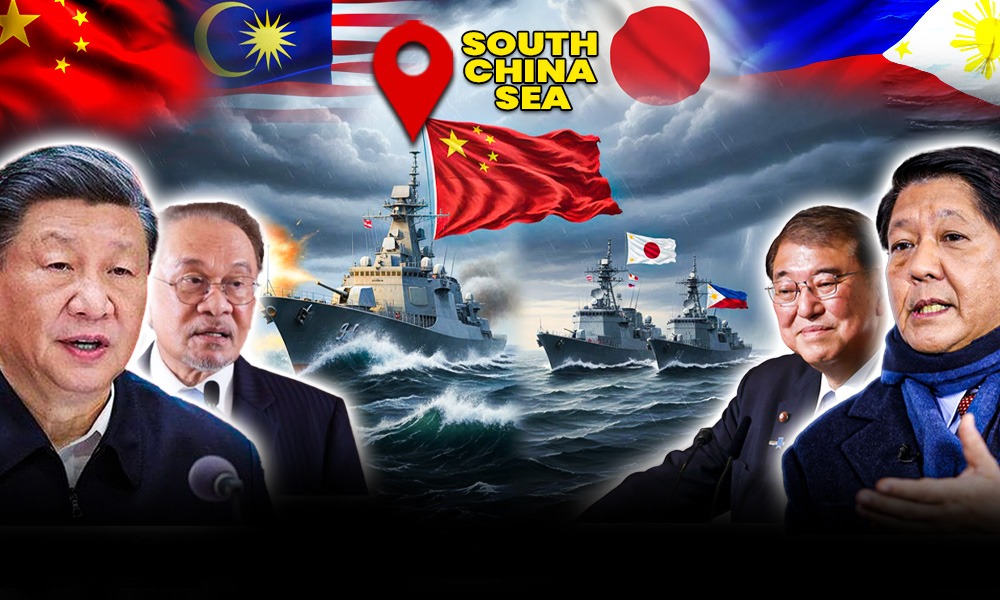
The recent simultaneous launch of the PLA-Malaysia joint drill and the Japan-Philippines military exercise 2025 is more than a mere scheduling conflict—it’s a stark visual of the South China Sea geopolitical divide. These parallel military maneuvers showcase two competing visions for the South China Sea dispute:
- Beijing’s Track: A campaign to solidify military and diplomatic influence through selective bilateral partnerships.
- Allied Track: A tightening network of US-aligned allies determined to uphold the rules-based order and resist maritime coercion, emphasizing robust security cooperation and reflecting the evolving US defense posture in the region.
The stakes are enormous. The South China Sea is the artery of global trade, carrying up to $5.3 trillion in maritime commerce annually. Any clash would immediately choke global supply chains and spike energy costs, making the conflict a frontline issue for global security and economic stability. These parallel military drills are thus diplomacy in motion, where the balance of power hinges on sustained presence and credible partnerships.
The China-Malaysia Joint Drill (Cooperation and Contention)
Scheduled for October 15–23, 2025, the PLA-Malaysia joint drill is officially framed as a collaboration focused on HADR, trust-building, and regional stability. This marks the sixth iteration, featuring over 1,000 personnel.
However, beneath the cooperative facade lies a complex reality: sovereignty contention.
- The Paradox: The two nations share overlapping claims, notably near the Luconia Shoals, deep within Malaysia’s EEZ but claimed by Beijing’s expansive Nine-Dash Line, fueling the Luconia Shoals dispute.
- The Southeast Asia Geopolitical Paradox: The exercise allows China to project an image of harmony and constructive security cooperation, while Malaysia gains military engagement, despite fundamental disagreements over South China Sea territorial disputes.
The Japan-Philippines Exercise (Alliance and Counterbalance)
The Japan-Philippines military exercise signifies a rapid transformation into a strategic cornerstone of alliance strategy and deterrence against assertiveness.
- Evolving Scope: Drills like Balikatan exercise 2025 now feature the Japanese Self-Defense Forces, marking a historic shift in Tokyo’s post-war US defense posture alignment.
- Legal Foundation: The Japan-Philippines Reciprocal Access Agreement (RAA), ratified in 2024–2025, enables large-scale joint training, boosting interoperability and solidifying the Indo-Pacific security architecture.
- Strategic Goal: This expansion, part of a crucial deterrence strategy, is openly aimed at counterbalancing China’s coercion. Japan’s aid bolsters the Philippine Coast Guard support. This entire multilateral framework reinforces freedom of navigation and aims to maintain the status quo in the South China Sea.
Philippines Defense Chief Condemns Latest Chinese Escalation at Ayungin Shoal
Geopolitical & Economic Implications: A Global Flashpoint
The militarization of features like Mischief Reef has created forward outposts, drastically changing the South China Sea security architecture.
- Gray-Zone Pressure & Crisis Management: Relentless harassment by CCG and maritime militia near Ayungin and Scarborough Shoal normalizes coercion tactics, requiring complex crisis management.
- Economic Ripple Effect: Increased incidents spiked freight rates, showing that risk is immediately transferred to insurance premiums and global supply chains—highlighting the fragility of maritime trade routes.
- Collective Deterrence: Regional exercises (like Balikatan exercise 2025) involve the U.S., Australia, and Japan. The goal is deterrence by interoperability, strengthening collective security and safeguarding global security.
Philippines Reaffirms ‘Incontrovertible’ Sovereign Rights Over the West Philippine Sea
Conclusion: Navigating a Contested Future
The concurrent drills define the South China Sea’s dual-track reality: engagement versus alignment; influence versus deterrence.
- Strategy: Deepening selective bilateral military cooperation to project regional dominance and diplomatic influence.
- Allied Strategy: Strengthening the rules-based order through defense frameworks like the RAA to operationalize deterrence strategy.
These actions confirm the South China Sea is now a global geopolitical theater, entering a phase of permanent strategic vigilance. The convergence of these actions reveals a new phase of strategic competition. The future of the Indo-Pacific will likely be defined by a sustained contest for influence, ensuring regional stability and the integrity of the maritime order.