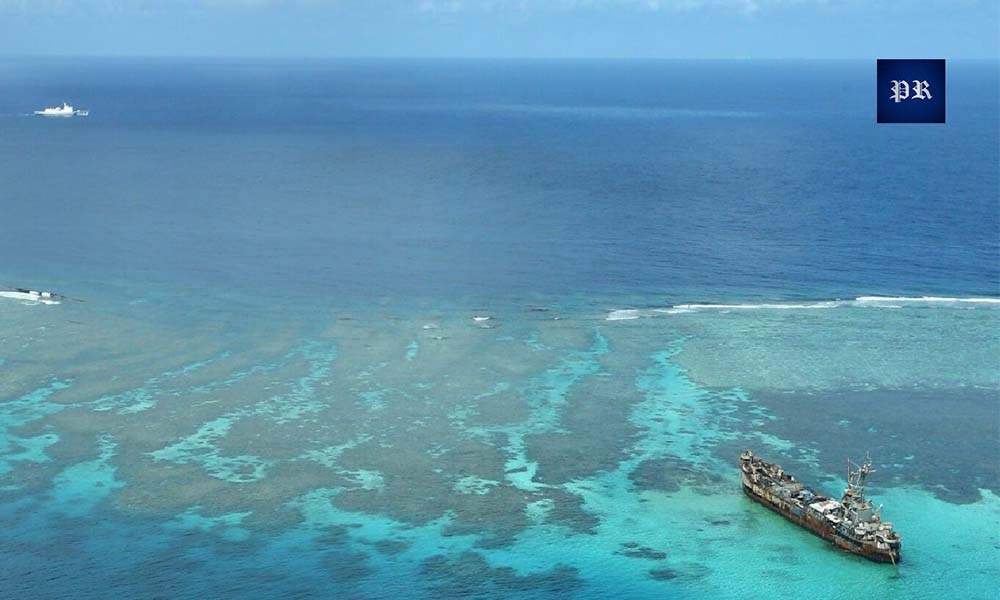
The South China Sea is boiling. It’s 2025, and what used to be silent standoffs are now full-blown, high-stakes maritime showdowns. Filipino crew members wake to the sound of steel grinding against steel. In early morning hours near Ayungin Shoal, their boats, on peaceful supply runs are rammed, sprayed with water cannons, and blocked by hulking Chinese coast guard ships. These aren’t just isolated incidents. They’re part of a dangerous pattern: China’s so-called “gray zone tactics” military-lite maneuvers that fly under the radar of war but cause real harm. But this year? The Philippines isn’t staying silent anymore.
Beijing claims nearly the entire South China Sea through its controversial “Nine-Dash Line,” which overlaps with the Philippines’ Exclusive Economic Zone (EEZ). Despite the 2016 Hague ruling rejecting China’s sweeping claims, Chinese vessels still swarm areas like Second Thomas Shoal, Pag-asa, and Sabina Shoal. In June 2025, a Chinese maritime militia vessel, hull 16838, ran aground near Pag-asa Reef and dragged a parachute anchor that destroyed over 30% of the coral reef, an environmental catastrophe costing around ₱11.1 million. The Philippines’ Coast Guard called it intentional, a quiet message wrapped in destruction. A few days later, China towed a Philippine ship out of the area, calling it “law enforcement.” Manila called it an act of aggression.
But something’s changed. This time, the Philippines is not backing down. Under President Ferdinand Marcos Jr. and a new slate of military leaders, the country has launched its “transparency initiative” , a powerful campaign to expose every Chinese move, every act of harassment, every encounter caught on camera. Filipinos are seeing, in real-time, how their troops are being blocked, flashed with lasers, even physically hurt. In May, Chinese coast guard forces used a high-pressure water cannon against a Filipino research team near Sandy Cay, damaging a civilian boat and nearly causing injuries. The U.S. State Department condemned the attack, calling it “reckless, dangerous, and unnecessary.” Filipino officials called it a line in the sand.
And the Philippines isn’t standing alone. In 2025, it’s building alliances faster than ever. U.S. warships are now regulars in the region, conducting joint patrols with the Philippine Navy. But it doesn’t stop there. For the first time ever, the Philippines and India conducted a joint naval sail in the South China Sea, showing China that this isn’t just a two-player game anymore. Australia, Japan, Canada, France, and even New Zealand are deepening their security ties with Manila. On July 12, a Philippine Coast Guard vessel, BRP Teresa Magbanua, challenged a Chinese surveillance ship operating inside Philippine waters. The Chinese vessel refused to respond over radio. Manila stood its ground anyway, and the standoff went public within hours.
Filipino voices are rising. Chief of Staff Gen. Romeo Brawner declared that Philippine forces are now ready to defend themselves “if attacked.” He added, “We will not be intimidated in our own waters.” Meanwhile, U.S. Admiral Stephen Koehler, speaking in Manila, said that China’s tactics “will not succeed in silencing a sovereign nation.” These aren’t just diplomatic statements. They’re red lines. And behind them is public support: Filipinos, especially the younger generation, are watching the drama unfold on YouTube, TikTok, and Facebook and they’re not buying China’s “historical claim” narrative anymore.
This isn’t just about rocks and reefs. Over $3 trillion in global trade passes through the South China Sea every year. If tensions escalate, it could choke global supply chains. But beyond economics, this is about identity, dignity, and sovereignty. China may have the ships, the tech, and the numbers. But the Philippines has something powerful too, international law, global allies, and a people who are no longer afraid to speak up. From Manila to Washington, voices are getting louder: The South China Sea is not China’s backyard. It’s the world’s shared sea. And the fight for it is far from over.
The Core of the Dispute: Sovereignty, Resources, and Global Rules on the Line
At the heart of the South China Sea crisis lies one explosive mix: territorial sovereignty, immense natural wealth, and a showdown over international law. The area is scattered with island groups like the Spratly Islands, where six countries, China, the Philippines, Vietnam, Malaysia, Brunei, and Taiwan, are all staking claims. Vietnam occupies the most features, Taiwan holds the largest single island (Taiping), but China’s outposts are the most heavily fortified. Then there’s the Paracel Islands, a hotspot claimed by China, Vietnam, and Taiwan but occupied entirely by China, despite protests. For Filipinos, the emotional flashpoint remains the Scarborough Shoal (Bajo de Masinloc), a traditional fishing ground just 120 nautical miles off Zambales that’s been under Chinese control since 2012, guarded by massive coast guard ships and maritime militia. Add to that Reed Bank, believed to be rich in untapped oil and gas, one reason it’s becoming a ticking energy time bomb.
Economically, the stakes are jaw-dropping. China’s own estimates claim the South China Sea could hold up to 125 billion barrels of oil and as much as 500 trillion cubic feet of natural gas. More conservative assessments, like the U.S. The Energy Information Administration, still reports up to 11 billion barrels of oil, a resource prize worth fighting over. But it’s not just about oil. These waters feed millions. Nearly 10% of the world’s fish catch comes from the South China Sea, making it a critical lifeline for food security from Palawan to Palau. Then there’s the sea lane itself: over $5.3 trillion in trade passes through this corridor annually. Disruptions here could shock everything from oil prices to electronics shipments worldwide, this isn’t just a Southeast Asia issue; it’s a global chokepoint.
But here’s the legal bombshell that still echoes to this day: the 2016 Hague arbitral ruling in Philippines v. China. On July 12, 2016, the Permanent Court of Arbitration ruled overwhelmingly in favor of the Philippines. It struck down China’s “nine-dash line” as having no legal basis under international law (UNCLOS) and declared that China’s activities, like island-building, blocking Filipino fishermen, and oil exploration, were unlawful. It was a landmark moment. But China didn’t just reject the ruling, they insulted it. On the ruling’s ninth anniversary in 2025, a Chinese Foreign Ministry spokesperson called the decision “nothing but a piece of waste paper,” vowing to ignore it forever. But the rest of the world? They’re not letting it go. Countries like Australia, the United States, Japan, Canada, France, and even the EU continue to affirm the ruling, demanding that Beijing respect UNCLOS and international order. For Manila, this ruling is a moral compass and a rallying cry.
China’s Intensifying Influence and Control in the South China Sea
China is waging a war but not the kind fought with bullets or bombs. Instead, it’s using what analysts call “gray zone tactics” covert, hybrid strategies designed to expand power without triggering a full-blown war. These tactics blur the line between peace and conflict, and in the South China Sea, they’re being deployed aggressively against the Philippines. Since 2010, 73% of maritime incidents in the region involved at least one Chinese law enforcement vessel, according to the ChinaPower Project. These aren’t warships but they don’t need to be. China’s massive maritime militia, often disguised as “fishing boats,” works hand-in-hand with coast guard vessels to harass Filipino fishermen, block resupply missions, and plant barriers across disputed shoals like Scarborough and Second Thomas. Just in June 2025, the Philippine Navy reported a spike to 49 Chinese vessels across three major contested zones, the highest monthly total this year.
But it doesn’t stop at the waterline. On July 3, 2025, Chinese warships and fighter jets staged a combat-readiness patrol near Scarborough Shoal, violating airspace and sending a loud message: this is ours, and we’ll defend it. At the same time, China has installed massive floating barriers, performed high-risk close-quarter maneuvers, and unleashed high-pressure water cannons on Philippine vessels, actions designed not just to provoke, but to intimidate. And behind the scenes? There’s cyberwarfare, Beijing’s silent weapon to sway public opinion and manipulate narratives in countries like the Philippines through troll farms, disinformation, and digital surveillance. The endgame? To quietly shift the status quo, monopolize natural resources, push the U.S. further out of Asia and cement China’s dominance over the South China Sea.
China’s strategy also has a more permanent footprint: artificial island building. Over the last decade, Beijing has reclaimed nearly five square miles of land, turning reefs into fortresses. At least one of these islands now houses radar systems, anti-aircraft guns, and military-grade runways. But the cost isn’t just geopolitical, it’s environmental. Entire coral ecosystems are being wiped out. For example, researchers now say Namyit Island, once a vibrant coral habitat, no longer supports new fish larvae or coral growth, devastating marine life and threatening food security for generations of Southeast Asian fishermen. These militarized reefs are not just scars on the ocean, they’re weapons of control.
And if ships and bases are the hard power, China’s soft power is its economic leverage. The Philippines is a partner in Beijing’s Belt and Road Initiative (BRI), which promises shiny new bridges and roads but often comes wrapped in what critics call “debt trap diplomacy.” A 2025 study by the Lowy Institute reveals that as Western aid from the U.S. and Europe declines, China’s influence in Southeast Asia is only growing. Beijing knows this. That’s why its development finance to the region jumped by $1.6 billion in 2023, reaching $4.9 billion, mostly poured into infrastructure projects that create dependency, not just development. When countries need loans, and China’s the only one lending, it holds the keys to influence.
So, whether through stealthy harassment at sea, runway construction on coral reefs, or billions in loans with quiet strings attached, China is reshaping the South China Sea without firing a single missile. But the pushback is building. As the Philippines exposes more incidents, strengthens alliances, and asserts its rights under international law, the question becomes: how far will China go, and how much is the region and the world willing to tolerate?
The Philippines Strikes Back: Defense, Diplomacy, and Determination in 2025
In 2025, the Philippines will no longer be the quiet player in the South China Sea. It’s standing taller, shoulder-to-shoulder with powerful allies and a clearer vision. As Chinese aggression escalates, so too does Manila’s response, now rooted in stronger alliances, a smarter military, and unshakable faith in international law. It’s not about provoking war, it’s about showing that the Philippines will not be bullied off its own waters.
The U.S. remains the strongest pillar in this new security landscape. This July, the Philippines and the United States launched “Cope Thunder,” one of their most robust joint military exercises to date. U.S. Pacific Fleet Commander Adm. Stephen Koehler, in a July 2025 press conference in Manila, vowed the U.S. would “strengthen deterrence and prevail in combat if necessary” to counter China’s bullying tactics. This wasn’t just rhetoric, it was a loud signal that America’s Mutual Defense Treaty with the Philippines still has teeth. But the U.S. isn’t alone. Japan is stepping in too, offering to export six used destroyers to the Philippine Navy, an unprecedented move that Beijing immediately criticized. That didn’t stop Manila. And on the diplomatic front, President Marcos Jr. flew to India from July 4–8, locking in a new era of defense and economic cooperation, including joint maritime drills in the South China Sea and future talks for more BrahMos supersonic cruise missiles, a game-changer in regional deterrence.
Even Australia, while geographically distant, has remained vocally committed to the 2016 arbitral ruling and the importance of peace and maritime law. Every ally stepping up adds weight to Manila’s voice and in 2025, that voice is louder than ever.
But it’s not just alliances. The Philippines is waging a legal and diplomatic offensive as well. Foreign Secretary Theresa Lazaro, on July 11, once again defended the 2016 ruling, saying it remains the “cornerstone of maritime rights in the region.” In ASEAN, the Philippines continues to push for a legally binding Code of Conduct not another symbolic statement, but a real framework to hold Beijing accountable. Meanwhile, top legal advisers are reportedly exploring the possibility of a second international case against China, proving Manila is ready to take the legal fight to the next level.
To back its words with action, the country is also pushing full speed ahead with military modernization under “Re-Horizon 3”, the newest phase of the AFP Modernization Program. In 2025, expect the delivery of two fully armed frigates, 12 more FA-50 fighter jets, and a dozen additional 155mm self-propelled howitzers. But that’s just the start. The Philippines is eyeing anti-submarine warfare helicopters and land-based anti-ship missile systems, designed specifically to defend the country’s maritime domain. The goal is clear: create a credible defense posture that can deter aggression, not just respond to it.
And throughout all of this, President Ferdinand Marcos Jr. is walking a tightrope, balancing assertiveness with independence. His administration’s foreign policy doesn’t follow the loudest power, it follows the Filipino people’s interest. As he declared recently: “Our development goals inform our independent foreign policy and reflect our national priorities. We build bridges, not walls. We forge alliances that are based on mutual respect, reciprocity, and shared goals.” It’s a powerful message: Manila won’t be boxed in, by China, or by anyone else.
Regional and Global Ripples: The Bigger Picture Behind the South China Sea Standoff
The crisis in the South China Sea isn’t just about two countries, it’s a geopolitical storm with regional and global consequences. And at the center of this storm is a deeply divided neighborhood. ASEAN, the 10-nation bloc that includes both the Philippines and several of China’s economic partners, has struggled to find a unified voice. Some members, like Vietnam and Malaysia, have their own claims and want stronger action. Others, Thailand, Laos, Myanmar, and Cambodia, are more cautious, heavily influenced by China’s trade and investment deals. This divide means ASEAN often tiptoes around the issue, choosing neutrality over unity. Despite years of ASEAN Plus One talks and ASEAN Regional Forums, progress remains slow. The big issue? There are no real enforcement tools. And China prefers it that way, consistently pushing for one-on-one negotiations rather than being challenged by a united Southeast Asian bloc.
Zooming out, the South China Sea is also one of the most active fronts in the U.S.–China rivalry, a high-stakes game of strategic chess. Washington’s policy remains consistent: keep the sea lanes open, challenge China’s excessive claims, and support allies like the Philippines and Japan. U.S. Navy vessels regularly conduct freedom of navigation patrols, often sailing right past China’s militarized reefs. But this is not a march toward war, it’s about presence, deterrence, and signaling strength. The U.S. knows that direct confrontation with China could be catastrophic, so it favors friction between ASEAN claimants and Beijing, using regional alliances to check China’s ambitions without firing a shot. Under Trump’s forecasted second term, analysts expect the U.S. to maintain this general approach, but possibly with less focus on the South China Sea itself. Trump tends to prioritize trade and economics over military engagements and has openly criticized traditional alliances in the past. Still, the broader strategy called “Indo-Pacific Security Cooperation” will likely continue to serve as America’s framework for pushing back against China’s maritime rise.
Trump Sparks Global Trade War with Sweeping Tariffs on Canada, China, and Mexico
But while governments debate and warships maneuver, ordinary people are caught in the middle. For Filipino fishermen, this is not just about politics, it’s about survival. Year after year, their access to traditional fishing grounds near Scarborough Shoal, Second Thomas Shoal, and even Reed Bank is being denied. They’re harassed, water-cannoned, or simply blocked from entering waters they’ve fished for generations. Some come home empty-handed. Others never return. In provinces like Zambales and Palawan, the fear is real and so is the economic pain. What’s often lost in global headlines is the human cost of this maritime dispute. Families are losing income. Communities are losing a way of life. And without a solution, the humanitarian consequences will only deepen.
So while world powers draw red lines on maps and strategists debate naval balances, the real stakes lie with the people whose boats drift across contested waters, who still hope the sea will feed them and not become a battleground they can’t escape.
Real-World Flashpoints: The 2024–2025 South China Sea Confrontations
What was once a maritime dispute is now a series of increasingly dangerous confrontations at sea, real incidents with real risks. At the heart of it all lies the Second Thomas Shoal, known locally as Ayungin Shoal, where the aging Philippine navy ship BRP Sierra Madre still stands, part outpost, part symbol of resistance. But China wants it gone. In 2024 and through mid-2025, every single resupply mission to that rusting vessel has been met with Chinese harassment, from shadowing ships to violent water cannon blasts that have damaged supply boats and endangered Filipino crew. Videos of these attacks have gone viral, showing just how far China will go to disrupt even humanitarian missions. Meanwhile, tensions at Scarborough Shoal are reaching new highs. China has ramped up naval and aerial patrols, using this disputed reef like a forward operating base. In July 2025, the Philippine Coast Guard intercepted a Chinese electronic surveillance vessel and a guided-missile destroyer entering the maritime zone near Cabra Island, clearly testing the limits of Filipino resolve. The message was clear: China is watching, waiting, and probing. Even beyond these two hotspots, the pattern is hard to ignore. In June 2025 alone, the Philippine Navy recorded 49 Chinese vessels in key contested waters, the highest monthly count of the year. That’s not normal maritime traffic. That’s a message. And for the Philippines, it’s a call to vigilance, strategy, and action in a sea that’s growing more volatile by the day.
What’s Next? The Outlook for 2025 and Beyond
Looking ahead, the South China Sea is expected to stay in a state many analysts call “heated without seething.” That means the tension won’t go away, but a full-scale war is still unlikely, at least for now. Instead, we’ll likely see a steady stream of close calls, standoffs, and high-risk maneuvers between Chinese and Filipino vessels. But here’s the catch: the more frequent these encounters become, the higher the risk of miscalculation. One wrong move, one clipped hull, one flared temper, one misunderstood signal, could ignite something no one wants: a sudden escalation with massive regional consequences. The waters may look calm from a distance, but beneath the surface, the pressure is building.
The international community plays a vital role here. From Washington to Canberra, from Tokyo to Brussels, nations continue to apply diplomatic pressure on Beijing to respect international law, especially the 2016 Hague ruling. It’s not just about siding with the Philippines; it’s about defending a global rules-based order. And the louder that international voice grows, the harder it becomes for China to reshape the region’s legal landscape unchecked. This isn’t just the Philippines’ fight anymore, it’s a global litmus test for what kind of world we’re building.
But make no mistake: the Philippines is standing its ground. Backed by international law, strengthened military capacity, and deeper alliances, the country has made it clear: it will not be pushed out of its own waters. President Marcos Jr. and his national security team are playing a careful game, assertive, but not reckless. They’re pushing back against illegal actions, but also leaving space for diplomatic dialogue and regional cooperation. It’s a strategy rooted in sovereignty and stability.
Still, the conflict carries a heavy cost. Economically, continued instability could rattle investor confidence, disrupt regional development, and most painfully, threaten the livelihoods of Filipino fishing communities. Every confrontation, every delay in maritime access, isn’t just a headline, it’s a lost day’s catch, a missed meal, a shrinking future for coastal families.
So as 2025 unfolds and beyond, the South China Sea will likely remain one of the world’s most fragile pressure points. But there’s still a path forward, grounded in law, anchored in diplomacy, and driven by the voices of nations and people who refuse to let aggression win the day.
Conclusion: The Battle for Balance in the South China Sea
The China–Philippines dynamic in 2025 has become a defining flashpoint in the Indo-Pacific, a clash of rising Chinese assertiveness met head-on by growing Filipino resistance. What we’re seeing is a volatile but non-shooting standoff, a struggle fought with fishing boats, coast guard ships, diplomacy, and defiance, not bullets. It’s a slow-burning tension that sits right at the edge of conflict, without crossing it.
At the core of this conflict lies the fight over sovereignty, control of vital natural resources, and Beijing’s aggressive use of gray zone tactics. In response, the Philippines has not backed down. Instead, it has strengthened military alliances, especially with the U.S., Japan, and India doubled down on international law, and accelerated its defense modernization efforts. Each maneuver, each policy shift, and each diplomatic move is part of a broader strategy: to defend its rightful waters, protect its people, and secure its place in the region.
But this isn’t just about one country standing up to a regional giant. The unfolding tension in the South China Sea is much bigger. It’s a global test of international law, regional unity, and the balance of power in the Indo-Pacific. The way these rising tensions are handled, through diplomacy, deterrence, or, if necessary, legal confrontation, will shape the future of peace, trade, and stability far beyond these waters. What happens here doesn’t stay here. It affects the world.