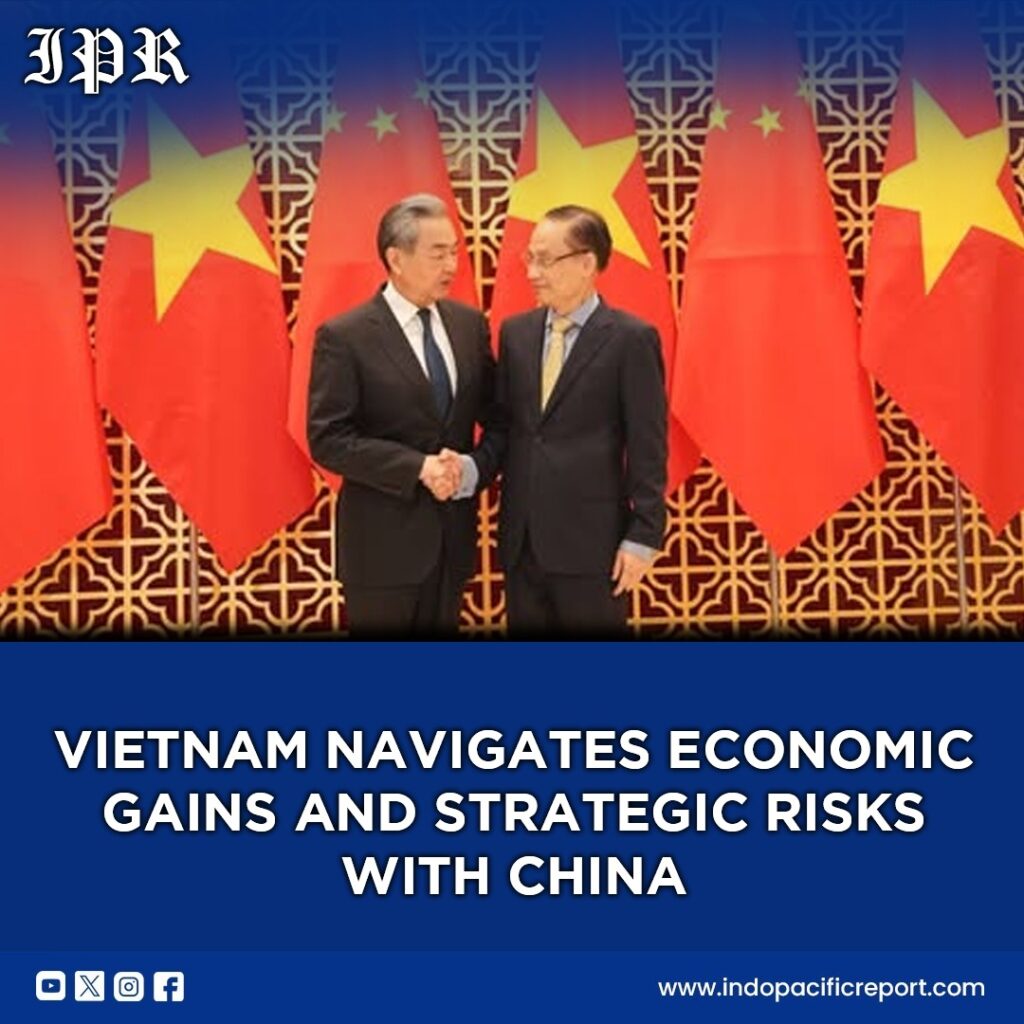
Vietnam and China are moving toward deeper cooperation while carefully managing their differences. At the 17th meeting of the Vietnam–China Steering Committee for Bilateral Cooperation in Hanoi, leaders from both countries discussed trade, investment, infrastructure, tourism, and people-to-people exchanges. At the same time, they emphasized resolving maritime disputes in the East Sea peacefully. The approach highlights a dual strategy: strengthening economic and political ties while keeping regional tensions under control.
From a great-power competition lens, Vietnam is carefully balancing its relationship with China. Beijing remains Vietnam’s largest trading partner, while Vietnam ranks as China’s fourth-largest. This economic interdependence provides incentives for cooperation but does not eliminate the underlying strategic tensions, particularly in the South China Sea. Vietnam’s engagement demonstrates a pragmatic approach: it seeks development benefits while preserving autonomy and signaling to other regional powers that it is not fully aligned with Beijing.
The developments also influence regional security architecture. Institutionalizing cooperation on strategic projects, like cross-border railways and economic zones, creates interdependencies that can stabilize bilateral ties. The emphasis on maritime dialogue and the East Sea Code of Conduct shows that both countries recognize the need for rules-based mechanisms to manage contested waters. This contributes to regional predictability while allowing China to project influence and Vietnam to assert its rights.
Alliance dynamics are complex. Vietnam continues to cultivate ties with external partners such as the United States, Japan, and ASEAN members while engaging operationally with China. This hedging strategy maximizes Hanoi’s strategic options. For U.S. allies and regional partners, Vietnam’s approach illustrates the challenge of engaging middle powers that simultaneously balance economic and security ties with multiple great powers.
Economically, the agreements signal a forward-looking strategy. Vietnam seeks Chinese investment in high-tech sectors, clean energy, railways, and cross-border trade. China emphasizes technology transfer, financing, and people-to-people exchanges. Aligning economic interests with strategic cooperation helps reduce risks of escalation, as both sides have shared stakes in growth and stability. Maritime security and energy supply are central to this strategy, ensuring that trade and resource flows remain protected.
In terms of the Indo-Pacific balance of power, Vietnam’s engagement illustrates selective accommodation. By deepening ties with China while maintaining legal and multilateral constraints, Hanoi strengthens its negotiating position regionally. China gains influence but must constantly manage Vietnam’s independent posture. For the wider region, this model shows how middle powers can shape outcomes through calibrated cooperation, careful diplomacy, and strategic hedging.
Looking forward, the key challenge is sustaining balance. Vietnam and China have opened channels to institutionalize cooperation, which could reduce the risk of bilateral crises. Yet unresolved maritime disputes and power asymmetries will require ongoing diplomacy. For the Indo-Pacific, this case highlights that combining economic integration with careful management of differences may provide a path to regional stability—if both sides respect international norms and avoid coercion.
Audience Question:
Can Vietnam deepen economic ties with China without compromising its strategic independence?